
What if one of the world’s most capital-intensive industries has been quietly gatekeeping its most profitable opportunities from the investors best positioned to benefit from them? Maritime trade underpins roughly 80% of global goods movement by volume, according to the United Nations Conference on Trade and Development, yet access to commercial ship investment has historically been reserved for a narrow circle of institutional players and well-connected insiders. The commercial ship investment platform is changing that calculus entirely.
You already sense that maritime assets represent a compelling, tangible alternative to volatile equity markets. That instinct is well-founded. The challenge has never been the asset class itself; it’s been the opacity of traditional financing structures, the complexity of regulatory compliance, and the absence of a transparent, governed framework that serious investors can trust.
This guide addresses all three. You’ll gain a clear understanding of how modern maritime investment platforms are structured, what regulatory frameworks govern them, and how AI-driven tools like ShipCheckAI are bringing a new layer of due diligence and transparency to vessel assessment. By the end, you’ll have the knowledge and confidence to evaluate your options with precision.
Key Takeaways
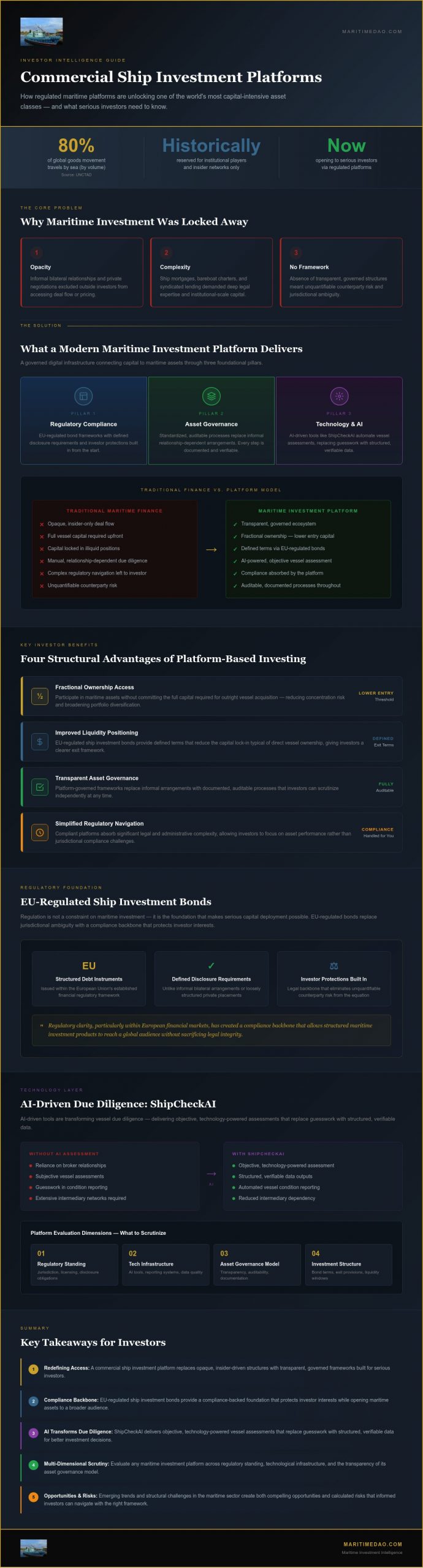
- A commercial ship investment platform redefines access to maritime assets by replacing opaque, insider-driven structures with transparent, governed frameworks built for serious investors.
- EU-regulated ship investment bonds provide a compliance-backed foundation that protects investor interests while opening one of the world’s most capital-intensive asset classes to a broader audience.
- AI-driven tools like ShipCheckAI are transforming vessel due diligence, delivering objective, technology-powered assessments that replace guesswork with structured, verifiable data.
- Evaluating a maritime investment platform requires scrutiny across multiple dimensions, including regulatory standing, technological infrastructure, and the transparency of its asset governance model.
- Emerging trends and structural challenges in the maritime sector create both compelling opportunities and calculated risks that informed investors can navigate with the right framework.
Understanding Commercial Ship Investment Platforms
At its core, a commercial ship investment platform is a governed digital infrastructure that connects capital with maritime assets through structured, regulated mechanisms. Rather than requiring investors to negotiate directly with shipowners, arrange private financing, or navigate opaque brokerage networks, these platforms consolidate the entire investment process into a transparent, accessible ecosystem. The purpose is precise: to replace the inefficiency and exclusivity of traditional maritime finance with a framework that serious investors can evaluate, trust, and act on with confidence.
The maritime finance ecosystem has historically operated through a web of bilateral relationships, ship mortgage instruments, and syndicated lending arrangements that favored institutional lenders and well-capitalized operators. Platform-based investment fundamentally restructures this model by introducing regulatory compliance, standardized asset governance, and technology-driven due diligence as foundational pillars rather than optional enhancements.
The Evolution of Maritime Investments
Maritime financing has deep roots in instruments like ship mortgages, bareboat charters, and sale-leaseback arrangements, structures that served large institutions well but left most investors without a viable entry point. The arrival of digital asset infrastructure and EU-regulated bond frameworks has shifted this dynamic considerably. Regulatory clarity, particularly within European financial markets, has created a compliance backbone that allows structured maritime investment products to reach a global audience without sacrificing legal integrity. Technology has accelerated this transition by automating processes that once required extensive intermediary networks, from vessel condition assessments to investor reporting.
Benefits of Investing through Platforms
Platform-based maritime investment introduces structural advantages that traditional models simply can’t replicate:
- Fractional ownership access: Investors can participate in maritime assets without committing the full capital required for outright vessel acquisition, reducing concentration risk and broadening portfolio diversification.
- Improved liquidity positioning: Structured investment instruments, such as EU-regulated ship investment bonds, provide defined terms that reduce the capital lock-in typical of direct vessel ownership.
- Transparent asset governance: Platform-governed frameworks replace informal, relationship-dependent arrangements with documented, auditable processes that investors can scrutinize independently.
- Simplified regulatory navigation: Compliant platforms absorb significant legal and administrative complexity, allowing investors to focus on asset performance rather than jurisdictional compliance.
Where traditional maritime investment demanded deep industry connections and substantial capital commitments, a well-structured commercial ship investment platform democratizes access without diluting the rigor that serious capital deployment requires. That distinction matters enormously for investors evaluating this asset class for the first time.
The Role of Regulation in Maritime Investments
Regulation isn’t a constraint on maritime investment. It’s the foundation that makes serious capital deployment possible. Without a governed compliance framework, investors face unquantifiable counterparty risk, jurisdictional ambiguity, and the kind of opacity that has historically kept this asset class confined to insider networks. The regulatory architecture surrounding EU-regulated ship investment bonds changes that calculus entirely, providing a structured legal backbone that protects investor interests while enabling genuine market participation.
Understanding EU-Regulated Ship Investment Bonds
EU-regulated ship investment bonds are structured debt instruments issued within the European Union’s established financial regulatory framework, designed to channel investor capital into maritime assets through legally governed, auditable mechanisms. Unlike informal bilateral arrangements or loosely structured private placements, these bonds operate under defined disclosure requirements, investor protection standards, and compliance obligations that create accountability at every stage of the investment lifecycle.
Within a commercial ship investment platform, these bonds function as the primary instrument connecting investor capital to vessel assets. The regulatory wrapper serves three critical functions: it mandates transparency in asset reporting, establishes enforceable investor rights, and creates a compliance record that independent parties can scrutinize. For investors evaluating maritime exposure, that combination of enforceability and transparency represents a structural advantage that unregulated alternatives simply can’t replicate.
Navigating Compliance Challenges
Compliance in maritime investment isn’t straightforward. The sector spans multiple jurisdictions, vessel registries, and flag state regulations, creating a layered environment where gaps between legal frameworks can expose investors to unexpected risk. Common pitfalls include insufficient due diligence on vessel ownership structures, failure to account for flag state obligations, and reliance on investment vehicles that lack verifiable regulatory standing.
Best practices for navigating this environment include:
- Verifying regulatory standing independently: Confirm that any bond issuer holds documented authorization within the relevant EU regulatory jurisdiction before committing capital.
- Scrutinizing disclosure documentation: Compliant platforms provide structured prospectuses and asset reporting; absence of these materials is a meaningful warning signal.
- Monitoring regulatory updates actively: EU financial regulation evolves, and investors benefit from monitoring publications from the European Securities and Markets Authority (ESMA) and relevant national competent authorities for material changes affecting maritime investment instruments.
- Assessing governance structures: Understand how the platform governs asset decisions, distributes returns, and handles default scenarios before capital is deployed.
Platforms that embed compliance as an operational principle rather than a procedural afterthought deliver a materially different investor experience. The transparency that regulation demands doesn’t just protect investors from bad outcomes; it creates the trust infrastructure that allows maritime finance to scale beyond its historically narrow audience. For investors ready to engage with this asset class on rigorous terms, exploring Maritime DAO’s regulated investment framework offers a concrete starting point grounded in documented compliance rather than informal assurances.
Integrating Technology: The AI Revolution in Maritime Investments
Traditional vessel assessment has always carried an uncomfortable truth: its accuracy depended almost entirely on the expertise, integrity, and availability of individual surveyors. That human dependency introduced variability that serious investors couldn’t systematically account for. Technology is dismantling that limitation, and the implications for anyone evaluating a commercial ship investment platform are significant.
AI-driven infrastructure is now embedded across the maritime investment lifecycle, from initial asset screening to ongoing compliance monitoring. The shift isn’t cosmetic. It represents a structural change in how investment-grade vessel data is generated, verified, and delivered to decision-makers who require precision rather than approximation.
The Impact of AI on Vessel Assessments
ShipCheckAI is Maritime DAO’s AI-driven inspection tool, purpose-built to bring objectivity and consistency to vessel condition assessments. Where traditional surveys produced qualitative judgments that varied between inspectors, ShipCheckAI generates structured, data-driven evaluations that investors can compare, audit, and rely on across multiple inspections. The platform processes vessel condition data systematically, reducing the interpretive variability that has historically made asset-level due diligence in maritime finance an exercise in managing uncertainty.
The practical benefits for investors are concrete:
- Consistency across assessments: AI-generated evaluations apply the same analytical framework regardless of vessel type, geography, or inspection timing, producing comparable outputs that support portfolio-level analysis.
- Reduced information asymmetry: Structured inspection data narrows the knowledge gap between platform operators and investors, replacing informal assurances with verifiable, documented findings.
- Scalable due diligence: Technology enables assessment capacity that human-only inspection teams can’t replicate, allowing platforms to evaluate larger asset pools without compromising analytical depth.
Looking forward, the trajectory points toward increasingly predictive capabilities. AI systems trained on vessel performance data, maintenance histories, and classification society records are moving from descriptive assessment toward forward-looking condition modeling, a development that will further sharpen investment decision-making in maritime asset classes.
Automating Compliance and Due Diligence
Compliance in maritime investment isn’t a single checkpoint. It’s a continuous process spanning flag state obligations, EU regulatory requirements, and asset-level governance standards. Automated systems handle this ongoing burden with a consistency that manual processes can’t sustain. Document verification, ownership structure analysis, and regulatory status monitoring can all be systematized, creating an auditable compliance record that supports investor confidence at every stage.
For investors engaging with Maritime DAO’s framework, this automation matters because it transforms compliance from a periodic review into an embedded operational function. Due diligence that once required weeks of manual coordination is compressed into structured, technology-driven workflows that deliver verifiable outputs rather than informal sign-offs. The result is a maritime investment environment where transparency isn’t aspirational; it’s engineered directly into the platform’s architecture.
Practical Guide to Evaluating and Selecting Investment Platforms
Choosing the right commercial ship investment platform isn’t a decision that rewards speed. The structural differences between platforms, particularly around regulatory standing, asset governance, and technological infrastructure, are substantial enough to materially affect both your risk exposure and your long-term returns. A methodical evaluation process is the only reliable way to separate platforms built on genuine compliance foundations from those that simply present well.
Determining Your Investment Goals
Before evaluating any platform, establish clarity on three dimensions: your investment horizon, your risk tolerance, and the specific maritime asset categories you want exposure to. Bulk carriers, tankers, and container vessels each carry distinct demand cycles, charter rate dynamics, and maintenance profiles. An investor seeking stable, income-generating exposure over a multi-year horizon has materially different requirements than one seeking shorter-duration instruments with defined exit terms.
Set concrete financial objectives before you engage with any platform’s marketing materials. Know the return profile you require, the capital you’re prepared to commit, and the liquidity conditions you can realistically tolerate. That clarity becomes your evaluation filter, not the platform’s pitch.
Performing Due Diligence
Effective platform research operates across several layers simultaneously. Start with regulatory verification. Confirm independently, through the relevant national competent authority or ESMA’s public registers, that the platform holds documented authorization for the instruments it offers. A platform’s own claims about its regulatory standing are not a substitute for independent verification.
Transparency is the next critical dimension. Scrutinize what the platform actually discloses:
- Asset-level documentation: Does the platform provide structured prospectuses, vessel condition reports, and auditable ownership records, or does it rely on summary descriptions and informal assurances?
- Governance mechanisms: How are investment decisions made, how are returns calculated and distributed, and what happens in a default scenario? These answers should be documented, not verbal.
- Technology infrastructure: Platforms that integrate AI-driven inspection tools, such as ShipCheckAI, provide a verifiable, structured layer of vessel assessment that human-only processes can’t consistently replicate.
- Third-party validation: Independent ratings, legal opinions, and auditor sign-offs carry weight that self-reported metrics don’t.
Watch for meaningful red flags: absence of verifiable regulatory documentation, vague or inconsistent asset reporting, governance structures that concentrate decision-making without investor oversight, and platforms that can’t articulate how they handle adverse scenarios. Complexity isn’t itself a warning sign, but opacity is.
Comparing platforms requires a consistent framework applied equally to every candidate. Evaluate regulatory standing, asset quality methodology, disclosure depth, and governance structure as parallel criteria rather than sequential checkboxes. Platforms that perform well across all four dimensions simultaneously are rare, and that scarcity is itself informative.
For investors ready to apply this framework to a regulated, technology-driven maritime investment structure, review Maritime DAO’s documented compliance and asset governance framework as a concrete benchmark against which other platforms can be measured.
The Future of Maritime Investments: Opportunities and Challenges
Maritime finance is at an inflection point. The structural foundations are already in place: regulated instruments, AI-driven due diligence, and platform-based access have collectively dismantled the barriers that kept this asset class confined to institutional insiders. What comes next is a period of accelerating innovation, broader participation, and, inevitably, new complexities that investors will need to navigate with the same rigor applied to any evolving market.
Emerging Trends in Maritime Finance
Tokenization represents the most structurally significant development on the horizon. By encoding vessel ownership or bond interests as blockchain-based digital tokens, maritime investment instruments gain programmable governance, near-instantaneous settlement, and secondary market functionality that traditional instruments can’t replicate. For a commercial ship investment platform operating within a regulated EU framework, tokenization isn’t a departure from compliance; it’s an extension of it, provided the underlying legal structure is built to accommodate digital asset classification under applicable financial regulation.
Retail investor participation is expanding in parallel. Fractional instruments and regulated bond structures are progressively lowering minimum commitment thresholds, opening maritime asset exposure to capital pools that were previously excluded entirely. This democratization carries genuine portfolio diversification value, particularly given maritime assets’ historically low correlation with public equity markets.
Global trade dynamics add another layer of opportunity. Shifting supply chain configurations, evolving energy transition requirements, and the continued growth of emerging market trade routes are all creating demand-side pressures that influence vessel values, charter rates, and asset class performance over medium-to-long investment horizons.
Navigating Potential Challenges
Growth in regulated maritime finance will attract increased regulatory scrutiny. EU financial authorities are actively developing frameworks around digital asset classification, cross-border bond distribution, and tokenized instrument governance. Investors should monitor ESMA publications and national competent authority guidance as these frameworks mature, since regulatory reclassification of investment instruments can affect both compliance obligations and product structures.
Market volatility remains a structural feature of maritime assets, not an anomaly. Charter rates respond to geopolitical disruptions, fuel cost fluctuations, and trade volume cycles with meaningful amplitude. Effective risk mitigation strategies include:
- Diversifying across vessel categories to reduce exposure to sector-specific demand cycles.
- Prioritizing platforms with transparent governance and documented default-handling procedures before capital is committed.
- Aligning investment horizon with instrument terms rather than assuming liquidity conditions that the underlying asset class doesn’t consistently support.
The investors who’ll benefit most from this evolving landscape are those who engage now, while the regulatory architecture is established but the competitive field remains relatively uncrowded. Maritime DAO’s EU-regulated ship investment bonds and ShipCheckAI inspection infrastructure represent a governed, technology-backed entry point into this asset class. Explore Maritime DAO’s investment framework to assess whether maritime assets belong in your portfolio.
Your Entry Point into Governed Maritime Finance Starts Here
Maritime asset investment has undergone a genuine structural transformation. What was once an insider-dominated market is now accessible through governed, transparent frameworks that serious investors can evaluate on their own terms. A well-selected commercial ship investment platform delivers three things simultaneously: EU-regulated compliance infrastructure that protects your capital, AI-driven vessel inspection technology that replaces guesswork with verifiable data, and fractional access to an asset class that was previously out of reach for most investors.
The knowledge you’ve built across this guide is your foundation. You understand how to verify regulatory standing independently, what to demand in asset-level disclosure, and why technology like ShipCheckAI changes the due diligence equation fundamentally. That framework doesn’t just help you evaluate Maritime DAO; it helps you evaluate every opportunity you’ll encounter in this space.
The window to engage with this asset class before it becomes crowded is real, and it won’t stay open indefinitely. Explore Maritime DAO’s investment opportunities today and put that framework to work.
Frequently Asked Questions
What are the benefits of investing in commercial ship investment platforms?
A commercial ship investment platform delivers structured access to maritime assets that were previously available only to institutional insiders and well-capitalized operators. The core advantages are practical: fractional participation reduces the capital commitment required for meaningful exposure, regulated bond instruments provide defined terms and enforceable investor rights, and transparent governance frameworks replace the informal, relationship-dependent arrangements that historically characterized maritime finance.
Beyond access, platform-based maritime investment offers portfolio diversification into an asset class with historically low correlation to public equity markets. Tangible assets like commercial vessels don’t move in lockstep with stock indices, which gives investors a genuine diversification mechanism rather than simply a different label on similar underlying risk.
How do EU-regulated ship investment bonds work?
EU-regulated ship investment bonds are structured debt instruments issued within the European Union’s financial regulatory framework, connecting investor capital to maritime assets through legally governed mechanisms. The bond structure mandates disclosure requirements, establishes enforceable investor rights, and creates a compliance record that independent parties can audit. Investors receive defined terms covering return distribution, asset governance, and default-handling procedures upfront, rather than relying on informal arrangements.
The regulatory wrapper is what distinguishes these instruments from loosely structured private placements. Issuers must hold documented authorization from the relevant national competent authority, and compliance obligations persist throughout the investment lifecycle, not just at the point of issuance. That ongoing accountability is the structural feature that makes these bonds a credible foundation for serious capital deployment.
What role does technology play in maritime investments?
Technology addresses one of maritime finance’s most persistent problems: the variability and opacity of vessel condition assessments. AI-driven tools like ShipCheckAI generate structured, data-driven evaluations that apply a consistent analytical framework across vessel types, geographies, and inspection timings. That consistency produces comparable outputs investors can audit, replacing the interpretive variability that made traditional surveyor-dependent due diligence an exercise in managing uncertainty rather than eliminating it.
Automation also handles the ongoing compliance burden that maritime investment requires. Document verification, ownership structure analysis, and regulatory status monitoring can all be systematized, compressing due diligence timelines and creating an auditable record that supports investor confidence at every stage of the investment lifecycle.
How can I evaluate the reliability of a maritime investment platform?
Start with independent regulatory verification. Don’t rely on a platform’s own claims about its compliance standing; confirm authorization directly through ESMA’s public registers or the relevant national competent authority. From there, scrutinize what the platform actually discloses: structured prospectuses, vessel condition reports, and documented governance procedures are baseline expectations for any credible commercial ship investment platform, not optional enhancements.
Assess governance structures with equal rigor. Understand how investment decisions are made, how returns are calculated and distributed, and what documented procedures exist for adverse scenarios. Platforms that integrate AI-driven inspection tools provide a verifiable assessment layer that strengthens the overall due diligence framework. Opacity in any of these dimensions is a meaningful warning signal, regardless of how the platform presents itself.
What challenges should I be aware of when investing in maritime assets?
Charter rate volatility is a structural feature of maritime assets, not an anomaly. Rates respond to geopolitical disruptions, fuel cost fluctuations, and trade volume cycles with meaningful amplitude, which means investors need realistic expectations about income consistency across different market conditions. Diversifying across vessel categories reduces exposure to sector-specific demand cycles, but it doesn’t eliminate the underlying volatility inherent to the asset class.
Regulatory complexity adds another layer of challenge. Maritime investment spans multiple jurisdictions, vessel registries, and flag state obligations, creating gaps where investor exposure can emerge unexpectedly. EU financial regulation governing digital asset classification and tokenized instruments continues to evolve, so monitoring ESMA publications and national competent authority guidance is a practical necessity rather than an optional precaution for active investors in this space.
Are there minimum investment requirements for maritime investment platforms?
Minimum investment thresholds vary across platforms and instrument types, and they’re determined by the specific regulatory classification of the investment product being offered. EU-regulated bond instruments have progressively reduced the commitment levels that were once standard in traditional maritime finance, where direct vessel acquisition required substantial capital outlays. Fractional structures and regulated bond frameworks have expanded access to investor profiles that were previously excluded entirely.
Rather than citing figures that may not reflect current platform terms, the practical advice is to review the offering documentation directly. A compliant platform will specify minimum commitment thresholds in its prospectus or investor disclosure materials. If that information isn’t clearly documented and accessible before you engage, treat the absence as a due diligence concern worth investigating further.