
By Gints Adams, Founder & Master Mariner, Maritime DAO
27 years maritime experience | Founder of the world’s first maritime DAO ecosystem
Ships have always been among the world’s most valuable assets. A single offshore supply vessel can be worth €15 million. A container ship, hundreds of millions. For most of human history, owning a share of that asset required institutional capital, maritime connections, and a level of access that kept ordinary people — including the seafarers who actually operate those ships — entirely shut out.
Ship tokenization changes this.
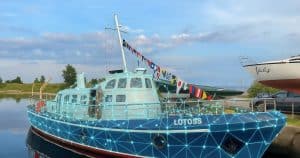
This guide explains exactly how ship tokenization works, what you legally own when you buy a tokenized maritime asset, how the technology functions, and what real-world results look like. We have built and tested this ourselves. MV LOTOSS — our first tokenized vessel — has issued 403 EU-regulated bonds and paid its first profit distributions to bondholders.
This is not theory. This is a live, working system.
What is ship tokenization?
Ship tokenization is the process of converting the economic value of a ship into digital tokens or bonds that can be bought, sold, and held by multiple investors simultaneously.
Instead of one company owning 100% of a vessel, the ship’s value is divided into smaller units — bonds, tokens, or digital shares — that represent a proportional claim on the vessel’s operating revenue. Each unit holder receives a share of profit when the ship generates income.
Think of it this way: a ship worth €4 million can be divided into 20,000 units at €200 each. A seafarer, a maritime investor, or any global citizen can buy one unit — or one thousand — and receive proportional profit distributions when the vessel operates.
The key word is proportional. If you hold 1% of the bonds and the ship earns €100,000 in a quarter, you receive €1,000.
What does “tokenization” actually mean technically?
Tokenization uses blockchain technology to create a permanent, transparent, tamper-proof digital record of ownership.
When a ship is tokenized, a smart contract is deployed on a blockchain — in our case, Ethereum. That smart contract contains the rules: how many units exist, what each unit entitles its holder to, how profit distributions are calculated and sent, and how ownership is transferred if someone sells their bond.
The blockchain record is public and permanent. Every bond issuance, every profit distribution, every transfer of ownership is recorded on-chain and cannot be altered retroactively.
This is why ship tokenization is more transparent than traditional ship investment — not just more accessible.
What do you legally own when you buy a tokenized ship bond?
This is the most important question — and the one most platforms fail to answer clearly.
At Maritime DAO, bondholders do not own equity in a company. They do not own a physical fraction of the ship’s hull. What they own is a right to a proportional share of the vessel’s operating profit — structured as an EU-regulated profit-sharing bond.
This distinction matters for several reasons:
Legal clarity. Profit-sharing bonds have an established legal framework in EU financial regulation. This is not a grey area. The bond structure is reviewed and compliant.
Practical simplicity. You do not need to worry about ship registration, flag state law, or maritime ownership bureaucracy. You hold a bond. The bond pays you when the ship earns revenue.
Separation from volatility. Your bond is denominated and distributed in fiat-equivalent value — not in cryptocurrency. The blockchain is used for transparency and record-keeping, not for currency speculation.
We are actively working with shipping registries to explore registering fractional ownership directly in Ships Ownership Certificates — which would take the legal recognition of bondholder rights even further.
How does a ship get tokenized? The step-by-step process
Step 1: Vessel selection and valuation
A ship is selected for tokenization based on trading history, condition, revenue potential, and compliance with international maritime standards. At Maritime DAO, every vessel is inspected using the ShipCheck AI framework — aligned with ISM Code, SOLAS, MARPOL, and MLC 2006 — before it enters the ecosystem.
Step 2: Legal structuring
The vessel’s value is structured into EU-regulated profit-sharing bonds. Legal review confirms the bond structure, the rights of bondholders, the profit distribution mechanism, and the governance framework. This step is non-negotiable — we do not tokenize vessels that cannot be structured compliantly.
Step 3: Smart contract deployment
A smart contract is deployed on the Ethereum blockchain. The contract encodes the total bond supply, individual bond price, profit distribution rules, and holder records. The contract is immutable once deployed — the rules cannot be changed by anyone after the fact.
Step 4: Bond issuance and sale
Bonds are made available for purchase on the Maritime DAO platform (app.maritimedao.com). Any global citizen can buy bonds from €200. The bond sale is recorded on-chain in real time.
Step 5: Vessel operation and revenue generation
The ship operates commercially. Revenue from freight, charter, or operations is collected. Expenses — crew, fuel, maintenance, port fees — are deducted. Net operating profit is calculated transparently and published on the Maritime DAO management dashboard.
Step 6: Profit distribution
Profit distributions are made to bondholders in proportion to their holdings. Distributions are automatic, on-chain, and require no manual processing or intermediary. Every bondholder receives their share directly.
Real-world results: MV LOTOSS
Ship tokenization is often discussed as a future concept. For Maritime DAO, it is already a documented reality.
MV LOTOSS is our pilot vessel — a motor vessel now in active (earning as rental premises) and being prepared for commercial operation.
– 403 EU-regulated profit-sharing bonds issued
– Minimum bond price: €200
– Q4/Q5 profit distribution: 3.9% paid to all bondholders
– All financials published transparently on the Maritime DAO dashboard
– All distributions made directly to bondholders — no intermediary, no delay
This is the track record that separates Maritime DAO from platforms offering promises. MV LOTOSS has already proven the model works.
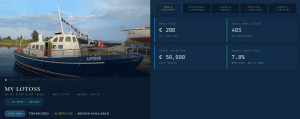
Full performance data is available at: microshipowner.com/rwa-management-html/
How ship tokenization differs from traditional ship investment
Minimum investment: Traditional ship investment requires millions of euros. Maritime DAO tokenization starts at €200. Note: why €200 – our moto is “Every seafarer and global citizen becomes a shipowner”, yes even cadet starting his/her carreer can become one and feel as trully engaged part of Maritime industry.
Who can invest: Traditional investment is limited to institutions and shipping companies. Maritime DAO is open to any global citizen.
Transparency: Traditional investment offers limited, private reporting. Maritime DAO offers full on-chain visibility.
Profit distribution: Traditional distribution is negotiated and delayed. Maritime DAO distributions are automatic and on-chain.
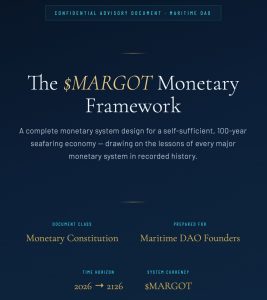
Governance: Traditional investment is controlled by a company board. Maritime DAO is governed by $MARGOT token holders. ($MARGOT token has not been issued yet, but we are finalizing Tokenomics, since we aim for long term and all Maritime society to be involved.
Vessel inspection: Traditional investment relies on annual survey only. Maritime DAO uses continuous AI-powered inspection.
Legal structure: Traditional investment uses equity, loans, or private placement. Maritime DAO uses EU-regulated profit-sharing bonds.
What is the role of the DAO in ship tokenization?
Maritime DAO is not a company that tokenizes ships on your behalf and asks you to trust it. It is a decentralised autonomous organisation — a governance structure where decisions are made collectively by participants.
$MARGOT token holders vote on:
– Which vessels enter the Maritime DAO fleet
– How vessel management decisions are made
– How ecosystem revenue is allocated
– Strategic direction of the platform
This means that as a bondholder, you are not just a passive investor. If you hold $MARGOT tokens, you have a voice in how the ecosystem is run. The ships that enter the fleet, the operators who manage them, the standards they are held to — these decisions involve you.
$MARGOT has not yet launched publicly, but ecosystem participants can begin earning tokens now through ShipCheck AI inspection reports.
How ship tokenization connects to vessel inspection
One of the most important questions any ship investor should ask is: how do I know the vessel is being maintained properly?
Traditional ship investment offers no good answer. You rely on annual surveys and operator assurances. Maritime DAO offers a different model.
ShipCheck AI is our AI-powered vessel inspection tool. It enables seafarers to complete structured inspection reports against international maritime standards — ISM, SOLAS, MARPOL, MLC 2006, and PSC criteria — continuously, not just annually.
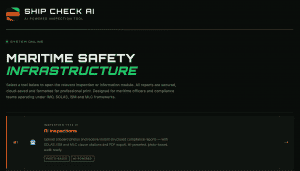
Every tokenized vessel in the Maritime DAO ecosystem is subject to ShipCheck AI inspection. Reports are published on the management dashboard. Bondholders can see the condition of their asset at any time.
This closes the trust gap that has always existed between maritime investors and the ships they finance.
Common questions about ship tokenization
Is ship tokenization legal?
Yes, when structured correctly. Maritime DAO issues EU-regulated profit-sharing bonds — a legally established financial instrument. The bond structure does not constitute an unregistered security or an unregulated token sale.
Is this cryptocurrency? Do I need a crypto wallet?
No wallet, no problem. When you register on the Maritime DAO platform at app.maritimedao.com, you simply sign up with your email address — a blockchain wallet is automatically created for you in the background. You never need to touch cryptocurrency or manage wallet keys. Once registered, you can purchase tokenized ship bonds directly and, if you choose, resell your bonds on the secondary market from day one.
If you are already a Web3 user and prefer to connect your own wallet, that option is available too. The platform works both ways — the technology adapts to you, not the other way around.
What happens to my bonds if the ship is sold?
Bond terms include provisions for vessel sale scenarios. Sale proceeds are distributed to bondholders proportionally. Full terms are available on the platform before purchase.
Can any ship be tokenized?
Not every ship qualifies. Vessels must meet condition standards, have documentable revenue history, and be capable of legal structuring as profit-sharing bonds. At Maritime DAO, every candidate vessel is inspected via ShipCheck AI before entering the ecosystem.
What are the risks of ship tokenization?
Like all investments, ship bonds carry risk. Vessels may operate at a loss in some periods — no distribution is made when there is no profit. The maritime market is subject to freight rate volatility, fuel cost changes, and operational risks. Maritime DAO publishes all vessel financials transparently so bondholders can assess these risks in real time.
The future of ship tokenization
MV LOTOSS is the beginning.
Maritime DAO’s pipeline includes a CTV crew transfer vessel, followed by offshore vessels, tankers, dry bulk vessels, and container ships. As the fleet grows, so does the governance power of $MARGOT holders, the inspection coverage of ShipCheck AI, and the income opportunities for seafarers worldwide.
The mission has not changed since day one: every seafarer and global citizen can become a shipowner.
Ship tokenization is how we make that true.
About the author
Gints Adams is the Founder of Maritime DAO and a Master Mariner with 27 years of maritime experience. As Senior Fleet Master for 7 years, he has made sure that a 15-vessel offshore fleet is operating above international standards, conducted 70+ vessel audits, led the 5G Remote Vessel project, and is an NI-approved DP Instructor. He founded Maritime DAO to make ship ownership accessible to every global citizen and seafarer.
About Maritime DAO
Maritime DAO is the world’s first decentralised maritime ship ownership ecosystem — combining EU-regulated ship investment bonds (microshipowner.com), transparent vessel management, and AI-powered inspection (shipcheckai.com) into one DAO-governed platform.
Invest in ships from €200 → microshipowner.com
View MV LOTOSS live data → microshipowner.com/rwa-management-html/
Inspect vessels, earn $MARGOT → shipcheckai.com
Enter the Maritime DAO platform → app.maritimedao.com