
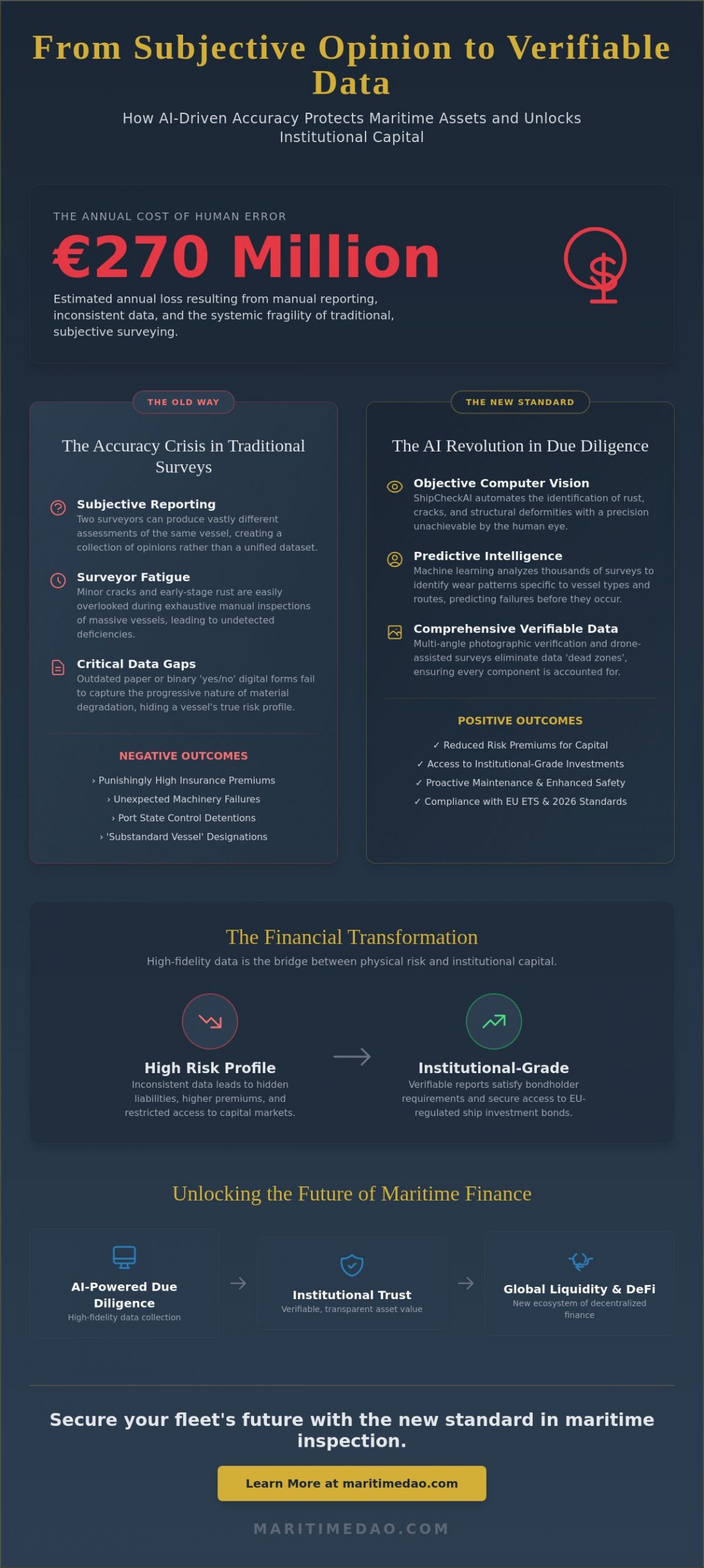
Manual reporting in the maritime industry results in an estimated annual loss of €270 million, a figure that exposes the systemic fragility of traditional, subjective surveying. You’ve likely felt the impact of inconsistent reporting through undetected structural deficiencies, machinery failures, and the punishingly high insurance premiums that follow data uncertainty. As the 2026 industry standard shifts toward an 11% reduction factor for carbon intensity and mandatory EU ETS compliance, maintaining high ship inspection accuracy isn’t just a technical preference. It’s the fundamental data bridge between physical risk and institutional capital.
This article demonstrates how AI-driven technology eliminates human error and secures the underlying value of maritime assets for global investors. You’ll discover how standardized inspection data reduces ‘substandard vessel’ flags by port authorities while providing the precision required for institutional-grade investments. We’ll examine how ShipCheckAI and drone-assisted surveys unite, govern, and open up new opportunities through verifiable condition reports that satisfy the most rigorous bondholder requirements. By the end, you’ll understand why automated intelligence is the only viable path to protecting asset value in an era of heightened regulatory oversight.
Key Takeaways
- Understand how the transition from subjective human surveying to data-driven computer vision defines the new standard for ship inspection accuracy and long-term asset protection.
- Discover how ShipCheckAI utilizes automated intelligence to identify structural deformities, detect corrosion, and eliminate the reporting inconsistencies found in traditional maritime surveys.
- Learn why high-fidelity condition reporting is essential for securing EU-regulated ship investment bonds and reducing the risk premium for institutional capital.
- Gain a practical framework for auditing your current survey methodology and integrating automated verification tools into your existing Technical Management Systems.
- Explore the synergy between AI-powered due diligence and the emerging ecosystem of decentralized maritime finance to unlock global liquidity and transparency for your fleet.
The Accuracy Crisis in Traditional Maritime Surveys
Ship inspection accuracy represents the precise correlation between a recorded condition report and a vessel’s actual physical state. It’s the metric that determines whether a maritime asset is a transparent investment or a hidden liability. Historically, this accuracy has been compromised by the ‘Human Factor’, where subjective reporting creates a fragmented view of fleet-wide health. When data is inconsistent, the consequences manifest as undetected structural corrosion, unexpected machinery fatigue, and costly environmental non-compliance. Traditional paper-based checklists or outdated digital forms simply don’t possess the granularity to capture complex structural nuances, leaving critical gaps in a ship’s risk profile.
While a ship classification society establishes the technical framework for construction and safety, the day-to-day execution of inspections often falls short of institutional-grade requirements. Legacy systems fail because they rely on binary ‘yes or no’ inputs that ignore the progressive nature of material degradation. This lack of detail forces technical managers into a reactive cycle, addressing failures only after they occur rather than predicting them through high-fidelity data. In an era where institutional capital demands total transparency, these manual gaps are no longer acceptable.
Quantifying Subjectivity in Manual Reports
The core of the crisis lies in the variation of deficiency grading. Two different surveyors can board the same vessel and produce vastly different assessments of hull integrity or engine wear based on their individual experience and perspective. This problem is compounded by surveyor fatigue, particularly during exhaustive inspections of massive bulk carriers where minor cracks or early-stage rust can be overlooked after hours of manual labor. Inspection Bias is the primary hurdle to maritime data integrity. Without a standardized, automated layer of verification, fleet managers are left with a collection of opinions rather than a unified dataset.
Why ‘Substandard’ Vessel Flags are Often Data Failures
Port State Control (PSC) detentions aren’t always a sign of a neglected fleet; they’re often the result of poor pre-inspection accuracy. When internal surveys fail to identify a deficiency that a port authority later flags, it indicates a breakdown in the data collection process. These discrepancies lead to ‘substandard vessel’ designations that trigger higher insurance premiums and restrict access to certain ports. Legacy systems obscure these critical safety trends by burying information in unsearchable PDF files or handwritten logs. By moving toward automated verification, companies can identify these risks before they reach the gangway of a port inspector.
How AI Reinvents Data Collection and Verification
ShipCheckAI transforms the inspection process from a subjective exercise into a verifiable technical audit. The platform utilizes advanced computer vision to automate the identification of rust, cracks, and structural deformities with a precision that manual surveyors often struggle to maintain. By analyzing thousands of previous surveys, the machine learning engine identifies patterns of wear specific to certain vessel types and trade routes, adding a layer of predictive intelligence to every report. This approach is fundamental to increasing ship inspection accuracy, as it replaces anecdotal evidence with a continuous, data-driven narrative of a vessel’s condition.
The methodology effectively eliminates data ‘dead zones’ by requiring multi-angle photographic verification. This ensures that every square meter of the hull and every critical component of the engine room is accounted for in the final report. Recent research from the Bureau of Transportation Statistics notes that AI Innovations to Boost Maritime Safety are becoming essential tools for identifying near-miss patterns and structural risks before they escalate into catastrophic failures. For operators seeking to bridge the gap between physical assets and institutional capital, the Maritime DAO provides the governance framework to leverage this high-fidelity data for vessel financing.
Automated Deficiency Detection Mechanisms
Modern AI algorithms are specifically trained to distinguish between superficial surface wear and deep structural corrosion. This distinction is vital for asset managers who must prioritize maintenance budgets without compromising safety. Through ‘Ground Truth’ verification, the software matches visual inputs against a massive database of known maritime deficiencies to provide an objective, standardized grade. This process significantly reduces the time-to-report while simultaneously increasing the depth of evidence collected, allowing technical teams to act on verified data within hours rather than days. AI doesn’t just see pixels; it understands the structural integrity of the metal itself.
ShipCheckAI: A Multi-Inspection Ecosystem
As a comprehensive multi-inspection ecosystem, ShipCheckAI integrates, verifies, and standardizes maritime data across hull, engine room, and safety equipment assessments. This integration ensures that data remains consistent regardless of the inspector’s experience level, as the AI governs the collection process through a standardized digital path. AI acts as a digital double-check for the human eye, capturing subtle thermal anomalies or micro-fractures that might be missed during a standard manual walkthrough. This unified approach allows for a holistic view of the vessel, where engine performance data can be viewed alongside hull integrity to identify systemic issues before they lead to machinery failure.
The Financial Impact of Inspection Precision
Precision in vessel assessment is the cornerstone of maritime financial governance. When ship inspection accuracy is treated as a verifiable technical standard rather than a variable opinion, it transforms the physical hull into a bankable institutional asset. High-fidelity data serves to reduce the ‘risk premium’ that institutional investors typically attach to the maritime sector due to historical opacity and fragmented reporting. By providing a transparent audit trail, operators can secure the underlying value of EU-regulated ship investment bonds, ensuring that capital remains protected through every stage of the vessel’s operational lifecycle.
This shift from speculative reporting to regulated innovation allows the maritime industry to bridge the gap between heavy industry and high finance. Verifiable data is the primary engine that drives the security of asset-backed securities, providing the structural integrity required for significant capital deployments. By unifying technical condition reports with financial instruments, the industry creates a transparent ecosystem where risk is governed, assets are protected, and opportunities are democratized for a global audience.
This transparency is equally crucial for the physical trade of assets. When navigating the market, BTR Marine Services LLC provides the expertise needed for the sale and purchase of new and used vessels, ensuring that these high standards of technical verification are applied to every transaction.
From Technical Data to Institutional Yield
Asset longevity is no longer a projection; it’s a governed reality backed by the ShipCheckAI technical pillar. Bondholders require consistent assurance that the collateral for their investment is maintained to institutional-grade standards. Accurate surveys justify higher valuations during fractional ship investment rounds by providing a unified, unalterable view of the asset’s physical health. This transparency allows for the issuance of maritime bonds that meet the rigorous demands of modern asset-backed securities, where data integrity is the primary driver of institutional yield.
Insurance and Compliance Optimization
Verified condition reports directly impact the bottom line by optimizing P&I and H&M insurance premiums. Underwriters favor fleets that utilize automated intelligence to eliminate data uncertainty and reduce the likelihood of undetected machinery failure or structural fatigue. In the context of 2026 regulations, such as the 11% Carbon Intensity Indicator (CII) reduction factor and the 70% EU ETS allowance requirement, precision is a prerequisite for compliant ESG reporting. Maintaining a transparent data ecosystem ensures that maritime debt instruments remain attractive to a global audience of sophisticated investors who value order, security, and the democratization of complex financial structures.
Implementing AI-Driven Accuracy in Your Workflow
Transitioning to an automated framework requires more than just new software; it demands a fundamental restructuring of how data is captured and verified at sea. Technical managers must begin by auditing their current survey methodology to identify precisely where manual data loss occurs, which frequently happens during the transition from physical deck notes to digital logs. By integrating ShipCheckAI into existing Technical Management Systems (TMS), operators can eliminate these gaps, ensuring that ship inspection accuracy remains consistent across the entire fleet. This integration creates a unified data stream that connects on-board captures directly to shore-side decision-makers, allowing for real-time oversight of asset health.
Establishing a centralized ‘Data Governance’ hub is the next critical step for fleet-wide analysis. This hub acts as the primary engine for cross-referencing inspection findings with your Planned Maintenance System (PMS), turning visual evidence into actionable work orders. Training crew and superintendents on AI-assisted capture techniques ensures that the quality of raw data remains high, while the AI provides the objective validation needed to meet institutional standards. For those ready to modernize their fleet management, you can begin your transition to a data-governed ecosystem today.
Step-by-Step AI Integration
Standardizing the hardware used for data capture is the first operational hurdle. High-accuracy tablets and autonomous drones, which are the 2026 industry standard for hazardous space surveys, must be deployed to ensure consistent image resolution. Configuring ShipCheckAI for specific vessel types is equally important, as the structural risks of a VLCC differ significantly from those of a Geared Bulk Carrier. A thorough understanding of the full range of ship inspection types required in 2026 is essential for configuring these tools to meet both statutory and institutional-grade requirements. This transition from descriptive, text-heavy reporting to evidence-based AI validation provides the transparency that bondholders and regulators now demand.
Ensuring Long-Term Data Integrity
Digital systems are powerful, but they don’t replace human expertise. Human intervention remains essential for handling ‘AI exceptions’ where complex structural anomalies require a surveyor’s nuanced judgment. Continuous firmware updates for inspection tools are mandatory to ensure the computer vision models stay aligned with the latest regulatory changes and material science findings. A unified maritime technology platform, which can be developed through the custom engineering services of sharkmatrix.com, is necessary for the secure storage and retrieval of this high-fidelity data, ensuring that the vessel’s condition remains verifiable for its entire operational life.
ShipCheckAI: The Future of High-Fidelity Maritime Due Diligence
ShipCheckAI functions as the primary technical engine within the Maritime DAO ecosystem, providing the high-fidelity due diligence required for institutional-grade maritime finance. By bridging the physical condition of a vessel with digital governance, this tool creates a vital synergy between traditional operations and decentralized maritime finance (DeMaFi). This integration is where ship inspection accuracy becomes a bankable metric, allowing for the democratization of ship ownership through transparent, verifiable data. It is a system designed to unite physical maintenance, regulatory compliance, and financial yield into a single, unified ecosystem that empowers stakeholders across the global trade spectrum.
The relationship between automated intelligence and asset management is now symbiotic. High-accuracy data acts as the ultimate gatekeeper, ensuring that only vessels meeting strict technical standards enter the tokenized investment pool. This approach identifies systemic inefficiencies and provides high-tech solutions that respect legacy systems while acting as a bridge to the digital world. By transforming technical condition reports into immutable data points, ShipCheckAI ensures that the relationship between physical assets and digital governance is clearly understood by every participant in the capital stack.
A Unified Ecosystem for Maritime Stakeholders
A single source of technical truth provides distinct advantages for owners, investors, and regulators alike. Owners gain access to global liquidity through EU-regulated Ship Investment Bonds, while investors receive verifiable assurance of asset health through continuous monitoring. In the lifecycle of a tokenized ship bond, ShipCheckAI provides the technical pillar necessary to maintain bondholder confidence and secure asset longevity. Future-proofing your fleet against the evolving capital market standards of 2026 requires this level of technical precision, structural integrity, and transparent reporting.
Join the Future of Maritime Innovation
Accessing the ShipCheckAI suite is a streamlined process through the Maritime DAO platform, where technical managers can integrate multiple inspections into a governed workflow. The path to 100% transparent vessel due diligence is no longer a theoretical ambition but a functional reality for modern shipowners who value order and security. By adopting these standards, you position your fleet at the intersection of heavy industry and high finance, where innovation is tempered by a commitment to legal frameworks. You can empower your fleet with ShipCheckAI and secure your position in the next generation of maritime asset management today.
Securing the Technical Foundation of Maritime Finance
The maritime industry stands at a critical juncture where manual subjectivity must give way to automated precision. By prioritizing ship inspection accuracy, operators can effectively bridge the gap between physical asset maintenance and institutional capital requirements. This transition is governed by a unified maritime investment ecosystem that utilizes AI-powered deficiency detection to provide a transparent, unalterable audit trail for every vessel in the fleet. It’s no longer enough to rely on descriptive logs; the modern market demands evidence-based validation that can withstand the scrutiny of bondholders and regulatory bodies alike.
Implementing these high-fidelity standards ensures that your assets remain compliant with the increasingly rigorous EU-regulated compliance framework. As we navigate the complexities of the 2026 regulatory landscape, the ability to provide verifiable technical truth becomes the primary driver of asset value and investor confidence. You can take the first step toward this digital frontier by choosing to optimize your vessel assessments with ShipCheckAI today. Embracing this level of structural integrity and transparency doesn’t just protect your current fleet; it opens the door to a more inclusive and democratized future for global maritime trade.
Frequently Asked Questions
How does AI actually improve ship inspection accuracy compared to a human surveyor?
AI enhances ship inspection accuracy by replacing subjective human judgment with objective computer vision algorithms trained on millions of historical data points. While a human surveyor might grade a deficiency differently based on fatigue or varying experience levels, the AI provides a standardized, evidence-based assessment. This ensures that every report across a global fleet remains consistent, verifiable, and free from the inherent biases of traditional manual reporting.
Can AI-driven inspection tools work without an active internet connection at sea?
Yes, ShipCheckAI is designed to function in low-connectivity environments through edge computing and local data caching. Inspectors capture high-fidelity imagery and technical data while on board without needing an active satellite link. Once the vessel reaches a port or establishes a stable connection, the encrypted data automatically synchronizes with the centralized governance hub for final processing and institutional verification.
What types of maritime inspections can ShipCheckAI perform?
ShipCheckAI provides a comprehensive suite of assessments covering hull integrity, engine room machinery, and safety equipment. The tool is configured to handle multiple inspections, ranging from routine structural walkthroughs to specialized audits for tankers and bulk carriers. By unifying these disparate data streams, the platform creates a holistic technical profile that serves as the foundation for institutional-grade due diligence and asset management.
Does using AI inspection software replace the need for classification society surveys?
AI-driven tools don’t replace the statutory role of a classification society; instead, they act as a high-tech bridge that prepares vessels for official surveys. By maintaining a continuous record of ship inspection accuracy, owners can identify and rectify deficiencies long before a class inspector boards. This proactive approach ensures that vessels remain in top technical condition, reducing the likelihood of unexpected detentions or costly repair delays.
How does accurate ship inspection data impact the value of maritime investment bonds?
Precise inspection data directly secures the underlying value of EU-regulated ship investment bonds by reducing uncertainty for institutional investors. When bondholders have access to transparent, AI-verified condition reports, the perceived risk of the asset decreases significantly. This transparency allows for more favorable financing terms and ensures that the physical state of the vessel matches the financial projections provided during fractional investment rounds.
Is ShipCheckAI compliant with current EU maritime financial regulations?
ShipCheckAI is architected to meet the transparency and reporting standards required by modern EU maritime financial frameworks. As regulations like the EU ETS and CII reduction factors become stricter in 2026, the platform provides the granular data necessary for compliant ESG reporting. This alignment ensures that the Maritime DAO ecosystem remains a trusted gateway for global capital looking for regulated, high-integrity maritime assets.
What kind of hardware is required to run AI ship inspection software effectively?
Effective AI-assisted inspections require a combination of high-resolution tablets and autonomous drones for comprehensive data capture. These devices must be capable of capturing 4K imagery and integrating with thermal sensors to provide the depth of evidence required by the ShipCheckAI engine. Standardizing this hardware across the fleet is essential for maintaining the high-fidelity data streams that institutional investors and technical managers rely on for decision-making.
Can AI detect structural issues that are invisible to the naked eye?
Yes, integrated AI systems can identify structural anomalies such as micro-fractures or thermal leaks that are often imperceptible to the human eye. By utilizing pattern recognition and thermal imaging, the software detects early-stage machinery fatigue and heat dissipation issues before they lead to catastrophic failure. This capability transforms inspections from a simple visual walkthrough into a deep technical audit, significantly enhancing the overall safety and longevity of the asset.