
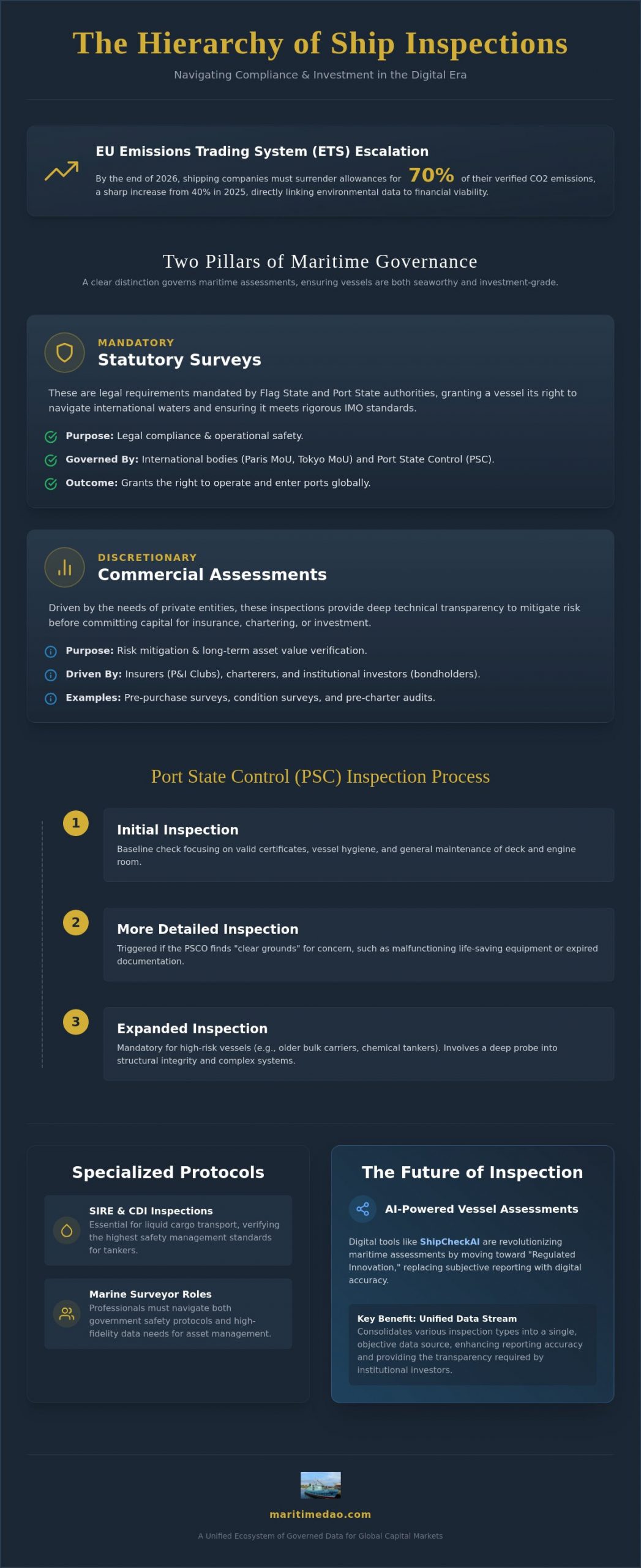
By the end of 2026, shipping companies operating within the EU Emissions Trading System must surrender allowances for 70% of their verified CO2 emissions. This represents a sharp escalation from the 40% requirement in 2025, signaling a new era where environmental data directly governs financial viability. Understanding the diverse ship inspection types has become a high-stakes exercise in risk management rather than a simple operational checklist. Many vessel owners and operators struggle to reconcile the immediate demands of statutory port state control with the rigorous, data-heavy due diligence now expected by institutional investors.
You recognize that manual reporting is no longer sufficient to keep pace with rapid amendments to SOLAS and the mandatory ban on PFOS firefighting foams. This comprehensive reference promises to demystify the complex landscape of maritime assessments, from mandatory safety surveys to AI-driven technical audits. We will provide a clear classification of modern inspection protocols, explore how digital tools like ShipCheckAI eliminate reporting inefficiencies, and explain how to align technical transparency with the structural integrity of EU-regulated Ship Investment Bonds. This methodical approach ensures your fleet remains compliant, efficient, and positioned to access global capital markets through a unified ecosystem of governed data.
Key Takeaways
- Distinguish between mandatory statutory surveys and discretionary commercial assessments to prioritize your operational and financial compliance efforts.
- Navigate the complexities of Port State Control by understanding how specific deficiencies trigger more detailed, high-stakes technical inspections.
- Protect institutional capital by mastering pre-purchase and annual condition surveys that verify long-term asset value and structural integrity.
- Identify the specialized requirements for liquid cargo transport, including SIRE and CDI protocols, to maintain high-tier safety management standards.
- Leverage ShipCheckAI to unify various ship inspection types into a single, objective data stream that enhances reporting accuracy and investor transparency.
Understanding the Hierarchy of Ship Inspection Types in 2026
Ship inspections represent the foundational layer of maritime governance. They’re systemic examinations designed to verify a vessel’s physical condition, operational safety, and total alignment with international legal frameworks. In the current 2026 landscape, these assessments have evolved from simple checklists into complex data streams that inform both port authorities and institutional investors. Understanding the various ship inspection types is essential for any stakeholder operating at the intersection of heavy industry and high finance.
The hierarchy of these assessments is governed by a clear distinction between statutory surveys and commercial inspections. Statutory surveys are mandatory, legal requirements that grant a vessel its right to navigate international waters. Commercial inspections, however, are discretionary; they’re driven by the needs of insurers, charterers, and bondholders who require deep technical transparency before committing capital. This dual-track system ensures that a vessel is not only seaworthy but also “investment-grade” within a unified maritime ecosystem.
Statutory vs. Non-Statutory Frameworks
Mandatory frameworks are dictated by Flag State and Port State compliance. These surveys ensure that the ship meets the rigorous standards set by the IMO. Conversely, voluntary commercial assessments focus on risk mitigation for private entities. This includes P&I Club condition surveys and pre-charter audits. The evolution of Marine Surveyor Roles reflects this complexity, as professionals must now navigate both government-mandated safety protocols and the high-fidelity data requirements of modern asset management. This shift represents a move toward “Regulated Innovation,” where digital accuracy replaces subjective reporting to satisfy both legal mandates and commercial due diligence.
The Role of International Maritime Governance
International bodies like the Paris MoU and Tokyo MoU provide the standardized protocols that govern global port entries. These organizations use a risk-based approach to target vessels for inspection, ensuring that safety standards remain consistent across different jurisdictions. By 2026, the transition from paper-based certificates to digital maritime asset identities has become a standard requirement. This digital shift allows for the seamless verification of mandatory documentation, such as the new 2026 requirements for electronic inclinometers on bulk carriers and updated fuel consumption data for the IMO DCS. These unified systems ensure that inspection data is transparent, governed, and ready for immediate audit by any regulatory body, reducing the friction traditionally associated with international port calls.
Statutory Surveys and Port State Control (PSC) Protocols
Port State Control (PSC) acts as the final enforcement mechanism for international maritime standards, ensuring that vessels entering foreign jurisdictions don’t pose a threat to life, property, or the environment. These statutory ship inspection types are rigorous, non-negotiable, and directly influence a ship’s operational eligibility. Unlike private surveys, PSC inspections are governed by international treaties, where the Port State Control Officer (PSCO) serves as a reliable gatekeeper for global maritime safety.
The inspection regime follows a structured hierarchy based on the vessel’s risk profile and observed condition. Initial Inspections serve as the baseline, focusing on the validity of certificates, the general hygiene of the vessel, and the overall maintenance of the deck and engine room. If the PSCO identifies “clear grounds” for concern, such as malfunctioning life-saving appliances or expired documentation, the process escalates to a More Detailed Inspection. For high-risk categories, such as older bulk carriers or chemical tankers, Expanded Inspections are mandatory, involving a deeper probe into structural integrity and complex operational systems.
The PSC Inspection Process Flow
Success in a PSC audit is the result of methodical pre-arrival preparation. In 2026, this preparation must account for recent regulatory updates, including the mandatory carriage of electronic inclinometers for ships over 3,000 GT and the strict ban on firefighting foams containing PFOS. The PSCO’s walk-through is a high-stakes assessment of both hardware and human factors. Beyond checking physical equipment like lifeboat hooks and fire dampers, the officer will evaluate crew proficiency through emergency drills, ensuring that the ship’s complement can respond to crises with unified precision.
Managing Reporting and Follow-up Actions
The outcome of these assessments is crystallized in two specific documents. Form A represents a “clean” report, indicating no deficiencies were found. Conversely, Form B lists specific non-compliances, each mapped to a specific Convention reference for rectification. Rapidly addressing these points is essential; unresolved deficiencies can lead to vessel detention, which severely impacts a fleet’s risk rating in databases like the Paris MoU. Proactive managers now leverage ShipCheckAI to conduct internal audits before port entry, identifying potential “Form B” items before they become legal liabilities. This commitment to transparency and maritime asset governance ensures that compliance remains a pillar of institutional security rather than an operational hurdle.
Commercial Assessments: Pre-Purchase and Condition Surveys
Commercial assessments represent the rigorous due diligence required to transform a physical vessel into a secure financial instrument. While statutory surveys confirm a ship’s right to sail, these commercial ship inspection types verify its economic viability and long-term asset value. For institutional participants, this technical transparency is the bedrock of trust. It ensures that the underlying collateral for EU regulated ship investment bonds remains structurally sound and operationally efficient throughout the investment lifecycle.
Due Diligence for Asset Acquisition
Acquiring a maritime asset in 2026 demands a forensic approach to structural integrity. A pre-purchase inspection isn’t merely a walk-through; it’s a unified audit of the hull, machinery, and cargo systems. Investors must scrutinize historical maintenance records and dry-docking reports to identify systemic risks before they manifest as financial liabilities. This level of technical scrutiny is a prerequisite for anyone learning how to invest in maritime assets with institutional precision. By identifying potential deficiencies in ballast tank coatings or propulsion efficiency, surveyors provide the data necessary to adjust valuation models. In 2026, this also includes verifying compliance with the updated IMDG Code Amendment 42-24 and ensuring the vessel is equipped for the mandatory reporting of lost containers.
Insurance and Charterer Inspections
Risk profiling in the maritime sector is heavily influenced by Protection and Indemnity (P&I) clubs. These organizations conduct specific ship inspection types to determine the insurability of a vessel, focusing on operational management and loss prevention. Similarly, on-hire and off-hire surveys document the ship’s state at the boundaries of a charter agreement, preventing disputes and protecting the interests of both owners and charterers. In a unified financial ecosystem, this commercial data doesn’t exist in a vacuum. It directly influences maritime bond yields and risk premiums. A vessel with a consistent history of clean condition surveys and transparent reporting commands better financing terms. The data provides objective proof of structural integrity and professional governance. This methodical verification process ensures that the relationship between physical assets and digital governance remains secure and predictable for all global stakeholders. Operators focused on reducing asset downtime and maximizing returns should explore how ship inspection efficiency is redefining maritime due diligence in 2026.
Specialised Inspections: Environmental and Safety Management
Specialised ship inspection types represent the highest tier of operational scrutiny, focusing on the volatile nature of liquid cargo and the urgent demands of global decarbonisation. These assessments are no longer viewed as isolated safety checks but as integrated governance protocols that protect both the environment and institutional capital. In 2026, the maritime industry has transitioned toward a model where technical performance and environmental stewardship are inseparable from financial health.
The Tanker and Chemical Sector Standards
The Ship Inspection Report Programme (SIRE) remains the definitive benchmark for oil tankers and chemical carriers. The industry has now fully embraced SIRE 2.0, a digital, tablet-based workflow that replaces subjective observation with objective, real-time data entry. This system allows vetting departments to analyze, verify, and document a vessel’s risk profile with unprecedented precision. For those holding maritime debt, these inspections provide the granular transparency required to ensure a vessel remains hirable by major oil companies. Similarly, the Chemical Distribution Institute (CDI) conducts specialised audits for liquid gas and chemical transport, focusing on the complex handling requirements of hazardous cargoes. These rigorous standards ensure that the highest-risk assets in the global fleet are governed by a unified framework of safety and technical excellence.
Environmental and ESG Auditing in 2026
Decarbonisation targets have fundamentally altered the scope of vessel assessments. As of January 1, 2026, shipping companies under the EU ETS are required to surrender allowances for 70% of their verified CO2 emissions from the previous year. This financial pressure makes Carbon Intensity Indicator (CII) and EEXI compliance audits a critical component of modern ship inspection types. Furthermore, the designation of the Canadian Arctic and the Norwegian Sea as new Emission Control Areas (ECAs) on March 1, 2026, requires vessels to undergo specific technical checks of their exhaust gas cleaning systems and fuel switching procedures. These environmental audits also extend to biofouling management and the operational efficacy of Ballast Water Management Systems (BWMS).
Maintaining a high ESG rating is now a prerequisite for accessing regulated capital markets. Verification of these green credentials through maritime investment compliance protocols ensures that an asset’s environmental performance aligns with investor expectations. Proactive managers utilize these audits to identify inefficiencies, reduce carbon exposure, and enhance the marketability of their fleet. To ensure your assets meet these evolving standards, you can leverage our unified compliance ecosystem to streamline your reporting and secure your investment’s future. This methodical approach to safety and environmental management ensures that every vessel operates as a transparent, high-performing component of the global trade infrastructure.
The Future of Inspection: AI-Powered Vessel Assessments
The final frontier of maritime governance lies in the transition from subjective human observation to objective, AI-driven data points. While traditional ship inspection types relied heavily on the individual judgment of a surveyor, the 2026 industry standard utilizes automated intelligence to ensure absolute technical transparency. ShipCheckAI is the primary catalyst for this revolution. It unifies disparate data streams into a single, high-fidelity technical identity for every vessel. This technological pillar doesn’t just improve reporting; it fundamentally changes the relationship between a physical asset and its financial backers by providing a transparent, governed, and unified record of condition.
ShipCheckAI and the Digital Inspection Workflow
The integration of computer vision and machine learning allows for automated deficiency detection that far exceeds human capacity. These systems analyze high-resolution imagery and real-time sensor data to identify structural anomalies, such as micro-fractures or early-stage corrosion, before they escalate into costly repairs. This methodical approach is the core strategic advantage of using AI to improve ship inspection accuracy. By standardizing report formats, we ensure that every stakeholder, from port authorities to institutional bondholders, receives identical, unalterable data. This digital workflow reduces the time spent in hazardous spaces while providing a depth of analysis previously considered impossible. It allows operators to detect, document, and democratize technical information across the entire maritime ecosystem.
Inspection Data as an Investment Catalyst
In a unified maritime ecosystem, inspection data serves as the ultimate investment catalyst. The high-fidelity reports generated by ShipCheckAI provide the foundational governance for maritime DAO investment models. Bondholders no longer need to rely on outdated or incomplete maintenance logs. Instead, they have access to transparent, verifiable condition reports that reflect the real-time status of their collateral. This level of technical oversight is essential for maintaining the structural integrity of EU-regulated Ship Investment Bonds. It bridges the gap between the physical world of global trade and the digital world of institutional finance. We’ve reached a point where data-backed maritime assets are no longer a future ambition; they’re the new institutional standard for a transparent and governed industry. By aligning physical condition with digital governance, we ensure that every maritime investment is secured by the most accurate data available today.
Securing the Future of Maritime Governance
The maritime industry has reached a pivotal junction where technical transparency dictates financial accessibility. We’ve explored how the landscape of ship inspection types has evolved into a unified data foundation, bridging the gap between mandatory port safety and the rigorous due diligence required for institutional-grade maritime asset bonds. By moving beyond subjective reporting and embracing objective, AI-driven assessments, operators can ensure their vessels remain compliant with 2026 environmental standards while maximizing asset value.
Success in this new era requires a commitment to structural integrity and regulated innovation. It’s time to deploy ShipCheckAI for your next vessel assessment to benefit from a first-of-its-kind EU-regulated compliance framework and superior AI-driven inspection accuracy. This methodical approach transforms raw technical data into a secure gateway for global capital. Your fleet’s future depends on the precision of its governance; start building that foundation today.
Frequently Asked Questions
What is the main difference between a ship survey and a ship inspection?
A ship survey is a comprehensive, periodic examination required by Flag States or Classification Societies to maintain statutory certification and legal seaworthiness. In contrast, a ship inspection is often a targeted, snapshot assessment conducted by Port State Control or commercial entities to verify immediate compliance or operational condition. This distinction ensures that while surveys provide a long-term technical baseline, inspections offer real-time verification of a vessel’s safety and environmental integrity within the broader maritime ecosystem.
How often must a commercial vessel undergo a Port State Control inspection?
The frequency of Port State Control visits is determined by a vessel’s risk profile within regional databases like the Paris MoU. High-risk vessels typically face mandatory inspections every five to six months; however, low-risk ships may only be targeted every 24 to 36 months. This risk-based targeting mechanism ensures that regulatory resources are focused on vessels with a history of deficiencies, maintaining a unified standard of safety across international trade routes.
Who is responsible for paying for a pre-purchase ship inspection?
The prospective buyer or investor typically bears the cost of a pre-purchase ship inspection. This commercial assessment serves as essential technical due diligence, allowing the buyer to verify the asset’s structural integrity and maintenance history before committing significant capital. By funding the inspection, the investor ensures the surveyor remains an independent gatekeeper, providing an objective report that directly informs the final valuation and risk mitigation strategy for the acquisition.
What are the “clear grounds” that lead to a more detailed ship inspection?
“Clear grounds” refer to objective evidence suggesting that a ship, its equipment, or its crew doesn’t meet international convention requirements. This may include expired statutory certificates, visible structural damage, or a lack of proficiency during emergency drills. When a Port State Control Officer identifies these triggers during an initial walk-through, they’re legally mandated to escalate the process to more detailed ship inspection types to ensure the vessel poses no threat to maritime safety.
How does SIRE 2.0 change the traditional tanker inspection process?
SIRE 2.0 transforms the traditional tanker inspection by replacing paper-based checklists with a digital, tablet-based reporting workflow. This system focuses on human factors and utilizes a library of targeted questions to generate objective, real-time data on a vessel’s operational performance. By standardizing the assessment process, SIRE 2.0 provides vetting departments and investors with a more granular, transparent view of a ship’s risk profile, ensuring higher levels of safety and technical governance.
Can AI-driven inspections replace human surveyors in 2026?
AI-driven tools like ShipCheckAI don’t replace human surveyors in 2026; instead, they augment them by providing high-precision data and automated anomaly detection. While computer vision can identify structural fatigue with greater accuracy than the human eye, the final technical judgment remains with the qualified surveyor. This synergy between automated intelligence and professional expertise creates a more reliable, transparent ecosystem for verifying the condition of complex maritime assets. Operators seeking to understand the full capabilities of this technology can explore how an AI ship inspection tool transforms empirical vessel data into trusted financial collateral.
What happens if a ship fails an expanded inspection at a major port?
Failing an expanded inspection at a major port often results in immediate vessel detention and the issuance of a Form B deficiency list. The ship is prohibited from sailing until all critical safety or environmental non-compliances are rectified and verified by a follow-up survey. Beyond the immediate loss of hire and repair costs, a failure severely damages the vessel’s risk rating, making it a less attractive prospect for premium charterers and institutional bondholders. Understanding how to maximize ship inspection efficiency is therefore critical to avoiding the operational and financial consequences of expanded inspection failures.
How do ship inspection types impact the value of maritime investment bonds?
The various ship inspection types directly influence the credit quality and risk premiums of EU-regulated Ship Investment Bonds. High-fidelity inspection data provides bondholders with transparent proof of the underlying collateral’s condition, ensuring that the asset remains productive and compliant. When a vessel consistently demonstrates superior technical health through AI-backed reporting, it reduces the probability of default and strengthens the bond’s standing within a governed, institutional-grade maritime finance ecosystem.