
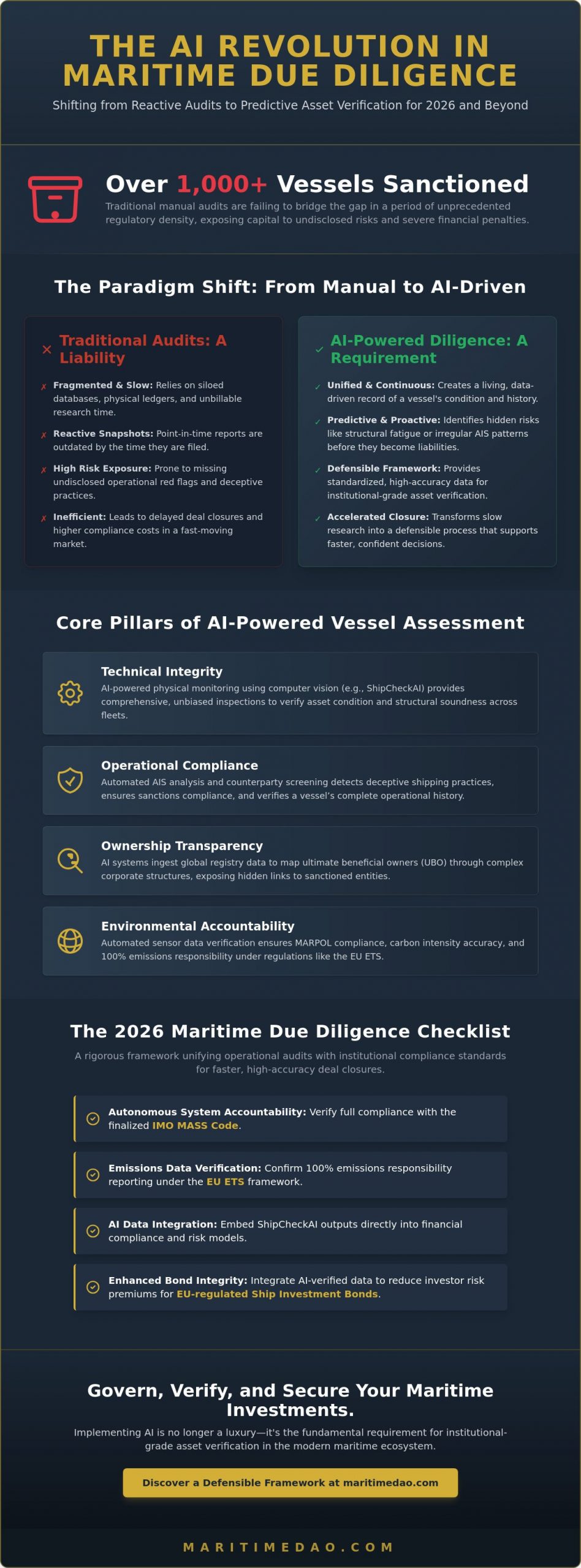
Over 1,000 vessels were sanctioned by the third quarter of 2025, highlighting a systemic failure in traditional risk assessment that manual audits can no longer bridge. As the maritime industry enters a period of unprecedented regulatory density, relying on fragmented research processes exposes capital to undisclosed operational histories and severe financial penalties. Implementing AI in maritime due diligence is no longer a luxury for the technologically curious; it’s a fundamental requirement for institutional grade asset verification. You likely recognize that the transition to 100% emissions responsibility under the EU ETS and the arrival of the IMO MASS Code have made vessel evaluation significantly more complex.
We’ve designed this framework to help you master these complexities by leveraging a unified, AI-driven approach to asset assessment. You’ll learn how to transform slow, manual research into a standardized and defensible process that accelerates deal closure while maintaining high accuracy. This guide provides a comprehensive 2026 checklist that covers autonomous system accountability, emissions data verification, and the integration of ShipCheckAI data into your financial compliance frameworks. Our methodical breakdown ensures you can govern, verify, and secure your maritime investments with absolute confidence in an evolving global ecosystem.
Key Takeaways
- Transition from reactive, snapshot vessel inspections to a unified ecosystem of continuous, data-driven monitoring for superior asset governance.
- Deploy ShipCheckAI to establish a defensible framework for AI in maritime due diligence, ensuring technical consistency across diverse vessel types and fleets.
- Protect capital by automating the detection of deceptive shipping practices and complex sanctions risks through advanced AIS analysis and counterparty screening.
- Enhance the structural integrity of EU-regulated Ship Investment Bonds by integrating AI-verified data to reduce investor risk premiums and increase transparency.
- Execute a rigorous 2026 checklist that unifies operational history audits with institutional compliance standards to secure faster, high-accuracy deal closures.
Defining AI in Maritime Due Diligence
AI-enhanced assessment represents a fundamental shift in how institutional investors approach the maritime sector. It integrates machine learning and computer vision to verify physical assets with a level of precision that traditional methods simply cannot match. This evolution transforms due diligence from a static, paper-based requirement into a dynamic risk management engine. By 2026, the industry has moved decisively away from reactive snapshot inspections, favoring continuous, data-driven monitoring that provides a living record of a vessel’s condition and history.
The urgency for this transition is driven by a tightening regulatory landscape. With the IMO MASS Code finalized and the EU ETS requiring 100% emissions accountability as of 2026, the demand for transparency in maritime capital markets has reached a critical threshold. AI in maritime due diligence serves as the technological bridge between these complex legal requirements and the need for fast, accurate investment decisions. It utilizes predictive intelligence to identify hidden operational risks, such as subtle structural fatigue or irregular AIS patterns, before they manifest as costly liabilities or compliance failures.
The Triple Pillar of Maritime Assessment
A robust framework for modern asset evaluation rests on three distinct yet integrated pillars. First, technical integrity is maintained through AI-powered physical monitoring, where tools like ShipCheckAI provide comprehensive inspections across multiple vessel types. Second, operational compliance is secured via real-time verification of movement history, ensuring the asset hasn’t engaged in deceptive shipping practices. Finally, financial viability is established by linking these granular asset health metrics directly to the performance of EU-regulated Ship Investment Bonds. This tripartite structure ensures that every investment is governed by transparency, security, and verified data.
Why Manual Due Diligence Fails in 2026
Traditional manual audits are increasingly falling into the fragmentation trap, where critical vessel records are scattered across siloed databases and physical ledgers. These processes are inherently outdated; by the time a manual report is filed, the asset’s operational status may have already changed. Innovation in maritime technology is currently outpacing oversight, making manual checks a liability for serious capital. The high cost of unbillable research time in traditional maritime law firms makes these legacy processes inefficient. In a fast-moving market, relying on human-speed research leads to delayed closures and a higher risk of missing undisclosed operational red flags. It’s no longer enough to trust a single point-in-time report when the financial stakes are this high.
Core Pillars of AI-Powered Vessel Assessment
Modern vessel evaluation operates at the intersection of heavy industry and high finance, requiring a unified ecosystem that validates both the physical and legal status of an asset. To achieve this, a robust framework for AI in maritime due diligence must address four core pillars: technical integrity, operational compliance, ownership transparency, and environmental accountability. This comprehensive approach ensures that institutional capital is protected from the systemic inefficiencies of legacy manual audits. By integrating these pillars, investors can move beyond surface-level checks to a state of regulated innovation where every data point is verified and defensible.
Mapping ultimate beneficial owners (UBO) through seven layers of corporate structure is no longer an exhaustive manual task for legal teams. AI systems now ingest global registry data to expose hidden links between shell companies and sanctioned entities. Simultaneously, verifying environmental impact through automated sensor data ensures MARPOL compliance and carbon intensity accuracy. These technical benchmarks are vital for the long-term performance and structural integrity of EU-regulated Ship Investment Bonds.
The Role of ShipCheckAI in Asset Verification
ShipCheckAI serves as the primary gateway for physical asset verification, automating ship surveys with high-precision computer vision. This technology eliminates the subjective bias inherent in traditional reports, providing a standardized assessment of a vessel’s condition across global fleets. By utilizing pre-purchase ship inspection software that processes multi-type vessel data, stakeholders receive a transparent view of technical integrity. This automation reduces human error and ensures that the physical “what” of an investment is as secure as the legal “who,” bridging a critical gap in traditional AI in maritime due diligence workflows. For a comprehensive understanding of how these automated inspection systems operate in practice, the AI powered vessel survey guide for 2026 details the technical pillars and regulatory frameworks that govern modern automated maritime inspection.
Sanctions and Reputational Risk Mitigation
Institutional reputations are governed by their ability to identify and avoid deceptive shipping practices (DSP) in real time. AI-driven intelligence provides continuous screening against global maritime watchlists, identifying dark activity and AIS manipulation that manual research often misses. When a vessel exhibits irregular movement patterns or frequent ship-to-ship transfers, the system flags these as high-risk indicators. This methodical approach to counterparty due diligence protects investors from the fallout of sanctions evasion. It creates a transparent history of operation, allowing for faster deal closure with the certainty that the asset has remained within the bounds of international maritime law.
AI vs. Traditional Surveys: A Comparative Analysis
Legacy maritime audits often rely on subjective expert opinions, leading to a fragmentation of truth that slows institutional deal flow. In contrast, AI in maritime due diligence unifies disparate data streams into a single, verifiable ecosystem of intelligence. While a traditional physical survey might require weeks of manual research, logistics coordination, and report drafting, AI-driven platforms provide near-instant visibility into an asset’s operational reality. This speed of execution is paired with a level of consistency that human inspectors cannot replicate. Manual surveys are inherently vulnerable to subjective bias; a deck’s condition might be rated differently by two separate surveyors based on their individual experience or the time of day. AI eliminates this variance by applying standardized computer vision algorithms that assess integrity with mathematical precision.
The depth of data available through AI systems far exceeds the scope of a standard paper-based report. By integrating high-resolution satellite imagery, real-time sensor data, and years of historical AIS records, these systems create a multi-dimensional profile of the vessel. This approach significantly enhances cost-efficiency for investment teams by reducing unbillable research hours. Instead of legal professionals manually cross-referencing port logs and registry updates, they can focus on high-level strategy and governance. This shift ensures that the relationship between physical assets and digital oversight remains transparent and methodical. For those looking to understand how to invest in maritime assets through a regulated framework, this AI-driven transparency is the foundation upon which defensible capital allocation is built.
The Human-AI Synergy in Bridge Discipline
Assigning accountability in increasingly autonomous maritime environments remains a complex legal challenge. However, the role of AI isn’t to replace human expertise but to act as a sophisticated assistant that enhances bridge discipline. We’re witnessing a fundamental shift from expert opinion to verifiable maritime intelligence, where decisions are governed by data rather than intuition. This synergy ensures that even as vessels become more automated, the human element remains the ultimate gatekeeper of safety. This shift toward AI in maritime due diligence ensures that institutional reputations are protected by objective, high-fidelity data.
Evidence and Legal Defensibility
In the event of a dispute or arbitration, the quality of evidence is paramount. AI-driven due diligence provides a robust audit trail, utilizing time-stamped movement histories and satellite-confirmed operations as verifiable evidence. This level of transparency is essential for modern ship finance. You can see how regulated maritime debt instruments utilize these data points to ensure that every underlying asset is legally and operationally defensible. This methodical approach to documentation provides a level of security that traditional surveys simply cannot match, establishing a new standard for asset-backed accountability.
The 2026 Maritime Asset Due Diligence Checklist
The 2026 framework for AI in maritime due diligence unifies technical precision with financial accountability, moving beyond the fragmented research methods of the past. To secure institutional capital, investors must follow a methodical, five-phase approach that validates every dimension of a maritime asset. This checklist serves as the architectural blueprint for a standardized, defensible due diligence process. It ensures that the relationship between physical integrity and digital governance is clearly understood before any capital commitment is finalized. By following these phases, you can transform complex data streams into a unified ecosystem of investment intelligence.
- Phase 1: Counterparty Screening. Conduct deep-layer mapping of ultimate beneficial owners (UBO) and verify all stakeholders against global sanctions watchlists to ensure institutional safety.
- Phase 2: Operational History. Utilize AI-driven AIS analysis to detect deceptive shipping practices, including dark activity, frequent ship-to-ship transfers, and irregular movement patterns.
- Phase 3: Technical Inspection. Execute a high-precision physical assessment of the hull and machinery using computer vision to identify structural fatigue or undisclosed damage.
- Phase 4: Regulatory Compliance. Audit the vessel’s ESG profile and safety certifications, ensuring full alignment with MARPOL standards and the 100% emissions responsibility mandated by the EU ETS in 2026.
- Phase 5: Financial Integration. Risk-weight the asset based on the previous four phases to determine its suitability for bond issuance and long-term portfolio performance.
Technical Checklist Items
Technical verification requires more than a simple walkthrough; it demands a data-driven audit of the vessel’s physical reality. Investors should prioritize the verification of predictive maintenance logs via AI to ensure that mechanical history hasn’t been manipulated or neglected. Assessing structural integrity through ShipCheckAI data provides a mathematical baseline for the asset’s condition, removing the variance of human opinion. Finally, a review of automated ship survey accuracy scores from AI powered vessel survey platforms helps determine the reliability of the technical data provided, ensuring that the “what” of your investment is structurally sound and operationally ready. For a deeper understanding of how these technical benchmarks translate into capital eligibility, the vessel assessment for financing framework outlines how environmental transparency and data accuracy govern institutional debt access in 2026.
Compliance Checklist Items
The regulatory landscape of 2026 is governed by strict transparency requirements and severe penalties for non-compliance. Your audit must include flag state registry verification to track historical changes and identify any red flags in the vessel’s administrative history. Compliance with pollution and emission standards, specifically IMO 2026 requirements, is vital for maintaining the asset’s market value. A comprehensive sanctions exposure check for all third-party counterparties remains the final gatekeeper for reputational safety. To begin securing your portfolio with these verified standards, explore our EU-regulated Ship Investment Bonds.
Integrating AI Insights into Regulated Ship Investment Bonds
The convergence of high-fidelity data and institutional finance represents the final stage of the digital maritime transition. By embedding AI in maritime due diligence directly into the lifecycle of EU-regulated Ship Investment Bonds, we create a transparent ecosystem where risk is mathematically governed rather than merely estimated. This integration reduces the risk premium for investors by providing a verified audit trail of the underlying asset’s condition and compliance status. It’s a fundamental shift that ensures the physical world of global trade is accurately mirrored in the digital world of regulated debt instruments. This methodical approach provides a level of structural integrity that legacy financial models can’t replicate.
Transparency is the cornerstone of modern maritime DAO investment, where decentralized governance meets heavy industry. When asset-backed securities are validated through tools like ShipCheckAI, the bondholder gains a level of security previously unavailable in traditional ship finance. This framework unifies, governs, and secures capital by linking the bond’s performance to real-time operational data. The future of global shipping finance depends on this first-of-its-kind synergy between physical asset integrity and regulated innovation, acting as a bridge for capital to flow into a traditionally opaque sector with absolute confidence.
The Value Proposition for Bondholders
Institutional-grade reliability is achieved through the unification of operational and financial data streams. Bondholders benefit from real-time monitoring of collateral assets post-investment, ensuring that the vessels remain compliant with MARPOL and EU ETS standards throughout the bond’s term. This continuous oversight enhances liquidity by providing transparent, AI-backed reporting that secondary market participants can instantly verify. It’s about creating a predictable environment where asset health is a constant, not a variable, allowing for a more accurate valuation of the underlying collateral over time.
Next Steps for Institutional Investors
Transitioning to an AI-driven framework requires a methodical evaluation of maritime fintech platforms for bond allocation. Investors should prioritize systems that standardize internal due diligence protocols with validated AI tools, ensuring that every asset in the portfolio meets a high-fidelity technical benchmark. As the industry modernizes, the ability to bridge legacy systems with high-tech solutions will define the leaders in maritime finance. This evolution ensures that AI in maritime due diligence remains a permanent pillar of institutional risk management. To begin this transition, explore the Maritime DAO ecosystem for regulated ship investment opportunities that leverage the full power of automated intelligence.
Securing the Future of Maritime Capital
The transition toward a unified, data-driven ecosystem is no longer a choice but a prerequisite for institutional investors. By adopting the 2026 assessment framework, you replace the fragmentation of legacy audits with a defensible, high-fidelity record of asset integrity. This methodical approach ensures that every investment is governed by transparency, security, and structural reliability. Implementing AI in maritime due diligence allows you to bridge the gap between heavy industry and high finance with absolute precision.
Success in this new frontier requires a commitment to regulated innovation. Our ecosystem unifies proprietary ShipCheckAI inspection technology with a robust EU-regulated compliance framework to protect your interests. You can now move beyond the risks of undisclosed operational history and manual research delays. It’s time to lead the transformation of global maritime finance through verified, asset-backed intelligence. Secure your maritime capital with EU-regulated Ship Investment Bonds and position your portfolio for long-term stability in an evolving global market.
Frequently Asked Questions
How does AI specifically improve maritime due diligence accuracy?
AI improves accuracy by unifying disparate data streams, such as high-resolution satellite imagery and real-time sensor logs, into a single source of truth. Unlike manual audits that rely on subjective expert opinion, machine learning algorithms apply standardized technical benchmarks across entire fleets. This consistency ensures that structural integrity and operational history are verified with mathematical precision. Implementing AI in maritime due diligence ensures that you don’t miss undisclosed risks often hidden in fragmented paper records.
Is AI-generated vessel evidence admissible in maritime legal disputes?
Time-stamped movement histories and satellite-confirmed operations are increasingly utilized as verifiable evidence in maritime arbitration and litigation. These digital records provide a robust audit trail that’s often more defensible than anecdotal testimony or fragmented paper logs. As long as the platform maintains a transparent chain of custody for the data, these insights serve as critical evidence for resolving disputes regarding vessel location, structural condition, or compliance failures during the investment lifecycle.
Can AI detect deceptive shipping practices better than human analysts?
AI systems excel at identifying deceptive shipping practices by detecting subtle patterns in AIS data that human analysts might overlook. These include irregular ship-to-ship transfers, dark activity where transponders are intentionally disabled, and complex movement histories across sanctioned jurisdictions. By screening against global maritime watchlists in real time, AI provides a continuous layer of oversight. This protects institutional reputations from the high-stakes risks of sanctions evasion and illicit global trade.
What is the role of ShipCheckAI in the due diligence process?
ShipCheckAI serves as the primary gateway for physical asset verification within the due diligence framework. It utilizes high-precision computer vision to automate ship surveys, providing a standardized assessment of a vessel’s hull and machinery. By integrating these technical findings into the broader investment lifecycle, it ensures that the physical condition of the asset is as transparent as the financial structures. It’s a vital tool for maintaining the structural integrity of maritime portfolios.
How do EU regulations affect AI use in maritime investment?
EU regulations, such as the 2026 Emissions Trading System requirements, mandate 100% responsibility for verified emissions, making AI-driven data tracking essential for compliance. These legal frameworks demand a high degree of transparency in maritime capital markets, pushing investors to adopt AI in maritime due diligence to ensure accurate reporting. Regulated innovation ensures that shipowners and investors stay aligned with evolving standards like the IMO MASS Code and MARPOL environmental benchmarks without manual errors.
What are the primary risks of relying solely on AI for vessel assessment?
The primary risk involves the “black box” effect, where the reasoning behind an AI’s risk rating might be opaque to the decision-maker. Additionally, the accuracy of AI depends entirely on the quality of the input data from sensors and satellites. To mitigate these risks, AI should be viewed as a sophisticated assistant that enhances, rather than replaces, human expertise. Bridge discipline and final accountability must always remain with qualified professionals who govern the automated systems.
How does AI-driven due diligence impact ship bond yields?
AI-driven due diligence directly influences bond yields by reducing the risk premium associated with undisclosed operational histories. When an asset’s technical integrity and compliance status are verified through a transparent, AI-backed reporting system, investor confidence increases. This structural reliability allows for more accurate risk-weighting, which can lead to more favorable terms for EU-regulated Ship Investment Bonds. Higher data fidelity ensures that the collateral remains liquid and defensible throughout the bond’s term.
What is the difference between sanctions screening and technical due diligence?
Sanctions screening focuses on the “who,” mapping ultimate beneficial owners and verifying counterparties against global watchlists to ensure legal compliance. In contrast, technical due diligence focuses on the “what,” assessing the physical condition and mechanical reliability of the vessel itself. Both are essential pillars of a unified ecosystem. While screening protects against reputational and legal risk, technical assessment ensures the structural integrity and long-term value of the physical asset you’re financing through regulated maritime investment channels.