
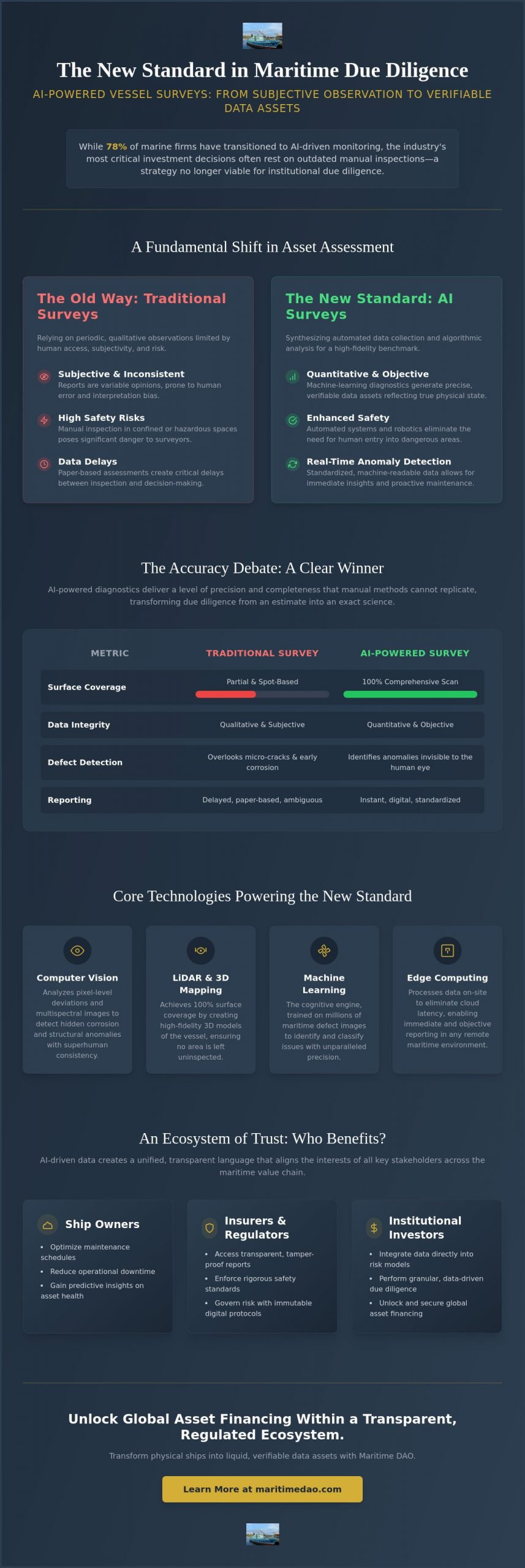
78% of marine firms have transitioned to AI-driven monitoring as of 2026, yet the industry’s most critical investment decisions often still rest on the subjective observations of a manual inspection. While an AI powered vessel survey is now a technical reality, many stakeholders remain tethered to traditional methods that suffer from inconsistent reporting, safety risks in confined spaces, and data delays. You likely recognize that in an era of high-stakes capital, relying on a static, paper-based assessment is no longer a viable strategy for institutional due diligence.
This guide explores how automated inspections transform physical ships into transparent, verifiable, and liquid data assets. By leveraging the latest IMO guidelines on AI and data security, maritime leaders can now access objective condition reports with unprecedented speed. We’ll examine the technical pillars of automated inspection, the regulatory framework of the new MASS Code, and the specific ways these systems govern risk, enhance safety, and unlock global investment opportunities within a unified maritime ecosystem.
Key Takeaways
- Transition from qualitative human observation to quantitative, machine-learning diagnostics for more reliable asset assessments.
- Leverage Computer Vision and LiDAR to achieve 100% surface coverage, detecting structural micro-cracks that traditional manual inspections often overlook.
- Understand how an AI powered vessel survey transforms subjective reporting into objective data assets for rigorous maritime due diligence.
- Integrate automated diagnostic data directly into ESG reporting frameworks and institutional financial risk models.
- Access multi-layered inspection capabilities through ShipCheckAI to secure global asset financing within a transparent, regulated ecosystem.
What is an AI Powered Vessel Survey? Defining the New Standard
An AI powered vessel survey defines the synthesis of automated data collection and sophisticated algorithmic analysis, establishing a high-fidelity benchmark for the maritime industry. This process represents a fundamental shift from qualitative human observation to quantitative machine-learning diagnostics. Instead of relying on a surveyor’s subjective interpretation of wear or damage, automated systems utilize high-resolution sensors to generate objective data sets. This transition ensures that vessel condition reports are no longer variable opinions but are instead precise, verifiable assets that reflect the true physical state of a ship.
At the heart of this standard is “Regulated Innovation.” This concept balances the speed of technological advancement with the sober requirements of international maritime law and institutional finance. Central to this is the role of Computer Vision. These advanced systems are trained to identify structural anomalies, such as micro-cracks or specific corrosion patterns, with a level of consistency that exceeds manual capabilities. By processing thousands of data points per second, AI models provide a comprehensive view of hull integrity, ensuring that minor issues are identified before they escalate into systemic failures.
The Evolution from Manual to Algorithmic Inspection
Traditional marine surveying relied on periodic, qualitative observations that were inherently limited by human access and subjectivity. The 2026 technological landscape allows for a departure from this legacy approach. With the implementation of the IMO framework for Maritime Autonomous Surface Ships (MASS) on July 1, 2026, the industry now has a structured pathway for integrating autonomous diagnostics into standard operations. Modern technology enables real-time anomaly detection while a vessel is active, moving away from the “snapshot” nature of old-world inspections. The data is objective. It’s also standardized, allowing global stakeholders to communicate through unified, machine-readable formats that eliminate ambiguity in asset reporting.
Key Stakeholders: Who Benefits from AI Surveys?
Institutional capital requires more than a simple certificate of seaworthiness; it demands a granular, data-driven vessel assessment for financing that integrates directly into complex risk models. Ship owners utilize an AI powered vessel survey to optimize maintenance schedules and significantly reduce operational downtime through predictive insights. Simultaneously, insurers and regulators gain access to transparent, tamper-proof condition reports that are governed by immutable digital protocols. This ecosystem of trust ensures that asset value is preserved, maintenance is proactive, and financial risk is managed with surgical precision across the entire maritime value chain.
Core Technologies Powering Next-Generation Ship Surveys
The efficacy of an AI powered vessel survey relies on a unified tripartite architecture: high-precision hardware, sophisticated algorithmic logic, and localized edge processing. This synergy allows for the detection of structural degradation that remains invisible to the human eye. By integrating these pillars, the maritime industry has moved beyond surface-level checks into a regime of deep-tissue diagnostics. These systems don’t just see the ship; they understand its structural integrity through a lens of historical data and predictive physics.
Machine Learning models now serve as the cognitive engine for these inspections, having been trained on millions of maritime defect images. This extensive training allows algorithms to identify micro-cracks and early-stage corrosion with a precision rate that manual surveys cannot replicate. To maintain this speed in remote maritime environments, edge computing processes data on-site. This eliminates the latency of cloud-based transfers, allowing for immediate, objective reporting regardless of the vessel’s geographic coordinates.
Computer Vision and Anomaly Detection
Algorithms now distinguish between superficial surface wear and critical structural failure by analyzing pixel-level deviations in texture and color. Multispectral imaging is essential here because it penetrates surface coatings to reveal hidden oxidation before it compromises the hull. Industry leaders are increasingly deploying AI-powered robotics for vessel inspections to maintain these rigorous safety standards across global fleets. As of 2026, Computer Vision serves as the primary gateway for converting raw visual input into actionable maritime safety intelligence. This technology ensures that every square centimeter of a vessel is governed by the same uncompromising diagnostic standard.
Digital Twins and 3D Structural Modeling
LiDAR and SLAM (Simultaneous Localization and Mapping) technologies work in tandem to map internal and external structures with millimeter precision. This data is converted into a functional Digital Twin, providing a 360-degree visualization that is accessible to remote inspection teams and bondholders alike. These models aren’t merely static representations; they are dynamic assets that incorporate historical survey data to predict future maintenance requirements. This level of transparency is vital for institutional investors who require a verified, real-time understanding of asset health. For those looking to secure their capital through these advanced methodologies, participating in a governed maritime ecosystem ensures that technology and finance remain perfectly aligned. This structural modeling creates an immutable record of a ship’s condition, facilitating faster due diligence and more accurate risk pricing.
AI vs. Traditional Marine Surveying: The Accuracy Debate
Can a machine truly replicate the intuition of a surveyor with 30 years of experience? This question lies at the heart of the industry’s transition toward the AI powered vessel survey. While seafaring experience provides invaluable context, human observation is fundamentally limited by physical access and cognitive fatigue. Traditional inspections often rely on representative spot checks, typically covering only a fraction of a vessel’s critical surfaces. AI-driven drones, however, achieve 100% surface coverage, capturing high-fidelity imagery that reveals structural anomalies invisible to the naked eye.
The transition to automated diagnostics significantly reduces the “Human Factor” errors that historically plagued condition reporting. Manual surveys are often subjective, influenced by an individual’s perspective or environmental constraints. By shifting to an algorithmic model, the industry gains an objective standard that is consistent across different ships, ports, and timeframes. Safety also drives this evolution. Remote inspections in hazardous environments, such as ballast tanks or confined engine spaces, remove personnel from high-risk zones. This ensures that data collection never comes at the cost of human life while maintaining a rigorous diagnostic pace.
Data Fidelity and Verification
Algorithmic data serves as a more reliable foundation for AI in maritime due diligence because it’s immune to the inconsistencies of manual reporting. These results are often secured via blockchain protocols, creating an immutable record that prevents unauthorized tampering or data manipulation. This technological framework provides a single source of truth for an entire ecosystem of stakeholders. Owners, insurers, and bondholders can all access a unified, transparent assessment of an asset’s health, which is essential for maintaining the structural integrity of global maritime finance.
Efficiency and Turnaround Times
Traditional manual reporting cycles usually require 48 to 72 hours for data processing and document finalization. In contrast, an AI powered vessel survey delivers near-instant analytics, allowing for immediate decision-making during critical maintenance windows. This speed directly enhances operational profitability by minimizing vessel off-hire time and optimizing shipyard schedules. For institutional fleet managers, the cost-benefit analysis is clear; automated surveys, supported by platforms like Nodal AI, offer a scalable, methodical solution that transforms maritime due diligence into a high-speed, data-driven process.
Strategic Implementation: Enhancing Asset Due Diligence
Strategic implementation of an AI powered vessel survey transforms raw physical assessments into high-fidelity financial data assets. This evolution is critical for maritime investment compliance, where the accuracy of a condition report directly influences the security of significant capital allocations. By standardizing these assessments into a “Vessel Health Score,” the industry provides institutional investors with a transparent, machine-readable metric that governs asset value across global trade corridors. This score serves as a unified benchmark, ensuring that risk is assessed with methodical precision rather than subjective estimation.
Integration of automated survey data into ESG reporting is no longer a luxury; it is a regulatory necessity as of 2026. These assessments provide the empirical evidence required for environmental stewardship and governance transparency, allowing firms to demonstrate structural integrity through verifiable data. During pre-purchase inspections or chartering negotiations, AI-driven diagnostics remove the ambiguity of manual checks, ensuring that all parties operate from a unified dataset. This methodical approach identifies systemic inefficiencies, protects asset integrity, and democratizes access to complex maritime ventures by lowering the barrier of technical uncertainty. A dedicated vessel condition report platform bridges the gap between physical maintenance data and institutional investment requirements, transforming raw inspection outputs into actionable financial intelligence.
AI Surveys in Maritime Capital Markets
In the world of high finance, data fidelity is the primary driver of risk mitigation. High-fidelity survey data significantly reduces the risk premium associated with EU regulated ship investment bonds, providing a clearer link between physical vessel condition and bond yield projections. Automated valuations now utilize real-time survey inputs to adjust asset pricing dynamically. This allows bondholders to monitor their collateral with surgical precision, ensuring that the financial structure remains robust throughout the asset’s lifecycle. To explore how these governed data assets integrate into institutional portfolios, visit Maritime DAO to review our latest asset frameworks.
Regulatory Compliance and Standardized Reporting
Aligning AI survey outputs with international standards, such as ISO 19030, ensures that automated reporting is recognized by global regulatory bodies. These systems simplify mandatory class inspections by providing a transparent audit trail that is easily verified by statutory authorities. This reduces the administrative burden on crews while increasing the reliability of safety documentation. As the industry moves forward, an AI powered vessel survey will likely become a prerequisite for green shipping certifications. This transition prepares fleets for a future where environmental compliance is governed by automated, tamper-proof data streams rather than periodic manual reviews.
ShipCheckAI functions as the specialized diagnostic gateway within the Maritime DAO ecosystem, acting as the definitive bridge between physical vessel integrity and digital asset value. It is the technological pillar that transforms an AI powered vessel survey from a technical report into a governed financial asset. By synthesizing automated diagnostics with decentralized protocols, ShipCheckAI vessel assessment ensures that every capital allocation is backed by a verifiable, machine-readable record of structural health. This transition is fundamental to the evolution of maritime DAO investment, where data fidelity serves as the primary arbiter of trust.
The system operates as a reliable gatekeeper, identifying systemic inefficiencies and providing the high-fidelity data required for complex asset management. It positions the traditionally exclusive world of ship finance as a transparent and accessible frontier, governed by the sober reliability of institutional standards rather than speculative hype. By uniting physical asset assessment with digital governance, ShipCheckAI identifies, validates, and secures the underlying value of global maritime trade.
The ShipCheckAI Advantage
The platform provides a unified environment for multi-layered inspections, allowing stakeholders to assess hull integrity, machinery condition, and regulatory compliance through a single interface. This consolidated approach enables the DAO to govern capital deployment with surgical precision, ensuring that maintenance funding and investment distributions are based on empirical reality. Community-verified data plays a critical role here; it maintains the structural integrity of the maritime bond market by preventing the data silos that often obscure risk in traditional shipping. Through this tripartite model of automation, verification, and governance, ShipCheckAI provides a level of transparency that was previously unattainable in global maritime operations.
Next Steps for Maritime Investors and Owners
Integrating an AI powered vessel survey into your maritime asset investment strategy is the most effective way to mitigate technical risk and enhance bond yield projections. Owners can access the ShipCheckAI platform to schedule continuous compliance monitoring, ensuring their vessels meet the rigorous standards required for institutional financing. For investors, this data provides the clarity needed to navigate the intersection of heavy industry and high finance with confidence. Explore how ShipCheckAI secures your maritime investments by providing the objective, tamper-proof insights necessary for modern asset governance.
The Future of Maritime Asset Governance
The maritime industry stands at a pivotal intersection where physical heavy industry meets the surgical precision of high finance. We’ve explored how the transition from qualitative human observation to quantitative machine diagnostics creates a new standard for asset integrity. An AI powered vessel survey is no longer a peripheral innovation; it’s a central pillar of modern maritime due diligence. By converting structural condition into objective, machine-readable data, stakeholders govern risk with rigorous accuracy and total transparency.
This ecosystem is underpinned by the synergy of ShipCheckAI’s specialized inspection capabilities and a robust, EU-regulated financial framework. Blockchain-secured data integrity ensures these assessments remain tamper-proof, providing a reliable foundation for institutional capital. As new IMO guidelines and the MASS Code redefine operational standards, the ability to bridge physical integrity with digital asset value becomes a competitive necessity. Secure your maritime assets with ShipCheckAI and Regulated Bonds to ensure your portfolio is built on a foundation of verified, high-fidelity data. This is your gateway to a more inclusive and resilient maritime future.
Frequently Asked Questions
What exactly is an AI powered vessel survey?
An AI powered vessel survey is the synthesis of automated data collection and sophisticated algorithmic analysis used to generate high-fidelity condition reports. Unlike traditional methods, it replaces qualitative human observation with quantitative machine-learning diagnostics. This process utilizes specialized sensors to identify structural patterns, ensuring that asset assessments are objective, verifiable, and standardized for global financial stakeholders.
Can AI surveys detect internal structural issues like traditional NDT methods?
AI-driven surveys utilize multispectral imaging and high-resolution sensors to identify internal structural degradation that often escapes the naked eye. These systems are trained on millions of images to detect micro-cracks and early-stage corrosion beneath surface coatings. While they complement traditional non-destructive testing, they provide a higher data density, achieving 100% surface coverage compared to the limited spot checks used in manual inspections.
How much faster is an AI-driven ship inspection compared to a manual one?
Is AI vessel surveying compliant with international maritime regulations?
Yes, an AI powered vessel survey is governed by the IMO Maritime Autonomous Surface Ships (MASS) Code, which takes effect on July 1, 2026. This framework, combined with the IMO Guidelines on AI Integration released in January 2026, provides a structured pathway for responsible technology adoption. These regulations ensure that automated diagnostics meet the rigorous safety and data security standards required by flag states and classification societies.
What are the primary safety benefits of using drones for ship surveys?
The primary safety benefit is the elimination of human entry into hazardous confined spaces, such as ballast tanks or fuel cells. By deploying drones and ROVs, ship owners remove personnel from high-risk environments where gas accumulation or structural instability pose significant threats. This remote approach ensures that comprehensive data collection occurs without compromising the safety of the crew or the surveying team.
How does AI survey data impact the valuation of maritime investment bonds?
High-fidelity survey data reduces the risk premium of maritime investment bonds by providing a transparent link between physical condition and financial performance. This data is often converted into a standardized Vessel Health Score, which allows institutional investors to monitor collateral with surgical precision. Objective reporting ensures that bond yields accurately reflect the asset’s true integrity, facilitating more stable and predictable capital markets.
Can ShipCheckAI be used for all types of commercial vessels?
ShipCheckAI is designed to perform multi-layered inspections across a wide range of commercial maritime assets, including bulk carriers, tankers, and container ships. The tool’s algorithmic models are adaptable to various structural configurations, ensuring consistent diagnostic quality regardless of vessel type. This versatility makes it an essential component for governing capital deployment and maintaining asset value within the broader Maritime DAO ecosystem.
Do I still need a human surveyor if I use an AI-powered tool?
Yes, the maritime industry utilizes a human-in-the-loop approach where final interpretations and decisions remain with trained professionals. While AI identifies anomalies and processes massive datasets with a precision humans can’t match, the surveyor’s expertise is vital for contextualizing findings. This collaborative model ensures that automated diagnostics are balanced with the sober reliability and institutional experience required for high-stakes maritime governance.