
The era of the “gut-feel” maritime investment died when the EU Emissions Trading System reached 100 percent carbon accountability in January 2026. You likely recognize that while the sector offers record-breaking yields, with VLCC earnings averaging 175,000 dollars per day in the first quarter, the barrier to entry remains high due to information asymmetry and freight rate volatility. Achieving sustainable returns requires more than just capital. It demands a systematic approach to avoiding common shipping investment mistakes that often sink even the most promising portfolios.
You’re ready to master the complexities of maritime finance by identifying and neutralizing the structural, regulatory, and operational risks that derail traditional allocations. This article provides a clear framework for due diligence, ensuring you understand the critical difference between unregulated instruments and EU-regulated maritime bonds. We’ll examine how to mitigate technical risk through AI verification and granular data analysis. You’ll gain the clarity needed to navigate a market defined by geopolitical shifts, rigorous ESG standards, and the transition to a transparent, unified maritime ecosystem.
Key Takeaways
- Navigate the unique risk profile of maritime capital by understanding how specialized cycles and high entry barriers necessitate a departure from traditional equity strategies.
- Neutralize operational uncertainty through high-frequency verification, identifying the three critical inspection tiers-pre-purchase, condition, and compliance-essential for institutional-grade due diligence.
- Protect your capital by avoiding common shipping investment mistakes, specifically the failure to differentiate between unregulated offshore syndicates and the robust governance of EU-regulated ship investment bonds.
- Optimize your capital structure by comparing the liquidity profiles of direct vessel ownership against fractionalized instruments that allow for more agile asset management.
- Deploy a comprehensive 2026 investor checklist built on a tripartite model of AI-driven verification, European regulatory compliance, and decentralized transparency.
The Unique Risk Profile of Maritime Capital Allocation
Maritime investment represents a specialized asset class characterized by formidable entry barriers and a distinct operational logic that separates it from traditional financial markets. Unlike liquid equities, this alternative investment in worldwide shipping demands a deep integration of maritime law, engineering, and macroeconomic forecasting. It’s an ecosystem where capital is tied to massive physical assets that operate in a high-stakes, cross-border environment. For those focused on avoiding common shipping investment mistakes, the first step is recognizing that maritime cycles don’t mirror the volatility of the S&P 500. While traditional markets often react to consumer sentiment, shipping cycles are dictated by the physical supply of hulls and the rigid geography of global trade routes.
The year 2026 marks a pivotal transition in how capital is deployed within this sector. The era of speculative “ship flipping,” where investors sought quick capital gains through asset play, has largely been superseded by a preference for yield-focused debt instruments. This shift is driven by a more stringent regulatory environment and the need for predictable cash flows in a volatile global economy. Investors are increasingly moving toward EU-regulated ship investment bonds, which provide a structured gateway into an industry that was once the exclusive domain of institutional giants and private dynasties.
Asset-Specific Volatility vs. Market Sentiment
Global events impact shipping with a physical immediacy that stocks rarely experience. When the Strait of Hormuz faced closure in early 2026, VLCC earnings didn’t just fluctuate; they reached record quarterly levels of 175,000 dollars per day. Conversely, the “herd mentality” often seen in the sector leads to catastrophic oversupply. Owners frequently order new vessels during peak rate periods, only for those ships to enter a saturated market years later. Successful allocation requires a clinical focus on vessel age and class. Modern, dual-fuel ships are now protected by a “green premium,” while older, inefficient hulls face mounting surcharges under the 100 percent carbon accountability rules of the EU Emissions Trading System.
The Information Gap: Why Traditional Due Diligence Fails
Information asymmetry remains the primary hurdle for external investors entering the maritime space. Traditional due diligence often relies on paper-based vessel logs and manual surveys, both of which are susceptible to manipulation or human error. This lack of transparency creates “hidden” maintenance debt, where structural corrosion or engine wear can liquidate an investment’s value overnight. In 2026, relying on antiquated reporting is a critical failure. Real-time, verifiable asset data is the only reliable safeguard against operational risk. Without high-frequency digital verification, an investor isn’t truly managing an asset; they’re merely gambling on the integrity of a distant operator.
Mistake #1: Overlooking Granular Vessel Condition Data
Investing blindly in maritime assets based solely on freight rate forecasts is a high-stakes gamble that often leads to capital erosion. While a balance sheet might show robust charter income, the physical reality of the vessel-its steel integrity, engine health, and maintenance history-dictates the actual risk profile. A central pillar of avoiding common shipping investment mistakes involves moving beyond surface-level appraisals toward high-frequency, granular data verification. Much like how commercial property managers mitigate risk by partnering with specialized maintenance services such as libertydoorrepair.com, maritime investors must account for the high costs of upkeep. Without independent oversight, an investor inherits “hidden” maintenance debt that can manifest as multi-million dollar repair bills during the next mandatory dry-docking cycle.
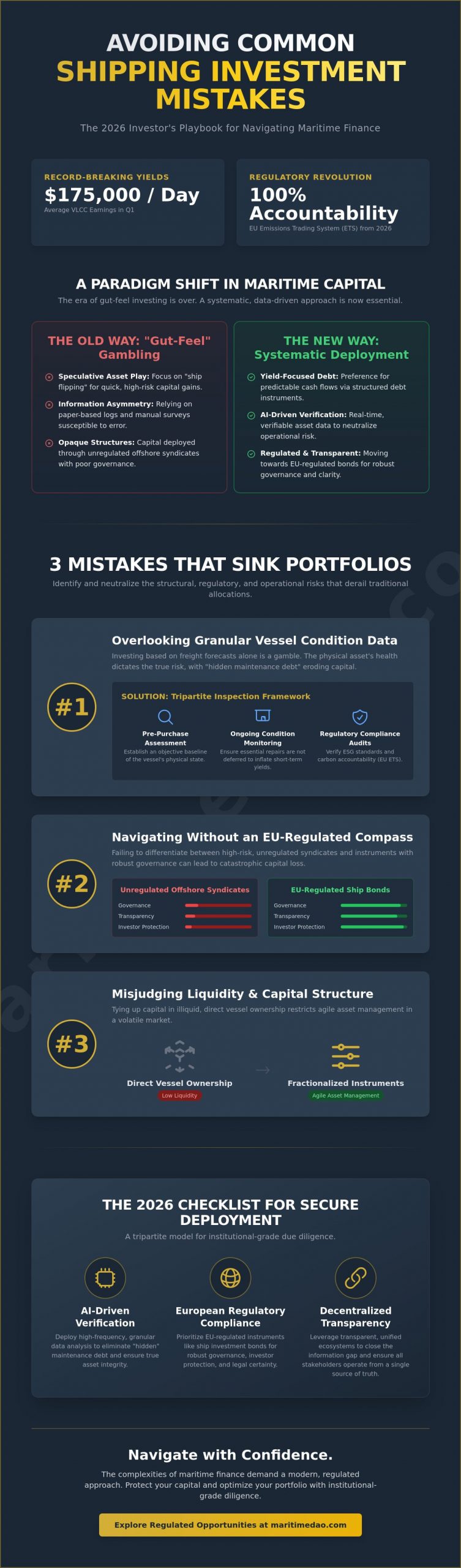
To secure a portfolio, institutional investors must demand a tripartite inspection framework. This system ensures that the asset remains viable throughout its lifecycle. Every allocation should be predicated on three distinct verification layers:
- Pre-purchase Assessments: Establishing an objective baseline of the vessel’s physical state before capital deployment.
- Ongoing Condition Monitoring: Utilizing high-frequency reporting to ensure the operator isn’t deferring essential repairs to inflate short-term yields.
- Regulatory Compliance Audits: Verifying that the vessel meets the stringent technical requirements of international maritime law.
The Role of AI in Vessel Assessment
Traditional maritime surveys are notoriously subjective, often reflecting the individual surveyor’s experience or regional biases. Modern asset management utilizes ShipCheckAI to transition from these anecdotal reports to a unified condition score. This technology aggregates hundreds of objective data points, eliminating human bias and providing a transparent metric for asset quality. By leveraging automated intelligence, investors can identify technical red flags months before they result in operational downtime. For those seeking to institutionalize their due diligence, the ShipCheckAI verification ecosystem provides the necessary technical floor for secure capital allocation.
Compliance as a Value Driver
The current regulatory environment has turned “cheap” older vessels into significant liabilities. Non-compliance with IMO 2026 standards or failing to maintain high CII (Carbon Intensity Indicator) ratings results in immediate financial penalties and restricted access to premium trade lanes. As highlighted in recent reports on 2026 maritime finance trends, the market now prices in environmental performance as a direct component of asset valuation. An asset that falls behind on EEXI requirements is effectively stranded capital. Automated assessments ensure that bondholders are protected by viable, compliant assets that can navigate the complexities of a decarbonizing global fleet.
Mistake #2: Navigating Without an EU-Regulated Compass
The maritime industry has long been associated with opaque offshore syndicates and complex tax-haven structures that offer high yields but provide little to no legal recourse for external investors. These “Wild West” investment vehicles often lack the rigorous reporting standards required by institutional capital, leaving participants vulnerable to mismanagement or asset stripping. A fundamental pillar of avoiding common shipping investment mistakes is ensuring that your capital is governed by a recognized, high-integrity financial framework. Without the oversight of a major regulator, an investor isn’t merely taking a market risk; they’re accepting a structural risk that can lead to a total loss of principal.
European financial governance provides a critical layer of protection that offshore jurisdictions cannot match. By operating within a unified regulatory ecosystem, investors benefit from mandatory transparency, audited financial disclosures, and strict asset-segregation rules. This structural integrity ensures that the relationship between the physical vessel and the digital or financial instrument is legally binding and enforceable across jurisdictions. In 2026, the distinction between a “black box” offshore fund and a transparent, regulated bond is the difference between speculative gambling and institutional-grade asset management.
The Security of Regulated Debt Instruments
EU-regulated ship investment bonds have emerged as the preferred vehicle for risk-averse capital seeking exposure to maritime yields. These instruments are governed by strict prospectuses that define how capital is deployed, how the underlying vessels are managed, and how bondholders are prioritized in the event of a default. This level of oversight ensures that every dollar is accounted for and that the operator remains accountable to its creditors. For a deeper structural analysis of these frameworks, investors should consult the EU Regulated Ship Investment Bonds guide, which details the specific protection layers that separate these bonds from unregulated alternatives.
Avoiding the “Unregulated Token” Trap
The rise of decentralized technology has introduced a new risk: the maritime DAO that operates without legal compliance. While blockchain offers immense potential for efficiency, “tokenized” assets that lack a legal nexus are a significant red flag. A truly regulated DAO uses blockchain as a technological pillar for transparency and automated governance, not as a tool to bypass financial laws. Smart contracts should be used to automate yield distribution and voting rights within a governed ecosystem that respects legacy legal systems. Choosing a partner that bridges the gap between decentralized innovation and sober, institutional regulation is essential for maintaining long-term portfolio security.
Mistake #3: Misjudging Liquidity and Capital Structure
Many investors enter the maritime sector with a traditional private equity mindset, only to find their capital trapped in an illiquid asset class for five to seven years. Physical ship ownership is notoriously capital-intensive, requiring a long-term horizon that doesn’t always align with the agility required in modern portfolio management. A central part of avoiding common shipping investment mistakes is recognizing that the shipping market is inherently illiquid at the physical asset level. Direct equity holders are the first to suffer when “lumpy” cash flows, often caused by unexpected port congestion or sudden route diversions, disrupt monthly projections and delay distributions.
In the 2026 market, the distinction between debt and equity is more than just a financial preference; it’s a fundamental survival strategy. While equity offers the allure of asset appreciation, debt-based instruments like EU-regulated bonds provide a structured yield that sits senior to the owner’s interest in the capital stack. This seniority ensures that bondholders receive scheduled payments before any equity distributions are made, offering a robust buffer against the freight rate volatility that can wipe out equity positions during a downcycle. By shifting the focus from ownership to secured lending, you decouple your returns from the operational risks of physical chartering.
Fractional Investment vs. Direct Ownership
Concentration risk is the silent killer of maritime portfolios. Owning 100 percent of a single vessel means your entire allocation is subject to a single point of failure. If that specific ship is detained or requires an emergency repair, your revenue stream vanishes instantly. Fractional investment models, governed through a unified digital ecosystem, allow you to spread capital across multiple vessel classes and global trade routes. This approach lowers the entry barrier from tens of millions to manageable institutional increments, ensuring that a single operational mishap doesn’t derail your entire maritime strategy.
Understanding Maritime Bond Yields
Maritime bond yields are generated by the commercial earning power of the fleet and are secured by a high-integrity legal nexus. In the capital stack, these bonds are prioritized, ensuring that investors are protected even when market sentiment shifts. By prioritizing debt over direct ownership, you gain exposure to the sector’s high-yield potential without the technical burdens of vessel management. For those looking to diversify their fixed-income portfolios with asset-backed security, you can explore the Institutional Case for Maritime Bond Yields to see how these instruments perform against traditional benchmarks. You can also review current ship investment bond opportunities to see how regulated debt can stabilize your maritime allocation.
The 2026 Checklist for Secure Maritime Capital Deployment
The transition from speculative asset play to institutional-grade maritime finance requires a departure from antiquated due diligence methods. In the 2026 environment, where regulatory scrutiny and environmental accountability are at their peak, successful capital allocation depends on a structured, tripartite verification model. This framework unites automated AI assessment, European regulatory compliance, and decentralized governance into a single, cohesive ecosystem. By strictly adhering to a standardized checklist, investors can move beyond the speculative pitfalls of the past, effectively avoiding common shipping investment mistakes that have historically plagued the sector.
A “Go/No-Go” framework is no longer a luxury; it is a fundamental requirement for protecting principal in a volatile global trade market. Before committing capital to any maritime instrument, you must verify that the opportunity meets the highest standards of structural integrity. This ensures that your investment isn’t just a digital entry, but a legally enforceable claim on a productive physical asset.
Step-by-Step Due Diligence Framework
- Regulatory Verification: Confirm the issuer operates under a robust financial framework. Is the instrument an EU-regulated ship investment bond, or is it an offshore syndicate with limited legal recourse?
- Objective Asset Assessment: Demand high-frequency, AI-powered vessel condition reports. Does the data come from an independent platform like ShipCheckAI, or are you relying on subjective, manual surveys provided by the operator?
- Capital Stack Priority: Analyze the security of your position. Is your capital secured by physical steel as a senior debt holder, or are you sitting in a vulnerable equity position subject to operational “lumpy” cash flows?
- Environmental Compliance: Verify the vessel’s CII rating and EU ETS status. Is the asset future-proofed against 2026 carbon surcharges, or is it a liability that will face restricted access to premium trade lanes?
Integrating Maritime DAO into Your Portfolio
Maritime DAO serves as the logical endpoint for investors who demand this level of technical and regulatory rigour. The platform acts as both a visionary architect and a reliable gatekeeper, bridging the gap between the physical world of global trade and the digital world of secure, transparent finance. Through the ecosystem, participants can access EU-regulated ship investment bonds that are unified with continuous technical oversight. ShipCheckAI maintains ongoing transparency for all bondholders, ensuring that the underlying assets remain compliant and operational throughout the investment lifecycle. You can Explore the Maritime DAO Ecosystem to begin your journey toward a governed, asset-backed maritime portfolio that prioritizes security, order, and institutional-grade yields.
Charting a Regulated Course in Maritime Finance
The evolution of the shipping market into a high-tech, regulated asset class provides a unique opportunity for those who prioritize transparency over speculation. By demanding granular vessel data and operating within a recognized legal framework, you neutralize the information asymmetry that once defined this sector. Success in 2026 isn’t about chasing spot rates; it’s about building a portfolio on structural integrity and objective verification.
Achieving long-term stability means avoiding common shipping investment mistakes like misjudging liquidity or ignoring technical compliance. The current landscape rewards the methodical investor who utilizes a “Go/No-Go” framework grounded in physical reality and institutional-grade oversight. You can secure your maritime portfolio with EU-regulated Ship Investment Bonds through an ecosystem that integrates AI-driven ShipCheckAI verification, an EU-regulated compliance framework, and decentralized governance for maximum transparency. It’s time to transition from unregulated volatility to a unified, governed future where your capital remains as resilient as the vessels it supports.
Frequently Asked Questions
What is the most common mistake made by new shipping investors?
The most prevalent error among new participants is failing to distinguish between unregulated maritime tokens and EU-regulated ship investment bonds. This oversight often leads to significant legal and financial exposure because unregulated instruments lack the structural integrity required for institutional-grade protection. By prioritizing regulated debt, you’re effectively avoiding common shipping investment mistakes that stem from a lack of jurisdictional oversight and mandatory disclosure requirements.
How does AI improve the safety of maritime investments?
Automated intelligence enhances investment security by providing objective, multi-layered vessel inspections through tools like ShipCheckAI. These systems remove human bias from the assessment process and reveal hidden maintenance liabilities or structural deficiencies before capital is committed. This transition from subjective surveyor opinions to granular, high-frequency data ensures that the underlying asset’s physical condition aligns with its reported valuation, protecting the long-term integrity of the portfolio.
Is shipping investment only for institutional players?
While maritime finance was historically the exclusive domain of institutional giants, the landscape in 2026 has been fundamentally reshaped by fractional ship investment platforms and regulated DAOs. These unified systems have democratized access, allowing accredited and retail investors to participate in high-yield maritime debt with lower entry barriers. This shift maintains the high-stakes register of institutional finance while opening the gateway to a global audience seeking secure, asset-backed returns.
What are the risks of investing in unregulated maritime DAOs?
Investing in unregulated maritime DAOs carries the risk of operating without a legal nexus to the physical asset. If a project fails or a vessel is seized, investors typically have no recourse in maritime courts because the digital instrument lacks a binding legal framework. These offshore structures often bypass essential governance protocols, leaving participants vulnerable to asset stripping or mismanagement without the protection of established financial regulations or transparent custodial standards.
How do EU-regulated ship investment bonds protect capital?
EU-regulated ship investment bonds protect capital by operating within a strict legal framework that mandates asset-backing and regular transparency reports. These instruments are governed by institutional-grade protocols that ensure bondholders sit senior in the capital stack, providing a buffer against market volatility. By integrating regulated innovation with sober reliability, these bonds offer a unified ecosystem where capital is secured by physical steel and governed by an enforceable prospectus.
Can I invest in shipping with a small amount of capital?
You can participate in the maritime industry with significantly lower capital requirements through fractional ship investment models. This approach allows for the democratization of complex financial structures, enabling individuals to own portions of a vessel’s debt rather than purchasing a ship outright. By leveraging these platforms, you can diversify across multiple vessel classes and trade routes, which is a key strategy for avoiding common shipping investment mistakes related to concentration risk.