
By 2026, AI-powered systems have proven they can detect 95% of potential engine failures before they occur, yet many institutional investors still struggle with the opaque reality of manual vessel condition reports. You’ve likely found that while the maritime sector offers robust asset-backed security, the difficulty in verifying ESG claims and navigating mandates like the FuelEU Maritime Regulation creates significant regulatory uncertainty for EU regulated ship investment bonds. It’s clear that traditional due diligence is no longer sufficient for a market that demands absolute transparency and structural integrity.
This guide empowers you to master the complexities of maritime debt and discover how AI-driven transparency is systematically de-risking these portfolios. We’ll explore the “Triple-Layer Security” model that integrates EU regulatory compliance, blockchain-based governance, and AI-verified physical asset condition. By examining the technical pillars of the EU Green Bond Standard and the role of ShipCheckAI in automated due diligence, you’ll understand how to identify compliant opportunities and achieve predictable yields from the next generation of asset-backed maritime securities.
Key Takeaways
- Understand the transition from opaque private placements to institutional-grade EU regulated ship investment bonds that leverage transparent, regulated frameworks.
- Identify compliant maritime securities by decoding the EU Green Bond Standard (EuGB) and its mandatory disclosure requirements regarding fuel efficiency and carbon intensity.
- Learn how to mitigate operational risk by replacing prone-to-error manual surveys with AI-driven “Physical Transparency” tools that provide verified asset condition data.
- Master a comprehensive checklist for evaluating bond issuers, focusing on their operational history and the legal integrity of their regulatory jurisdictions.
- Discover how the Maritime DAO ecosystem enhances investor governance through a unified structure that bridges the gap between digital blockchain assets and physical global trade.
The Evolution of Maritime Debt: Why EU Regulation Matters in 2026
The landscape of maritime finance has undergone a fundamental shift, moving away from fragmented, private arrangements toward a unified system of institutional-grade debt. EU regulated ship investment bonds now represent a sophisticated fusion of traditional corporate bond fundamentals and modern regulatory oversight. These instruments aren’t just speculative plays; they’re governed, asset-backed securities that provide the structural integrity required by global capital markets. By 2026, the European Securities and Markets Authority (ESMA) has solidified its role in overseeing this debt, ensuring every issuance adheres to rigorous transparency standards that were previously absent in the maritime sector. This evolution has transformed a traditionally opaque industry into a transparent ecosystem where risk is quantified through data rather than intuition.
From Private Placements to Public Transparency
For decades, ship financing remained locked behind opaque private placements, often accessible only to a small circle of specialized lenders. EU regulations have changed this by standardizing the “Ship Bond” as a recognized asset class, creating a predictable framework for both issuers and investors. The introduction of the EU Green Bond Standard (EuGB) has particularly influenced maritime interest rates, as compliant vessels often benefit from a “greenium” that lowers borrowing costs. This shift marks 2026 as the definitive turning point for institutional entry. Large-scale funds now view maritime debt as a reliable component of a diversified portfolio. It’s a move from the shadows of private debt into the clarity of regulated public markets.
Key Regulatory Pillars: EUGB and the Taxonomy
The transition to a sustainable blue economy is governed by two primary pillars: the EU Green Bond Standard and the EU Taxonomy. Under these frameworks, “Green Shipping” isn’t a vague marketing claim but a technical status defined by specific greenhouse gas intensity thresholds. To carry the EuGB label, ship owners must adhere to the 85% proceeds rule, which mandates that the vast majority of capital raised is allocated directly to economic activities aligned with the EU Taxonomy. This ensures that funds drive genuine decarbonization rather than superficial upgrades. Central to this is the “Do No Significant Harm” (DNSH) principle, which requires that a vessel’s environmental performance in one environmental objective doesn’t negatively impact other ecological goals like marine biodiversity or pollution prevention. This tripartite approach of regulation, transparency, and accountability ensures that EU regulated ship investment bonds provide a secure gateway for capital to flow into the future of global trade.
Decoding the EU Green Bond Standard (EuGB) for Shipping
The European Green Bond Standard (EuGB) provides a voluntary but rigorous framework that separates institutional-grade assets from high-risk, unverified maritime debt. Since its application in late 2024, it’s become the primary benchmark for EU regulated ship investment bonds. To carry this label, an issuer doesn’t just promise environmental stewardship; they must prove it through a tripartite system of taxonomy alignment, external verification, and ongoing reporting. This structure eliminates the ambiguity of “greenwashing” by mandating that at least 85% of bond proceeds are directed toward activities that strictly align with the EU Taxonomy’s climate objectives. It’s a high-stakes register that ensures capital is anchored in physical reality.
Mandatory disclosures are the backbone of this ecosystem. Ship owners are now required to provide granular data on fuel efficiency and carbon intensity, specifically reflecting the progressive GHG reductions mandated by the FuelEU Maritime Regulation. These aren’t static reports. They represent a dynamic ledger of a vessel’s operational reality. Unlike non-EU “grey” debt instruments, which often rely on self-reported and unverified metrics, EU regulated ship investment bonds provide a governed path for capital that values precision over projection. This transparency is further reinforced by External Reviewers who must be registered with the European Securities and Markets Authority (ESMA), providing an additional layer of institutional reliability.
Technical Screening Criteria for Vessels
Bond eligibility for a vessel begins with its Energy Efficiency Design Index (EEDI) and Energy Efficiency Existing Ship Index (EEXI). These metrics serve as the baseline for identifying which assets can be included in a green portfolio. Retrofitting existing fleets is a critical component of this process. Regulated bonds provide the necessary capital for shipowners to install route optimization software or alternative propulsion systems, which have been shown to reduce fuel consumption by an average of 15%. Maintaining bond status depends entirely on verified carbon data; if a vessel fails to meet its intensity targets, the bond’s “green” designation, and its associated “greenium,” may be at risk.
The Registration and Oversight Framework
ESMA acts as the central gatekeeper in this architecture. The authority oversees the registration and supervision of external reviewers, ensuring that the third-party entities validating these bonds operate with independence and technical competence. This oversight extends to post-issuance reporting, where issuers must publish annual impact assessments. Investors can verify a bond’s official status through centralized EU databases, providing a level of security that traditional ship finance never offered. For those seeking to navigate these complex requirements, exploring the governance models at Maritime DAO can provide a practical look at how regulated innovation is implemented in the real world.
AI-Driven Due Diligence: Solving the Maritime “Black Box”
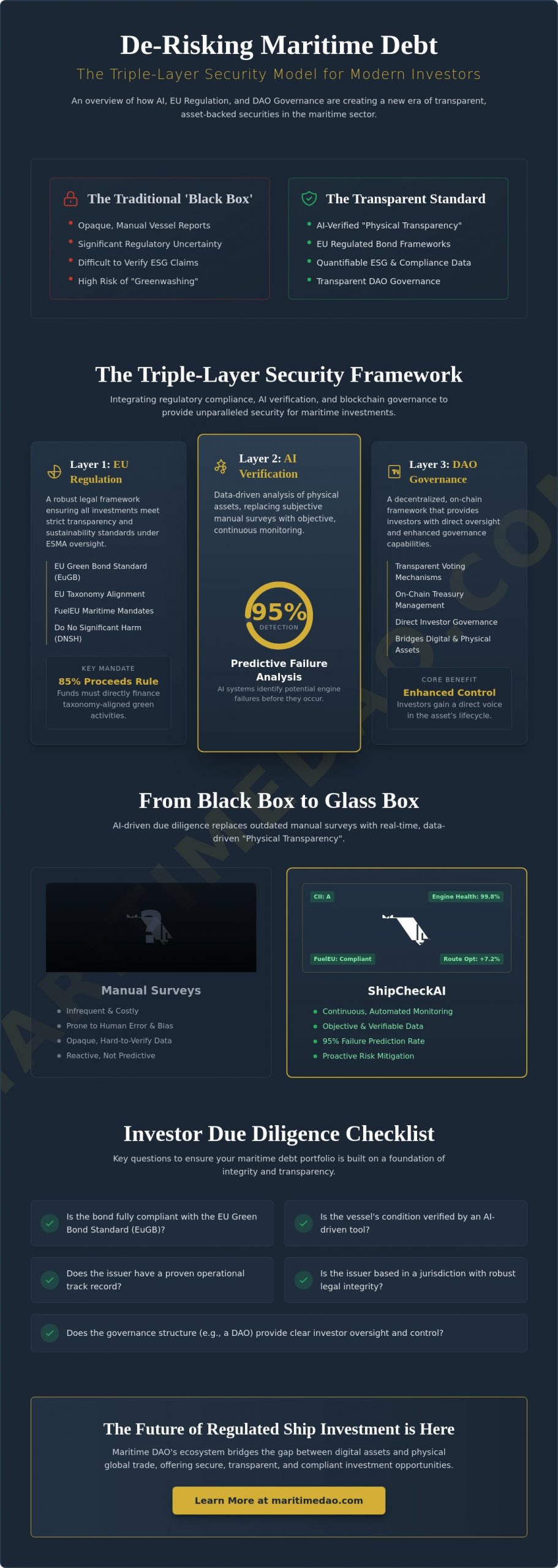
Financial regulation provides the legal skeleton for an investment, but it doesn’t guarantee the physical integrity of the underlying asset. For investors in EU regulated ship investment bonds, the primary risk often lies in the “black box” of vessel operations. Traditional maritime due diligence has historically relied on manual ship surveys, which are frequently prone to human error, subjective bias, and significant time delays. These snapshots in time don’t capture the dynamic reality of a vessel’s health. The OECD ocean economy report highlights that as the maritime sector scales toward 2050, the complexity of managing these high-value assets requires a shift toward automated, data-driven oversight. Physical Transparency is the necessary companion to financial disclosure; it ensures that the ship backing the bond actually exists in the condition reported on the balance sheet.
Integrating ShipCheckAI into the pre-issuance phase of a bond transforms the due diligence process from a static hurdle into a continuous governance tool. By utilizing automated intelligence, issuers can provide bondholders with real-time monitoring of vessel condition. This technological layer removes the opacity that has traditionally plagued maritime debt, offering a level of security that aligns with the high-stakes requirements of institutional finance. It’s no longer enough to trust a paper report; 2026 demands a unified ecosystem where physical data and financial governance are inseparable. For a structured approach to implementing these methods, the AI in maritime due diligence 2026 asset assessment checklist provides a standardized framework for transforming slow, manual research into a defensible verification process.
ShipCheckAI: A New Standard for Vessel Assessment
ShipCheckAI automates the analysis of hull integrity and engine performance, utilizing algorithms that have been shown to detect 95% of potential engine failures before they occur. This system reduces the cost and time of comprehensive inspections by streamlining data collection across multiple inspection types. By cutting unplanned downtime for vessels by up to 50%, the tool directly protects the cash flows that service EU regulated ship investment bonds, allowing for more accurate calculations of bond risk profiles based on actual performance data rather than theoretical models.
Linking AI Data to Financial Smart Contracts
The convergence of AI and decentralized technology allows for the creation of smart contracts that respond to physical reality. When a vessel’s maintenance score or operational efficiency drops below a governed threshold, the system can trigger automated compliance alerts or adjust risk premiums. This creates a direct relationship between the ship’s operational health and the bond’s financial performance. AI-driven data prevents greenwashing by creating an immutable record of real-world fuel consumption and emission levels that cannot be manipulated by manual reporting.
Evaluating Ship Bond Issuers: A Checklist for Investors
Selecting the right issuer for EU regulated ship investment bonds requires a dual focus on institutional reliability and technical expertise. Investors must look beyond the yield to assess the structural integrity of the issuing entity. A credible issuer acts as both a visionary architect and a reliable gatekeeper, bridging the gap between the physical world of global trade and the digital world of regulated finance. This evaluation begins with verifying the legal jurisdiction. Jurisdictions like Luxembourg or Ireland are standard for these instruments because they provide the robust legal frameworks necessary for ship financing bonds and asset-backed securities. An issuer’s track record must demonstrate a sophisticated balance between maritime operations and the sober reliability of institutional finance. If an issuer cannot prove they understand both the engine room and the balance sheet, the investment’s foundation is compromised.
Financial and Operational Due Diligence
The financial health of an issuer is often revealed through their debt-to-equity ratios within the context of modern ship leasing. High leverage is common in maritime finance, but it must be tempered by stable revenue streams. Charter-party agreements are the primary engine of this stability; they secure the cash flow necessary for consistent bond repayments. Investors should prioritize issuers who maintain a diversified vessel portfolio within a single bond issuance. This tripartite approach of balanced leverage, secured charters, and fleet diversification reduces the impact of a single vessel’s downtime on the overall portfolio’s performance. It’s a methodical way to ensure the security of capital in a high-stakes environment.
Regulatory and Technical Verification
Technical verification is where the “regulated” aspect of these bonds is truly tested. Investors must confirm that the issuer utilizes External Reviewers registered with ESMA to validate their green claims. This isn’t a mere formality; it’s a mandatory pillar of the EU Green Bond Standard. Furthermore, the presence of AI-verified condition reports, such as those provided by ShipCheckAI assessments, offers a layer of physical transparency that traditional surveys lack. Applying a rigorous AI in maritime due diligence framework ensures that undisclosed operational histories and vessel sanction risks are identified before capital is committed. Finally, analyze the bond’s “Transition Plan” for fleet decarbonization. A forward-looking issuer doesn’t just meet today’s FuelEU Maritime standards; they provide a clear roadmap for how the fleet will evolve to meet the 2050 net-zero targets. To see how these standards are applied in a transparent, governed ecosystem, you can access compliant maritime debt opportunities at Maritime DAO.
- Jurisdiction: Verify alignment with EU-recognized financial hubs like Luxembourg or Ireland.
- Asset Condition: Insist on AI-driven, multi-inspection reports to bypass human error in surveys.
- Taxonomy Alignment: Ensure at least 85% of proceeds are dedicated to Taxonomy-compliant maritime activities.
- Governance: Look for unified structures that integrate blockchain-based voting or oversight for bondholders.
Maritime DAO: The Future of Regulated Ship Investment
Maritime DAO serves as the premier ecosystem for EU regulated ship investment bonds, acting as a visionary architect for the next generation of maritime finance. By merging the physical world of global trade with the digital world of blockchain, it creates a “regulated innovation” model that respects legacy systems while fixing systemic inefficiencies. The Decentralized Autonomous Organization (DAO) structure isn’t a speculative experiment; it’s a serious governance framework that empowers investors with direct voting rights on key operational and financial milestones. This unified approach ensures that capital is governed by a transparent, methodical system that prioritizes order and security, providing an institutional-grade register for asset-backed debt. For a deeper understanding of how this model is reshaping access to the $14 trillion shipping industry, the comprehensive guide to maritime DAO investment in 2026 provides essential context on tokenized real-world assets and MiCA-compliant frameworks.
A Unified Ecosystem for Maritime Finance
The platform’s structural integrity relies on its tripartite integration of AI inspections, financial smart contracts, and strict regulatory compliance. ShipCheckAI provides the necessary “Physical Transparency” layer, while the bond issuance platform ensures that every instrument meets the rigorous standards of the EU Green Bond Standard. This synergy builds institutional trust by replacing manual, biased reports with an immutable ledger of asset health. A significant milestone occurred on March 9, 2026, when the issuer Digi Creative SIA received approval in Latvia to offer tokenized bonds under EU regulations. This successful issuance of the LOTOSS Bonds demonstrates that the bridge between decentralized technology and heavy industry is now fully operational, legally sound, and governed by the highest standards of financial oversight. To understand the broader structural shifts driving this transformation, the evolution of maritime capital markets in 2026 provides critical context on how antiquated debt structures are being replaced by transparent, AI-driven instruments.
Getting Started with Maritime DAO
Tokenized debt offers a first-of-its-kind opportunity for liquidity and fractional ownership in a traditionally exclusive market. For accredited investors and institutional partners, the onboarding process is a methodical gateway into a diversified portfolio of EU regulated ship investment bonds. Once onboarded, partners can utilize the ShipCheckAI dashboard to monitor their holdings in real-time, accessing granular data on fuel efficiency and engine performance. This level of connectivity ensures that the relationship between physical assets and digital governance is transparent at every step. We invite you to join this elite ecosystem and explore our current EU-regulated ship bond offerings to secure your position in the future of maritime debt.
Securing Your Position in the 2026 Maritime Debt Market
The transition toward a fully transparent and regulated maritime market is no longer a future projection; it’s a present reality. By integrating the technical precision of EU-regulated bond frameworks with the physical oversight of ShipCheckAI, investors can finally navigate this asset class with institutional confidence. These structures ensure that EU regulated ship investment bonds are more than just debt instruments. They’re governed, asset-backed securities rooted in verified operational data and structural integrity. This synergy of regulation and intelligence eliminates the historical opacity of vessel condition, replacing it with a tripartite model of legal clarity, physical transparency, and financial security.
Achieving predictable yields in global trade requires a partner that acts as both a visionary architect and a reliable gatekeeper. Maritime DAO provides this unified ecosystem, bridging the gap between traditional finance and decentralized technology through a robust global maritime capital markets investment ecosystem. It’s time to move beyond the unverified private placements of the past and embrace a model where every vessel is monitored and every bond is compliant. Join the future of maritime finance with Maritime DAO. We look forward to building this new frontier of regulated innovation with you.
Frequently Asked Questions
What makes a ship investment bond “EU regulated” in 2026?
A bond is considered EU regulated when it’s issued under a prospectus approved by a national competent authority within the European Union and falls under the oversight of the European Securities and Markets Authority (ESMA). For example, the LOTOSS Bonds were approved by Latvian authorities in March 2026. These EU regulated ship investment bonds must adhere to strict transparency, disclosure, and governance standards, ensuring they provide the structural integrity required for institutional-grade debt instruments.
How does the EU Green Bond Standard (EuGB) apply to the shipping industry?
The EuGB label applies to maritime debt when at least 85% of the capital raised is allocated to activities that align with the EU Taxonomy’s environmental objectives. This includes investments in zero-emission vessels or retrofitting existing fleets to meet FuelEU Maritime GHG reduction targets. Issuers must also appoint ESMA-registered external reviewers to verify their sustainability claims, providing a governed framework that prevents greenwashing and ensures capital drives genuine decarbonization in the blue economy.
Can retail investors access EU regulated ship investment bonds?
Traditionally, maritime debt was restricted to institutional players, but the democratization of finance through tokenized structures is opening access to a broader audience. While many issuances still target accredited investors or institutional partners due to minimum ticket sizes, platforms like Maritime DAO are lowering barriers to entry. This inclusive approach allows for fractional ownership, though investors must still pass standard KYC and AML protocols as required by EU financial regulations.
What is the role of ShipCheckAI in the bond issuance process?
ShipCheckAI acts as a technical gatekeeper during the pre-issuance phase by providing automated, data-driven vessel condition reports. It replaces prone-to-error manual surveys with AI analysis that can detect 95% of potential engine failures before they occur. By integrating these multi-type inspections into the bond’s risk profile, the tool ensures that the physical asset backing the security meets the high-stakes requirements of institutional finance and maintains operational transparency throughout the bond’s lifecycle.
How do ship bonds compare to traditional maritime equity investments?
Ship bonds represent debt instruments that offer predictable, asset-backed yields and higher priority in the capital stack compared to equity. While equity investments provide potential for significant capital appreciation, they also carry higher risk and volatility. EU regulated ship investment bonds provide a more stable alternative for those seeking regular income. These bonds are secured by physical maritime assets, making them a sober and reliable choice for investors prioritizing capital preservation and structural integrity.
What happens if a vessel in a bond portfolio fails an AI inspection?
If a vessel fails a ShipCheckAI inspection or its performance score drops below a governed threshold, the system triggers automated compliance alerts for the bondholders. Depending on the bond’s governing smart contracts, this may mandate immediate maintenance or adjust the risk premium of the instrument. This real-time feedback loop ensures that physical asset degradation is identified and addressed before it can negatively impact the cash flows required for bond repayments.
Are tokenized ship bonds legal under EU financial regulations?
Tokenized maritime debt is legal and increasingly standardized under the EU’s Markets in Crypto-Assets (MiCA) regulation and the DLT Pilot Regime. These frameworks classify digital representations of debt as regulated financial instruments, provided they’re issued by authorized entities. For instance, the $MARGOT utility token operates under MiCA standards. This legal clarity ensures that tokenized bonds aren’t speculative assets but are governed securities that bridge the gap between blockchain technology and traditional global trade.
What are the typical yields for regulated maritime debt instruments?
Yields for regulated maritime debt are influenced by the vessel’s risk profile, the issuer’s creditworthiness, and the prevailing market conditions in the shipping sector. While green bonds may offer a “greenium” resulting in slightly lower borrowing costs for issuers, investors typically receive competitive returns that reflect the asset-backed nature of the security. Because these transactions are often private or niche, specific yield data is typically provided directly by the issuer within the regulated prospectus or offering memorandum.