
The traditional maritime debt market has long operated as a walled fortress, accessible only to institutional titans and often obscured by the opaque risks of unregulated bond structures. You aren’t alone in your skepticism of an industry where vessel valuations often feel arbitrary and the barriers to entry remain prohibitively high. This guide demonstrates how modern ship financing bonds are moving beyond these legacy constraints to become a cornerstone of the regulated, asset-backed security market.
We’ll explore a new era where technology and legal frameworks converge to provide the transparency you’ve been seeking. You’ll learn how the implementation of Basel IV and the expansion of the EU Emissions Trading System are reshaping capital requirements; this shift is creating a unique opening for sophisticated private debt. We’ll detail how a tripartite ecosystem of automated intelligence, EU-regulated frameworks, and verified transparency is mitigating investment risk. From the mechanics of asset-backed structures to the use of AI for real-time vessel verification, this article provides the roadmap to understanding how maritime finance is becoming a unified, governed, and inclusive frontier for global capital.
Key Takeaways
- Understand how modern ship financing bonds utilize Special Purpose Vehicles to isolate vessel risk and provide a structured alternative to traditional maritime mortgage lending.
- Identify the critical role of EU-regulated frameworks in transforming maritime debt from speculative instruments into secure, institutional-grade asset-backed securities.
- Learn how AI-driven inspection protocols mitigate investor risk by providing objective, high-frequency assessments of physical vessel conditions and operational integrity.
- Discover how decentralized governance models unify physical global trade with digital transparency to democratize access to traditionally exclusive maritime capital markets.
- Recognize the strategic advantages of a tripartite ecosystem that integrates regulatory compliance, automated intelligence, and structural asset isolation.
Understanding Ship Financing Bonds and Asset-Backed Securities
Ship financing bonds represent a sophisticated evolution in maritime capital allocation. These instruments are debt securities issued by shipowners or specialized entities, backed by the intrinsic value and earning potential of physical vessels. Unlike traditional bilateral loans, these bonds allow investors to participate directly in the global trade infrastructure. Historically, the industry relied on the Ship mortgage as the primary security mechanism. However, the modern market has transitioned toward structured asset-backed securities (ABS) that isolate risk and enhance liquidity.
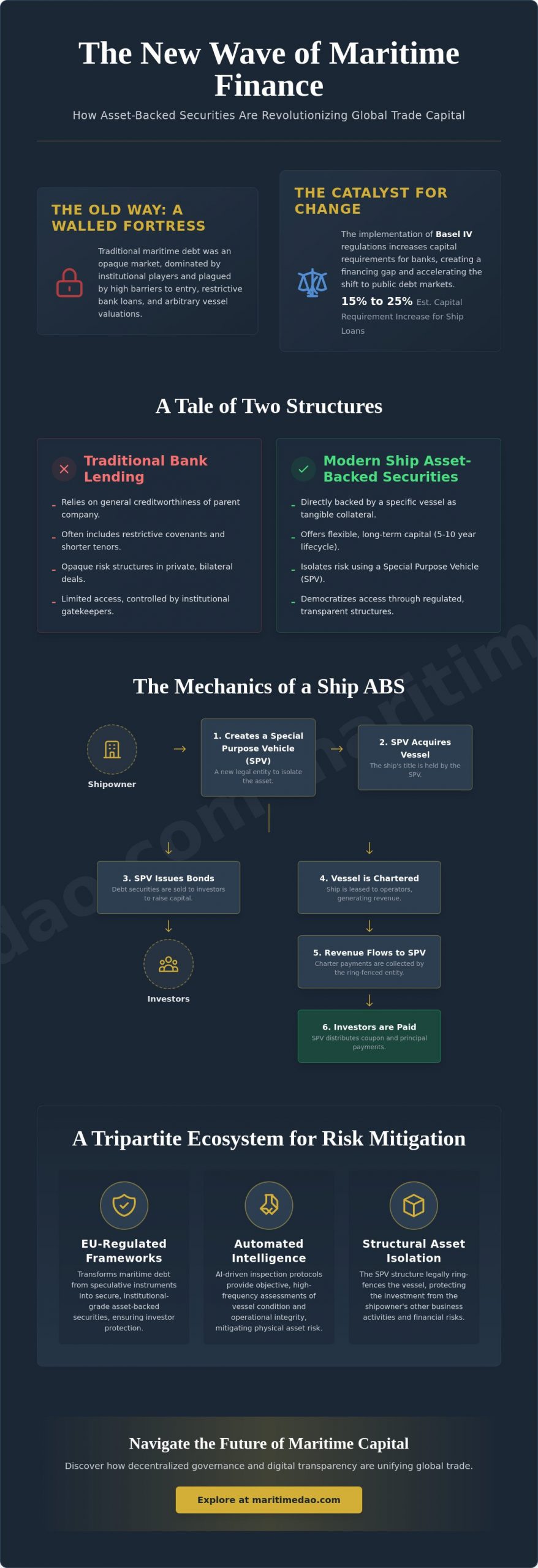
In 2026, the shift toward ship financing bonds has accelerated due to systemic changes in the banking sector. The full implementation of Basel IV regulations has increased capital requirements for European banks by an estimated 15% to 25% for ship loans. This regulatory pressure has forced traditional lenders to become more selective, creating a significant financing gap that public and private debt markets are now filling. While corporate shipping bonds rely on the general creditworthiness of a parent company, vessel-specific ABS provide a more granular level of security by tying the bond’s performance to the operational success of a defined asset. For a broader perspective on how these dynamics are reshaping the industry, the evolution of maritime capital markets in 2026 provides essential context on the structural forces driving this transition.
The Shift from Private Lending to Public Debt
Banks are no longer the sole gatekeepers of maritime capital. Conventional bank financing often carries restrictive covenants and shorter tenors that don’t always align with the long-term lifecycle of a vessel. Bonds provide shipowners with flexible, long-term capital while offering institutional investors a predictable yield. These investors, ranging from pension funds to private debt managers, are increasingly drawn to the maritime sector’s essential role in global commerce; this is especially true as new digital frameworks provide the transparency that was previously lacking in private deals.
Key Characteristics of Ship Asset-Backed Securities
The structural integrity of a maritime ABS rests on three pillars: the physical asset, the legal isolation of that asset, and the predictable cash flow it generates. This tripartite structure ensures that the investment is governed by the actual performance of the ship rather than the parent company’s balance sheet.
- Asset-Backed Nature: The vessel serves as the primary collateral, ensuring that the bond’s value is anchored to a tangible, productive resource.
- Cash Flow Mechanics: Revenue for interest and principal payments is typically derived from charter hire, where the vessel is leased to reputable operators for specific durations.
- Risk Isolation: By using specialized legal structures, the vessel’s performance is protected from the broader financial risks of the shipowner’s other business activities.
Ship asset-backed securities function as a unified vehicle for capital allocation and vessel security, bridging the gap between institutional liquidity and industrial necessity.
The Mechanics: How Ship Asset-Backed Securities (ABS) Function
The structural architecture of ship financing bonds relies on a precise synchronization of maritime operations and financial engineering. At the core of this mechanism is the Special Purpose Vehicle (SPV), a legal entity designed to hold the vessel’s title and isolate it from the broader liabilities of the shipowner. By ring-fencing the asset, the SPV ensures that the bond’s performance is tied exclusively to the cash flows and valuation of a specific ship. This method is a cornerstone for anyone understanding asset-backed securities, as it converts a physical industrial tool into a governed investment instrument.
The lifecycle of a maritime bond typically spans five to ten years, moving from initial asset appraisal to final maturity or refinancing. During this period, credit enhancement techniques, such as over-collateralization or debt service reserve accounts, are employed to bolster the bond’s rating and provide an additional layer of investor protection. Coupon rates aren’t static; they reflect a calculated risk profile based on the vessel’s age, its technical condition, and the credit quality of the charterer. High-quality time-charter agreements with reputable global commodities firms often result in more favorable pricing for the issuer and lower volatility for the bondholder.
The Issuance Process for Maritime Bonds
The path from a physical vessel to a liquid security involves three distinct phases of validation and structuring. First, asset selection requires a rigorous technical appraisal. Modern issuers utilize tools like ShipCheckAI to conduct high-frequency inspections, ensuring the vessel meets strict operational standards before it’s even considered for a bond pool. Second, the legal structuring phase defines the SPV’s parameters and establishes debt seniority; this determines where investors sit in the priority of claims. Finally, the issuance must clear regulatory filing and compliance checks, adhering to EU financial standards to ensure the bond is fit for institutional portfolios. Platforms like Maritime DAO are increasingly acting as the unified gateway for these regulated issuance processes.
Cash Flow and Debt Service
Investors receive returns through a structured payment waterfall that prioritizes the vessel’s survival and the bondholder’s yield. Operational expenses (OPEX), including crew wages, insurance, and maintenance, are typically prioritized at the top of the waterfall. This isn’t just an operational necessity; it’s a risk mitigation strategy to maintain the vessel’s “in-class” status and market value. After OPEX and mandatory reserves are funded, the remaining charter hire income is channeled toward debt service. The stability of this cash flow is heavily influenced by the time-charter agreement, which provides a fixed-rate income stream that protects bondholders from the volatile fluctuations of the spot market.
Risk Mitigation: Regulatory Frameworks and Investor Protections
The historical reputation of maritime debt was often marred by the “junk bond” stigma of the late 20th century, where high-yield offerings frequently lacked the transparency necessary to safeguard capital. Today, the landscape has shifted toward a model of regulated innovation. Modern ship financing bonds are no longer speculative instruments; they are governed by rigorous legal frameworks and supported by real-time auditability. By leveraging blockchain technology, issuers can now provide a transparent record of bond collateral, allowing investors to verify asset status without relying on delayed, static reports. This digital ledger, combined with objective data from tools like ShipCheckAI, offers a superior risk profile compared to traditional credit ratings that often fail to capture the immediate operational reality of a vessel.
Traditional ratings agencies often struggle with the technical nuances of a ship’s condition, relying on annual inspections that quickly become obsolete. In contrast, modern asset-backed structures utilize high-frequency, AI-driven assessments to provide a continuous stream of performance data. This shift from static to dynamic due diligence ensures that the bond’s valuation is always anchored to the actual state of the physical asset. It’s a move that replaces the old “handshake” culture of shipping with a methodical, data-driven approach that prioritizes structural integrity and institutional reliability.
EU Financial Regulation in Maritime Markets
The implementation of MiFID II and the Prospectus Regulation has fundamentally altered the protective environment for bondholders. These mandates require exhaustive disclosure and standardized reporting, ensuring that both retail and institutional investors have access to the same high-stakes data. In 2026, transparency requirements for maritime debt issuers have become a prerequisite for market entry, moving the industry into a unified, governed space. These EU-regulated bonds offer a safer gateway for capital by imposing strict governance on how assets are managed and how financial results are communicated to the global audience.
Structural Protections for Bondholders
Beyond regulatory oversight, the structural integrity of a maritime bond is reinforced by specific legal covenants that protect the bondholder’s position. Negative pledge clauses prevent issuers from encumbering the asset further, while loan-to-value (LTV) covenants provide a safety buffer against market volatility. A bond trustee acts as the reliable gatekeeper, overseeing the asset’s management and ensuring that bondholder interests are prioritized in every operational decision. EU-regulated ship investment bonds reduce the historical default risk associated with high-yield shipping debt. This unified approach, which integrates legal compliance, automated intelligence, and structural isolation, provides a resilient ecosystem for significant capital investment.
The Role of Technology in Modern Vessel Due Diligence
Traditional vessel due diligence has historically relied on manual, bureaucratic oversight that occurs at infrequent intervals. These static snapshots fail to provide the continuous security required for high-stakes ship financing bonds. In an industry where a single technical failure or regulatory non-compliance event can significantly devalue an asset, bondholders need more than a yearly report. AI-powered vessel assessments have emerged as a necessary prerequisite for bond issuance, transforming the way maritime debt is governed. By linking physical technical health directly to financial yield, technology ensures that the bond’s underlying collateral remains viable throughout its entire lifecycle.
Continuous monitoring prevents the “hidden” asset depreciation that often leads to unexpected defaults. When investors can see the real-time operational status of a vessel, the risk premium associated with uncertainty begins to evaporate. This technological bridge creates a more stable investment environment, where the relationship between the physical world of global trade and the digital world of institutional finance is clearly defined. It’s a shift from trusting a shipowner’s word to verifying a ship’s condition through objective, automated intelligence.
ShipCheckAI: Enhancing Bondholder Confidence
The introduction of ShipCheckAI addresses the critical issue of information asymmetry between shipowners and investors. By conducting high-frequency vessel inspections, this tool standardizes condition reports for global capital markets, providing a level of transparency that was previously impossible. This methodical approach allows for the early detection of maintenance issues, ensuring that the vessel’s market value consistently supports the bond’s principal. It creates a unified standard of truth where technical integrity, operational efficiency, and financial security are intrinsically linked. Learn more about ShipCheckAI vessel assessment for bond issuance to see how this technology is implemented within a regulated framework.
Automated Compliance and Reporting
Digital governance frameworks now integrate live inspection data to provide real-time alerts for technical failures that impact asset value. This automated compliance system acts as a reliable gatekeeper, notifying bond trustees and investors of any deviations from the agreed-upon operational standards. When a vessel’s performance dips or it fails to meet new environmental regulations like the EU ETS, the system triggers immediate corrective actions. This proactive risk management prevents the sudden defaults that plagued legacy shipping debt. By maintaining a transparent, real-time connection between the ship and the security, issuers can protect the structural integrity of the entire investment ecosystem. To explore how these technological pillars integrate with institutional-grade debt, you can access our regulated investment gateway.
Navigating the Future of Maritime Capital Markets with Maritime DAO
2026 marks a systemic transition in how the world finances its merchant fleets. The convergence of traditional banking restrictions and the maturation of decentralized governance has created a first-of-its-kind paradigm for global trade. Maritime DAO acts as the visionary architect of this shift, unifying the physical world of global logistics with the digital efficiency of institutional-grade finance. By providing a compliant gateway to ship financing bonds, the organization dismantles the legacy barriers that once made this asset class the exclusive domain of a few institutional titans. It’s a move toward a more inclusive, yet deeply serious, financial ecosystem where structural integrity is the primary mandate.
The core advantage of a DAO structure lies in its ability to provide absolute governance and transparency. It replaces the opaque, “handshake” culture of traditional shipping with automated protocols that ensure every stakeholder has real-time visibility into asset performance. This model doesn’t just democratize access; it enforces a level of accountability that legacy systems simply cannot match. By acting as a reliable gatekeeper between the high seas and high finance, the DAO ensures that capital is allocated only to vessels that meet the most rigorous technical and regulatory standards. This is the essence of regulated innovation, where the excitement of a new frontier is tempered by a methodical commitment to legal frameworks. Understanding the full scope of this transformation requires examining how shipping finance has evolved across global maritime capital markets to reach this pivotal moment.
The Maritime DAO Ecosystem
Governing maritime investments requires a methodical synergy between legal frameworks, technical verification, and automated protocols. This ecosystem replaces the fragmented, manual processes of the past with a transparent standard where every bond is backed by a verified physical asset. It’s a tripartite approach designed to ensure structural integrity across the entire investment lifecycle. Explore our guide to EU Regulated Ship Investment Bonds to see how these instruments are governed within our technological framework. This integration of AI-driven inspection data and EU-regulated debt structures creates a resilient foundation for significant capital investment.
Next Steps for Investors
Investors looking to navigate this new frontier must focus on the data. Evaluating opportunities within the DAO framework allows for a granular analysis of vessel performance and charter quality that was previously unavailable to the public. As the global merchant marine continues to modernize, the integration of physical assets and digital governance will become the industry standard. This unified, transparent, and regulated capital market offers a resilient path for those seeking to empower global trade through sophisticated maritime debt. The transition is already underway, and the tools to participate in this modernized merchant marine are now accessible to a global audience ready for institutional-grade opportunities.
Charting the Course for Regulated Maritime Capital
The modernization of the global merchant marine is no longer a distant vision; it’s a structural reality defined by transparency and legal precision. By moving away from opaque private lending toward ship financing bonds, the industry has established a unified ecosystem where physical assets and digital governance converge. You’ve seen how the isolation of vessel risk through specialized structures and the implementation of high-frequency technical due diligence provide a reliable foundation for capital preservation. This transformation ensures that maritime debt is governed by objective data rather than speculative assumptions.
Success in this new frontier requires a tripartite commitment to structural integrity, automated intelligence, and regulatory adherence. Our institutional-grade asset-backed structures are built on full compliance with EU financial regulations; this provides the sober reliability that sophisticated investors demand. By utilizing ShipCheckAI proprietary technology, we’ve replaced information asymmetry with real-time auditability. It’s time to step into a democratized capital market that respects legacy industrial value while embracing the efficiency of the digital age. Explore EU-Regulated Ship Investment Bonds at Maritime DAO and join the architects of a more inclusive global trade infrastructure.
Frequently Asked Questions
What is the difference between a ship financing bond and a traditional maritime loan?
Ship financing bonds are structured capital market products issued to multiple investors, whereas traditional maritime loans are bilateral agreements typically held by a single bank. These bonds offer greater flexibility in tenor and repayment structures, allowing shipowners to access a broader pool of institutional liquidity beyond the banking sector. While banks often impose restrictive covenants, bonds utilize standardized documentation to facilitate secondary market trading and enhance capital efficiency.
Are ship asset-backed securities considered safe investments?
Safety in maritime debt is anchored to the underlying structural protections and the technical quality of the collateral. Modern asset-backed securities (ABS) mitigate risk by using Special Purpose Vehicles to isolate vessel assets from the issuer’s general liabilities. While no investment is without risk, the use of EU-regulated frameworks and high-frequency technical monitoring significantly reduces the historical volatility often associated with unregulated shipping debt.
How does EU regulation impact maritime bond issuance?
EU regulation, specifically MiFID II and the Prospectus Regulation, mandates high levels of transparency and standardized disclosure for all ship financing bonds. These frameworks ensure that bondholders receive comprehensive data regarding the vessel’s technical condition and the issuer’s financial health. Compliance with these standards transforms maritime debt into an institutional-grade asset class that meets the rigorous requirements of European capital markets.
Can retail investors buy ship financing bonds?
Retail investors can now access these markets through regulated platforms that facilitate fractional participation in bond offerings. In 2026, the minimum investment for certain tokenized ship bonds is as low as €200, effectively dismantling the traditional high barriers to entry. This democratization allows individual investors to diversify their portfolios with maritime assets that were previously reserved for high-net-worth individuals and institutional titans. For a comprehensive overview of how this shift is unfolding, the 2026 trend analysis on maritime investment for retail investors details the structural changes making individual participation possible.
What role does AI play in securing maritime debt instruments?
AI serves as a reliable gatekeeper by providing objective, high-frequency assessments of a vessel’s physical condition. Tools like ShipCheckAI eliminate the information asymmetry that often exists between shipowners and bondholders. By analyzing technical data points in real time, AI prevents asset depreciation from going unnoticed and ensures that the bond’s collateral value remains consistent with its initial appraisal throughout the investment lifecycle.
What happens to a ship bond if the vessel is involved in an accident?
Vessel accidents are managed through a tripartite system of insurance, collateral substitution, and debt service reserves. Comprehensive hull and machinery insurance typically covers the physical loss, with the bond trustee acting as the loss payee to protect investor interests. In the event of a total loss, the insurance proceeds are used to redeem the bonds at par, ensuring that capital is returned to investors methodically.
How are yields calculated for maritime asset-backed securities?
Yields are determined by a combination of a benchmark rate and a risk premium based on asset quality. As of June 2026, the 30-day average SOFR was 3.59233%, which serves as a foundational reference for many floating-rate instruments. The final coupon rate reflects the vessel’s age, the technical health verified by AI, and the creditworthiness of the company providing the long-term time-charter agreement.
Why is Maritime DAO using a DAO structure for regulated bonds?
The DAO structure provides a unified, transparent governance layer that automates the relationship between physical assets and digital capital. It replaces fragmented legacy systems with a methodical protocol where every transaction and inspection report is recorded on a digital ledger. This architecture ensures that the ship financing bonds ecosystem remains governed, inclusive, and protected against the inefficiencies of traditional bureaucratic management.