
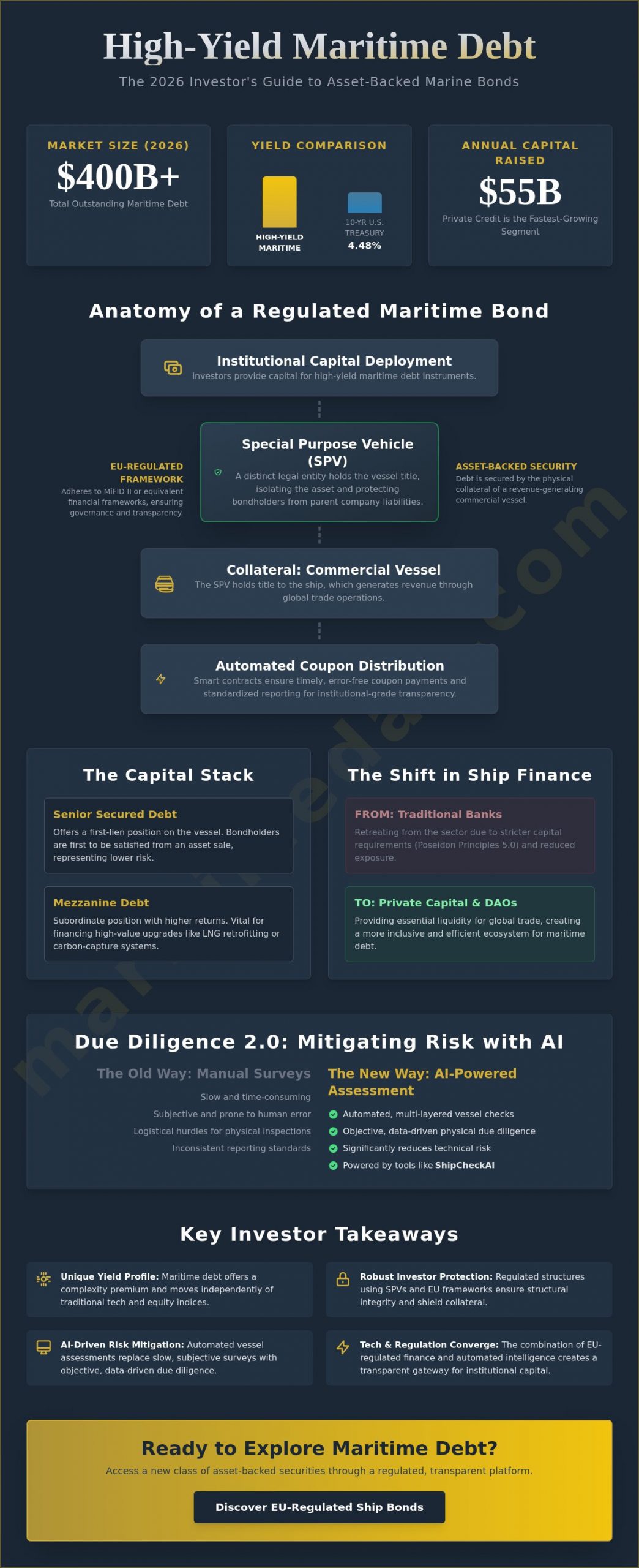
In 2026, the $400 billion maritime debt market has shed its reputation for opacity, transforming into a high-tech frontier where transparency is governed by code and institutional compliance. Investors are increasingly looking at high-yield maritime debt instruments as a way to capture superior credit spreads without the volatility typically associated with offshore assets. This shift is particularly striking as the 10-year U.S. Treasury yield sits at 4.48%, pushing capital to seek more robust returns through regulated innovation.
You’ve likely felt the frustration of opaque vessel valuations or the anxiety of deploying capital into jurisdictions where regulatory oversight feels like a moving target. We understand that performing physical due diligence on global assets is a logistical hurdle that often outweighs the potential yield. This guide demonstrates how high-yield maritime debt instruments bridge the gap between institutional asset-backed security and superior credit spreads in the 2026 shipping market. We’ll examine the structural integrity of EU-regulated maritime bonds, identify platforms for secure capital deployment, and explain how AI-driven tools like ShipCheckAI reduce technical risk through automated, multi-layered vessel assessments.
Key Takeaways
- High-yield maritime debt instruments offer a specialized entry point into non-investment grade credit, providing coupons that reflect the capital-intensive nature of global shipping.
- Regulated maritime bond structures utilize Special Purpose Vehicles (SPVs) and EU frameworks to ensure structural integrity and robust investor protections.
- Maritime debt typically commands a complexity premium, offering a unique yield profile that moves independently of traditional tech and equity indices.
- AI-powered vessel assessment tools mitigate technical risk by replacing slow, subjective manual surveys with objective, data-driven physical due diligence.
- The convergence of EU-regulated financial structures and automated intelligence provides a unified, transparent gateway for institutional capital deployment.
Defining High-Yield Maritime Debt Instruments in 2026
High-yield maritime debt instruments represent a specialized class of non-investment grade financial vehicles, primarily bonds or loans, that are secured by the physical collateral of commercial vessels. Unlike unsecured corporate debt, which relies on the general creditworthiness of an issuing company, these instruments function as asset-backed securities where the underlying collateral is a mobile, revenue-generating infrastructure asset. These instruments typically offer higher coupons to compensate for the capital-intensive nature of global shipping and the technical complexities of maritime operations. Modern 2026 structures have moved away from the opaque bilateral agreements of the past, instead prioritizing structural integrity through EU-regulated frameworks and unified digital governance.
Senior Secured vs. Mezzanine Maritime Debt
Investors must distinguish between different layers of the capital stack to understand the priority of claims during maritime liquidation or vessel arrest. Understanding the priority of claims is a fundamental component of Shipping investments, particularly when evaluating the risk profile of distressed or specialized assets. Senior secured bonds offer a first-lien position on the physical hull, ensuring that bondholders are the first to be satisfied from the proceeds of an asset sale. In contrast, mezzanine debt occupies a subordinate position but remains vital for financing high-value specialized vessel upgrades. This tier of capital is frequently deployed for LNG retrofitting and the installation of carbon-capture systems, allowing shipowners to bridge the gap between traditional senior debt and equity while capturing higher returns for lenders.
The Shift from Bank Lending to Private Maritime Capital
The landscape of ship finance has undergone a tectonic shift as traditional banks have retrenched from the sector since the early 2020s. Stricter regulatory capital requirements and the adoption of the Poseidon Principles version 5.0 have forced many legacy lenders to reduce their exposure to older tonnage. This retreat has opened a gateway for private maritime capital and decentralized autonomous organizations (DAOs) to provide the necessary liquidity for global trade. It’s a new era of capital deployment. These platforms unite capital from institutional sources, creating a more inclusive ecosystem for high-yield maritime debt instruments. As of June 2026, the total outstanding maritime debt market is estimated to exceed $400 billion, with private credit funds and bond issuances representing the fastest-growing segments of the $55 billion in annual debt raised.
The Anatomy of a Regulated Maritime Bond Structure
The structural integrity of high-yield maritime debt instruments relies on a sophisticated legal and technological architecture designed to ensure investor protection and operational clarity. In 2026, the standard for a regulated issuance involves the utilization of a Special Purpose Vehicle (SPV), which is a distinct legal entity that holds the vessel title. This isolation of the asset ensures that bondholders are shielded from the broader liabilities of the parent shipping company, effectively ring-fencing the collateral. These structures must adhere to MiFID II or equivalent EU financial frameworks, providing a level of governance and transparency that was previously absent from the private credit market.
Governance within these modern frameworks is increasingly managed via smart contracts to ensure automated coupon distribution. By encoding the terms of the bond into a secure, blockchain-based ledger, the ecosystem eliminates the delays and human errors associated with manual bank transfers. This technological layer provides standardized reporting that bridges the gap between daily maritime operations and institutional finance requirements. It creates a unified, transparent record that allows for real-time monitoring of cash flows and asset performance. If you are interested in how these systems integrate, you can explore the available EU-regulated ship investment bonds currently fueling fleet modernization.
EU Compliant Maritime Bonds: Security and Transparency
Choosing EU Regulated Ship Investment Bonds offers a legal safety net that unregulated offshore maritime tokens simply cannot match. The issuance process requires rigorous prospectus approval by European national competent authorities, ensuring that all risk factors are disclosed and vetted. This regulatory oversight is a core pillar of alternative maritime financing models that utilize established stock markets for fleet expansion. Unlike speculative digital assets, these bonds are governed by established contract law and financial directives, providing a unified framework for capital deployment that respects legacy systems while embracing innovation.
Asset-Backed Security and Vessel Covenants
The security of high-yield maritime debt instruments is further reinforced by stringent financial and technical covenants. Key debt covenants typically include Loan-to-Value (LTV) ratios and minimum liquidity requirements, which act as early warning systems for bondholders. Maintenance of Class is the most critical technical covenant. It mandates that the vessel remains seaworthy and compliant with international maritime regulations at all times. If a ship loses its class status, it constitutes a technical default, allowing the trustee to intervene. Independent trustees play a vital role in this ecosystem, acting as the reliable gatekeeper that monitors these metrics and protects bondholder interests through every stage of the vessel’s lifecycle.
Yield Comparison: Maritime Debt vs. Traditional Credit Sectors
The institutional appeal of high-yield maritime debt instruments lies in their inherent complexity premium, a yield spread that typically exceeds standard industrial bonds of comparable credit quality. This premium compensates investors for the technical rigor required to assess vessel valuations, maritime law, and global trade dynamics. While traditional corporate bonds are often tethered to the performance of the S&P 500 or tech indices, maritime yields demonstrate a low correlation with these benchmarks. The primary driver of this independence is the mobile asset advantage. A ship can be redeployed to profitable trade routes in response to regional economic shifts, whereas fixed assets like real estate are permanently bound to local market failures. In 2026, the nominal yield on a 10-year U.S. Treasury at 4.48% serves as the floor for USD-denominated debt, while maritime instruments frequently command spreads that reflect their superior asset-backed recovery rates compared to the 3.0% default rate forecasted for general emerging market high-yield corporates by JP Morgan.
This ecosystem integrates physical assets, digital governance, and institutional compliance to provide a unified investment gateway. By focusing on the structural integrity of the vessel rather than the parent company’s balance sheet, lenders create a more resilient credit profile. It’s a methodical approach to capital deployment. Active management of these assets ensures they continue to unite trade routes, govern supply chains, and open up opportunities for superior risk-adjusted returns.
Bypassing the ‘Sovereign Ceiling’ in Global Shipping
Accessing maritime DAO investment allows capital to flow into assets that are fundamentally extra-territorial. Vessels operate under international flag states, meaning their credit ratings aren’t strictly capped by the sovereign rating of the owner’s home country. This structure empowers investors to capture yield without being exposed to specific localized political or economic instability. Beyond geographic flexibility, most maritime debt is denominated in hard currencies like USD or EUR. This provides a unified hedge against the volatility of emerging market currencies in a global trade environment.
Risk-Adjusted Returns and Volatility Mitigation
The structural integrity of maritime debt is reinforced by long-term time charters, which act as a reliable gateway for predictable cash flows. These contracts ensure that debt service remains consistent even during periods of broader market volatility. The 2026 landscape is increasingly governed by environmental compliance. The January 2026 update to the Poseidon Principles and the IMO focus on Well-to-Wake emissions are now critical factors in determining vessel residual value. Investors prioritize modern, efficient tonnage to mitigate transition risk, ensuring that the underlying collateral retains its value in a decarbonizing economy.
Due Diligence 2.0: Qualifying Debt with AI Vessel Inspections
The reliability of high-yield maritime debt instruments depends on the physical integrity of the underlying collateral. Traditional ship surveys are notoriously slow and subjective. They often rely on the inconsistent judgment of individual inspectors, creating a transparency gap that has historically contributed to wider credit spreads. In 2026, AI-powered vessel assessment fundamentally changes the risk profile for investors by providing a verifiable, data-driven baseline for asset health. This technological shift allows for the implementation of dynamic Loan-to-Value (LTV) monitoring, where the collateral’s real-time condition is fed directly into the financial governance ecosystem.
By integrating automated intelligence into the due diligence process, lenders can identify systemic inefficiencies before they escalate into financial defaults. It’s a method of regulated innovation. These systems unite technical data, operational history, and financial viability to create a unified view of the asset. This level of transparency ensures that the bond’s structural integrity remains intact throughout the vessel’s lifecycle. You can access these advanced technical insights by utilizing ShipCheckAI to perform multi-layered vessel inspections before committing capital.
ShipCheckAI: Integrating Technical Data into Financial Analysis
ShipCheckAI serves as a reliable gatekeeper by identifying structural fatigue or maintenance neglect before it impacts the vessel’s market value. The tool utilizes computer vision to standardize ship condition reports, removing the human error inherent in legacy inspection methods. For bondholders, this means receiving a transparent, objective assessment of the hull and machinery. High-quality inspection data doesn’t just protect the lender; it also creates a direct link to lower insurance premiums. Underwriters increasingly recognize that vessels governed by AI-driven maintenance protocols represent a lower risk of catastrophic failure.
Automating Vessel Due Diligence for Global Portfolios
Scaling a portfolio of maritime debt often hits a bottleneck during the physical inspection phase. Automated due diligence allows institutional investors to expand their reach without increasing the logistical overhead of manual surveys. Predictive maintenance acts as a leading indicator of a shipowner’s financial health. If a vessel’s condition deteriorates, it’s often the first sign of liquidity stress. The ecosystem standardizes inspection types across different vessel classes, including Dry Bulk, Tankers, and Container ships. This unified approach ensures that regardless of the asset type, the risk assessment remains methodical, expansive, and deeply serious about asset security.
Maritime DAO: The Logical Gateway for High-Yield Maritime Debt
Maritime DAO serves as the definitive architect of the modern ship finance landscape, unifying EU-regulated financial structures with the technical precision of ShipCheckAI. By integrating these pillars into a single ecosystem, the platform addresses the systemic inefficiencies that have long plagued traditional maritime investment. It’s a first-of-its-kind regulated maritime fintech platform that prioritizes structural integrity and legal compliance over speculative hype. This unified approach ensures that capital deployment is grounded in physical reality while benefiting from the efficiency of digital governance. The platform acts as a bridge, allowing the physical world of global trade to connect seamlessly with the digital world of transparent finance.
Automated governance is the core of this ecosystem. It ensures that yield is distributed fairly and compliantly through smart contracts that reflect the underlying bond terms. Unlike traditional shipping funds that often suffer from ‘black box’ reporting issues, the DAO provides a transparent record of all transactions and asset assessments. This level of clarity empowers both institutional and accredited retail investors to participate in an industry that was once the exclusive domain of specialized banks and private equity giants. By removing the gatekeepers of legacy finance, the system creates a more inclusive and efficient market for high-yield maritime debt instruments.
The Maritime DAO Ecosystem Advantage
The Maritime DAO ecosystem provides a unified platform for vessel inspection, asset management, and capital deployment. This tripartite structure allows investors to monitor the health of their collateral in real-time, ensuring that the high-yield maritime debt instruments they hold are backed by seaworthy and revenue-generating assets. Decentralized governance doesn’t mean a lack of oversight; instead, it means that compliance is encoded into the system’s DNA. This prevents the transparency issues found in legacy funds and democratizes access to institutional-grade credit spreads without compromising on security or regulatory rigor. It’s a methodical expansion of what’s possible in ship finance.
Getting Started with Maritime Debt Investments
Onboarding for regulated maritime bond platforms is a methodical and secure process designed to meet the highest standards of financial compliance. Investors begin by verifying their status and exploring a curated list of current offerings, which are categorized by vessel type and charter duration. This allows for precise portfolio construction tailored to specific risk appetites and yield targets. Whether you’re looking at dry bulk carriers or modernized tankers, the platform provides the technical and financial data necessary for informed decision-making. You’ll find that the relationship between physical assets and digital governance is clearly defined at every step.
Explore EU-Regulated Ship Investment Bonds on Maritime DAO to see how regulated innovation is reshaping the future of global trade finance and opening new gateways for capital deployment.
The Future of Ship Finance is Regulated and Transparent
The transition from traditional bank lending to a high-tech, asset-backed ecosystem is no longer a forecast; it’s the current reality of the $400 billion maritime debt market. We’ve explored how high-yield maritime debt instruments now offer a complexity premium that’s fundamentally derisked through automated intelligence and rigorous EU legal frameworks. By moving beyond the opacity of legacy systems, investors can now access global trade infrastructure with the same level of confidence found in traditional bond markets. This shift represents a permanent evolution in how capital and heavy industry interact.
You can now participate in this transformation by utilizing a unified platform that integrates physical asset security with digital governance. Our ecosystem combines an EU-regulated framework, ShipCheckAI integration for 100% asset transparency, and decentralized governance for maximum investor protection. We invite you to Secure Your Portfolio with EU-Regulated Ship Investment Bonds and take your place at the intersection of heavy industry and high finance. The gateway to institutional-grade maritime returns is open, governed, and ready for your capital. It’s time to build a more resilient and inclusive financial future.
Frequently Asked Questions
What are high-yield maritime debt instruments?
High-yield maritime debt instruments are non-investment grade financial vehicles, typically bonds or loans, that are secured by the physical collateral of commercial vessels. They offer higher coupons to compensate for the capital intensity and technical complexity of the shipping sector. Unlike general corporate debt, these are fundamentally asset-backed securities where the physical hull serves as the primary security for the lender.
How do high-yield maritime bonds differ from traditional corporate bonds?
Traditional corporate bonds rely on the general cash flow of a company, whereas maritime bonds are secured by mobile, revenue-generating infrastructure. This “mobile asset” advantage allows vessels to be redeployed to profitable trade routes if a specific region faces economic downturns. Additionally, maritime debt often moves independently of traditional equity indices, providing a unique complexity premium and diversification benefit for institutional portfolios.
Is maritime debt regulated by the EU?
Modern maritime debt structures can be issued under EU-regulated frameworks, such as MiFID II, to ensure high standards of transparency and investor protection. These regulated instruments require prospectus approval by national competent authorities in Europe, distinguishing them from unregulated offshore tokens. This framework provides a unified legal safety net that governs the issuance, management, and distribution of maritime-linked capital.
What is the role of AI in maritime debt due diligence?
AI plays a critical role in reducing technical risk by providing objective, real-time assessments of a vessel’s physical condition. Tools like ShipCheckAI utilize computer vision and predictive analytics to identify structural fatigue or maintenance neglect that human inspectors might overlook. This data-driven approach allows for dynamic monitoring of the collateral, ensuring that the structural integrity of high-yield maritime debt instruments remains intact throughout the vessel’s lifecycle.
How much yield can I expect from maritime debt in 2026?
While specific returns vary by vessel class and charter duration, maritime debt in 2026 typically offers a significant spread over the 10-year U.S. Treasury yield, which currently sits at 4.48%. These instruments capture a complexity premium that reflects the technical rigor of the industry. Investors prioritize modern, efficient tonnage that complies with the latest Poseidon Principles and IMO environmental standards to ensure long-term value retention.
What happens if a vessel in the debt portfolio is arrested or damaged?
If a vessel is arrested or damaged, the debt structure’s asset-backed covenants and insurance protocols are triggered to protect bondholder interests. Most regulated maritime bonds require comprehensive hull and machinery insurance and include first-lien positions that give lenders priority claims in the event of liquidation. Independent trustees and smart contract governance ensure that recovery processes are handled methodically and transparently according to the encoded legal framework.
Can retail investors access high-yield maritime debt?
Access is primarily available to institutional and accredited investors through unified fintech platforms that leverage decentralized governance. While traditionally an exclusive market for specialized banks, the rise of regulated DAOs has democratized entry points. These platforms provide a transparent gateway for qualified participants to deploy capital into high-yield maritime debt instruments while maintaining the sober reliability of institutional finance.
What are the primary risks associated with high-yield maritime debt?
The primary risks include technical asset depreciation, market volatility in charter rates, and evolving environmental regulations. The 2026 shift toward Well-to-Wake emission metrics means older, less efficient vessels face higher transition risks. Investors mitigate these through high-quality due diligence, automated condition monitoring, and selecting debt instruments backed by modern fleets that align with global decarbonization strategies and Poseidon Principles version 5.0.