
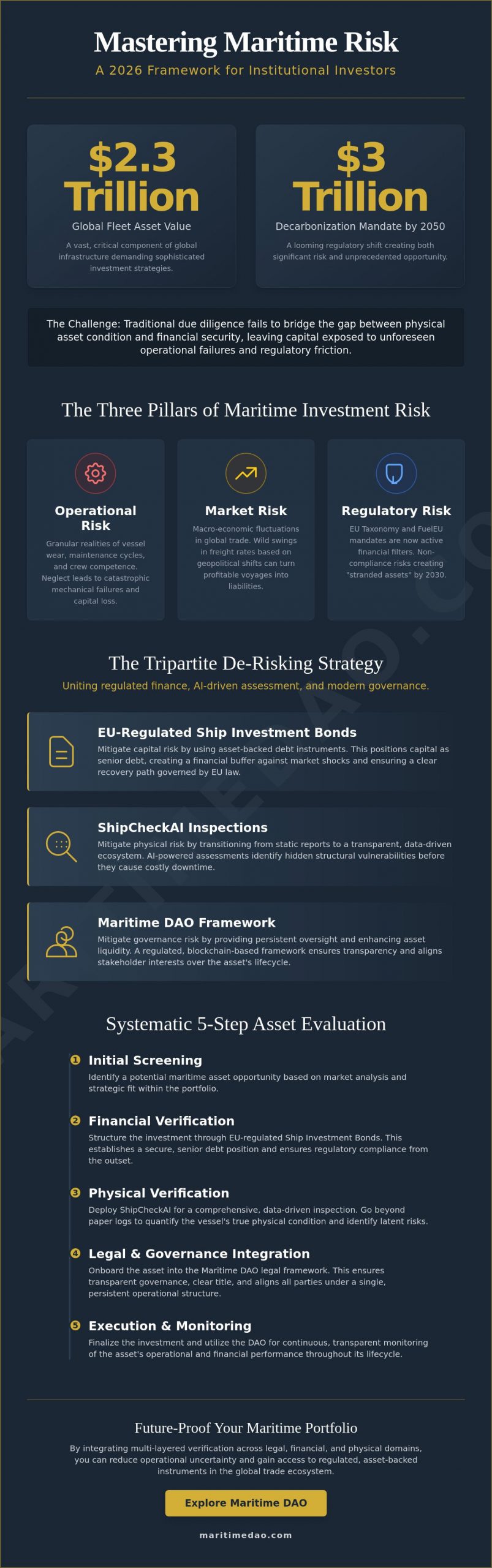
With a global fleet asset value of $2.3 trillion and a $3 trillion decarbonization mandate looming by 2050, the maritime sector is no longer a place for speculative guesswork. For institutional players, the central challenge remains how to de-risk maritime investments in an environment often characterized by opaque vessel reporting and shifting regulatory goalposts. You likely recognize that traditional due diligence often fails to bridge the gap between physical asset condition and financial security. This systemic disconnect leaves capital exposed to unforeseen operational failures, regulatory friction, and high barriers to entry for high-quality maritime debt.
This article provides a definitive 2026 framework to master maritime risk by integrating EU-regulated financial instruments with advanced, AI-driven vessel assessments. We will examine a tripartite strategy that unites the structural integrity of Ship Investment Bonds, the precision of ShipCheckAI inspections, and the emerging transparency of DAO legal frameworks. By the end of this guide, you will possess a systematic approach to due diligence that reduces operational uncertainty and opens access to regulated, asset-backed instruments in the global trade ecosystem.
Key Takeaways
- Learn to implement EU-regulated Ship Investment Bonds as a sophisticated debt instrument designed to buffer capital against the inherent volatility of global freight rates.
- Discover how ShipCheckAI transitions due diligence from static, paper-based reporting to a transparent, data-driven ecosystem that identifies hidden structural vulnerabilities.
- Master a systematic 5-step approach on how to de-risk maritime investments by integrating multi-layered verification across legal, financial, and physical domains.
- Examine the role of the Maritime DAO model in providing persistent governance and enhancing liquidity for physical assets within a regulated, blockchain-based framework.
Navigating the Three Pillars of Maritime Investment Risk
Maritime investment is often perceived as an opaque venture, yet it represents one of the most critical components of global infrastructure. With approximately 109,000 commercial vessels currently operating and a total fleet asset value of $2.3 trillion, the scale of this asset class is immense. Understanding how to de-risk maritime investments requires moving beyond simple asset acquisition. It demands a rigorous analysis of three distinct pillars: operational, market, and regulatory risk. These factors form the foundation of any sophisticated alternative investment in shipping today.
Operational risk involves the granular realities of vessel wear and maintenance cycles. Neglecting the “human element,” such as crew competence or technical upkeep, leads to catastrophic mechanical failures and loss of capital. Market risk, conversely, is driven by the macro-economic fluctuations of global trade. Freight rates can swing wildly based on geopolitical shifts, impacting yields and turning a profitable voyage into a liability. Historically, these factors turned shipping into a “black box” where information asymmetry favored the insider over the institutional investor, leaving capital exposed to variables that felt impossible to quantify.
In 2026, regulatory risk has moved to the forefront of the investment thesis. The EU Taxonomy and FuelEU Maritime mandates are no longer distant goals; they’re active financial filters that dictate vessel longevity. These regulations determine which ships can enter specific ports and which are eligible for favorable financing. Without a transparent view into a vessel’s compliance status, an investor cannot accurately project its long-term value or exit potential.
The Predictability Gap in Traditional Shipping
Traditional due diligence methods rooted in the 20th century are insufficient for the 2026 digital economy. Paper-based logs and annual surveys provide only a static snapshot of a vessel’s health. In a high-interest environment, the cost of unplanned downtime is amplified; a single week of a vessel being out of service can erode months of projected returns. Modern investors require a unified, data-led approach to risk that identifies vulnerabilities before they manifest as mechanical failures.
Regulatory Compliance as a De-risking Tool
Compliance is now a primary tool for anyone looking at how to de-risk maritime investments. Staying ahead of EU mandates protects the residual value of a maritime asset and ensures continued market access. The industry has shifted from “optional green” initiatives to “mandatory compliant” structures. Vessels that fail to integrate decarbonization technologies risk becoming “stranded assets” by 2030. With over $3 trillion needed by 2050 to achieve industry-wide decarbonization, the financial gap between compliant and non-compliant ships is widening rapidly.
Mitigating Capital Risk through EU-Regulated Ship Investment Bonds
Capital preservation is paramount in heavy industry. While direct equity in a single vessel offers the potential for high returns, it simultaneously exposes the investor to the full brunt of freight rate volatility and operational liability. A more sophisticated approach to how to de-risk maritime investments involves the use of EU-regulated ship investment bonds. These are debt instruments backed by physical maritime assets, issued within a compliant legal framework that prioritizes investor protection and structural transparency. By positioning capital as senior debt rather than equity, investors create a financial buffer that absorbs market shocks before their principal is ever at risk.
The role of European financial regulators is central to this security. With the European Commission issuing €100 billion in long-term EU-Bonds in the first half of 2026 alone, the infrastructure for regulated debt is more robust than ever. These authorities enforce strict reporting standards and disclosure requirements that transform a traditionally opaque asset class into a transparent financial product. Because these bonds are asset-backed, the physical hull of the vessel remains the ultimate collateral. In a default scenario, the legal framework provides a clear path to recovery, ensuring that the investment is governed by established maritime law and modern financial oversight. This tripartite alignment of physical assets, legal governance, and regulatory supervision defines the next generation of ship finance.
Regulated vs. Unregulated Maritime Debt
The maritime industry has long been plagued by “offshore” shipping schemes that lack oversight and leave investors with little to no legal recourse. These unregulated structures often hide operational inefficiencies and lack the rigorous audit trails required by institutional capital. In contrast, EU regulated ship investment bonds represent the gold standard for security. They mandate a level of transparency that includes regular financial audits and technical vessel assessments, ensuring that the issuer’s claims are verified by independent third parties.
Fixed Yields in a Volatile Industry
Predictability is a rare commodity in global trade. While ship-owning companies often provide unpredictable dividends tied to the current spot market, bond coupons offer fixed yields that remain steady regardless of freight rate fluctuations. This seniority ensures that debt holders are paid before equity holders, providing a layer of protection during cyclical downturns. For those seeking how to de-risk maritime investments, the psychological and financial benefit of institutional-grade predictability cannot be overstated. You can explore these structured opportunities by reviewing the available maritime debt instruments currently offered within our ecosystem.
Leveraging AI-Driven Surveys for Physical Asset Due Diligence
The structural integrity of a vessel is the final line of defense for any maritime capital allocation. While financial instruments provide the legal framework for recovery, the physical asset’s condition dictates the actual residual value. Traditional maritime due diligence has long relied on paper-based “snapshot” surveys that are susceptible to human error and subjective interpretation. These legacy methods often fail to identify subsurface corrosion or latent engine anomalies, leaving investors exposed to unplanned downtime that can jeopardize the yield of even the most robustly structured bonds. In an industry where 90% of global trade moves by sea, the cost of a single mechanical failure is too high to leave to manual chance.
Understanding how to de-risk maritime investments in 2026 requires a shift from document-centric reports to data-driven, automated assessments. ShipCheckAI addresses this systemic vulnerability by utilizing a unified AI model to analyze physical vessel data with institutional precision. This technology integrates multiple inspection layers, including pre-purchase, condition, and regulatory compliance, into a single, objective risk profile. By moving beyond the naked eye, the system identifies structural patterns that human inspectors might overlook, providing a high-fidelity view of the asset’s operational health. This data-driven approach is shifting the industry from a reactive maintenance model to a predictive one, where risks are identified before they manifest as financial liabilities.
This transition toward automated intelligence is part of a broader industry movement toward digitalization and transparency. Advanced surveying technologies, such as underwater drones and ultrasonic testing, are now being synthesized through AI to provide deep insights into a vessel’s lifespan. This eliminates the information asymmetry that once plagued shipping finance, ensuring that the collateral backing a bond is as sound in reality as it is on the balance sheet. By establishing a transparent technical baseline, investors can finally bridge the gap between the physical world of global trade and the digital world of asset management.
ShipCheckAI: Accuracy Beyond the Naked Eye
ShipCheckAI identifies corrosion patterns and engine irregularities with a speed and precision that manual surveys cannot match. This automated assessment validates the fair market value of a vessel by providing real-time data rather than relying on historical averages or outdated logs. Instead of waiting for periodic dry-dock inspections, the system allows for continuous condition monitoring. This ensures that any deviation from the asset’s baseline performance is flagged immediately, protecting the capital stack from sudden depreciation.
Standardising Vessel Assessment for Global Investors
For institutional players, a unified AI inspection report provides a digital twin of the physical investment, making complex technical data accessible to non-maritime experts. This standardization is achieved through clear Condition Scores that simplify the due diligence process. These scores are directly linked to financial efficiency; higher scores often correlate with lower insurance premiums and reduced operational risk. Knowing how to de-risk maritime investments involves recognizing that technical health is the primary driver of financial performance in the 2026 maritime ecosystem.
A Step-by-Step Guide to Evaluating a Maritime Asset Opportunity
Transitioning from initial interest to capital deployment requires a structured methodology that bypasses the emotional bias often found in speculative markets. Maritime due diligence is the intersection of legal, financial, and physical verification. To master how to de-risk maritime investments, one must adopt a “Regulatory Gateway” approach, where an opportunity is only advanced if it meets stringent compliance thresholds. This logical progression ensures that every dollar of capital is protected by both the rule of law and the physical reality of steel. By following a systematic five-step framework, investors can move with the confidence of an institutional gatekeeper rather than a speculative outsider.
Phase 1: Legal and Regulatory Clearance
The first phase focuses on the structural integrity of the investment vehicle itself. You must first verify the bond’s EU regulatory status and the issuer’s track record to ensure the offering aligns with institutional transparency standards. This step filters out offshore schemes that lack oversight. Second, it’s essential to review the asset-backed security documents and the seniority of the debt. Senior secured positions provide the highest level of protection in liquidation scenarios, ensuring the physical vessel remains viable collateral. Finally, you must ensure the vessel complies with 2026 carbon emission mandates, such as the FuelEU Maritime requirements. Non-compliance at this stage is a definitive signal to exit, as regulatory friction directly erodes asset liquidity and residual value.
Phase 2: Physical and Operational Validation
Once the legal foundation is confirmed, the focus shifts to the physical asset and its commercial viability. Step four involves requesting a ShipCheckAI condition report to verify the physical state of the hull and machinery through automated assessment. This objective data replaces the subjective “snapshot” of traditional surveys, identifying latent risks before they manifest as mechanical failures. The fifth step is to analyze the commercial employment contract, or charter party, of the vessel. This analysis reveals the revenue stability and counterparty risk associated with the asset’s current operations. De-risking is not about avoiding maritime volatility, but about pricing it accurately through data. By integrating these technical and financial pillars, you can build a resilient portfolio in the global trade sector. You can begin your due diligence process by exploring regulated maritime asset opportunities within our unified ecosystem.
Future-Proofing Portfolios with the Maritime DAO Ecosystem
The final pillar of a modern maritime framework is the structural shift from centralized management to decentralized governance. Traditional ship finance often suffers from a lack of ongoing oversight once capital is deployed, creating a period of vulnerability for the investor. The maritime DAO investment model addresses this by providing continuous, automated governance through smart contracts. These digital protocols ensure that compliance, maintenance verification, and yield distribution occur according to pre-defined rules, removing the risk of human error or administrative malfeasance. By unifying physical asset data with on-chain transparency, the ecosystem provides a level of security that legacy brokerage models can’t replicate.
Tokenization plays a critical role in this transformation by providing liquidity to traditionally illiquid ship assets. Historically, maritime investments required multi-million dollar commitments and long lock-up periods. Today, the ability to fractionalize these assets through regulated tokens allows for broader portfolio diversification without increasing the underlying risk profile. This democratization of finance ensures that high-quality maritime debt is accessible to a global audience, governed by the same institutional standards that protect major capital players. When considering how to de-risk maritime investments, the ability to exit a position through a liquid secondary market is as important as the initial due diligence. It’s a fundamental change in how global trade is financed and managed.
Transparency through Decentralised Governance
DAO members gain unprecedented access to real-time inspection data and financial audits, creating a transparent “glass box” environment for asset management. On-chain reporting prevents the manipulation of performance data, as every transaction and technical update is recorded on an immutable ledger. This governed ecosystem is inherently more resilient than a traditional brokerage because it relies on verifiable data rather than interpersonal trust. It ensures that the vessel’s operational status, verified by the AI tools discussed in previous sections, is always visible to the capital providers. You don’t have to wait for quarterly reports when the data is updated in real-time on a unified ledger.
Liquidity and the Regulated Tokenized Asset
Fractional ship ownership allows investors to spread capital across multiple vessels or routes, effectively mitigating the impact of localized market downturns. Tokenized bonds can be traded or exited more efficiently than physical ship shares, which often require complex legal transfers and months of negotiation. This liquidity is a fundamental component of how to de-risk maritime investments, providing the flexibility needed to respond to global trade shifts. With the tokenized Real World Asset market forecasted to reach up to $16 trillion by 2030, the integration of maritime assets into this digital framework is an inevitable evolution. A tripartite alignment of asset-backed security, AI-verified condition, and decentralized governance defines this new frontier.
Explore Regulated Ship Investment Bonds at Maritime DAO and secure your position in the future of global trade.
Scaling Global Trade through Regulated Innovation
The path to institutional maritime participation is now defined by a tripartite union of legal security, technical precision, and decentralized governance. By leveraging an EU-Regulated Financial Framework alongside ShipCheckAI proprietary technology, you eliminate the information asymmetry that once plagued this $2.3 trillion asset class. Mastering how to de-risk maritime investments ensures that your capital is backed by 2026 compliance-ready assets, protecting your portfolio from the regulatory friction of a decarbonizing world.
The transition from legacy risk to regulated opportunity is already underway. This framework provides the essential gateways to engage with global trade with the confidence of an institutional gatekeeper, ensuring that physical assets and digital governance remain perfectly aligned. You’re now equipped to build a resilient, liquid, and transparent maritime portfolio that respects both historical reliability and future innovation. The structural inefficiencies of the past are being replaced by a unified ecosystem where capital is protected and opportunities are democratized for a global audience.
Secure your capital with EU-regulated maritime bonds and lead the next era of maritime finance. The future of global trade is here, and it’s governed by transparency.
Frequently Asked Questions
Is it possible to completely de-risk a maritime investment?
No investment is entirely risk-free, but a systematic approach to how to de-risk maritime investments significantly lowers the probability of capital loss. By combining EU-regulated debt seniority with AI-verified physical assets, you move from speculative uncertainty to calculated exposure. Risk is managed through structural integrity and data transparency rather than avoided entirely. This tripartite strategy ensures that every variable is quantified and governed within a reliable legal framework.
How do EU-regulated ship bonds differ from traditional shipping stocks?
EU-regulated ship investment bonds represent senior debt, whereas traditional shipping stocks are equity positions. Bondholders have a higher claim on assets and receive fixed yields, providing a buffer against the freight rate volatility that often causes shipping stock prices to fluctuate. This debt seniority is a primary mechanism for those seeking institutional-grade predictability. It’s a move from volatile market speculation to asset-backed financial security.
Can AI really replace a human ship surveyor?
AI acts as a visionary architect rather than a simple replacement for human expertise. Tools like ShipCheckAI identify corrosion patterns and structural anomalies with a level of precision that the naked eye often misses. This technology provides an objective risk profile that complements manual inspections, turning subjective reports into a unified data ecosystem. It ensures that the technical baseline of a vessel is verified by automated intelligence rather than human guesswork.
What happens to my investment if the vessel is involved in an accident?
The asset-backed nature of these instruments provides a robust legal framework for recovery. In the event of an accident, comprehensive insurance coverage and the seniority of the bondholders ensure that debt claims are prioritized. The physical hull remains the ultimate collateral, and the EU-regulated legal structure governs the process of capital protection under established maritime law. This ensures that your principal is protected by multiple layers of institutional security.
How much capital is required to start investing in maritime assets via a DAO?
The DAO model democratizes access by allowing for fractional ownership of maritime assets. While traditional ship finance once required massive capital outlays, tokenization reduces entry barriers without compromising the regulatory standards of the investment. This allows for broader diversification across multiple vessels, which is a key strategy for how to de-risk maritime investments in a volatile global economy. It opens a traditionally exclusive industry to a global audience of professional investors.
What are the tax implications of investing in EU-regulated maritime bonds?
Tax treatment depends entirely on your specific jurisdiction and individual financial situation. EU-regulated bonds are often treated as standard fixed-income instruments, but specific maritime tax regimes or double-taxation treaties may apply. You should consult with a qualified tax professional to understand how these regulated instruments integrate with your broader fiscal strategy. The transparent nature of these bonds typically simplifies the reporting process compared to offshore shipping schemes.
How does the Maritime DAO ensure the AI data from ShipCheckAI is accurate?
The Maritime DAO maintains accuracy by recording all technical assessments on an immutable ledger. ShipCheckAI utilizes automated validation protocols to ensure that multi-point inspections are consistent and verifiable across the entire fleet. This creates a transparent audit trail where data cannot be manipulated, providing a governed ecosystem that identifies systemic inefficiencies. The relationship between physical assets and digital governance is clearly maintained through this automated verification process.
Is maritime investment suitable for a long-term retirement portfolio?
Regulated maritime assets can serve as a powerful diversifier for long-term portfolios due to their asset-backed nature and essential role in global trade. Since 90% of trade moves by sea, the industry offers a foundational reliability that aligns with long-term growth objectives. However, suitability depends on your individual risk tolerance and the specific structural protections of the instruments you choose. It’s an opportunity to bridge the gap between heavy industry and high finance for steady yield.