
While traditional stock markets grapple with unpredictable volatility, the global maritime industry continues to power over $33 trillion in trade value. For decades, the ability to generate passive income from shipping assets remained locked behind the closed doors of opaque networks and high-entry barriers. You’ve likely felt the frustration of being sidelined from these high-yield opportunities because performing technical due diligence on a physical vessel felt nearly impossible for an individual investor.
The era of the “old boys” club is ending. This guide shows you how to secure institutional-grade maritime yield through a transparent, EU-regulated framework. We’ll examine how ShipCheckAI provides the technical clarity needed for confident investment, how regulated maritime bonds offer a stable alternative to equity volatility, and how these systems unite to create a unified ecosystem for the modern era. You’ll discover a methodical path to diversifying your portfolio with assets that are governed, verified, and accessible. By leveraging automated intelligence and legal structural integrity, you can now participate in a market that remains the backbone of global commerce.
Key Takeaways
- Transition from the logistical burden of physical container management to the sophisticated security of EU-regulated maritime bonds.
- Discover how to generate passive income from shipping assets by leveraging vessel-backed debt and professional chartering mechanisms.
- Evaluate the distinct capital requirements and risk profiles associated with direct vessel ownership versus diversified maritime bond portfolios.
- Utilize ShipCheckAI to perform rigorous, AI-verified technical due diligence on maritime assets to mitigate operational and structural risks.
- Bridge the gap between global trade and digital finance through a unified ecosystem governed by transparent, institutional-grade standards.
The Evolution of Passive Income from Shipping Assets in 2026
The global shipping industry has undergone a fundamental transformation. What was once a fragmented network of physical logistics is now a unified asset class accessible to a broader spectrum of investors. In 2026, the strategy for generating passive income from shipping assets has shifted. We’ve moved away from the operational headaches of physical container leasing toward the structural security of financial instruments. While global trade value remains robust, exceeding $33 trillion, the method of capture has evolved into something more sophisticated and transparent. This shift represents a democratization of a sector that was once the exclusive domain of institutional giants.
Why Traditional Maritime Investment Was Closed to the Public
Historically, entering the world of shipping investments required immense capital. Acquiring a single vessel involves tens of millions of dollars, creating a barrier that excluded all but the largest institutional players. Beyond the cost, a deep information asymmetry existed. Investors needed specialist technical knowledge to evaluate hull integrity, engine performance, and regulatory compliance. Without a fleet of surveyors, the risk was simply too high. There were no regulated, retail-friendly vehicles to bridge this gap, leaving the industry’s high yields to a select few. It was a “blue-chip” asset class without a public gateway, governed by “old boys” networks and opaque brokerage deals.
The 2026 Landscape: From Logistics to Fintech
The current landscape is defined by “regulated innovation.” We’ve seen a surge in on-chain real-world assets, which reached $33.69 billion by May 2026. This growth isn’t just about technology; it’s about trust. Blockchain and AI have unified the maritime ecosystem, creating a transparent layer where asset data is immutable and accessible. Tools like ShipCheckAI now allow for multi-layered vessel assessment without the need for an in-house technical team. The rise of EU-regulated Ship Investment Bonds has provided the missing link, offering a secure framework for capital. Investors have shifted their sentiment. They no longer settle for speculative digital assets. Instead, they seek tangible, asset-backed income that is governed by law and verified by automated intelligence. This transition ensures that the maritime yield is not just high, but also sustainable and structurally sound. It’s a new era where technology, finance, and heavy industry converge to offer a reliable path to wealth.
Mechanisms of Maritime Yield: How Shipping Assets Generate Cash Flow
Global shipping operates on a fundamental tripartite value structure: physical asset value, functional utility in global trade, and the resulting yield generated through active operation. While the physical ship is the core asset, the true engine of value for an investor is the chartering contract. Maritime passive income is the capture of global trade rents via regulated debt instruments. This model allows investors to bypass the complexities of logistics while securing a share of the revenue generated by the world’s most essential transport infrastructure. By focusing on the financial layer of the industry, you can access a unified ecosystem where capital is protected by tangible assets and governed by transparent legal frameworks.
Charter Rates and the Cash Flow Cycle
The primary mechanism for generating passive income from shipping assets is the chartering market. Most vessels operate under one of two primary contract types. Time Charters provide a fixed daily hire rate for a specific duration, ranging from months to years. This offers high predictability and insulates the investor from fluctuating fuel costs. Voyage Charters, by contrast, focus on a single trip from one port to another. The earning potential of these contracts is heavily influenced by the vessel’s deadweight tonnage (DWT), which measures the total weight a ship can safely carry. Larger DWT typically commands higher daily rates because of the economies of scale provided to the charterer. To protect the net yield, operators must meticulously manage “ballast” legs, which are the portions of a journey where the ship travels without cargo. Minimizing these empty legs ensures that the cash flow cycle remains efficient and distributions to bondholders stay consistent.
Debt vs. Equity in Shipping: Which is Truly Passive?
When seeking maritime yield, the distinction between debt and equity is critical for risk management. Equity investments, such as purchasing shipping stocks, often expose you to extreme market volatility and operational risks. For example, as of June 2026, dividend yields for major carriers like ZIM stand at 5.02%, while others like Matson offer only 0.74%. These returns can fluctuate wildly based on management decisions and shifting charter rates.
Maritime bonds represent a more stable alternative. As a bondholder, you’re a creditor rather than a part-owner, which places you in a senior position within the capital stack. This seniority means bondholders are paid before equity holders, providing a robust layer of structural integrity. Debt instruments offer fixed, predictable returns that are less sensitive to the daily “noise” of the shipping markets. If you’re looking to build a resilient portfolio, you might explore how decentralized governance models are now making these institutional-grade debt instruments accessible to a global audience. This shift toward vessel-backed debt creates a reliable gateway for those who prioritize capital preservation alongside consistent income.
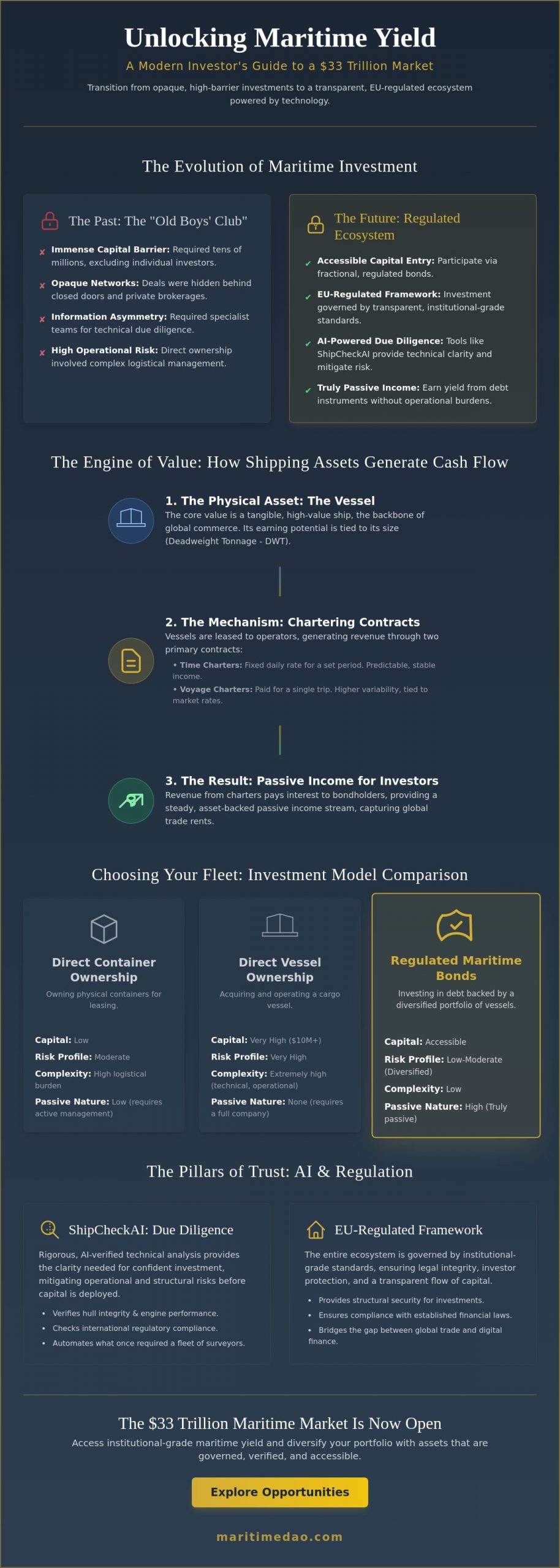
Comparing Shipping Asset Classes: Containers vs. Vessels vs. Bonds
Identifying the most resilient vehicle for passive income from shipping assets requires a granular understanding of risk, liquidity, and operational overhead. While the maritime sector offers diverse gateways, the underlying structure of your investment dictates whether your yield is truly passive or merely a secondary job. Investors must choose between the logistical burden of physical units, the high-stakes risk of direct ownership, or the sophisticated protection of regulated financial instruments. In 2026, the trend has moved decisively toward the latter. Market participants now prioritize transparency and structural integrity over the high-maintenance models of the past.
The Problem with Physical Container Leasing
Many retail platforms market container leasing as a simple entry point into maritime trade. The reality is often far more complex. Physical containers carry significant hidden costs, including ongoing maintenance, insurance, and fluctuating storage fees. If global demand shifts, your assets can become “zombies,” stuck in low-demand ports where repositioning costs exceed the asset’s residual value. These logistical hurdles turn a supposedly passive stream into an operational nightmare. Beyond these logistics, the “buyback” guarantees offered by many operators often lack legal enforceability. Without a regulated framework, you’re essentially trusting a private company’s balance sheet rather than a secured asset class.
The Case for Vessel-Backed Debt
Direct vessel ownership offers high rewards but demands extreme capital and carries concentrated risk. A single mechanical failure or a Port State Control detention can halt your cash flow immediately. By contrast, EU regulated ship investment bonds provide a diversified alternative. These bonds allow you to participate in passive income from shipping assets by spreading capital across an entire fleet rather than a single hull. This structure mitigates the impact of individual vessel downtime and provides a more stable liquidity profile. Security is further enhanced through several layers of protection:
- Maritime Liens: These provide bondholders with a senior, legally recognized claim against the physical vessel itself.
- Insurance Wrappers: Comprehensive coverage protects the underlying asset against hull damage, machinery failure, and third-party liabilities.
- Institutional Governance: Regulated bonds ensure that the issuance adheres to strict transparency and reporting standards.
This model transforms maritime yield from a logistical challenge into a professional financial product. It bridges the gap between heavy industry and modern finance, allowing you to capture global trade rents without ever needing to manage a physical container or hull. By choosing vessel-backed debt, you’re opting for a unified ecosystem that prioritizes capital preservation and steady distributions.
Navigating Risk: AI-Driven Due Diligence and Regulatory Compliance
Risk management in the maritime sector is frequently misunderstood as a binary choice between safe and unsafe. In reality, a sophisticated investor looks for the distinction between “safe to sail” and “operationally optimal.” A vessel may meet the minimum legal requirements for Port State Control yet remain technically inefficient, leading to higher fuel consumption and reduced yield. To secure consistent passive income from shipping assets, investors must look beyond traditional surveys. The 2026 landscape demands a unified approach that combines automated technical verification with a robust legal framework. This ensures that the underlying asset is not only seaworthy but also financially high-performing.
The urgency for this level of detail is clear. In Q1 2026, DNV reported a 23% increase in fleet detentions compared to the previous year, highlighting a growing gap in traditional maintenance standards. By integrating multi-layered data points, AI-powered inspections reduce maritime investment risk by 40% compared to traditional surveys through the proactive identification of technical failures. This technological layer acts as a reliable gatekeeper, providing the transparency required for institutional-grade capital allocation.
Transforming Inspections with ShipCheckAI
Traditional “pen and paper” surveys are static, subjective, and prone to human error. ShipCheckAI replaces this legacy system with a methodical, data-driven assessment process. By analyzing hull integrity and engine efficiency through automated intelligence, the tool creates a transparent digital twin of the physical asset. Bondholders benefit from continuous monitoring, ensuring that the vessel remains in peak condition throughout the duration of the debt term. This transition from periodic inspections to real-time data verification allows the ecosystem to identify, govern, and mitigate risks before they impact distributions. It’s a shift that prioritizes structural integrity over speculative assumptions.
The Regulatory Shield: EU Compliance in 2026
While technology provides the technical proof, regulatory compliance provides the legal security. Many offshore “token” schemes lack the oversight necessary for serious capital protection. In contrast, the 2026 framework for maritime DAO investment relies on EU-regulated bonds that mandate transparent reporting and automated governance. These structures ensure that the relationship between physical assets and digital ownership is clearly defined and legally binding. By operating within a governed framework, investors are protected by the same rigorous standards found in traditional institutional finance. This unified ecosystem of AI-verified assets and EU-regulated debt creates a first-of-its-kind gateway for global trade participation. If you’re ready to move beyond speculative digital assets, you can access our regulated ship investment portal to explore verified opportunities.
Maritime DAO: Accessing Institutional-Grade Yield
Maritime DAO serves as the visionary architect of a new maritime economy, acting as the definitive bridge between the physical world of global trade and the digital world of finance. By establishing a unified ecosystem, it integrates EU-regulated Ship Investment Bonds, ShipCheckAI inspections, and decentralized governance into a single, cohesive structure. This framework allows investors to secure passive income from shipping assets without the opacity of traditional maritime networks. It’s a system designed to unite, govern, and open up opportunities that were previously restricted to institutional giants. Through this architecture, the relationship between physical vessels and digital governance is clearly understood, providing a reliable gatekeeper for global capital.
The Maritime DAO Ecosystem Advantage
The core advantage of this model is its tripartite commitment to transparency, compliance, and inclusivity. Unlike traditional “old boys” networks, the DAO provides a platform where investors have a voice in the ecosystem’s evolution. This unified governance is supported by the seamless integration of ShipCheckAI, which ensures that every vessel in the bond portfolio is subject to ongoing, multi-layered inspections. By operating within an EU-regulated framework, the DAO offers a compliant gateway for global stakeholders who demand structural integrity. It effectively eliminates the “black box” nature of maritime finance, replacing it with automated intelligence and mandatory reporting that protects every participant in the capital stack.
Your Pathway to Passive Maritime Income
Entering this market is a methodical process designed for clarity and security. It begins with the setup of a secure digital wallet, which serves as your portal to the ecosystem. From there, you can select the specific bond issues that align with your risk profile, whether you prefer the stability of container feeder vessels or the higher yield potential of bulk carriers. Once your position is established, monitoring performance becomes effortless through the Maritime DAO dashboard. This tool provides real-time data on charter rates, vessel condition, and distribution schedules. One of the most significant benefits is the liquidity advantage. Unlike physical ship ownership, which can take months to liquidate, these bonds can be traded in a secondary market, providing a level of flexibility previously unknown in the shipping industry. This structured approach ensures that generating passive income from shipping assets is both professional and accessible.
Securing Your Position in the Global Maritime Economy
The transition from fragmented physical logistics to a unified financial ecosystem is complete. You now possess the tools to bypass the operational headaches of traditional shipping and enter a market governed by transparency and structural integrity. By choosing vessel-backed debt over physical ownership, you’re prioritizing capital preservation and predictable distributions. This evolution is anchored by an EU-Regulated Financial Framework, verified by proprietary ShipCheckAI inspection technology, and managed through decentralised governance that ensures maximum transparency for every stakeholder.
Generating passive income from shipping assets is no longer a matter of navigating opaque networks; it’s about leveraging a sophisticated, high-tech gateway to global trade rents. You can now monitor asset performance with institutional precision and trade with the confidence that your interests are protected by law and automated intelligence. The path to a diversified, high-yield portfolio is open and methodical. Take the next step toward a resilient financial future and Explore EU-Regulated Ship Investment Bonds and Start Earning Passive Income. The ocean remains the world’s most essential trade route, and your place within its economy is ready to be claimed.
Frequently Asked Questions
Is passive income from shipping assets truly “hands-off”?
Yes, generating passive income from shipping assets through regulated bonds is entirely hands-off for the investor. Unlike physical container leasing or direct vessel management, bondholders don’t handle maintenance, chartering negotiations, or port logistics. The technical and operational burdens are managed by professional operators, while the financial distributions are governed by the bond’s legal structure. This allows you to capture yield without any operational friction.
How do EU-regulated ship investment bonds differ from traditional maritime stocks?
EU-regulated ship investment bonds represent debt, whereas traditional maritime stocks represent equity. As a bondholder, you occupy a senior position in the capital stack, meaning your interest payments are prioritized over shareholder dividends. While stocks are subject to public market volatility and management’s dividend discretion, bonds provide a fixed, predictable yield backed by the physical vessel. This structure ensures a more stable income profile compared to variable equity returns.
What is the minimum investment for maritime assets via Maritime DAO?
The minimum entry point is designed to democratize access to an industry once reserved for institutional capital. While specific thresholds vary by bond issuance, the use of blockchain technology allows for fractional participation. This eliminates the need for the multi-million dollar outlays typically required for vessel acquisition. You should review the specific documentation for each bond issue on the dashboard to confirm current entry requirements.
How does ShipCheckAI protect my investment from technical failure?
ShipCheckAI utilizes automated intelligence to perform multi-layered inspections that identify technical vulnerabilities before they lead to failure. By creating a digital twin of the vessel’s hull and machinery, the tool monitors structural integrity and engine efficiency with precision. This proactive approach reduces the likelihood of Port State Control detentions and mechanical downtime. It ensures that the underlying asset remains in optimal condition to sustain your distributions.
Can I sell my maritime bonds before they reach maturity?
Yes, you can exit your position through the secondary market provided by the Maritime DAO. Unlike traditional private maritime placements, which are often illiquid for several years, these bonds are designed for enhanced flexibility. You can list your holdings for sale to other participants within the ecosystem. This liquidity gateway allows you to manage your capital according to your individual financial timeline without waiting for bond maturity.
What happens if a vessel in the bond pool is involved in an accident?
The impact of an accident is mitigated by the structural diversification of the bond pool and comprehensive insurance coverage. Most bond issues spread risk across multiple vessels, ensuring that a single incident doesn’t halt overall cash flow. Every vessel is protected by hull and machinery insurance, which covers physical damage and third-party liabilities. This protects the bondholder’s principal and maintains the integrity of the yield ecosystem.
Are maritime bonds more stable than cryptocurrency or real estate?
Maritime bonds offer a unique stability profile by combining the tangible security of real estate with the yield potential of global trade. While cryptocurrency is often speculative and real estate is subject to local market cycles, shipping bonds capture “rents” from the global supply chain. This asset class is governed by established maritime law and EU financial regulations. It provides a grounded alternative for those seeking reliable passive income from shipping assets.
How does the Maritime DAO ensure regulatory compliance across different jurisdictions?
The Maritime DAO utilizes a robust legal framework that aligns with EU financial regulations and Marshall Islands DAO legislation. This dual-jurisdiction approach ensures that the ecosystem remains compliant while facilitating global trade participation. Automated governance protocols enforce transparency and mandatory reporting across all operations. By integrating traditional legal structures with digital governance, the DAO provides a unified and secure gateway for stakeholders worldwide.