
What if the most critical component of your vessel isn’t the engine or the hull, but the immutable data trail it leaves behind? In a landscape where institutional capital demands total transparency, a sophisticated maritime inspection compliance tool has evolved from a safety requirement into a foundational financial asset. You’ve likely dealt with the systemic risks of manual data entry errors and the struggle to provide consistent, high-quality reports across a diverse fleet. These operational gaps don’t just threaten safety; they create significant friction when proving compliance to bondholders or meeting the stringent requirements of EU-regulated ship investment bonds.
It’s exhausting to manage fragmented systems that fail to speak the language of modern finance. This article provides a comprehensive framework to evaluate and deploy the advanced tools necessary to unify shipboard operations with global investment standards. We’ll explore how to leverage automated audit trails and real-time visibility to transform your compliance data into a powerful instrument for capital growth and institutional trust.
Key Takeaways
- Understand the transition from legacy digital checklists to automated compliance engines that integrate physical vessel data directly into institutional reporting frameworks.
- Identify essential technical capabilities, such as AI-enhanced structural recognition and reliable offline functionality, to maintain data continuity during remote deep-tank inspections.
- Apply a rigorous 15-point selection checklist to ensure your chosen maritime inspection compliance tool natively supports complex FuelEU and IMO 2026 regulatory mandates.
- Discover how standardized inspection reports bridge the gap between physical assets and capital markets, satisfying the strict due diligence requirements of institutional bondholders.
- Learn how ShipCheckAI provides the transparent, verifiable condition reporting necessary to govern and scale the ecosystem of EU-regulated ship investment bonds.
What is a Maritime Inspection Compliance Tool in 2026?
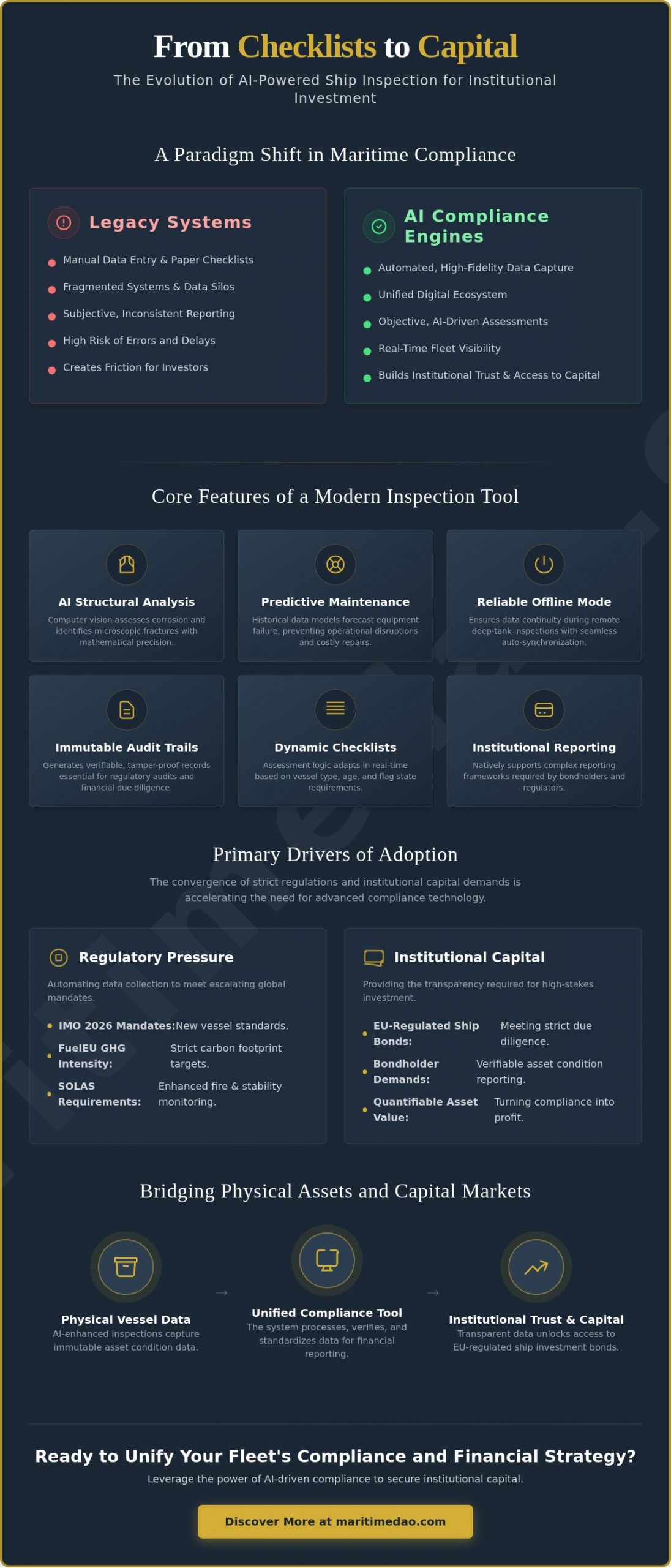
The maritime industry is undergoing a structural transformation. A maritime inspection compliance tool in 2026 is a sophisticated digital ecosystem that unifies physical vessel assessments with rigorous regulatory and institutional reporting standards. It represents the definitive shift from legacy “digital checklists” to “automated compliance engines” powered by machine learning and high-fidelity data capture. This evolution is driven by a singular core objective: ensuring that every asset within a fleet meets the escalating demands of the IMO, FuelEU mandates, and specific investor-defined benchmarks. For the modern shipowner, 2026 marks a critical turning point where maritime fintech platform innovation and automated surveys converge to create a transparent, data-driven layer for the global shipping industry. By automating data capture, verifying structural integrity, and validating financial risk, these tools provide the structural integrity required for high-stakes capital investments.
The Evolution from Paper to AI-Driven Surveys
Traditional surveys were often hindered by data silos, significant lag times, and the inherent subjectivity of manual reporting. These limitations frequently led to discrepancies during Port State Control inspections, creating operational delays and financial friction. AI-powered vessel surveys eliminate these biases by utilizing computer vision to assess corrosion and structural integrity with mathematical precision. Real-time data synchronization ensures that shore-based management and institutional partners have an immediate, high-fidelity view of the fleet’s condition. It’s a system that effectively bridges the gap between the engine room and the boardroom, replacing guesswork with a unified source of truth.
Regulatory Drivers: IMO, FuelEU, and Beyond
Regulatory pressure is the primary catalyst for this technological leap. The 2026 FuelEU GHG intensity targets require vessels to document and reduce their carbon footprint with unprecedented accuracy. A robust maritime inspection compliance tool automates the collection of emission and efficiency data, transforming “Green Shipping” mandates from a regulatory burden into a quantifiable asset value. As new SOLAS requirements regarding fire detection and stability monitoring take effect in early 2026, the ability to prove compliance through automated audit trails becomes the baseline for vessel valuation. These tools don’t just record defects; they govern the entire lifecycle of the asset, providing the sober reliability required by institutional finance. The intersection of heavy industry and high finance is where this technology truly excels, allowing traditionally exclusive maritime opportunities to be opened to a global audience through transparent, legal frameworks.
Core Features of a Modern AI Ship Inspection Tool
The technical architecture of a modern maritime inspection compliance tool must transcend basic data entry to provide a unified, verifiable audit trail. It’s no longer sufficient to merely record observations. Instead, the system must act as an intelligent governor of asset health. AI-enhanced image recognition now allows for the precise assessment of structural integrity and corrosion, identifying microscopic fractures or coating failures that escape the human eye. This level of granularity is essential for maintaining the asset-backed security of a vessel. These systems unite operational data, govern regulatory adherence, and open up institutional capital opportunities through a single, transparent interface.
Offline functionality remains a non-negotiable pillar of operational reliability. When a surveyor enters a deep tank or a double-bottom void, active satellite connectivity is often non-existent. A robust system captures high-resolution data locally and synchronizes it once connectivity is restored, ensuring no data gaps exist in the lifecycle of the ship. This continuity is what separates a professional tool from a generic mobile app. Furthermore, dynamic checklist logic ensures that the assessment adapts in real-time based on the vessel’s type, age, and flag state, ensuring that no specific regulatory requirement is overlooked during the survey process.
AI and Machine Learning in Vessel Assessment
Predictive maintenance models now utilize historical inspection data to forecast equipment failure before it disrupts operations. By applying computer vision to thousands of images, the system identifies safety hazards with a high degree of precision, as seen in diesel-engine fault detection tools that have demonstrated 92% accuracy in recent 2026 benchmarks. This data normalization ensures that a bulk carrier in Singapore and a tanker in Rotterdam are graded against the same institutional standards, removing the subjectivity that once plagued traditional surveys. It’s a methodical approach that prioritizes structural integrity over anecdotal reporting.
Integrations and Data Connectivity
An API-first architecture allows these systems to link directly with ERP and fleet management software, creating a “Single Source of Truth” for the entire organization. This transparency is vital when interacting with bodies like the Federal Maritime Commission’s Office of Compliance, where verifiable documentation is required for regulatory adherence. When inspection data flows seamlessly into centralized logbooks, port state control can verify a vessel’s status instantly, reducing detention risks. Automated report generation further bridges the gap between stakeholders; owners receive technical breakdowns for maintenance, while investors receive condition reports that validate the security of their capital. For those exploring the next frontier of ship finance, understanding these technical pillars is the first step toward participating in the Maritime DAO ecosystem.
The 15-Point Maritime Compliance Tool Selection Checklist
Selecting a maritime inspection compliance tool is no longer a simple procurement task; it’s a high-stakes strategic decision that defines the transparency of your global fleet. As institutional capital moves closer to the physical world of global trade, the criteria for evaluating these systems have shifted from basic functionality to rigorous institutional-grade governance. A robust tool must act as a bridge between the engine room and the financial ledger, ensuring every data point is verifiable, immutable, and aligned with the highest regulatory standards. To bridge the gap between operations and investment, your selection process should prioritize five critical pillars:
- Regulatory Alignment: Does the tool natively support FuelEU GHG intensity targets and the mandatory IMO 2026 standards for fire detection and stability monitoring?
- User Experience: Can a crew member with minimal technical training complete a comprehensive survey in high-stress, low-light environments?
- Evidence Quality: Does the system support high-resolution video, multi-angle photography, and automated sensor data attachments to eliminate subjective reporting?
- Auditability: Is there a tamper-proof, timestamped trail of who performed the inspection to satisfy the due diligence of the International Maritime Organization (IMO) and port state authorities?
- Financial Integration: Can the generated data be instantly utilized for maritime asset due diligence to secure bondholder trust?
Operational Efficiency Benchmarks
The value of a maritime inspection compliance tool is measured by its impact on the “time-to-report” metric. Leading systems now automate the generation of branded PDF reports, reducing the gap between physical inspection and stakeholder delivery from days to minutes. High crew adoption rates are equally vital; if the interface isn’t intuitive, data quality suffers. Modern platforms must also offer multi-inspection capability, allowing a single application to handle everything from pre-purchase assessments to annual surveys and special dry-docking reports. This versatility ensures a unified data ecosystem across the entire lifecycle of the vessel, much like how Computer Market Research streamlines complex partner data for global enterprises to ensure operational consistency.
Technical and Security Requirements
Structural integrity applies to data just as much as it applies to hulls. Enterprise-grade encryption is essential for protecting sensitive technical and commercial vessel data from cyber threats. Given that shipping operates in low-bandwidth zones, the reliability of the offline-to-online synchronization is a critical failure point to evaluate. Finally, look for customizability. The ability to build bespoke checklists for unique asset classes, such as bulk carriers or specialized submersibles, ensures the tool evolves alongside your fleet. By prioritizing these technical pillars, operators can achieve a 25% reduction in unplanned maintenance events through better data visibility and predictive insights.
Linking Inspection Data to EU-Regulated Ship Investment Bonds
The convergence of technical asset management and institutional finance has transformed the humble survey into a critical financial instrument. For the modern investor, a maritime inspection compliance tool serves as the primary gateway to verifying the underlying value of asset-backed securities. By utilizing ShipCheckAI, institutional participants can access granular, immutable data that confirms a vessel’s structural and operational health. This level of transparency is no longer optional; it’s the cornerstone of maintaining the integrity of EU regulated ship investment bonds. When bondholders can verify the physical state of their collateral in real-time, the “information asymmetry” that historically plagued maritime finance begins to dissolve.
Reducing this friction has direct economic benefits for ship operators. Standardized, high-fidelity data from a maritime inspection compliance tool allows underwriters to price risk with surgical precision, often resulting in lower insurance premiums and reduced financing costs. It’s a system where operational excellence is directly rewarded with capital efficiency. By bridging the gap between physical operations and digital governance, these tools ensure that a vessel’s market value is anchored in verifiable fact rather than subjective estimation. The emergence of the maritime fintech platform has been instrumental in unifying these inspection data streams with regulated capital allocation frameworks, dismantling the legacy silos that once separated ship operators from institutional investors.
Transparency as a Financial Multiplier
High inspection scores now correlate directly with more favorable bond interest rates. Investors are willing to accept lower yields in exchange for the certainty provided by real-time “Health Checks” of the underlying assets. This ecosystem, governed by the Maritime DAO, ensures that data is not just collected but remains decentralized and tamper-proof. It empowers a global audience to participate in an industry that was once the exclusive domain of massive conglomerates, all while maintaining the sober reliability of traditional finance. The result is a more inclusive, yet deeply secure, investment landscape.
Due Diligence for the Digital Era
The pre-issuance phase of maritime debt instruments has historically been a bottleneck, often requiring weeks of manual auditing and physical inspections. Automated vessel surveys change this dynamic entirely. By standardizing the “Risk Score” for maritime assets across global markets, these tools allow for rapid capital deployment without compromising on rigorous due diligence. It’s a methodical transition from legacy paperwork to a unified, digital governance framework that supports the next generation of maritime debt. This streamlined approach ensures that capital flows where it’s most effective, backed by the structural integrity of real-time data.
Ready to explore how these standards secure your capital? Discover the potential of regulated maritime investment today.
ShipCheckAI: The Unified Compliance Solution for Maritime DAO
ShipCheckAI stands as the definitive bridge between heavy industry and high finance. It’s the only maritime inspection compliance tool engineered to serve the dual needs of technical vessel operators and institutional bondholders within a single, high-fidelity interface. By utilizing advanced AI to analyze photographic evidence against SOLAS and MLC conventions, the platform transforms raw operational data into structured, bankable reports. This system doesn’t just record the physical state of a vessel; it validates the structural integrity of the entire investment ecosystem. It unites disparate data points, governs fleet-wide standards, and opens up new pathways for global capital to enter the maritime sector with total confidence.
The operational impact of this technology is measurable and profound. In recent institutional deployments, the use of ShipCheckAI’s automated assessment engine has reduced inspection-to-financing lead times by 60%. This efficiency gain is achieved by eliminating the manual bottlenecks of traditional auditing, allowing for rapid capital deployment without sacrificing rigorous due diligence. For the Maritime DAO, this transparency is the foundational pillar that allows fractional ownership and EU-regulated ship investment bonds to scale. It ensures that every participant, from a €200 retail contributor to a major institutional bondholder, has access to the same “Single Source of Truth” regarding asset health.
Looking ahead to late 2026, the roadmap for ShipCheckAI includes the direct integration of real-time sensor data into the compliance engine. This evolution will move the industry beyond periodic surveys toward a model of continuous, automated oversight. By linking stability inclinometers and emissions sensors directly to the audit trail, the tool will provide an immutable record of compliance that satisfies the most stringent “Green Shipping” mandates and GHG intensity targets.
Unified Governance and Operations
ShipCheckAI ensures that every vessel within the DAO fleet adheres to a unified set of institutional standards. This “regulated innovation” approach respects the legacy requirements of maritime law while leveraging the speed of decentralized technology. Owners who integrate this maritime inspection compliance tool into their daily operations gain more than just a reporting app; they gain a strategic advantage in the capital markets. Joining the ecosystem allows operators to leverage their high compliance scores to secure more favorable financing terms and build long-term trust with global investors.
Conclusion: Securing the Future of Maritime Finance
The transition from tactical inspection to strategic compliance is the defining trend of the 2026 maritime landscape. We’ve moved beyond the era of subjective, paper-based surveys into a future where data is the most valuable asset on board. By implementing a unified tool like ShipCheckAI, ship owners and investors can bridge the historical gap between physical operations and financial governance. It’s a methodical, transparent, and deeply serious approach to asset management that secures the future of global trade. The next step in your 2026 compliance strategy is to move toward a system that values order, security, and the democratization of complex financial structures. Explore how the Maritime DAO ecosystem is redefining the intersection of heavy industry and institutional finance today.
Navigating the New Frontier of Institutional Maritime Capital
The transition to 2026 requires more than just digital checklists; it demands a unified ecosystem where AI-driven assessments meet the rigorous transparency requirements of global bondholders. By prioritizing a maritime inspection compliance tool that natively supports FuelEU and IMO standards, operators don’t just ensure safety. They build a verifiable audit trail that acts as a foundational financial asset, bridging the gap between vessel operations and institutional investment standards. Standardized reporting is now the critical layer that connects physical assets to the reliable world of high finance.
This evolution represents a unique opportunity to democratize ship finance through structural integrity and clear legal frameworks. ShipCheckAI delivers the precise blend of AI-driven vessel assessment technology, institutional-grade investment transparency, and the sober reliability of the EU-regulated framework. It’s time to move beyond fragmented data silos and embrace a unified, transparent future. Optimize your fleet compliance with ShipCheckAI and the Maritime DAO ecosystem to ensure your assets are governed by the highest standards of modern finance. The horizon of global trade is open, and it is built on the methodical precision of real-time data.
Frequently Asked Questions
What is the primary benefit of an AI-powered maritime inspection compliance tool?
The primary benefit is the elimination of human bias through the creation of immutable, high-fidelity data trails. By utilizing computer vision for corrosion and structural assessments, the tool provides a mathematical certainty that traditional manual surveys lack. This transparency is vital for maintaining asset-backed security and securing the trust of institutional capital markets.
How do these tools help with FuelEU 2026 regulatory compliance?
These tools automate the collection and verification of GHG intensity data required by the EU’s “Fit for 55” package. A modern maritime inspection compliance tool integrates with vessel systems to document emissions and efficiency metrics with precision. This ensures that operators can prove adherence to escalating intensity reduction targets without the risks associated with manual data entry.
Can a maritime inspection tool actually reduce vessel financing costs?
Yes, because it significantly reduces the information asymmetry between ship operators and institutional lenders. Standardized, AI-verified condition reports allow bondholders to price risk more accurately, which often leads to lower risk premiums. When structural integrity is verified through a transparent digital ecosystem, operators can secure more favorable interest rates and financing terms.
Is ShipCheckAI compatible with existing fleet management software?
ShipCheckAI utilizes an API-first architecture specifically designed for seamless integration with enterprise ERP and fleet management systems. This connectivity ensures that technical data flows into a centralized ecosystem without creating fragmented data silos. It acts as a unified governance layer that enhances, rather than replaces, your existing operational software.
How does the tool handle inspections in areas with no internet connectivity?
The system features robust offline functionality to support surveys in deep tanks, double bottoms, or remote maritime zones. Data is captured and encrypted locally on the mobile device during the physical assessment. Once the surveyor regains satellite or terrestrial connectivity, the tool automatically synchronizes the records with the cloud-based global logbook.
What types of ship inspections can be performed using ShipCheckAI?
ShipCheckAI is a versatile platform that supports multiple inspection types, including pre-purchase surveys, annual condition assessments, and special dry-docking reports. It also features specialized checklists for SOLAS safety compliance, MLC labor standards, and structural integrity monitoring. This multi-inspection capability ensures a unified data trail across the entire lifecycle of the vessel.
Does the Maritime DAO tool satisfy EU-regulated bond due diligence requirements?
The tool is engineered specifically to satisfy the stringent transparency mandates of EU-regulated ship investment bonds. It provides the “Single Source of Truth” that institutional investors require to verify the underlying asset value before capital deployment. Automated audit trails ensure that every maritime debt instrument is backed by verifiable, tamper-proof physical health reports.
How secure is the vessel data stored within a digital compliance platform?
Vessel data is protected by enterprise-grade encryption and governed by decentralized protocols that prevent unauthorized tampering. This structural integrity ensures that sensitive technical and commercial information remains accessible only to authorized stakeholders. The platform acts as a reliable gatekeeper, maintaining a secure yet transparent environment for high-stakes maritime investments.