
For the modern institutional investor, a vessel’s physical condition is no longer a secondary concern; it is the primary data point that governs the integrity of the entire financial ecosystem. The era of relying on subjective, manual surveys is ending as intelligent ship inspection systems emerge as the essential bridge between heavy industry and high finance. You likely recognize the systemic inefficiency of the current model, where human error and significant reporting lags create a dangerous disconnect between a ship’s actual state and its financial representation.
This guide explores how AI-powered accuracy is transforming maritime due diligence into a precise, transparent, and unified process. You’ll discover how these systems ensure compliance with the rigorous 2026 standards, including the latest SOLAS amendments and CCS rules, while securing institutional investments through verifiable data. We will detail the transition from reactive maintenance to continuous monitoring, showing how technical assessments integrate directly into financial risk models to empower global capital and stabilize the maritime investment landscape.
Key Takeaways
- Understand the definitive transition from reactive maintenance to a predictive, data-driven model using integrated AI, IoT, and computer vision ecosystems.
- Learn how intelligent ship inspection systems eliminate subjective human bias by identifying critical structural weaknesses through objective and repeatable pattern recognition.
- Discover how automated vessel assessments fulfill the rigorous transparency requirements and ESG reporting mandates necessary for EU-regulated ship investment bonds.
- Gain a practical framework for implementing autonomous hardware, such as drones and ROVs, to standardize technical data across diverse fleet profiles.
- Explore how ShipCheckAI creates a unified data environment that simultaneously serves the due diligence needs of vessel owners, insurers, and institutional capital providers.
What Are Intelligent Ship Inspection Systems?
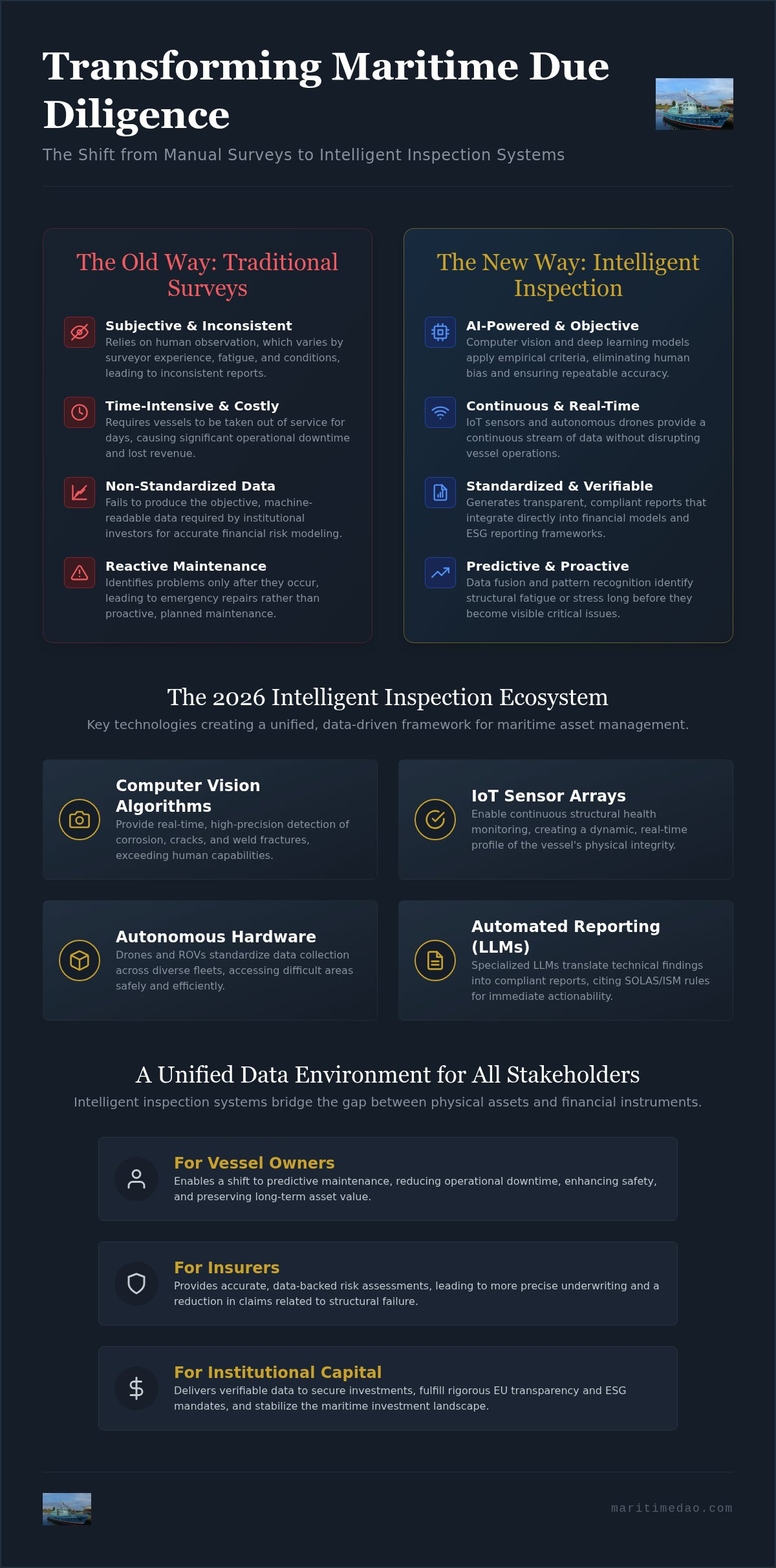
Intelligent ship inspection systems represent a fundamental shift in how the maritime industry preserves asset value and ensures safety. These are not merely digital checklists or isolated sensors; they’re unified ecosystems where autonomous hardware integrates with sophisticated AI-powered software to provide a real-time assessment of a vessel’s structural health. While legacy systems often focused on voyage optimization or fuel consumption, these new frameworks prioritize the physical integrity of the hull and machinery. They create a bridge between the physical reality of a ship and the digital requirements of modern finance.
The year 2026 marks a decisive tipping point for this technology. With the release of the China Classification Society’s “RULES FOR INTELLIGENT SHIPS 2026” on June 1, the industry now has a formalized framework for automated assessment. We’ve moved beyond reactive maintenance. Ship owners now utilize predictive, data-driven management to identify issues before they jeopardize a vessel’s seaworthiness or its financial standing. This transition is essential for any stakeholder looking to maintain transparency in an increasingly regulated global market.
The Limitations of Traditional Manual Surveys
Legacy maritime inspections are inherently flawed because they rely on subjective human observation. A surveyor’s report can vary based on experience, fatigue, or even lighting conditions inside a dark cargo tank. These physical assessments are also incredibly time-intensive. They often require taking a vessel out of service for days, leading to significant operational downtime. Perhaps most critically, manual surveys fail to produce the standardized, machine-readable data that institutional investors demand. Without objective metrics, financial risk models remain speculative rather than grounded in technical reality.
Key Technologies in 2026 Inspection Ecosystems
The current technological landscape is defined by three primary pillars. First, computer vision algorithms now provide real-time detection of corrosion and structural cracks with a precision that exceeds human capability. Second, IoT sensor arrays allow for continuous structural health monitoring, building upon the foundational data tracking seen in traditional Vessel Monitoring Systems (VMS). Finally, automated report generation has been revolutionized by LLMs specialized in maritime terminology. These models translate complex technical findings into transparent, compliant reports that cite specific SOLAS or ISM regulations. This ensures that every data point collected by intelligent ship inspection systems is immediately actionable for both technical managers and bondholders.
The Role of AI in Enhancing Vessel Assessment Accuracy
The precision of intelligent ship inspection systems hinges on their ability to replace subjective observation with empirical, repeatable data. In a traditional survey, two different inspectors might categorize the same level of hull corrosion differently based on their personal risk tolerance or environmental conditions. AI-driven computer vision eliminates this variance by applying objective criteria to every square centimeter of the vessel. By processing high-resolution imagery through deep learning models, these systems recognize structural patterns that indicate fatigue or stress long before they’re visible to the human eye.
This accuracy is further bolstered by data fusion. Modern systems don’t look at a vessel in isolation; they integrate historical survey records with real-time sensor inputs to create a comprehensive risk profile. As the International Institute of Marine Surveying suggests, AI-powered robotics could revolutionise boat inspections by providing a level of granular detail that was previously impossible to achieve. This holistic approach ensures that every assessment is grounded in the full lifecycle of the asset, rather than a single point-in-time snapshot. It’s about moving from a “snapshot” of health to a continuous stream of verifiable condition data.
Automated Defect Recognition (ADR)
ADR algorithms represent the vanguard of structural integrity monitoring. These tools automatically categorize the severity of defects, such as pitting or weld fractures, and map them onto 3D digital twins for spatial context. This spatial mapping is vital for determining whether a defect is a localized issue or a symptom of a broader structural failure. By utilizing ADR, operators can significantly reduce false positives in non-destructive testing (NDT), ensuring that maintenance resources are directed exactly where they’re needed. It’s a methodical process that turns raw visual data into a governed, transparent record of vessel health.
ShipCheckAI: A Multi-Type Inspection Framework
ShipCheckAI serves as the operational standard within this new ecosystem. It provides the versatility required for various assessment types, ranging from high-stakes pre-purchase inspections to routine annual class surveys. By leveraging deep learning, ShipCheckAI improves ship inspection accuracy by continuously refining its ability to identify anomalies across diverse vessel classes. This standardization is critical for global stakeholders who require unified reporting to make informed capital decisions. When technical data is this precise, it becomes a reliable foundation for financial instruments. For those seeking to bridge the gap between physical asset management and institutional finance, exploring the governance structures at Maritime DAO offers a clear path forward. This integration ensures that every inspection directly supports the transparency required for regulated maritime investments.
Compliance and Institutional Trust: The EU Regulatory Landscape
Compliance in 2026 is defined by the convergence of technical precision, legal accountability, and financial transparency. As global regulators tighten standards, the role of intelligent ship inspection systems shifts from a maintenance convenience to a mandatory gateway for institutional capital. The maritime industry currently faces a rigorous wave of updates, including new SOLAS amendments and the mandatory prohibition of PFOS fire extinguishing media effective January 1, 2026. For institutional investors, these aren’t merely operational hurdles; they’re critical risk factors that must be verified through objective, AI-driven data rather than paper-based legacy reports.
Institutional trust is built upon the ability to demonstrate continuous compliance with evolving mandates such as the IMDG Code Amendment 42-24 and the latest IMSBC Code requirements. By utilizing automated systems, owners can provide verifiable evidence that their vessels meet the new 2026 standards for protective coatings and fire detection in cargo control rooms. This alignment is not just a local requirement but part of a global shift in maritime governance, reflected in initiatives like the Federal Maritime Commission AI Compliance Plan, which underscores the increasing necessity for algorithmic transparency in shipping operations.
Securing Maritime Capital Markets
Institutional investors now demand a level of granular due diligence that traditional surveys simply cannot provide. The security of EU regulated ship investment bonds is directly linked to the physical integrity of the underlying asset; any ambiguity in a vessel’s condition creates a volatility that capital markets reject. Intelligent monitoring reduces this “risk premium” by transforming physical asset health into a machine-readable data stream. This allows for the seamless integration of technical condition reports into financial risk models, ensuring that bondholders are protected by a unified, transparent, and governed ecosystem of information.
Governance in the Maritime DAO Ecosystem
Within the Maritime DAO framework, decentralization serves as a reliable gatekeeper for data integrity. The Maritime DAO investment model utilizes blockchain technology to create immutable inspection logs, ensuring that assessment data cannot be tampered with or obscured. This architecture allows for a multi-layered auditing process where decentralized governance protocols verify the accuracy of every ShipCheckAI report. By uniting physical asset management with digital governance, the ecosystem provides a “first-of-its-kind” level of security that democratizes access to maritime debt while maintaining the sober reliability required by high-finance institutions.
How to Implement an Intelligent Inspection Workflow
Transitioning from legacy manual surveys to a unified digital ecosystem requires more than just new software. It demands a structured, five-step operational blueprint that bridges the gap between raw physical data and institutional-grade reporting. By following a methodical implementation strategy, owners ensure that their intelligent ship inspection systems provide the structural integrity and transparency required for modern capital markets. This process begins with defining specific inspection parameters based on the vessel’s age, type, and the latest 2026 regulatory mandates, such as the new SOLAS requirements for lifting appliances and anchor handling winches.
Once parameters are set, the workflow moves into the physical deployment of autonomous hardware. Drones and underwater ROVs collect high-definition visual data from environments that are often hazardous or inaccessible to human surveyors. This raw data is then processed through a specialized AI ship inspection tool, which filters thousands of data points to identify anomalies. To maintain the highest levels of credibility, findings undergo a hybrid review where AI-generated insights are validated by human maritime experts. The final step involves integrating these validated findings into the asset’s financial and regulatory profile, creating a transparent record that satisfies both class societies and institutional bondholders.
Pre-purchase vs. Operational Inspections
The application of these workflows varies significantly depending on the investment stage. For those acquiring new assets, utilizing pre-purchase ship inspection software is essential for identifying “hidden” liabilities that traditional surveys might overlook. In contrast, routine operational monitoring focuses on “always-on” due diligence to maintain the vessel’s value throughout its lifecycle. Both approaches should feed directly into comprehensive AI in maritime due diligence checklists, ensuring that every assessment is governed by a consistent, machine-readable standard.
Overcoming Implementation Hurdles
Successful implementation requires addressing several technical and operational challenges. Managing data bandwidth remains a primary concern for remote vessel inspections, necessitating edge-computing solutions that process data locally before syncing with the cloud. Crew members must also be trained to interact with intelligent hardware, shifting their role from manual inspectors to technical supervisors of autonomous systems. Finally, ensuring interoperability between different AI platforms is vital for maintaining a unified ecosystem. By standardizing data formats, operators can ensure that inspection results are accessible across the entire value chain. To begin your transition to a data-driven fleet, you can access the ShipCheckAI deployment framework through the Maritime DAO platform today.
ShipCheckAI: The Future of Unified Maritime Due Diligence
ShipCheckAI represents the functional apex of the technological transition toward data-driven vessel management. It’s a unified data layer that synchronizes technical maintenance, insurance underwriting, and institutional financial reporting into a single, immutable stream of truth. By operating as the core diagnostic engine within the Maritime DAO ecosystem, the tool ensures that every stakeholder has access to the same high-fidelity information. This transparency is what allows intelligent ship inspection systems to move beyond simple maintenance and become the foundational infrastructure for modern maritime finance.
The 2026 roadmap for ShipCheckAI envisions a shift from descriptive reporting to prescriptive, autonomous asset management. While early iterations focused on identifying corrosion or structural fatigue, the current ecosystem utilizes deep learning to trigger governed maintenance workflows automatically. This evolution reduces the “time-to-truth” for investors, ensuring that a vessel’s physical state is always reflected in its financial valuation. For those seeking the most secure methods for how to invest in maritime assets, this level of AI-powered accuracy provides the necessary guardrails for large-scale capital deployment.
Closing the Gap Between Asset and Investor
ShipCheckAI provides the “ground truth” required for the successful issuance of tokenized ship bonds. In the past, the distance between the physical ship and the institutional investor was filled with opaque reports and subjective surveys. Today, the system streamlines capital deployment by providing instant vessel assessments that are audited by decentralized governance protocols. This process enables real-time maritime asset valuations, allowing bondholders to monitor the health of their underlying collateral with the same precision found in traditional equity markets. It’s a methodical approach that replaces speculation with structural integrity.
Join the Maritime DAO Innovation
Accessing the ShipCheckAI suite is a straightforward process managed through the Maritime DAO platform. The ecosystem offers subscription-based intelligent inspection services designed for global fleets, providing a scalable solution for owners who value transparency and regulatory excellence. By integrating these tools, you’re not just adopting software; you’re joining a governed community dedicated to the democratization and stabilization of maritime finance. The future of global trade is digital, data-driven, and deeply serious about security. Secure your maritime investments with verified data and lead the transition into the next era of institutional shipping.
The Future of Maritime Asset Governance
The maritime sector’s transition from opaque, manual oversight toward a model of absolute technical transparency is now irreversible. By adopting intelligent ship inspection systems, owners and investors move beyond the inherent limitations of subjective reporting to secure a future grounded in empirical data. This shift ensures that physical vessel health isn’t a variable; it’s a verified constant within the global financial ecosystem. You’ve seen how AI-powered accuracy, decentralized governance, and regulatory alignment unite to redefine vessel assessments for the institutional age.
ShipCheckAI serves as the essential bridge between heavy industry and high finance, providing a unified platform where technical precision meets institutional reliability. You’re invited to Secure Your Maritime Assets with ShipCheckAI and benefit from an EU-Regulated Compliance Framework, AI-Powered Accuracy for Bond Issuance, and Immutable Blockchain Governance. Embracing these sophisticated tools allows you to lead a more transparent, secure, and democratized maritime industry where structural integrity is the cornerstone of every investment.
Frequently Asked Questions
What are the primary types of intelligent ship inspection systems used in 2026?
The primary types of intelligent ship inspection systems in 2026 include aerial drones for internal tank surveys, underwater ROVs for hull assessments, and integrated AI software ecosystems. These systems utilize computer vision and IoT sensor arrays to provide a unified health profile of the vessel. They are governed by new standards like the CCS Rules for Intelligent Ships 2026, which formalize the use of automated data in classification surveys.
How does AI improve the accuracy of a vessel condition report?
AI improves report accuracy by replacing subjective human observation with objective, repeatable data. Deep learning algorithms identify structural anomalies, such as micro-fractures or early-stage corrosion, that are often invisible to the naked eye. By analyzing thousands of high-resolution images and sensor inputs, the system creates a granular, machine-readable record that eliminates the variance typically found in manual surveys.
Can intelligent inspection systems replace traditional classification society surveys?
These systems currently serve as a sophisticated supplement to traditional classification society surveys rather than a total replacement. While the physical presence of a certified surveyor is still required for final legal sign-off, the automated data provided by intelligent ship inspection systems is increasingly mandated for class renewals. This hybrid approach ensures that human expertise is supported by empirical, high-fidelity evidence, streamlining the entire certification process.
Are AI-driven maritime inspections compliant with EU financial regulations?
AI-driven maritime inspections are specifically designed to meet the rigorous transparency requirements of EU financial regulations, including mandates for ESG reporting and bondholder disclosure. By providing immutable, verifiable data, these systems satisfy the due diligence standards necessary for EU-regulated ship investment bonds. This alignment ensures that technical condition reports are directly compatible with the legal frameworks governing institutional maritime capital.
What is the cost-benefit ratio of implementing ShipCheckAI for a small fleet?
Implementing ShipCheckAI for a small fleet offers a significant cost-benefit ratio by reducing vessel downtime and minimizing the risk of catastrophic structural failure. Automated assessments allow for predictive maintenance, which prevents expensive emergency repairs and extends the operational lifespan of the asset. Owners also benefit from improved transparency, which can lead to lower insurance premiums and enhanced credibility when seeking institutional financing.
How do drones and ROVs integrate with intelligent inspection software?
Drones and ROVs act as the physical data gateways, feeding high-resolution visual and sensor data directly into the intelligent inspection software. The hardware navigates hazardous environments to capture information that’s then processed through edge-computing or cloud-based AI models. This integration allows for real-time defect recognition and spatial mapping, transforming raw footage into actionable technical insights and 3D digital twins.
What role does blockchain play in verifying ship inspection data?
Blockchain technology creates an immutable, timestamped record of every vessel assessment, ensuring that inspection data can’t be altered or obscured. Within the Maritime DAO ecosystem, this decentralized ledger allows for a multi-layered auditing process where data integrity is governed by transparent protocols. This provides institutional investors with absolute certainty regarding the maintenance history and physical condition of the underlying maritime assets.
Is ShipCheckAI compatible with existing maritime asset management platforms?
ShipCheckAI is engineered for broad interoperability, utilizing standardized data formats and secure APIs to integrate with existing maritime asset management platforms. This connectivity ensures that AI-driven inspection results can be seamlessly incorporated into broader operational and financial workflows. By unifying technical data with legacy management systems, the tool provides a comprehensive view of fleet health and investment risk.