
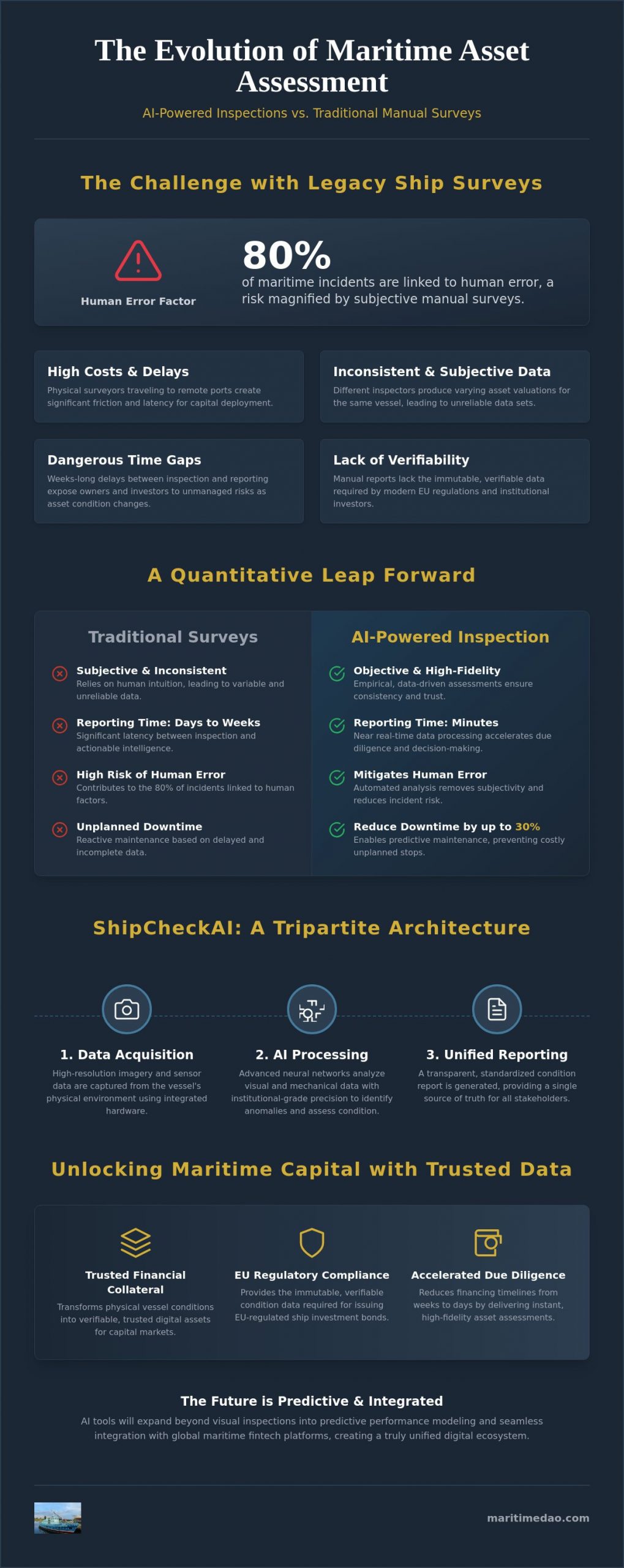
Eighty percent of maritime incidents are still linked to human error, yet the global shipping industry continues to rely on subjective, manual surveys to value its most critical capital assets. You likely recognize the friction inherent in this legacy approach, where high deployment costs, inconsistent data sets, and the difficulty of verifying asset conditions often stall the issuance of maritime bonds. Integrating a sophisticated AI ship inspection tool into your operations solves these systemic inefficiencies by replacing human intuition with empirical, high-fidelity data.
This guide demonstrates how AI-powered assessments transform physical vessel conditions into trusted financial collateral for the global maritime capital markets. You’ll discover how ShipCheckAI creates a unified ecosystem where automated intelligence, regulatory compliance, and predictive maintenance converge to ensure operational excellence. We will detail the specific frameworks that standardize vessel reports, accelerate due diligence for financing, and reduce unplanned downtime by up to 30 percent through the power of regulated innovation.
Key Takeaways
- Understand how an AI ship inspection tool functions as a unified software ecosystem, transitioning maritime due diligence from subjective manual surveys to objective, high-fidelity data.
- Explore the tripartite architecture of ShipCheckAI, which integrates data acquisition, automated processing, and transparent reporting to deliver institutional-grade asset assessments.
- Analyze the quantitative advantages of AI-driven inspections, including the reduction of reporting timelines from days to minutes and the significant mitigation of unplanned vessel downtime.
- Discover the methodology for implementing ShipCheckAI within asset-backed financing frameworks to provide the verifiable condition data required for EU-regulated ship investment bonds.
- Preview the future of maritime intelligence as AI tools expand into predictive performance modeling and seamless integration with global maritime fintech platforms.
The Evolution of Maritime Due Diligence: Why an AI Ship Inspection Tool is Essential
The global shipping industry is currently undergoing a fundamental structural transformation. An AI ship inspection tool is no longer a peripheral luxury; it is the central pillar of a unified software ecosystem designed for automated vessel assessment. This shift marks the definitive transition from subjective, manual surveys to a regime of objective, data-driven maritime intelligence. In 2026, industry standards have evolved to prioritize real-time asset transparency, ensuring that global stakeholders can access high-fidelity condition reports without the latency of traditional methods. By leveraging advanced computer vision, these tools mitigate the human error factor that remains responsible for 80 percent of maritime incidents. This technology acts as a methodical gatekeeper, identifying systemic inefficiencies and building a high-tech bridge between physical hulls and digital ledger reliability.
Limitations of Traditional Ship Surveys
Legacy inspection models are inherently restricted by human geography and biological limits. High deployment costs and logistical delays often arise when physical surveyors must travel to remote port locations, creating a significant friction point for rapid capital deployment. These manual processes frequently result in subjective reporting, where different inspectors produce inconsistent asset valuations for the same vessel. It’s common to see a dangerous time-gap between the initial physical inspection and the delivery of an actionable report. This delay exposes owners and investors to unmanaged risks, as the vessel’s condition may deteriorate or change during the weeks spent waiting for data processing. Traditional surveys simply lack the structural integrity required for the fast-paced demands of modern maritime finance.
The Rise of Regulated Innovation in 2026
Innovation is now governed by a commitment to transparency and legal frameworks. New EU regulations are driving the adoption of transparent maritime technology, requiring that asset condition data be verifiable and immutable. We are witnessing a sophisticated intersection where maritime operations, traditional finance, and decentralized technology unite to create a more inclusive investment landscape. Institutional investors now demand AI in maritime due diligence as a mandatory prerequisite for capital deployment. This requirement ensures that every investment is backed by high-fidelity data rather than speculative estimates. By utilizing an AI ship inspection tool, organizations can provide the methodical, academic-level rigour that the intersection of heavy industry and high finance requires. This approach doesn’t just improve safety; it democratizes access to complex financial structures by providing a transparent, governed foundation for every maritime asset assessment.
ShipCheckAI: A Multi-Dimensional Framework for Vessel Assessment
ShipCheckAI serves as the vanguard of automated vessel assessment. It functions through a tripartite architecture that unites three distinct pillars into a single, high-fidelity platform:
- Data Acquisition: Capturing high-resolution imagery and sensor data from the vessel’s physical environment through integrated hardware.
- AI Processing: Utilizing neural networks to analyze visual and mechanical data with institutional-grade precision.
- Unified Reporting: Generating transparent condition reports that provide a single source of truth for all stakeholders.
Unlike legacy systems that isolate specific checks, this AI ship inspection tool performs structural, mechanical, and safety-critical assessments simultaneously. This level of connectivity is essential for the Maritime DAO ecosystem, where it acts as a governed gateway for global maritime trade. By synchronizing physical data with digital governance, the platform provides a transparent window into the asset’s lifecycle, ensuring that every data point is governed by the same rigorous institutional standards.
Automating Diverse Ship Inspection Types
ShipCheckAI redefines the speed of maritime transactions. Pre-purchase inspections now accelerate the acquisition cycle for bond-backed vessels, ensuring that capital is deployed without the friction of manual delays. Ongoing condition monitoring maintains hull and engine room integrity through a persistent digital oversight layer that tracks wear and tear in real time. These compliance audits map data directly to IMO and EU financial standards, ensuring that every vessel meets the requirements of modern institutional finance. It’s a system designed for a global audience, where traditionally exclusive data is now accessible and verified. For a deeper understanding of these workflows, you can explore the comprehensive reference to ship inspection types for a detailed breakdown.
Advanced Computer Vision and Machine Learning
The core of the system lies in its ability to perceive what remains invisible to the human eye. By utilizing advanced neural networks, the tool detects micro-cracks and early-stage corrosion with unprecedented precision, often identifying structural vulnerabilities months before they become critical. This aligns with a broader Classification Society Perspective on how autonomous systems enhance safety and reliability. Predictive analytics forecast high-risk areas before mechanical failure occurs, transitioning the industry from reactive repairs to proactive asset management. By standardizing ship inspection accuracy across a global fleet, the platform ensures that a vessel in the Atlantic and one in the Pacific are governed by the same rigorous data protocols. This methodical approach to asset management removes the guesswork from maritime investment. If you’re looking to optimize your fleet’s governance, consider how these unified assessment frameworks can enhance your operational transparency and secure your long-term capital investments.
Manual vs. AI-Driven Inspections: A Quantitative Analysis
The shift from traditional surveying to an automated regime is most visible in the disparity of reporting velocity. While manual surveys often require days to compile and verify, an AI ship inspection tool generates high-fidelity data in minutes. This acceleration isn’t merely a matter of convenience; it represents a fundamental change in how asset reliability is governed. By replacing subjective checklists with high-resolution AI heatmaps, the industry eliminates the “different inspector, different result” syndrome that has historically plagued maritime valuations. Every assessment is grounded in empirical evidence, ensuring that a vessel’s condition is a matter of record rather than opinion.
Data granularity represents another pillar of this quantitative shift. Manual checklists are often binary and limited by human fatigue. In contrast, an AI-driven heatmap identifies thousands of distinct data points across a hull, mapping corrosion levels and structural stress with mathematical precision. This level of detail empowers owners to make informed decisions about maintenance cycles and capital allocation, ensuring that resources are directed where they are most needed. It’s a methodical approach that replaces guesswork with structural integrity.
Efficiency Metrics for Shipowners and Operators
Efficiency is the primary driver for shipowners seeking to optimize operational expenditure. Verified data indicates that AI-enabled predictive maintenance can reduce unplanned downtime by up to 30 percent, allowing operators to address vulnerabilities before they escalate into structural failures. Achieving true ship inspection efficiency is now recognized as the primary bridge between physical operations and institutional capital, ensuring that asset transparency and operational momentum are no longer mutually exclusive. This scalability enables a single platform to govern inspections for an entire global fleet, regardless of geographical dispersal. The integration of AI in maritime safety allows for more precise risk profiling. This precision typically leads to more favorable insurance premiums as underwriters gain confidence in the transparent data stream provided by the platform. Centralized oversight reduces the overhead associated with manual surveyor deployments and ensures that every vessel adheres to the same rigorous safety protocols.
The Investor’s Perspective on Data Integrity
Institutional asset management requires a level of data integrity that legacy paper logs simply can’t provide. Digital compliance records are superior because they are immutable and verifiable, acting as a safeguard against “greenwashing” or the falsification of maintenance records. ShipCheckAI provides the structural transparency required for EU regulated ship investment bonds, where the underlying asset’s condition must be beyond reproach. This level of granular oversight transforms a physical ship into a reliable financial instrument, bridging the gap between heavy industry and high finance. Investors can now verify asset conditions through a unified source of truth, democratizing access to maritime debt markets that were once the exclusive domain of a few institutional giants.
Implementing AI Inspection for Asset-Backed Financing
The integration of physical maritime assets into institutional financial frameworks requires a methodical, multi-stage implementation process. This AI ship inspection tool acts as the primary gateway for converting operational data into investment grade collateral through a five step protocol:
- Step 1: Data Ingestion. The process begins with the ingestion of historical logs and technical specifications, creating a digital baseline for the vessel’s lifecycle.
- Step 2: Real-Time Assessment. ShipCheckAI is deployed to capture high-fidelity visual and structural data, identifying current condition markers with mathematical precision.
- Step 3: Standardized Reporting. The system generates a Vessel Condition Report, a unified document that serves as the definitive health certificate for the DAO governance layer.
- Step 4: Yield and Risk Mapping. Inspection outcomes are directly linked to bond yield calculations, where superior asset health translates into lower risk tiers and optimized interest rates.
- Step 5: Persistent Oversight. Continuous monitoring ensures that the asset-backed security remains intact, providing a transparent record of maintenance throughout the bond’s duration.
By following this systematic approach, stakeholders ensure that every maritime bond is anchored by verifiable, empirical evidence. It’s a structure that values order, security, and the democratization of complex capital markets.
Bridging the Gap Between Heavy Industry and High Finance
The translation of technical inspection data into financial risk ratings is the cornerstone of regulated innovation. By utilizing immutable digital records, we ensure maritime investment compliance across diverse jurisdictions. ShipCheckAI serves the persona of a reliable gatekeeper, verifying that physical assets meet the rigorous demands of digital markets. This bridge allows institutional investors to engage with the shipping industry with the same confidence they bring to traditional asset classes, knowing that the structural integrity of their investment is governed by automated intelligence. Buyers conducting due diligence before vessel acquisition will find that selecting the right pre-purchase ship inspection software is a critical first step in ensuring that every capital commitment is grounded in verified, institutional-grade data.
Governance and Transparency in the DAO
The Maritime DAO utilizes high-fidelity AI data to govern capital deployment decisions with total transparency. Bondholders gain real-time access to the health of their underlying assets, removing the opacity that has historically characterized maritime debt. This ecosystem is moving toward a future of automated governance, where AI inspections can trigger smart contract actions, such as maintenance escrow releases or risk premium adjustments. This level of connectivity ensures that the relationship between physical assets and digital governance is clearly understood at every step. Secure your capital through our governed maritime investment ecosystem and participate in the future of institutional global trade.
The Future of ShipCheckAI: Beyond Visual Inspections
The evolution of maritime intelligence is moving rapidly from passive observation to active predictive modeling. ShipCheckAI is currently expanding its capabilities beyond structural diagnostics to incorporate predictive hull performance and fuel efficiency modeling. This transformation is central to the vision of a unified maritime ecosystem where every physical vessel possesses a digital AI twin. These twins act as persistent, data-rich mirrors that allow stakeholders to simulate various operational scenarios and optimize maintenance cycles with mathematical precision. This AI ship inspection tool thus becomes the foundational layer for a new era of maritime fintech, enabling seamless asset trading across global platforms by providing a real-time valuation of the vessel’s technical and operational health. It integrates operational performance, financial liquidity, and environmental compliance into a single governed gateway.
The democratization of this traditionally exclusive industry remains a core objective of our technological roadmap. By providing granular, high-fidelity data, the platform clearly defines how to invest in maritime assets through a lens of total transparency. This clarity is the essential catalyst for moving maritime capital from closed-door institutional circles to a broader, global audience, ensuring that every participant has access to the same institutional-grade intelligence.
Enabling Fractional Ship Ownership
High-fidelity AI data is the primary mechanism for reducing the “trust barrier” that has historically excluded smaller investors from large-scale vessel acquisitions. By standardizing asset assessments across the globe, the platform allows for the granular partitioning of ownership. This means multiple participants can hold stakes in a single vessel with the same confidence as a traditional bank. ShipCheckAI plays a vital role in maintaining the long-term value of maritime DAO investment portfolios. It ensures that every fractional share is backed by a verified, high-performing physical asset that is governed by a unified source of truth. It’s a digital mirror of physical value.
Sustainability and Environmental Compliance
The future of maritime finance is inextricably linked to environmental governance and the global push for decarbonization. ShipCheckAI is expanding to monitor and report on carbon emissions and the overall environmental footprint of a fleet in real time. This automated reporting is critical for the issuance of “Green Bonds,” where compliance with international sustainability standards is a non-negotiable prerequisite for capital access. By ensuring long-term asset viability in an increasingly regulated global market, the AI ship inspection tool protects both the ecosystem and the investor’s capital. It provides the methodical evidence required to demonstrate that a vessel is future-proofed against the rising tide of environmental legislation, maintaining its status as a high-value, compliant asset for the duration of its operational life.
Advancing the Frontier of Regulated Maritime Finance
The transition from subjective manual surveys to a regime of automated intelligence is a definitive shift toward structural integrity in global shipping. By utilizing an AI ship inspection tool, you replace the friction of legacy logistics with high-fidelity data that is both verifiable and immutable. We’ve explored how the tripartite architecture of ShipCheckAI creates a unified source of truth, bridging the gap between heavy industry and institutional capital. This ecosystem doesn’t just improve safety; it democratizes access to complex financial structures through a commitment to transparency and legal frameworks.
It’s time to leverage this regulated innovation to optimize your fleet’s governance and capital allocation. Our ecosystem operates within an EU-regulated compliance framework, utilizing ShipCheckAI multi-inspection technology to maintain institutional-grade asset governance. Secure your maritime assets with ShipCheckAI and explore our EU-regulated bond offerings at Maritime DAO. Join a global network of visionary architects who are redefining the future of maritime trade. The era of transparent, data-driven vessel assessment is here, and it’s built for your operational excellence.
Frequently Asked Questions
What is an AI ship inspection tool and how does it differ from a traditional survey?
An AI ship inspection tool is a unified software ecosystem designed for the automated assessment of vessel integrity through high-fidelity data acquisition. Unlike traditional surveys that rely on the subjective observations of a manual inspector, this technology utilizes computer vision to identify structural vulnerabilities with mathematical precision. This shift ensures that asset evaluations are governed by empirical evidence rather than human intuition, providing a more reliable foundation for maritime finance.
Can ShipCheckAI perform underwater hull inspections without a dry dock?
ShipCheckAI facilitates underwater hull assessments through the integration of autonomous sensors and remotely operated vehicles, eliminating the immediate necessity for dry-docking. This capability allows for the persistent monitoring of hull integrity while the vessel remains in operation. By capturing real-time visual data beneath the waterline, the system identifies biofouling or early-stage corrosion that manual inspections might overlook during routine port stays, maintaining operational continuity.
How does AI improve the accuracy of ship condition reports for investors?
AI improves report accuracy by replacing binary checklists with granular data visualizations, such as high-resolution heatmaps that track structural stress over time. These reports provide institutional investors with a transparent window into the asset’s physical health, significantly reducing the risk of unforeseen mechanical failure. This methodical approach ensures that every valuation is backed by a verified digital record, fostering a climate of trust and reliability in maritime capital markets.
Is ShipCheckAI compliant with IMO and EU maritime financial regulations?
ShipCheckAI is engineered to align with the rigorous standards set by the IMO and EU maritime financial frameworks for asset transparency and safety. The platform ensures that all data collection and reporting protocols meet the transparency requirements necessary for regulated asset management. By adhering to these institutional benchmarks, the tool acts as a reliable gatekeeper for vessels seeking to qualify for sophisticated financial instruments like green bonds or asset-backed securities.
What types of vessels are compatible with the ShipCheckAI inspection platform?
The platform is compatible with a wide range of commercial vessels, including bulk carriers, tankers, container ships, and specialized offshore units. Its modular architecture allows for the customization of assessment parameters to suit the specific mechanical and structural requirements of different vessel classes. This flexibility ensures that global fleet operators can maintain a unified standard of governance across their entire portfolio of maritime assets through a single interface.
How does the Maritime DAO use inspection data for its ship investment bonds?
The Maritime DAO utilizes this inspection data as the primary governance layer for its ship investment bonds to ensure capital security. Technical outcomes are directly linked to risk-tiering and bond yield calculations, ensuring that capital is allocated based on verifiable asset health. This connectivity allows the DAO to automate governance decisions, providing bondholders with real-time insights into the integrity of the physical assets backing their digital investments.
Can AI inspections reduce the insurance premiums for my vessel fleet?
AI inspections can lead to reduced insurance premiums by providing underwriters with an objective, high-fidelity risk profile of the vessel. When operators can demonstrate a proactive approach to maintenance through regular digital audits, they lower the perceived risk of structural failure or environmental incidents. This transparency allows for more precise actuarial modeling, which often translates into more favorable terms for fleet owners who prioritize data-driven safety.
How often should a vessel undergo an AI-driven inspection for bond compliance?
For bond compliance, vessels typically undergo a baseline AI ship inspection tool assessment during the initial acquisition phase, followed by scheduled annual or semi-annual reviews. However, the ecosystem also supports continuous monitoring protocols that track specific performance markers in real time. These intervals are governed by the specific requirements of the bond’s legal framework, ensuring that the asset-backed security remains intact and transparent throughout the investment lifecycle.