
In 2026, the $400 billion ship finance market is no longer a walled garden reserved for the institutional elite. As European banks tighten their lending criteria under Basel IV, a sophisticated maritime capital deployment platform has emerged to bridge the gap between physical global trade and digital capital markets. You’ve likely encountered the persistent hurdles of opaque vessel condition reports or the high barriers to entry that keep yield-bearing maritime debt out of reach. It’s difficult to find stability when regulatory uncertainty in decentralized finance clashes with the need for institutional-grade security.
This guide demonstrates how a unified maritime capital deployment platform integrates EU-regulated bonds with AI-driven due diligence to modernize shipping investments. We’ll explore how ShipCheckAI provides real-time transparency on asset health, how regulated frameworks enable fractional ownership, and the specific ways these systems unite to create a governed, liquid ecosystem for maritime debt. By the end, you’ll understand how to access secure, yield-bearing assets within a framework that prioritizes structural integrity, legal compliance, and technical precision.
Key Takeaways
- Learn how a modern maritime capital deployment platform replaces opaque brokerage deals with a unified digital ecosystem for vessel financing.
- Identify the core pillars of regulated innovation, specifically the use of EU-regulated ship investment bonds to provide secure, yield-bearing opportunities.
- Discover how ShipCheckAI conducts multi-type vessel assessments to deliver real-time transparency and technical verification of maritime assets.
- Understand the governance structure of the Maritime DAO, which bridges the gap between physical global trade and decentralized financial security.
- Follow a methodical roadmap for strategic capital allocation to efficiently onboard and deploy funds into tokenized shipping portfolios.
The Evolution of the Maritime Capital Deployment Platform in 2026
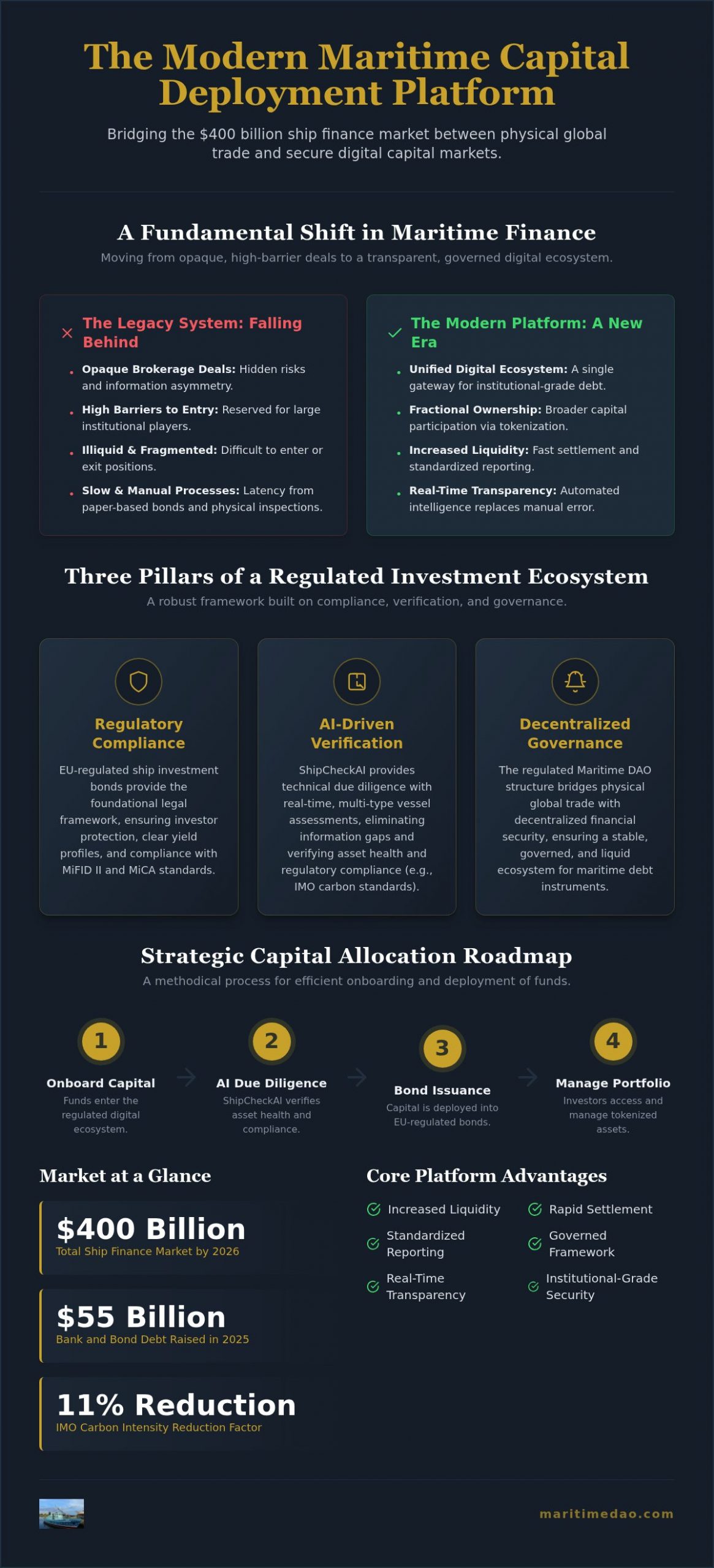
The maritime capital deployment platform represents a fundamental shift in how global trade is funded. It is a digital ecosystem where vessel financing and asset management converge through a unified technological stack. Historically, maritime asset investment relied on opaque, high-touch brokerage deals that excluded all but the largest institutional players. By 2026, the implementation of Basel IV banking standards has forced European lenders to become increasingly selective, creating a vacuum that only regulated innovation can fill. This transition from private, paper-based negotiations to transparent electronic deployment marks a new era for shipping finance. It’s no longer just about moving money; it’s about the precision of capital placement within a governed, legal framework.
From Private Equity to Electronic Capital Markets
The digitalization of maritime assets is dismantling the silos that once defined proprietary trading. In the past, ship debt was a fragmented market characterized by high entry barriers and illiquidity. Today, the modern maritime capital deployment platform serves as a unified gateway for institutional-grade maritime debt. This system allows for the fractionalization of large-scale assets, enabling a broader spectrum of capital to participate in the $400 billion ship finance market. By transitioning to electronic capital markets, the industry gains three distinct advantages: increased liquidity, standardized reporting, and rapid settlement cycles. These platforms provide a structural bridge that connects the physical world of global logistics with the digital speed of modern finance.
Why Traditional Ship Finance is Falling Behind
Legacy ship finance systems are struggling to keep pace with the rigorous demands of 2026. Manual vessel assessments and paper-based bond issuances introduce significant latency and risk into the capital allocation process. In a market where the International Maritime Organization has increased carbon intensity reduction factors to 11% relative to the 2019 baseline, investors can’t afford to wait weeks for physical inspection reports. Traditional models lack the real-time transparency required to monitor asset health and regulatory compliance. Modern investors demand a governed framework where automated intelligence replaces manual error, ensuring that every dollar deployed is backed by verifiable, up-to-the-minute data. This shift is driven by the need for structural integrity and a total absence of the opaque reporting that previously plagued the industry.
Core Pillars of a Regulated Maritime Investment Ecosystem
A robust maritime capital deployment platform rests upon three structural pillars: Regulatory Compliance, AI-Driven Verification, and Decentralized Governance. These components work in unison to transform a historically volatile sector into a predictable, institutional-grade asset class. By integrating these layers, the ecosystem provides a secure environment for asset-backed securities that mitigate the risks associated with global shipping. This governance model ensures that every fractional interest is protected by the same legal and technical rigors as traditional whole-ship ownership. It’s a system designed to provide stability in an era of rapid industrial transition.
EU-Regulated Ship Investment Bonds: The Compliance Standard
The primary vehicle for capital allocation within this ecosystem is the ship investment bond. These instruments are governed by strict European financial directives, ensuring they meet the high standards required by institutional investors and family offices. Utilizing EU regulated ship investment bonds allows for a structured approach to maritime debt, providing clear legal recourse and a transparent yield profile. In the 2026 market, where $55 billion in bank and bond debt was raised in 2025 alone, compliance with MiFID II and MiCA frameworks acts as a critical trust builder. These bonds serve as the foundational gateway for risk-averse capital seeking exposure to the global blue economy.
ShipCheckAI: The Technical Foundation of Deployment
Technical verification is the second pillar that secures the investment lifecycle. Integrating AI vessel inspection software directly into the deployment process eliminates the information asymmetry that often leads to capital loss. ShipCheckAI enhances the accuracy of maritime inspections by conducting multi-type vessel assessments, providing bondholders with real-time data on asset health and maintenance history. The necessity of AI in maritime due diligence before capital deployment cannot be overstated; it ensures that capital is only assigned to vessels that meet strict operational and environmental standards. This automated intelligence provides the empirical evidence needed to support high-stakes financial decisions on a modern maritime capital deployment platform.
Democratizing access to this sector requires a shift toward fractional ownership. By breaking down large-scale maritime assets into accessible, asset-backed securities, the platform opens the market to a global audience. This inclusivity is governed by a decentralized autonomous organization that maintains the structural integrity of the entire ecosystem. You can learn more about how these governed structures protect your interests by reviewing the compliant framework established by the Maritime DAO. This methodical approach ensures that the relationship between physical assets and digital governance remains transparent and secure for all participants.
Mitigating Risk with ShipCheckAI: The New Standard for Asset Due Diligence
The primary obstacle to large-scale maritime capital deployment is the inherent opacity of physical asset health. Investors frequently ask how they can verify the condition of a vessel located halfway across the globe. Traditional due diligence relies on subjective human judgment, which often introduces significant variance and potential for oversight in risk assessment. A modern maritime capital deployment platform solves this by replacing qualitative observations with quantitative, AI-driven data. By establishing a rigorous technical baseline, the platform ensures that capital is only assigned to vessels that meet strict operational and safety standards, thereby protecting the underlying value of the investment.
Automating the Vessel Assessment Process
The transition from manual checklists to AI-powered vessel surveys represents a significant leap in structural integrity. ShipCheckAI utilizes advanced computer vision and sensor fusion to perform multiple inspection types simultaneously, including pre-purchase, annual, and specialized condition surveys. This automation drastically reduces human error, ensuring that critical defects or maintenance lapses are identified with surgical precision. The system analyzes hull integrity, engine performance, and safety equipment through a standardized lens that remains immune to the fatigue or bias of traditional marine surveyors. AI-driven data acts as the ultimate collateral verification for maritime debt. This technical accuracy directly influences the valuation of ship bonds, as higher-quality data correlates with lower risk premiums and more stable yield projections for bondholders.
Continuous Monitoring vs. Static Reports
Long-term investors require more than a single snapshot of an asset’s condition at the time of purchase. Static reports quickly become obsolete in the demanding environment of global shipping, where wear and tear are constant. Integrating an AI ship inspection tool into the platform dashboard allows for the continuous monitoring of asset health throughout the bond’s lifecycle. This real-time visibility reduces the “black box” risk typically associated with maritime alternative investments. When bondholders can access live data on vessel performance and maintenance compliance, they gain a level of transparency previously reserved for physical shipowners. This methodical approach to monitoring ensures that any degradation in asset value is identified early, allowing for proactive governance and the preservation of capital across the entire ecosystem.
Transparency and Governance: The Role of a Regulated DAO
The Maritime DAO functions as the governing architect of the maritime capital deployment platform. It is a decentralized autonomous organization specifically engineered to manage tokenized ship ownership within a strictly regulated environment. Unlike speculative digital entities, this DAO operates under a comprehensive EU-compliant framework, providing the structural integrity required for institutional participation. It ensures transparent capital deployment by recording every transaction, vote, and asset update on an immutable ledger. This methodical approach eliminates the traditional opacity of ship finance, replacing it with a system where governance is both automated and legally enforceable.
Smart contracts serve as the operational backbone of this ecosystem. These self-executing protocols handle automated dividend distribution and coordinate voting processes with mathematical certainty. By removing manual intermediaries, the platform ensures that bondholders receive their yields the moment they are generated, while maintaining a clear audit trail for regulatory bodies. This level of automation is not a replacement for law, but rather a digital extension of it, ensuring that the rights of every participant are protected without the delays of legacy banking systems. It creates a unified environment where capital flows are governed by code yet anchored in legal reality.
Bridging Blockchain and Maritime Law
Understanding how maritime DAO investment functions in 2026 requires a shift in perspective. It’s the intersection of maritime law and regulated tokenized assets. Governance protocols within the platform are specifically designed to protect minority bondholders, ensuring that large-scale capital cannot override the rights of smaller fractional owners. This legal-technological hybrid allows the DAO to act as a reliable gatekeeper, bridging the gap between physical global trade and modern financial security.
The Institutional Case for Decentralized Governance
For institutional lenders, the primary benefit of decentralized governance is the radical reduction in the cost of capital. Transparency is the most effective tool for lowering risk premiums. By utilizing a unified ledger for all capital deployment activities, the platform provides a single source of truth for auditors, regulators, and investors alike. This creates a tripartite value proposition: enhanced speed of execution, institutional-grade security, and significantly lower administrative fees. As the shipping industry faces increasing pressure to modernize, the adoption of a regulated DAO structure within a maritime capital deployment platform becomes the logical choice for those seeking to deploy capital with maximum efficiency and minimum friction.
Strategic Capital Allocation: Accessing the Maritime Bond Market
The transition from identifying an opportunity to executing a trade within the shipping sector has historically been fraught with friction. By 2026, a sophisticated maritime capital deployment platform removes these barriers through a streamlined, digital-first onboarding process. Both accredited and retail investors can now access institutional-grade debt without the need for bespoke mandates or extensive physical networks. This accessibility is governed by a strict legal framework, ensuring that every participant operates within a secure and transparent ecosystem. It’s a methodical shift that prioritizes structural integrity over speculative speed.
Step-by-Step: From Onboarding to Yield
The journey starts with KYC and AML compliance, which is handled through automated verification systems aligned with EU financial regulations. Once the identity gate is passed, investors can navigate a curated list of bond offerings. Strategic allocation involves more than simply chasing the highest coupon; it requires a deep dive into the technical health of the underlying asset. You’ll evaluate bonds based on several criteria:
- Vessel Specifics: Analyze the ship type, age, and deadweight tonnage to ensure it fits your risk profile.
- ShipCheckAI Scores: Review the multi-type inspection data to verify the physical condition and maintenance compliance of the vessel.
- Deployment Terms: Examine the duration, yield, and asset-backed security structures that protect your principal.
After selection, the platform’s AI-driven dashboard provides a continuous stream of operational data. This allows you to monitor portfolio performance in real-time, moving beyond the static quarterly reports of the past. If your liquidity needs change, the secondary market provides a regulated environment to trade tokenized bond interests, offering a level of exit flexibility previously unheard of in maritime debt.
Diversifying Your Portfolio with Shipping Assets
Maritime debt serves as a powerful hedge against traditional market volatility, as global trade cycles often operate independently of equity market fluctuations. Understanding how to invest in maritime assets is essential for constructing a balanced 2026 portfolio that prioritizes structural integrity. By deploying capital through a regulated maritime capital deployment platform, you’re not just funding a vessel; you’re participating in a modernized global economy that values order and transparency. It’s time to move beyond legacy systems and join the evolution of maritime finance, where technical precision meets institutional reliability.
The Future of Maritime Debt: Navigating a Regulated Frontier
The convergence of institutional finance and automated intelligence has fundamentally altered the landscape of shipping investments. By integrating an EU-regulated framework with the technical precision of ShipCheckAI, the industry has finally solved the persistent issues of asset opacity and high entry barriers. This evolution provides a governed ecosystem where fractional ownership and secondary market liquidity are no longer theoretical concepts but operational realities. Utilizing a sophisticated maritime capital deployment platform ensures that your capital is assigned with surgical accuracy, backed by real-time asset health data and immutable governance.
As global trade continues to transition toward digitalization and decarbonization, the demand for transparent, yield-bearing maritime debt will only intensify. You now have the opportunity to participate in this high-stakes market with the security of legal compliance and technical verification. It’s time to bridge the gap between traditional asset management and the next generation of financial technology. The horizon for institutional-grade maritime debt has never been clearer.
Explore EU-Regulated Ship Bonds on Maritime DAO and take your place in the future of regulated ship finance.
Frequently Asked Questions
What is a maritime capital deployment platform?
A maritime capital deployment platform is a unified digital ecosystem that integrates technical verification with regulated financial instruments to facilitate vessel financing. It acts as a bridge between institutional capital and physical maritime assets, utilizing blockchain for transparency and AI for due diligence. This tripartite structure ensures that capital is deployed efficiently, securely, and within a governed framework that respects both maritime law and modern financial standards.
Are ship investment bonds regulated in the EU?
Yes, ship investment bonds on the platform are structured to comply with European financial directives, including MiFID II and the Markets in Crypto-Assets (MiCA) regulation. This regulatory alignment provides investors with a clear legal framework and institutional-grade protection. By adhering to these standards, the platform ensures that every bond offering meets the rigorous disclosure and transparency requirements necessary for professional and accredited capital allocation in the 2026 market.
How does ShipCheckAI protect my investment?
ShipCheckAI protects your investment by delivering objective, multi-type vessel assessments that eliminate the subjectivity of traditional surveys. The tool utilizes computer vision and sensor fusion to monitor hull integrity, engine performance, and safety compliance in real time. This technical oversight ensures that the underlying collateral for your bonds remains in optimal condition, drastically reducing the risk of asset degradation or unforeseen operational failures during the investment lifecycle.
Can retail investors participate in maritime DAO investments?
Retail investors can participate in maritime DAO investments through a fractional ownership model that lowers the traditional barriers to entry. By tokenizing EU-regulated ship investment bonds, the platform allows individuals to access yield-bearing maritime debt with smaller capital outlays. This inclusive approach is governed by a decentralized autonomous organization, ensuring that retail participants enjoy the same transparency, security, and voting rights as larger institutional lenders within the ecosystem.
What are the typical yields for maritime bond instruments in 2026?
Yields for maritime bond instruments in 2026 reflect a market with over $400 billion in outstanding debt and significant competition from alternative lenders. Following the implementation of Basel IV, yields have become more competitive as private credit funds fill the gap left by selective European banks. Investors typically find that these asset-backed bonds offer a premium over traditional corporate debt, reflecting the specialized nature of global shipping and the high-stakes environment of international trade.
How does the DAO structure handle vessel management and operations?
The DAO structure manages vessel operations through a system of smart contracts and automated technical gatekeeping. It coordinates with professional ship managers while using real-time data from the maritime capital deployment platform to ensure compliance with maintenance schedules and environmental mandates. This governance model allows for collective decision-making on major capital expenditures, ensuring that operations are transparent, methodical, and aligned with the long-term interests of all bondholders.
What happens if a vessel fails a ShipCheckAI inspection?
If a vessel fails a ShipCheckAI inspection, the platform triggers an immediate governance protocol requiring a corrective action plan. For vessels already financed, this may lead to a mandatory repair period to restore the asset’s collateral value. For new offerings, a failed inspection results in the immediate restriction of capital deployment. This methodical approach ensures that only vessels meeting the highest safety and operational standards remain active within the regulated investment ecosystem.
Is there a secondary market for tokenized ship bonds?
Yes, the platform facilitates a regulated secondary market where tokenized ship bonds can be traded among verified participants. This feature provides a level of liquidity that was previously unavailable in traditional ship finance, where debt was often held until maturity. By allowing investors to exit positions or rebalance portfolios, the secondary market enhances the overall attractiveness of maritime debt as a flexible and liquid asset class for modern portfolios.