
The global shipping industry is undergoing a fundamental shift where the physical reliability of a hull must now match the precision of a digital smart contract. You likely recognize that the era of opaque vessel data and speculative maritime tokens is ending, replaced by a demand for institutional-grade transparency. To succeed in this new frontier, performing comprehensive due diligence for digital maritime investments has become an exercise in bridging the gap between heavy industry and high finance. You deserve a methodology that replaces uncertainty with verified, real-time intelligence.
We understand that the complexity of ship-backed security audits and the shifting sands of global regulations can feel like a barrier to significant capital deployment. This reference guide provides the clarity you need to master these intricacies by uniting AI-driven technical assessments with the rigorous standards of EU-regulated financial compliance. We will outline a definitive checklist for digital maritime DD, explain the mechanics of regulated bond frameworks, and show you how a unified ecosystem of automated intelligence ensures the structural integrity of your portfolio.
Key Takeaways
- Understand the shift from manual surveys to a unified framework for due diligence for digital maritime investments that leverages real-time data.
- Learn how AI-driven vessel assessments identify structural risks and standardize technical reports across diverse global fleets.
- Evaluate the legal enforceability of EU-regulated ship investment bonds to ensure structural integrity within a DAO ecosystem.
- Use the 2026 reference checklist to verify that smart contract code accurately reflects the underlying legal prospectus.
- Discover how a unified ecosystem bridges the gap between physical maritime assets and institutional-grade digital governance.
The Evolution of Due Diligence for Digital Maritime Investments
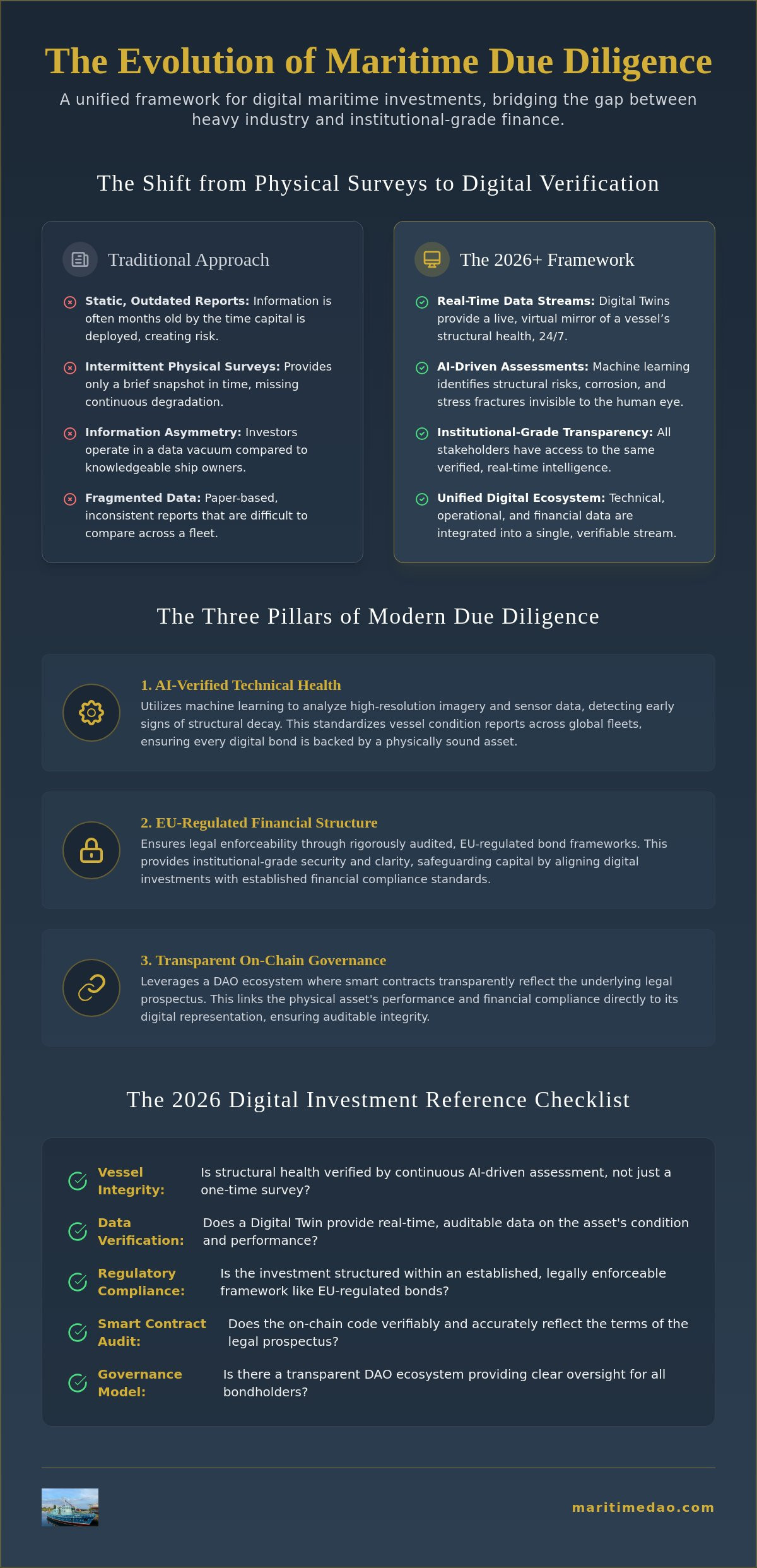
The legacy of maritime finance is built on the physical ledger and the intermittent physical survey. For decades, investors relied on static reports that were often months out of date by the time capital was deployed. This traditional model creates a dangerous information asymmetry where ship owners possess deep operational knowledge while investors operate in a vacuum of delayed data. As we move into 2026, this paradigm is collapsing. Executing robust due diligence for digital maritime investments now requires a synthesis of naval architecture and algorithmic auditing, ensuring that every asset is as sound in its physical form as it is in its digital wrapper.
In its most fundamental sense, due diligence serves as the primary safeguard against systemic risk, yet the methods for achieving this have been radically reimagined. The modern framework is a tripartite system: it demands AI-verified technical health, EU-regulated financial structure, and transparent governance. We’re moving away from fragmented, paper-based surveys toward a unified digital asset assessment. This evolution doesn’t just improve accuracy; it redefines the scope of what an investor should expect. You’re no longer just evaluating a hull; you’re auditing a governed ecosystem where physical performance and financial compliance are inextricably linked.
From Physical Surveys to Digital Twin Verification
Digital twins act as a live, virtual mirror of a vessel’s structural health, providing bondholders with a level of oversight previously reserved for technical managers. Traditional inspections provide a static snapshot that’s often obsolete by the time an investment is finalized. By shifting to continuous asset monitoring, the industry has eliminated the “blind spots” that historically led to unforeseen maintenance costs. This digital verification doesn’t just mitigate risk; it accelerates capital deployment. When technical data is streamed in real-time, the time required to validate asset value drops from weeks to hours, allowing for the rapid scaling of global shipping portfolios.
Why 2026 is the Turning Point for Maritime Due Diligence
The current year marks a definitive shift as institutional investors demand 24/7 transparency in maritime debt. Increased regulatory scrutiny across global markets has made the “black box” approach to shipping finance untenable. Institutional-grade capital now flows toward structures that offer legal certainty and technical proof. Leading maritime fintech platforms are standardizing these processes, creating a bridge between the high-stakes world of global trade and the precision of decentralized technology. This transition ensures that due diligence for digital maritime investments is no longer a hurdle to be cleared, but a continuous mechanism for maintaining trust and structural integrity throughout the investment lifecycle.
Technical Integrity: AI-Driven Vessel Assessment as a DD Pillar
AI-driven vessel assessment utilizes machine learning algorithms to identify structural risks and anomalies that often remain invisible to the human eye. In the context of due diligence for digital maritime investments, technical integrity is no longer a matter of subjective opinion but a quantifiable data set. By analyzing high-resolution imagery and sensor data, these systems detect early signs of corrosion, stress fractures, and mechanical degradation. This level of granularity is essential when tokenizing a physical asset, as the digital bond’s value is directly tied to the vessel’s operational health.
Traditional classification societies like DNV’s maritime due diligence services have long provided a foundation for technical safety, but the integration of automated intelligence adds a layer of real-time standardization. Automated intelligence standardizes ship condition reports across global fleets, ensuring that an investor in Singapore can evaluate a bulk carrier in Rotterdam with the same level of confidence. This process unifies technical, operational, and environmental data into a single, verifiable stream. Integrating this data into the investment decision-making framework allows for a more accurate assessment of an asset’s true net present value.
ShipCheckAI: Standardizing Digital Inspections
ShipCheckAI serves as a critical gateway for comprehensive vessel assessments prior to bond issuance. By conducting multiple inspection types, including hull, engine, and environmental compliance reviews, it creates a transparent record of asset health. This methodology significantly reduces the human error and inherent bias found in traditional ship surveys. Beyond current status, the AI plays a predictive role, forecasting maintenance costs and potential operational downtime. This foresight allows bondholders to model cash flows with institutional precision, ensuring that capital is protected from unforeseen technical failures.
Verifying Technical Claims in Digital Maritime Investments
True technical transparency requires cross-referencing AI-generated reports with historical AIS data and maintenance logs to ensure a complete picture of asset history. This multi-layered approach is fundamental to maritime investment compliance, ensuring that every claim made in a legal prospectus is backed by empirical technical evidence. By unifying these disparate data sources, investors gain a holistic view of the vessel’s lifecycle and its impact on the security’s performance. AI-driven vessel assessment stands as the primary risk-mitigation tool for 2026 bondholders, providing a definitive barrier against asset devaluation. To see how these technical pillars integrate into a secure financial ecosystem, you can explore the Maritime DAO platform.
Regulatory and Governance Due Diligence in a DAO Ecosystem
The shift from physical vessel integrity to digital asset security requires a rigorous assessment of the legal and operational frameworks that govern these instruments. Evaluating the legal enforceability of EU-regulated ship investment bonds is the cornerstone of due diligence for digital maritime investments. Unlike speculative crypto-assets, these bonds are grounded in established financial law, providing investors with the same protections found in traditional debt markets while leveraging the efficiency of blockchain technology. You’re not just auditing a technical system; you’re verifying a regulated financial product that bridges the gap between decentralized innovation and institutional reliability.
A critical component of this process involves performing due diligence on the underlying smart contracts. It’s essential to ensure that the code reflects every provision of the legal prospectus to prevent “drift” between technical execution and legal obligation. The DAO acts as the orchestrator of this relationship, managing asset governance and facilitating investor voting rights through a unified framework. Assessing the transparency of the maritime DAO investment model allows you to confirm that governance is both decentralized and legally sound, ensuring that every operational pillar is governed by code that respects legacy financial systems.
EU Financial Regulation and Asset-Backed Security
Navigating the Markets in Crypto-Assets (MiCA) regulation alongside existing EU bond frameworks is mandatory for institutional participation in 2026. Regulated debt instruments offer structural security that unregulated maritime tokens simply can’t match, as they operate under the sober reliability of established financial oversight. By utilizing third-party custodians, the ecosystem ensures that digital keys and physical assets are managed with professional rigor. This structure provides a clear legal recourse for bondholders, positioning the investment as a credible alternative to traditional maritime debt.
DAO Governance: Transparency and Accountability
Accountability in a digital ecosystem relies on a clear understanding of the “on-chain” vs. “off-chain” governance split. While day-to-day operational decisions may happen off-chain, financial distributions and high-level asset governance are executed on-chain to ensure immutability. This decentralized oversight prevents the mismanagement of physical assets by requiring collective authorization for significant actions, such as asset divestment or major refits. Maintaining maritime investment transparency is achieved through immutable governance logs, providing an audit trail that is accessible to all stakeholders. This methodical approach ensures that due diligence for digital maritime investments remains a transparent, governed, and ultimately secure process for global capital.
The 2026 Digital Maritime Investment Reference Checklist
Performing thorough due diligence for digital maritime investments requires a methodology that moves beyond traditional checklists to include automated, real-time verification pillars. The 2026 standard is defined by five critical assessment categories: technical integrity, legal compliance, and digital security. This framework ensures that every ship-backed bond is supported by empirical data rather than speculative projections. By unifying these disparate fields, investors can maintain the structural integrity of their portfolios while capturing the efficiencies of decentralized finance.
Your assessment should prioritize the following institutional benchmarks:
- Technical: AI-verified condition reports and maintenance forecasts generated through tools like ShipCheckAI.
- Legal: Verification of EU-regulated bond status and strict alignment with the legal prospectus.
- Digital: Independent smart contract audits and complete DAO governance transparency.
- Financial: Accurate asset valuation, debt-to-equity ratios, and realistic yield projections.
- Environmental: Full IMO 2023/2026 compliance and Carbon Intensity Indicator (CII) ratings.
Commercial Viability and Market Positioning
Assessing a vessel’s earning potential requires a deep analysis of current and future freight markets. It’s not enough to look at historical rates; you must evaluate the track record of the technical manager and the bond issuer to gauge operational resilience. Benchmarking projected returns against traditional shipping equities allows you to determine if the digital instrument offers a superior risk-adjusted yield. This commercial scrutiny ensures that the underlying physical asset can meet the financial obligations defined in the smart contract.
ESG and Sustainability Benchmarking
Modern digital DD tools now track real-time emissions data, which is essential for green bond compliance. The role of AI in verifying decarbonization targets has become a mandatory requirement for institutional-grade maritime assets. By integrating social and governance metrics into the final score, you create a holistic view of the investment’s long-term viability. This comprehensive approach to due diligence for digital maritime investments protects capital against the rising costs of environmental non-compliance. To streamline your assessment process using these institutional standards, you can access the Maritime DAO ecosystem.
Securing Capital through the Maritime DAO Ecosystem
The Maritime DAO ecosystem unifies the technical, legal, and financial pillars of due diligence for digital maritime investments into a single, cohesive gateway. This integration eliminates the friction of traditional shipping finance by providing a transparent environment where every asset is governed by code and protected by law. For institutional and accredited investors, this represents a shift from fragmented risk assessment to a systematic, high-tech methodology that ensures structural integrity at scale. It’s a new standard for a global industry.
Investing in EU-regulated ship investment bonds offers a distinct advantage over unregulated digital assets. These instruments provide a familiar legal framework for capital protection while utilizing blockchain for real-time settlement and transparency. By scaling a maritime portfolio through ShipCheckAI verification, investors can deploy capital with the confidence that every vessel has passed a rigorous, AI-driven audit. Safety is non-negotiable. This tripartite approach ensures that technical verification, legal compliance, and digital governance work in unison to protect institutional interests.
Accessing Regulated Maritime Debt
The process of capital allocation within a compliant DAO framework is designed for professional rigor and operational speed. ShipCheckAI supports the issuance of high-quality maritime bonds by providing the empirical technical data required for institutional-grade prospectus verification. This automated due diligence workflow significantly reduces transaction costs and eliminates the delays associated with manual, third-party surveys. It’s a methodical approach that allows for the rapid deployment of capital into verified, income-generating assets without compromising on safety or compliance. Efficiency drives returns. For investors in 2026, the next steps involve integrating these digital workflows into their existing portfolio management systems to capture the full potential of automated intelligence.
The Future of Verified Maritime Intelligence
As the ecosystem evolves, it’ll increasingly support fractional ship ownership, democratizing access to a sector that was once the exclusive domain of legacy banks. Investors can now build a diversified portfolio of AI-vetted shipping assets, spreading risk across different vessel types and global trade routes. This evolution ensures that due diligence for digital maritime investments remains a continuous, data-driven process rather than a one-time event. This ongoing oversight provides a level of security that traditional ship finance can’t match, as it relies on real-time data rather than historical snapshots. Maritime DAO serves as the primary bridge between the established trust of traditional maritime operations and the high-velocity efficiency of digital financial governance.
Charting the Future of Institutional Maritime Finance
The transformation of global shipping finance is no longer a distant vision; it’s a present reality governed by technical precision and legal rigor. By integrating AI-powered ShipCheckAI assessments with a robust EU-regulated financial framework, investors can now bypass the opacity that once defined this sector. This unified approach ensures that every tokenized asset is backed by real-time data and institutional-grade transparency through DAO governance. The landscape of due diligence for digital maritime investments has been fundamentally reshaped, providing a secure bridge between physical maritime trade and the digital capital markets.
You now possess the framework to evaluate these complex assets with confidence, moving from intermittent physical surveys to continuous digital oversight. The convergence of naval engineering and fintech compliance offers a first-of-its-kind opportunity to scale portfolios with unprecedented efficiency. To begin your journey into this new frontier of secure, high-yield assets, you’re invited to Explore EU-Regulated Ship Investment Bonds at Maritime DAO. The future of maritime investment is transparent, governed, and ready for your participation.
Frequently Asked Questions
What is the most critical step in due diligence for tokenized maritime assets?
The most vital phase involves verifying the structural integrity of the physical hull alongside the legal enforceability of the digital instrument. This requires a tripartite review that unites AI-driven technical data, EU regulatory compliance, and rigorous smart contract auditing. You must ensure that the digital bond is not merely a speculative token but a governed debt instrument backed by a verified physical asset.
How does ShipCheckAI improve the accuracy of vessel assessments?
ShipCheckAI utilizes machine learning algorithms to analyze high-resolution imagery and sensor data, identifying structural risks like micro-fractures or deep-seated corrosion that human eyes often miss. It standardizes technical reports across diverse global fleets, removing the subjective bias inherent in traditional surveys. This automated intelligence provides predictive maintenance forecasts, allowing bondholders to model operational downtime with institutional precision.
Are EU-regulated ship investment bonds safer than traditional maritime equity?
These bonds offer a superior risk-adjusted profile by combining debt-priority status with the strict oversight of EU financial frameworks. Traditional maritime equity often suffers from information asymmetry and opaque management structures, whereas digital bonds provide institutional-grade transparency through immutable governance logs. This regulated innovation ensures that your capital is protected by established legal recourse and real-time technical oversight.
Can I verify the condition of a vessel in real-time before investing?
Yes, the integration of digital twin technology and continuous sensor monitoring allows for live technical data streams. You can access a vessel’s current operational status and maintenance history through the DAO’s unified dashboard before committing capital. This capability eliminates the “blind spots” associated with periodic manual surveys, ensuring the physical asset’s condition perfectly matches its digital representation.
What regulatory frameworks govern digital maritime investments in 2026?
The landscape is primarily governed by the Markets in Crypto-Assets (MiCA) regulation and existing EU bond frameworks. These laws ensure that digital maritime assets operate within a transparent, governed, and legally sound ecosystem. By adhering to these institutional standards, the industry has bridged the gap between decentralized technology and the sober reliability of traditional finance.
How does a DAO handle physical ship management and maintenance?
The DAO serves as a digital architect, overseeing technical managers who execute physical maintenance and daily operations. All significant management decisions, such as major refits or divestments, are governed by smart contracts that reflect investor voting rights. This structure ensures that physical asset management remains transparent, accountable, and strictly aligned with the legal prospectus.
What happens if the AI inspection contradicts a manual survey?
AI-driven reports act as the primary technical truth because they rely on quantifiable, high-resolution data sets rather than subjective human observation. If a discrepancy arises, the ecosystem triggers a secondary, targeted audit to reconcile the data points. This methodical process ensures that due diligence for digital maritime investments remains accurate and free from the errors typical of legacy inspection methods.
Is due diligence for digital assets more expensive than traditional maritime DD?
It’s actually more cost-effective because automated intelligence and digital workflows reduce the need for multiple manual administrative layers. While it requires specialized auditing for smart contracts, the overall transaction costs are lower due to the speed and precision of AI-driven tools. This efficiency allows for faster capital deployment while maintaining a higher standard of due diligence for digital maritime investments.