
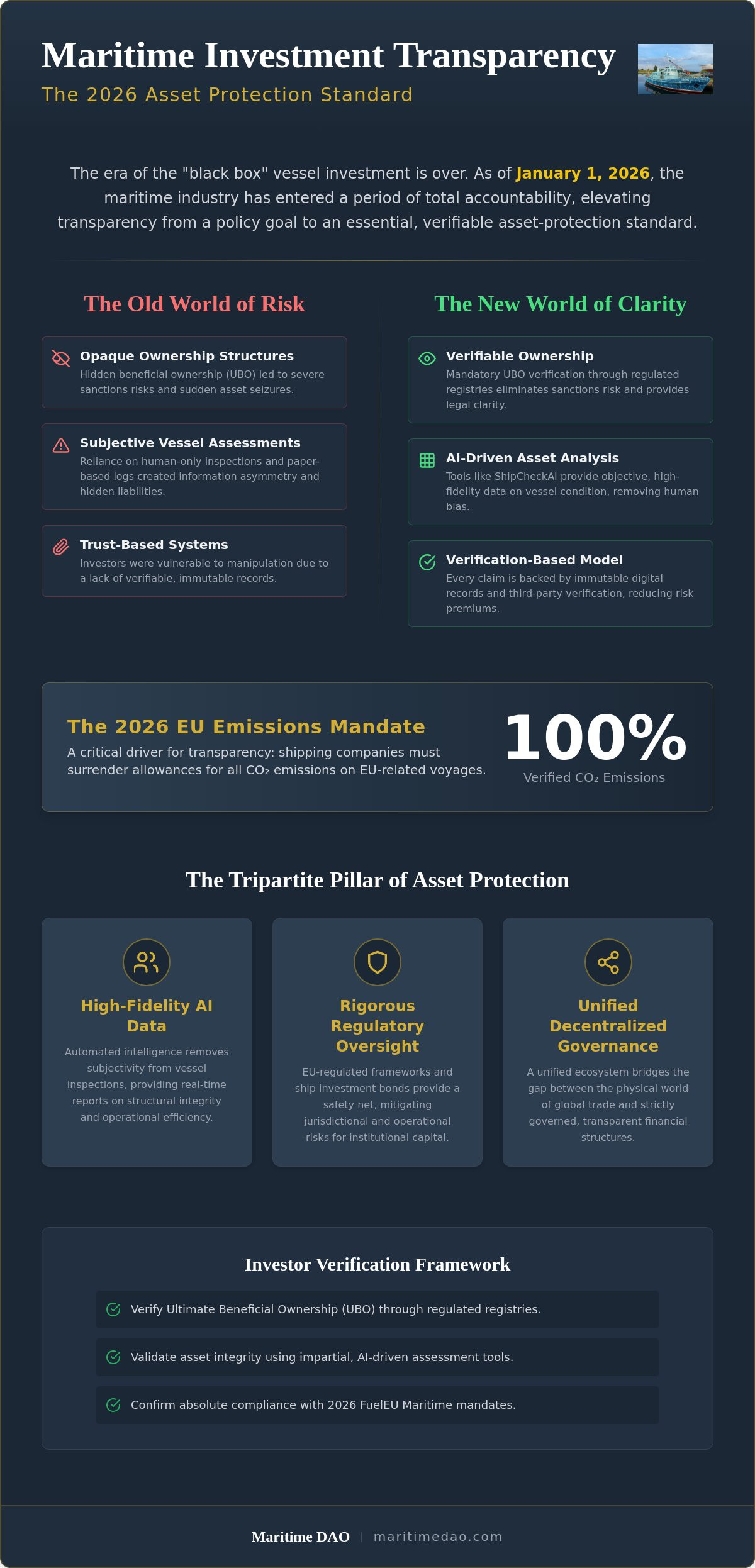
The era of the “black box” vessel investment is officially over. As of January 1, 2026, the maritime industry has entered a period of total accountability, where shipping companies must surrender allowances for 100% of their verified CO₂ emissions for all EU-related voyages. This shift has elevated maritime investment transparency from a high-level policy goal to an essential, verifiable asset-protection standard. You’ve likely felt the profound uncertainty of opaque offshore ownership structures or the lack of real-time data on a vessel’s true condition. It’s a valid concern; the complexity of global trade often masks the risks of non-compliance with evolving EU regulations.
This guide clarifies how modern technology and institutional oversight are unifying these disparate systems. You’ll discover how AI-driven analysis and EU-regulated financial frameworks now provide a clear, data-backed path for capital deployment. We’ll explore the integration of automated intelligence in risk reduction, the impact of the 2026 FuelEU Maritime mandates, and the framework for assessing regulated maritime debt instruments with confidence. By the end of this analysis, you’ll understand how to turn transparency into your most reliable investment hedge.
Key Takeaways
- Define maritime investment transparency as a verifiable asset-protection standard that integrates ownership clarity, technical condition, and strict regulatory compliance.
- Discover how ShipCheckAI utilizes automated intelligence to remove human subjectivity from vessel inspections, ensuring high-fidelity, real-time asset reports.
- Identify why EU-regulated ship investment bonds have become the premier instrument for institutional investors seeking to mitigate jurisdictional and operational risks in 2026.
- Gain a practical framework for verifying Ultimate Beneficial Ownership (UBO) and validating asset integrity through regulated registries and AI-driven assessments.
- Understand the role of a unified ecosystem in bridging the gap between the physical world of global trade and decentralized, yet strictly governed, financial structures.
The Evolution of Maritime Investment Transparency in 2026
The maritime industry is shedding its historical reputation for secrecy, replacing it with a sophisticated framework of accountability. In 2026, maritime investment transparency is defined as the verifiable clarity of three critical vectors: beneficial ownership, real-time vessel condition, and absolute regulatory compliance. This is no longer a peripheral ESG metric; it’s the primary mechanism used to protect institutional capital. This evolution marks a definitive transition from the “Old World” of opaque offshore registries and hidden shells to a robust ecosystem of maritime investment compliance. Investors are no longer satisfied with self-reported data or vague jurisdictional assurances. They demand a system where every claim is backed by immutable records and third-party verification.
Capital is aggressively migrating toward the shipping sector because transparency has become a verifiable asset-protection standard. Institutional lenders and private equity firms are prioritizing projects that offer a clear line of sight into operational performance and legal standing. Modern maritime investment transparency stands upon a tripartite pillar: high-fidelity AI data, rigorous regulatory oversight, and unified decentralized governance. These three elements work in concert to ensure that the physical reality of a vessel matches its financial representation. By integrating these pillars, the industry has successfully lowered the risk premium associated with maritime debt, making shipping a more attractive alternative to traditional fixed-income assets.
Why Historical Opaqueness is a Risk Factor
The cost of “blind” investing in traditional maritime structures has become too high to ignore. In the past, hidden beneficial ownership often led to severe regulatory and sanctions risks, leaving investors vulnerable to sudden asset seizures or legal entanglements. This lack of clarity created a trust-based system that was easily manipulated. Today, the market has pivoted to a verification-based model. Verification ensures that every stakeholder is identified and every asset is accounted for, removing the shadow of doubt that once plagued large-scale maritime finance. Without this clarity, investors face an unacceptable level of jurisdictional uncertainty that can erode returns overnight.
The Role of Digital Transformation in Asset Clarity
Digital transformation has replaced the fallible nature of paper-based vessel logs with immutable digital records. While the International Maritime Organization (IMO) sets the global baseline for safety and environmental standards, modern investors require deeper operational insights. Real-time monitoring systems now provide a continuous stream of data on fuel consumption, engine health, and emissions performance. This connectivity reduces the information asymmetry that historically existed between shipowners and passive investors. Transparency is the elimination of information gaps between physical assets and financial markets. By bridging this gap, technology ensures that every investment decision is grounded in objective, real-time reality rather than historical projections.
Technological Pillars: AI and Real-Time Vessel Assessment
The physical state of a maritime asset is no longer a matter of opinion or subjective interpretation. In the 2026 investment landscape, AI-driven tools have effectively removed human bias from vessel condition reports, replacing traditional “expert” assessments with high-fidelity, data-backed analysis. This shift is fundamental to achieving true maritime investment transparency. By utilizing automated intelligence, investors can now verify the structural integrity and operational efficiency of a ship without relying on the potentially compromised narratives of intermediaries. These systems analyze thousands of data points, from hull thickness to engine thermal signatures, to identify structural anomalies that human inspectors might miss.
ShipCheckAI and the Standardization of Inspections
ShipCheckAI serves as a cornerstone of this new assessment paradigm by providing an objective lens through which assets are evaluated. By integrating this AI ship inspection tool guide into the investment lifecycle, stakeholders gain access to standardized, multi-type inspections that provide a comprehensive risk profile. These aren’t isolated snapshots; they’re deep-dive evaluations that ensure every bondholder’s security is grounded in technical reality. Whether it’s a pre-purchase survey or a routine maintenance check, the standardization of data ensures that all assets within a portfolio are measured against the same rigorous benchmarks, providing a level of consistency that was previously impossible in the fragmented shipping market.
From Annual Audits to Continuous Monitoring
The industry is moving rapidly from periodic annual audits to a model of continuous, real-time monitoring. The integration of IoT sensors and AI-governed data feeds creates a “living” audit trail that documents every mile traveled and every ton of fuel consumed. This constant visibility allows for the early detection of issues, significantly reducing hidden maintenance costs that often erode investment returns. Transparency in vessel operations directly correlates to bond yield stability; when an asset’s health is known in real-time, the risk of sudden operational failure is neutralized. This level of disclosure aligns perfectly with the Poseidon Principles for Financial Institutions, which now govern over 80% of the global ship finance market, demanding that climate and operational data be both accurate and accessible.
As these technological pillars unite, they form a unified gateway for capital that values order and security. Automated data feeds ensure that the relationship between the physical ship and its digital representation is never broken, maintaining the integrity of the investment throughout its term. To explore how these tools integrate into a broader financial ecosystem, investors should consider the role of a regulated maritime finance platform in managing these complex data streams.
Regulatory Frameworks: EU Compliance as a Safety Net
The regulatory landscape of 2026 has transformed maritime investment transparency from a voluntary disclosure into a mandatory financial requirement. EU financial regulations now serve as a critical safety net, providing a governed framework that protects capital from the volatility of unregulated markets. Central to this shift is the application of the EU Taxonomy and MiCA-inspired frameworks to maritime assets, ensuring that every instrument is subject to strict oversight and reporting standards. Within this environment, EU regulated ship investment bonds have emerged as the gold standard, offering a level of structural integrity that traditional offshore structures simply cannot match. This transition is enforced by the maritime fintech platform, which acts as a reliable gatekeeper by automating compliance checks and ensuring that asset data is both accurate and immutable.
The Poseidon Principles and Beyond
The Poseidon Principles have evolved into the definitive institutional benchmark for climate and financial disclosure, now representing roughly two-thirds of the global ship finance market. By aligning investment portfolios with these standards, institutions can effectively mitigate the risk of “stranded assets,” which are vessels that fail to meet the 100% EU ETS allowance surrender or the 11% IMO carbon intensity reduction required in 2026. This alignment isn’t just about environmental stewardship; it’s a fundamental strategy for capital preservation. As highlighted in Mirova’s 2025 Transparency Report, the integration of ESG data into core financial strategy is now a prerequisite for institutional participation. The move from voluntary reporting to mandatory enforcement ensures that maritime investment transparency is backed by the full weight of European law.
Legal Recourse in Transparent Bond Structures
A primary distinction in the 2026 market is the gap between unregulated offshore tokens and EU-regulated bonds. While the former often lacks clear legal standing, the latter provides bondholders with verifiable, enforceable claims on physical assets. These instruments function as true asset-backed securities, where the underlying vessel serves as collateral within a governed legal framework. This transparency ensures that investors have clear legal recourse in the event of a default, a security feature that’s absent in speculative digital asset circles. By anchoring digital finance in the physical reality of heavy industry, these regulated structures provide the democratization of complex financial assets without sacrificing the sobriety of institutional finance.
How to Verify Transparency: An Investor Checklist
Identifying high-fidelity opportunities in 2026 requires a methodical departure from legacy due diligence practices. As the industry moves toward a verification-based model, the burden of proof has shifted from the investor to the platform. Achieving true maritime investment transparency is no longer about trusting a relationship; it’s about auditing a system. For a comprehensive methodology on this process, the due diligence for digital maritime investments reference guide provides an institutional-grade framework for bridging technical assessments with EU-regulated financial compliance. To ensure your capital is protected by the highest standards of regulated innovation, utilize the following five-step verification framework:
- Step 1: Verify Ultimate Beneficial Ownership (UBO). Scrutinize the asset’s standing through regulated registries to ensure absolute clarity on who controls the vessel, neutralizing sanctions and jurisdictional risks.
- Step 2: Demand AI-Validated Condition Reports. Reject subjective, paper-based logs. Ensure the asset has undergone recent, high-fidelity inspections that utilize automated intelligence to identify structural or mechanical anomalies.
- Step 3: Confirm Regulatory Jurisdiction. Ensure the investment vehicle is governed by EU-regulated frameworks, providing a level of legal recourse and oversight that offshore “token” structures cannot offer.
- Step 4: Audit Real-Time Data Access. Verify that bondholders have continuous access to operational data feeds, including fuel consumption and emissions performance, to monitor asset health in real-time.
- Step 5: Review the Governance Model. Assess whether the platform utilizes a unified, transparent governance structure that aligns the interests of shipowners, technology providers, and investors.
Performing Due Diligence on Vessel Condition
Investors must scrutinize the technical veracity of an asset before committing capital. This process begins with the maritime inspection compliance tool checklist, which provides a standardized benchmark for evaluating vessel integrity. It’s essential to verify the credentials of the AI inspection platform used; an uncertified or proprietary system without third-party validation is a significant red flag. Opaque maintenance logs or gaps in historical operational data often signal underlying structural issues that could lead to unforeseen capital expenditures or regulatory fines. By demanding standardized, AI-powered surveys, you ensure that the physical reality of the ship matches its financial projections.
Assessing the Investment Platform Architecture
The tech stack of a maritime finance platform acts as the digital infrastructure for your financial security. In 2026, the role of smart contracts is pivotal, as they automate the transparent distribution of profits and enforce compliance rules without human interference. You must verify the immutable link between the digital bond and the physical, IMO-registered vessel. This connectivity ensures that your investment is an asset-backed security with a verifiable claim on a tangible piece of global trade. A platform that unifies these technological and legal pillars provides the democratization of maritime finance while maintaining the sobriety of institutional asset management. To secure your position in a governed shipping ecosystem, you should access the Maritime DAO investment gateway and review our current regulated offerings.
Maritime DAO: A Unified Ecosystem for Transparent Finance
Maritime DAO unifies technical verification and institutional finance into a single, cohesive gateway for global capital. By consolidating AI-driven inspections and governed financial instruments, the ecosystem establishes a new paradigm for capital deployment in the shipping sector. In this architecture, ShipCheckAI functions as the “eyes” of the investor, providing high-fidelity technical data, while EU-regulated ship investment bonds serve as the “shield,” offering a robust legal and financial framework for asset protection. This synergy ensures that maritime investment transparency is no longer a fragmented policy goal but a functional, verifiable reality that protects every stakeholder in the value chain.
The future of global trade depends on frictionless capital flow, which can only be achieved through total accountability. Maritime DAO acts as a visionary architect, building a bridge between the physical world of heavy industry and the digital world of regulated finance. This unified approach eliminates the systemic inefficiencies of the past, replacing them with a methodical system of governance that values order and security. By integrating real-time operational data with decentralized yet strictly governed oversight, the DAO provides a first-of-its-kind infrastructure for institutional and private investors alike.
Regulated Innovation: The Maritime DAO Model
The Maritime DAO model succeeds by bridging the gap between traditional maritime legacy and digital finance. It respects the established standards of global shipping while introducing the efficiency of automated governance. This ecosystem ensures all participants adhere to the same transparency standards, creating an environment where data integrity is the primary currency. A unified approach to asset management means that technical health, regulatory status, and financial performance are monitored simultaneously. This connectivity allows for more precise risk pricing and ensures that capital is directed toward vessels that meet the highest environmental and operational benchmarks of 2026.
Next Steps for the Transparent Investor
For investors seeking to move beyond speculative digital assets, the path forward is grounded in regulated innovation. Accessing EU-regulated ship investment bonds through the Maritime DAO platform provides a clear, data-backed route to maritime exposure. Every asset within the ecosystem is accompanied by a “digital twin” condition report, ensuring that the physical reality of the ship is always visible to the bondholder. This long-term commitment to maritime investment transparency ensures that your portfolio remains resilient against the evolving regulatory mandates of the EU and IMO. To begin your transition into a more secure and accountable financial future, you can explore the Maritime DAO ecosystem and our regulated bond offerings.
The Future of Governed Maritime Capital
The maritime landscape of 2026 demands a definitive departure from the speculative uncertainty of the past. We’ve explored how the integration of high-fidelity AI data and strict EU mandates has fundamentally redefined maritime investment transparency, transforming it from a policy goal into a verifiable asset-protection standard. By utilizing ShipCheckAI proprietary inspection technology and operating within a robust EU-regulated financial framework, investors now possess the tools to verify asset integrity with institutional precision. This unified ecosystem, supported by an expansive global maritime stakeholder network, successfully bridges the gap between physical trade and digital governance.
It’s an era where technical truth and legal recourse unite to provide a secure, democratized gateway for global capital. As the industry moves toward total accountability, your investment strategy must pivot from trust-based assumptions to verification-based certainty. Leveraging these technological and regulatory pillars ensures your portfolio remains resilient and compliant in an increasingly transparent world. We invite you to join this new frontier of regulated innovation.
Secure your capital with EU-regulated ship investment bonds on the Maritime DAO platform.
Frequently Asked Questions
What is maritime investment transparency?
Maritime investment transparency is the verifiable clarity regarding a vessel’s ultimate ownership, its real-time technical condition, and its total compliance with international maritime law. It functions as a high-fidelity bridge between physical assets and financial markets, ensuring that every claim made by a shipowner is backed by immutable data. This standard eliminates the historical information gaps that once obscured jurisdictional and operational risks for institutional capital.
How does AI improve transparency in ship inspections?
Automated intelligence removes human subjectivity and bias from the assessment process by analyzing thousands of distinct data points simultaneously. AI systems evaluate hull integrity, engine thermal signatures, and historical maintenance logs to identify structural anomalies that human inspectors often overlook. This technological pillar provides an objective, standardized technical audit that serves as a reliable baseline for risk profiling and asset valuation.
Why are EU-regulated ship investment bonds safer than unregulated options?
EU-regulated bonds operate within a strictly governed legal framework that provides investors with enforceable claims on physical assets. Unlike unregulated offshore tokens, these instruments are subject to MiCA-inspired oversight and the EU Taxonomy, ensuring high levels of maritime investment transparency. This structure offers a clear path for legal recourse and asset recovery, anchoring digital finance in the sober reliability of traditional institutional frameworks.
What is Ultimate Beneficial Ownership (UBO) in shipping?
Ultimate Beneficial Ownership identifies the actual individuals who own or control a maritime asset, effectively piercing through complex offshore shell company structures. In the 2026 regulatory environment, verifying UBO is an essential step in mitigating sanctions and jurisdictional risks. Regulated registries now provide a transparent audit trail, ensuring that investors know exactly who they are doing business with before capital is deployed.
Can retail investors benefit from maritime investment transparency?
The democratization of ship finance allows retail investors to participate in an industry that was once the exclusive domain of large institutions. High standards of maritime investment transparency provide smaller investors with the same high-fidelity data and regulatory protections enjoyed by major banks. By utilizing regulated gateways, individuals can invest in asset-backed bonds with confidence, knowing the underlying vessel’s health and legal standing are verified.
How does ShipCheckAI verify the condition of a vessel for investors?
ShipCheckAI utilizes proprietary automated intelligence to process multi-type inspection data into a comprehensive technical report. The system integrates visual evidence and sensor data to create a “digital twin” of the vessel, reflecting its current operational state. This process provides bondholders with a living audit trail, ensuring that the ship’s physical reality is accurately represented in the financial documentation at all times.
What role does blockchain play in maritime transparency?
Blockchain serves as an immutable ledger for recording ownership transfers, AI-validated inspection reports, and regulatory compliance certificates. This technology ensures that once data is entered into the ecosystem, it cannot be altered or manipulated by any single party. By providing a decentralized yet governed record of truth, blockchain maintains the integrity of the investment throughout its entire lifecycle, from issuance to maturity.
How do the Poseidon Principles affect my investment?
The Poseidon Principles serve as a global benchmark for climate alignment, governing how financial institutions assess and disclose the carbon intensity of their shipping portfolios. For an investor, alignment with these principles ensures that capital is directed toward vessels that meet the strict 2026 emissions targets. This reduces the risk of holding “stranded assets” that may become commercially unviable due to the 100% EU ETS allowance surrender requirements.