
What if your physical assets were invisible to your financial reporting? As we enter 2026, the era of “good faith” maritime governance has ended, replaced by a forensic liability model that demands absolute transparency from every institutional stakeholder. You likely recognize that the overlapping layers of EU ETS mandates, FuelEU Maritime reporting, and shifting IMO standards have turned maritime investment compliance into a high-stakes technical challenge. It’s a daunting reality when the physical condition of a vessel feels disconnected from its financial reporting, especially with the 100% emissions surrender requirements now in full effect.
We understand the difficulty of navigating these complex international waters. This guide provides the strategic clarity you need to master these complex intersections, allowing you to secure your shipping asset investments against sanctions, AML violations, and environmental penalties. We’ll examine the 2026 EU compliance deadlines, establish a robust framework for conducting due diligence on regulated maritime bonds, and demonstrate how AI-driven technology verifies asset integrity to bridge the gap between physical reality and digital governance.
Key Takeaways
- Understand the mandatory synthesis of operational safety and financial transparency required for institutional maritime assets in 2026.
- Navigate the evolving landscape of maritime investment compliance by aligning with EU-regulated frameworks and rigorous global sanctions protocols.
- Utilize ShipCheckAI to mitigate human error and secure physical asset integrity through automated, multi-layered inspection reporting.
- Implement a dual-layered due diligence framework that validates both the legal standing of the issuer and the technical condition of the physical vessel.
- Explore how a governed ecosystem ensures every financial instrument is backed by a transparently inspected and fully compliant physical vessel.
Defining the Dual Pillars of Maritime Investment Compliance
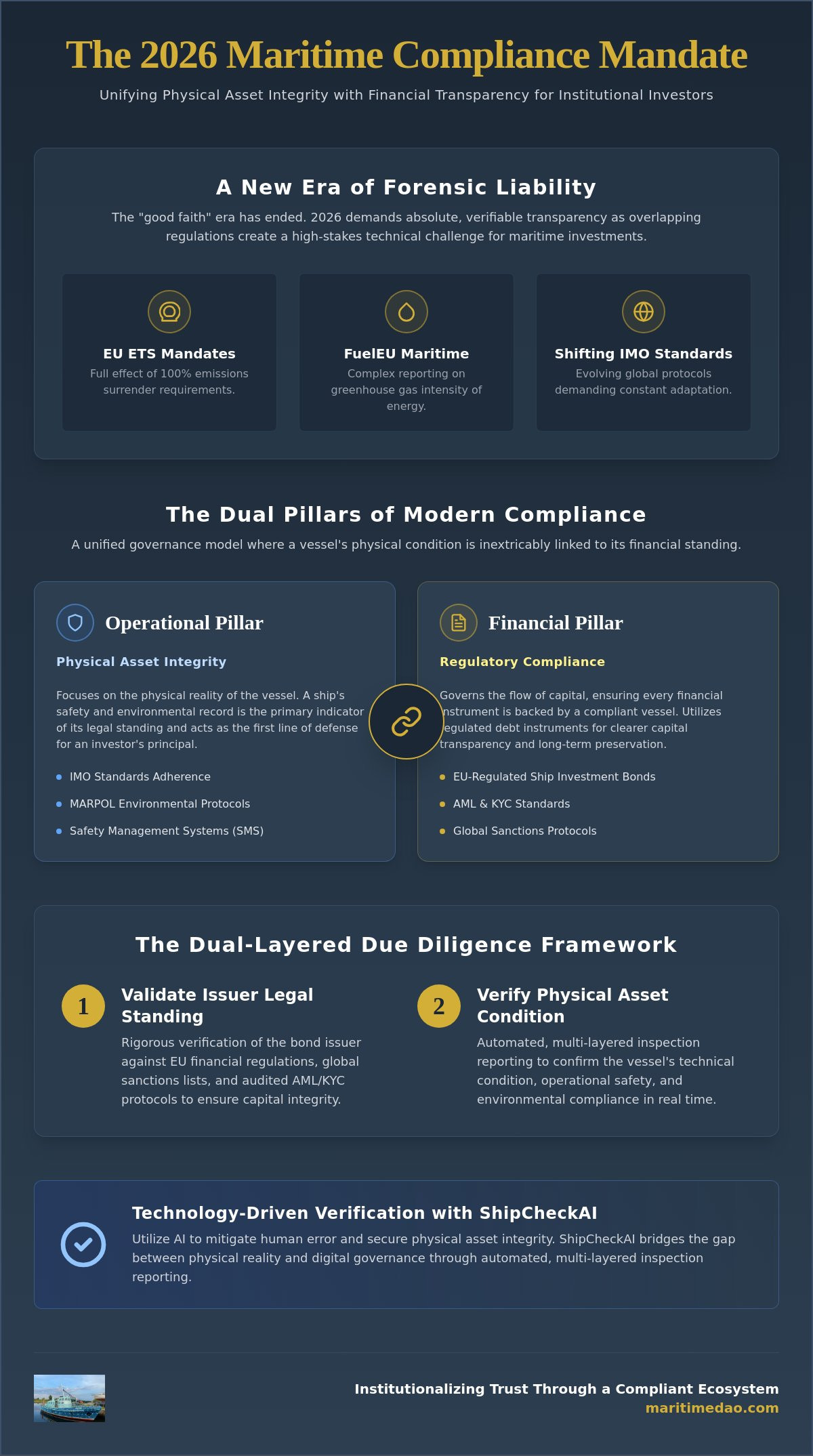
Modern maritime investment compliance in 2026 represents the ultimate fusion of operational safety and financial transparency. It’s no longer sufficient for institutional investors to treat vessel safety and capital regulation as separate silos. Instead, the industry has shifted toward a unified governance model where the physical condition of an asset is inextricably linked to its financial standing. This synthesis ensures that every investment instrument is backed by a vessel that is legally, technically, and environmentally sound. By establishing this high-stakes register, the industry finally moves beyond speculative hype toward regulated innovation.
The framework rests on two distinct but interdependent pillars. The operational pillar focuses on the physical reality of the ship, encompassing adherence to IMO standards, MARPOL environmental protocols, and Safety Management Systems (SMS). The financial pillar governs the flow of capital, ensuring compliance with EU bond regulations, AML, and KYC standards. To protect institutional assets, these pillars must be unified through a transparent ecosystem that monitors, governs, and reports on both in real time. This approach mitigates the systemic risks that traditionally plagued maritime debt, providing a stable foundation for long-term capital preservation.
The Role of Operational Integrity
A vessel’s safety record is the primary indicator of its legal standing. In 2026, adherence to international safety management isn’t just about avoiding port state control detentions; it’s a core requirement for maintaining the validity of financial instruments. Technical management has become a non-negotiable component of financial due diligence. If a ship fails to meet its environmental targets or violates SMS protocols, the underlying investment faces immediate devaluation and potential regulatory seizure. Technical excellence acts as the first line of defense for the investor’s principal, ensuring the asset remains a viable component of global trade.
The Financial Regulatory Landscape
The financial pillar has been transformed by the full implementation of EU financial standards for maritime assets. Institutional lenders often rely on established Ship Mortgage Frameworks to structure debt, but modern compliance requires deeper, real-time data integration to satisfy institutional transparency. We’ve seen a decisive shift toward EU-regulated ship investment bonds over speculative equity. These regulated debt instruments provide a clearer path for capital transparency, especially when managed through a maritime fintech platform. By utilizing these structures, investors gain access to a governed environment where every bond is backed by a verified, inspected, and compliant vessel, ensuring that the capital remains as resilient as the asset itself.
Navigating International and EU Financial Regulatory Frameworks
The regulatory landscape for maritime assets has reached a state of mature, institutional oversight. In 2026, maritime investment compliance is defined by a rigorous adherence to both cross-border financial laws and specific regional mandates. Institutional investors now face a tripartite challenge: they must manage capital flow, verify physical asset integrity, and ensure complete alignment with evolving sanctions regimes. This environment has moved beyond simple “check-the-box” exercises, requiring a sophisticated integration of legal and technical data. Order is the baseline.
Central to this shift is the emergence of ship asset-backed securities (ABS) that meet global reporting standards. These instruments require a level of transparency that mirrors traditional capital markets. Meeting your Investment Compliance Obligations means ensuring that every dollar tied to a vessel is accounted for through audited AML and KYC protocols. Without this clarity, cross-border ship financing risks immediate freezing by regulators who prioritize the structural integrity of the global financial system over individual trade efficiency. It’s a high-stakes register where maritime investment transparency isn’t just a value; it’s a requirement for capital survival.
EU Compliant Maritime Bonds and MiCA
The 2026 regulatory climate has clarified the legal status of digital maritime debt. Under the Markets in Crypto-Assets (MiCA) framework, a clear distinction exists between speculative utility tokens and regulated maritime bonds. For an issuer to be considered institutional-grade, they must provide a comprehensive prospectus approved by a relevant EU financial authority, real-time reporting on the underlying vessel’s operational status, and immutable records of ownership. This structure ensures that maritime investment compliance is built into the very architecture of the bond, protecting the investor from the volatility of unregulated markets.
Sanctions Screening and KYC Protocols
Sanctions enforcement has become a forensic operation. The Office of Financial Sanctions Implementation (OFSI) and EU authorities now scrutinize “control” layers rather than simple legal ownership. If a sanctioned entity exerts influence over a vessel’s management or its revenue stream, the investment becomes a liability. Effective screening utilizes real-time monitoring of all intermediaries to detect these hidden links before they compromise the capital structure. Institutional investors looking for a secure entry point into this sector can utilize the Maritime DAO compliant ecosystem to ensure their assets remain protected by the highest standards of international law. By unifying these regulatory gateways, the industry finally bridges the gap between legacy shipping and modern finance.
Physical Asset Integrity as a Compliance Mandate
Vessel condition serves as the ultimate collateral in the modern regulatory environment. In 2026, maritime investment compliance mandates that the physical state of a ship is transparently documented and verifiable at all times. Institutional investors can’t rely on sporadic, paper-based reports that are susceptible to human error or manipulation. Instead, they require a standardized, data-driven assessment that aligns with the rigorous demands of institutional audits. This shift ensures that the underlying asset maintains its value and remains legally operational within the global trade network. Order is established through technical precision.
Traditional inspections often fail to provide the granular detail needed for high-stakes financial reporting. By transitioning to a model of automated intelligence, the industry eliminates the “human error” variable that historically obscured asset risks. Deploying a dedicated AI ship inspection tool transforms subjective manual surveys into empirical, high-fidelity data that satisfies the forensic demands of institutional audits. This level of technical oversight is a prerequisite for bondholder security; it provides a real-time bridge between the engine room and the boardroom. It’s about creating a unified record of truth that protects capital from the unseen decay of physical infrastructure.
ShipCheckAI: Bridging Technical and Financial Gaps
ShipCheckAI serves as the primary gateway for this technical verification. By facilitating multi-type inspections, ranging from pre-purchase and annual surveys to specific condition-based assessments, it provides a comprehensive view of asset health. This data doesn’t exist in a vacuum. It feeds directly into the maritime fintech platform, creating a unified stream of reporting for bondholders. If a vessel’s safety or operational metrics fall below pre-defined thresholds, the system triggers automated compliance alerts. This proactive governance ensures that technical failures are addressed before they escalate into financial liabilities.
Environmental Stewardship and MARPOL
The financial risk of non-compliance with 2026 emission standards is absolute. With the EU ETS now requiring 100% surrender of emissions allowances, environmental monitoring is a core compliance requirement. ShipCheckAI verifies the functionality of essential hardware, such as ballast water treatment systems and carbon monitoring equipment, ensuring they meet MARPOL standards. In an era where a single “E” rating in Carbon Intensity Indicator (CII) reporting can trigger mandatory corrective action plans by April 30, 2026, technical verification is the only way to safeguard an investment’s economic viability. Environmental stewardship is no longer an ESG preference; it’s a financial necessity that governs the long-term yield of the asset.
The 2026 Due Diligence Framework for Maritime Debt
Due diligence in 2026 is no longer a static, periodic exercise. It has evolved into a continuous, data-driven protocol that ensures institutional capital remains protected against the volatility of global trade. To achieve true maritime investment compliance, investors must move beyond traditional financial statements and engage with a five-step verification process. This framework integrates legal standing, technical health, and regulatory screening into a single, unified record of truth. It’s a forensic approach designed for a high-stakes environment where transparency is the only acceptable standard.
The first step requires the rigorous verification of the legal issuer and their regulatory jurisdiction, ensuring the investment bond is governed by established EU financial mandates. Once the legal foundation is set, the process moves to a technical audit of the physical asset using AI-powered vessel surveys. This is followed by a deep review of the maritime inspection compliance tool logs, which provide an immutable history of maintenance and safety adherence. By analyzing these data streams, investors can identify operational risks before they impact the debt structure or asset-backed security (ABS) protections. The final step involves a total ecosystem screening, utilizing real-time KYC and sanctions protocols to verify every intermediary involved in the vessel’s operation. Achieving full maritime investment transparency across each of these steps is what separates institutional-grade portfolios from those exposed to systemic regulatory risk. Investors seeking a structured methodology can also benefit from the comprehensive due diligence for digital maritime investments reference guide, which unites AI-driven technical assessments with EU-regulated financial compliance standards.
Institutional Checklist for Maritime Assets
A robust checklist is essential for maintaining order within the portfolio. This includes a comprehensive review of the ISM Code and Safety Management System (SMS) audits to ensure the vessel operates at peak efficiency. Investors must also verify that P&I insurance and hull coverage compliance are active and meet the specific requirements of the debt instrument. Central to this technical audit is the ShipCheckAI Vessel Assessment report. This document highlights any red flags in the ship’s physical integrity, allowing stakeholders to govern, mitigate, and resolve issues with clinical precision. Technical management is the backbone of financial security.
Governance and DAO Transparency
The rise of decentralized autonomous organizations has revolutionized how the industry handles immutable records. A maritime DAO investment provides a level of transparency that traditional private equity structures simply cannot match. Within this ecosystem, smart contracts act as digital gatekeepers, automatically enforcing regulatory restrictions and ensuring that capital flows only to compliant assets. This governed environment creates a permanent audit trail, making maritime investment compliance a built-in feature rather than an afterthought. It’s a first-of-its-kind bridge between legacy shipping and institutional fintech that prioritizes security and democratization. Secure your position in a governed maritime ecosystem today.
Institutionalizing Trust through Maritime DAO’s Compliant Ecosystem
Maritime DAO represents the culmination of technical ambition and the sober reliability of institutional finance. By integrating EU-regulated ship investment bonds with advanced AI inspection technology, the platform establishes a unified gateway for maritime investment compliance. This ecosystem ensures that every financial instrument is backed by a verified, inspected, and compliant vessel, effectively removing the opacity that has historically hindered institutional entry into shipping markets. It’s a first-of-its-kind architecture where transparency isn’t a secondary goal; it’s the foundation of the entire capital structure. Through this unified approach, stakeholders can govern, monitor, and optimize their portfolios with a level of precision previously reserved for traditional liquid assets.
Regulated Innovation in Maritime Finance
The transition to digital maritime assets requires a delicate balance between blockchain efficiency and the strict demands of global regulators. Maritime DAO addresses this by positioning itself as a reliable gatekeeper, bridging the gap between legacy shipping systems and the future of decentralized finance. Through the ShipCheckAI tool, the ecosystem maintains an immutable record of asset integrity, ensuring that technical data is always available for institutional oversight. Regulated tokenized assets are no longer a speculative concept but a functional reality that offers superior liquidity, clarity, and security. This commitment to “regulated innovation” ensures that the excitement of a new frontier is always tempered by legal frameworks and structural integrity. By unifying these technological pillars, the platform future-proofs institutional assets against the evolving pressures of global carbon pricing and maritime law.
Next Steps for Compliant Investing
Securing your position in this new frontier requires a methodical approach to asset selection and risk management. Institutional stakeholders can now access EU regulated ship investment bonds through a streamlined, compliant interface that prioritizes order and security. Integrating ShipCheckAI into your existing maritime due diligence workflow allows for real-time monitoring of physical collateral, providing an extra layer of protection against operational failure or regulatory seizure. For those facing specific regulatory hurdles or complex cross-border requirements, consulting with Maritime DAO experts ensures that every investment remains fully aligned with the latest international standards. The future of maritime investment compliance is here. It’s a unified, transparent, and methodical ecosystem designed to protect, grow, and democratize institutional capital in the global shipping sector.
Mastering the Future of Maritime Capital
The landscape of global trade is undergoing a fundamental transformation where the physical and digital worlds finally converge. Success in this new era requires a commitment to structural integrity, automated intelligence, and regulatory transparency. We’ve defined how a unified approach to maritime investment compliance is no longer a peripheral concern but the central pillar of institutional asset preservation. By utilizing an EU-regulated bond issuance framework, you can access a governed ecosystem where every asset is verified through ShipCheckAI’s multi-layered technical audits, ensuring that physical risk never compromises your financial standing. This methodical approach ensures that institutional-grade governance, transparency, and operational security are built into the very architecture of your portfolio. It’s time to bridge the gap between legacy shipping and modern finance. Explore Compliant Maritime Investment Opportunities with Maritime DAO and secure your place in a first-of-its-kind financial ecosystem. The tools for a more secure, democratized, and transparent maritime future are ready for your deployment.
Frequently Asked Questions
What is maritime investment compliance in the context of 2026 regulations?
Maritime investment compliance in 2026 is the mandatory synthesis of operational safety, environmental stewardship, and financial transparency. It requires institutional assets to align with the full implementation of the EU ETS, FuelEU Maritime reporting, and strict AML/KYC protocols. This framework ensures that every capital allocation is backed by a vessel that is technically sound, legally cleared, and environmentally verified according to global standards.
How do EU-regulated ship investment bonds differ from traditional shipping equity?
EU-regulated ship investment bonds provide a structured debt instrument with predictable returns and superior transparency compared to volatile equity stakes. Unlike traditional equity, which often lacks real-time technical oversight, these bonds are governed by a formal prospectus and backed by physical assets verified through continuous AI-driven monitoring. This creates a more stable, institutional-grade risk profile that prioritizes capital preservation over speculative growth.
Can AI ship inspection tools like ShipCheckAI satisfy institutional due diligence requirements?
ShipCheckAI provides the forensic, data-driven reporting necessary to meet the high-stakes demands of institutional audits. By automating multi-layered inspections and eliminating human error, the tool creates an immutable record of a vessel’s physical integrity. This level of technical oversight bridges the gap between engine room operations and financial reporting, providing the transparency required to satisfy rigorous due diligence standards for asset-backed securities.
What are the main risks of non-compliance in maritime asset management?
The primary risks include severe financial penalties, asset seizure, and a total loss of investment liquidity. Non-compliance with 2026 environmental standards, such as the EU ETS or Carbon Intensity Indicator (CII) ratings, can lead to mandatory corrective action plans or exclusion from major ports. Additionally, failure to maintain maritime investment compliance exposes stakeholders to significant legal liability under global sanctions and anti-money laundering regulations.
How does a Maritime DAO ensure compliance with international financial sanctions?
A Maritime DAO utilizes smart contracts and real-time screening protocols to monitor every intermediary within its ecosystem. By automating the verification of control layers rather than just legal ownership, the platform detects sanctioned entities before they can compromise the capital structure. This governed approach ensures that all transactions remain transparent, immutable, and fully aligned with the latest OFSI and EU sanctions lists.
Is tokenized ship ownership legal under current EU financial law?
Tokenized ownership is legal when structured as a regulated security under the Markets in Crypto-Assets (MiCA) framework. In 2026, the distinction between speculative utility tokens and regulated debt instruments is absolute. For tokenization to be compliant, the issuer must provide a comprehensive, authority-approved prospectus and maintain transparent, audited records of the underlying physical asset to ensure institutional reliability.
What is the role of the IMO in maritime investment compliance?
The IMO sets the global operational and environmental standards that form the technical foundation of the compliance framework. Regulations such as MARPOL and the Carbon Intensity Indicator are critical benchmarks used in institutional due diligence. While the IMO governs the physical ship, financial compliance frameworks integrate these technical standards to verify the economic viability and legal standing of the asset for investors.
How much does it cost to implement a compliant maritime investment framework?
Implementation costs vary based on fleet scale and the complexity of existing management systems. Institutional stakeholders typically find that the investment in a unified governance model is offset by reduced risk premiums and the avoidance of regulatory penalties. While specific fees for technical and legal integration depend on the asset profile, moving toward a transparent, AI-driven ecosystem is a necessary strategy for long-term capital preservation.