
Why has the world’s most vital trade artery remained a “black box” for institutional portfolios for so long? For decades, the maritime sector was defined by opaque vessel surveys and regulatory uncertainty that kept all but the most specialized lenders at bay. You’ve likely found that while shipping is the backbone of global commerce, the high barriers to entry and fragmented cross-border frameworks make maritime debt difficult to standardize. It’s a systemic inefficiency that has historically limited the democratization of this essential asset class.
This article will help you master the shifting landscape, demonstrating how EU regulated ship investment bonds are transforming the sector into a transparent, governed, and institutional-grade ecosystem. You’ll gain a clear understanding of how the EU Green Bond Standard and the 2026 Taxonomy thresholds provide a rigorous framework for evaluating maritime debt. We’ll examine how technical verification through ShipCheckAI ensures predictable yields backed by verified physical assets, moving the industry toward a future where maritime finance is as reliable as any other high-stakes capital investment.
Key Takeaways
- Understand how the transition from fragmented private placements to EU regulated ship investment bonds is establishing a new standard for institutional-grade maritime debt.
- Navigate the complex intersection of the EU Taxonomy, MiCA, and DORA to ensure your capital deployment remains compliant with 2026 operational resilience laws.
- Evaluate the strategic advantages of fixed-income ship bonds over volatile equity, focusing on enhanced liquidity profiles and secondary market accessibility.
- Discover how ShipCheckAI replaces outdated paper surveys with AI-powered technical verification to eliminate engine and structural risks before issuance.
- Learn the methodical process for institutional onboarding and capital deployment within the Maritime DAO ecosystem to access global maritime asset financing.
The Paradigm Shift: From Opaque Private Debt to EU Regulated Ship Bonds
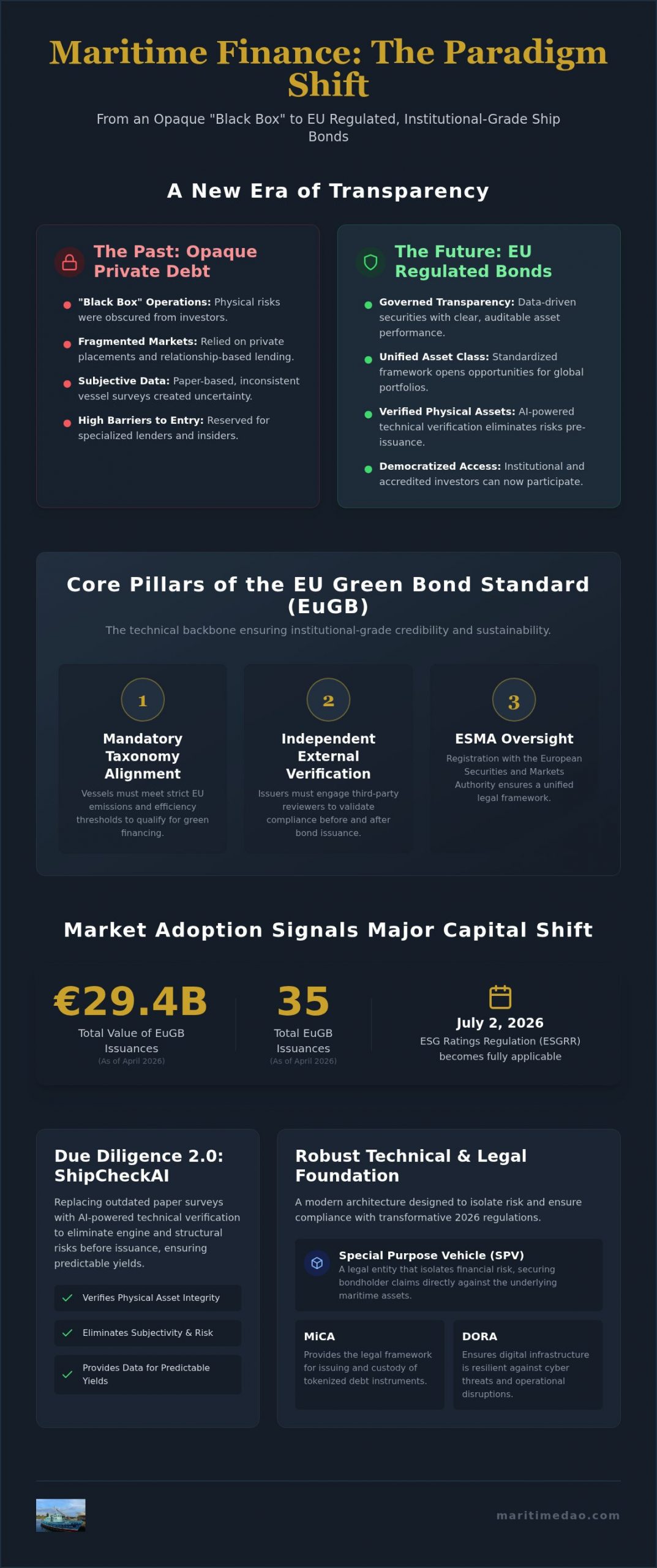
The maritime industry is shedding its legacy of opacity to embrace a future of governed innovation. For decades, the sector relied on private placements and relationship-based lending, creating a fragmented market that was difficult for institutional capital to navigate. The emergence of EU regulated ship investment bonds represents a fundamental structural transition toward a unified, institutional-grade asset class. By 2026, the era of trust-based lending is being replaced by a system of rigorous, data-driven securities governed by the European Securities and Markets Authority (ESMA). This new framework serves to unite fragmented capital, govern operational risk, and open opportunities for global portfolios within a transparent ecosystem.
Ending the Black Box Era of Maritime Finance
Historically, seeking an alternative investment in shipping meant confronting significant hurdles, including a lack of standardized technical data and prohibitively high entry costs. Traditional vessel surveys were often paper-based and subjective, leading to a “black box” effect where physical risks were obscured from the bondholders. Regulated bonds solve this by mandating transparency through technical pillars. They democratize access to maritime yields, allowing institutional and accredited investors to participate in a market previously reserved for specialized banks. Standardized reporting reduces risk premiums by providing a clear, auditable trail of asset performance, ensuring that every decimal of yield is backed by verified operational data.
The Core Pillars of the EU Green Bond Standard (EuGB)
The EuGB framework acts as the technical backbone of this modern market, requiring mandatory alignment with the EU Taxonomy to ensure that “green” labels are backed by specific technical screening criteria. This transition is supported by three critical pillars of structural integrity:
- Mandatory Taxonomy Alignment: Every vessel must meet strict emissions and efficiency thresholds to qualify for green financing.
- External Verification: Issuers must engage independent reviewers to validate compliance before and after bond issuance.
- ESMA Oversight: Registration with the European Securities and Markets Authority ensures that all participants adhere to a unified legal framework.
This shift is accelerated by the ESG Ratings Regulation (ESGRR), which becomes fully applicable on July 2, 2026. As of April 2026, the market has already seen 35 EuGB issuances totaling approximately €29.4 billion, signaling a massive shift in capital flows toward regulated frameworks. By 2026, the EuGB will serve as the definitive seal of institutional credibility, effectively eliminating the regulatory uncertainty that once plagued cross-border maritime finance.
Technical Architecture of Regulated Maritime Debt Instruments
The structural integrity of EU regulated ship investment bonds relies on a robust legal and technical foundation designed to bridge the physical world of global trade with the digital world of high finance. At the core of this architecture is the Special Purpose Vehicle (SPV), a legal entity that isolates financial risk and ensures that bondholder claims are secured directly by the underlying maritime assets. These instruments are issued in strict adherence to the EU Prospectus Regulation, which mandates comprehensive disclosure and investor protection standards. By utilizing an SPV, issuers can ring-fence vessel operations from broader corporate liabilities, creating a clean, institutional-grade debt instrument that fits seamlessly into modern portfolios.
Regulatory Compliance: MiCA and DORA in Maritime Finance
The 2026 regulatory environment introduces two transformative pillars for maritime debt: the Markets in Crypto-Assets (MiCA) regulation and the Digital Operational Resilience Act (DORA). While MiCA provides the legal framework for the issuance and custody of tokenized debt instruments, DORA ensures that the underlying digital infrastructure remains resilient against cyber threats and operational disruptions. This intersection of blockchain governance and traditional EU law creates a zone of regulated innovation where the efficiency of decentralized technology is tempered by the reliability of institutional oversight. It’s a system that protects the ecosystem from the speculative volatility often associated with digital assets while maintaining the speed and transparency of automated intelligence.
Technical Screening Criteria (TSC) for Sustainable Shipping
To qualify as Taxonomy-aligned, EU regulated ship investment bonds must adhere to specific Technical Screening Criteria (TSC) that go beyond generic green bond claims. These criteria mandate a steady reduction in greenhouse gas emissions, targeting a zero-emission trajectory by 2050. For a ship to be considered “green” under the 2026 thresholds, it must demonstrate substantial carbon intensity reductions or utilize zero-emission propulsion systems. Verification is no longer a matter of self-reporting; it requires independent, third-party auditors to validate environmental performance against the Taxonomy’s rigorous standards. This methodical verification process ensures that bond yields are linked to genuine decarbonization efforts, effectively eliminating greenwashing from the maritime debt market.
The management of these instruments is further enhanced by a Decentralized Autonomous Organization (DAO) structure. A DAO serves as a transparent gatekeeper, utilizing smart contracts to automate bond servicing, interest payments, and governance votes. This model ensures that capital deployment is methodical and governed by the collective interests of stakeholders rather than a centralized authority. For those looking to integrate these frameworks into their investment strategy, exploring the Maritime DAO ecosystem offers a practical gateway into this unified market of regulated maritime assets.
Strategic Comparison: Regulated Ship Bonds vs. Traditional Maritime Equity
Navigating the maritime capital stack requires a clear understanding of the risk-reward profiles that differentiate debt from equity. While traditional maritime equity offers exposure to the industry’s upside, it simultaneously subjects investors to the full force of market volatility and spot rate fluctuations. In contrast, EU regulated ship investment bonds provide a prioritized position within the capital structure. This seniority ensures that debt holders are satisfied before any capital is returned to equity participants. This bond structure effectively unites physical security, legal compliance, and digital accessibility into a single instrument. By shifting the focus from speculative ownership to governed debt, institutional investors can secure predictable yields that are insulated from the erratic swings of global trade cycles.
Fixed-Income Stability in a Volatile Industry
Shipping equities often track the volatile cycles of the Baltic Dry Index or container freight rates, leading to significant price swings that can erode capital quickly. Regulated debt instruments mitigate this risk by providing a fixed-income structure that is decoupled from daily charter rate volatility. These bonds are asset-backed instruments, meaning the underlying vessel serves as collateral, providing a layer of physical security that equity positions lack. This stability is particularly valuable in a fluctuating global trade environment where yield predictability is a primary objective. By focusing on fixed coupons rather than variable dividends, investors can build a more resilient portfolio that leverages the essential nature of maritime trade without the associated equity risks.
Secondary Market Liquidity and Tokenization
One of the historical deterrents to maritime investment has been the “illiquidity discount” caused by the difficulty of exiting positions in a timely manner. The 2026 landscape has fundamentally altered this dynamic through the tokenization of EU regulated ship investment bonds. This technological pillar enables 24/7 trading on regulated platforms, significantly enhancing liquidity profiles compared to traditional private placements or physical vessel ownership. The tokenized Real-World Asset (RWA) market, which grew by 260% in 2025, has paved the way for this transition toward more liquid maritime debt. The Maritime DAO ecosystem facilitates this liquidity by providing a unified gateway for secondary market access, allowing investors to manage their exposure with the same precision found in traditional bond markets. This evolution reduces entry barriers and ensures that capital is no longer trapped in long-term, illiquid structures, creating a more dynamic and accessible investment environment.
Due Diligence 2.0: Verifying Vessel Assets with ShipCheckAI
The physical integrity of the vessel is the ultimate guarantor of any debt instrument. Traditional due diligence often relies on outdated paper surveys that provide only a static snapshot of a ship’s condition, creating significant blind spots for holders of EU regulated ship investment bonds. Structural decay or engine inefficiencies can remain hidden until they cause operational disruptions or financial defaults. ShipCheckAI replaces these subjective assessments with a system of automated intelligence, ensuring that the bond’s underlying value is grounded in verified, real-time technical data. This transition from trust-based reporting to technical verification is essential for maintaining the institutional-grade status of maritime debt.
ShipCheckAI: A New Standard for Vessel Assessment
Accuracy in maritime assessment requires a multi-layered approach that human inspectors simply cannot replicate at scale. ShipCheckAI performs multiple types of vessel assessments, ranging from ultrasonic thickness measurements of the hull to thermal imaging of critical engine components. By 2026, the tool is expected to integrate drone-based autonomous hull scanning to detect micro-fractures that are invisible to the naked eye. This 360-degree asset view allows for the detection of potential failures before they manifest as costly repairs, providing a level of foresight that protects the bondholder’s capital. For a deeper look at the technical specifications, you can explore this AI ship inspection tool to understand how it governs asset risk.
Linking Technical Data to Financial Transparency
The true innovation lies in the connectivity between physical asset data and financial governance. When ShipCheckAI identifies a structural or engine risk, the data can be fed directly into the bond’s smart contracts to trigger automated covenant protections. This ensures that the bond’s risk rating is a dynamic reflection of the vessel’s health rather than a static historical score. By standardizing these condition reports, the system provides institutional bondholders with a unified view of their collateral. AI-driven due diligence effectively solves the “Black Box” problem by converting opaque physical risks into transparent, actionable data points for financial oversight.
It’s the technical backbone that allows EU regulated ship investment bonds to maintain their structural integrity in a complex global market. This framework ensures that capital deployment is always backed by a combination of structural excellence and operational transparency. To see how these technical audits integrate with our governed debt offerings, you can review the latest bond issuances on the Maritime DAO platform.
Executing Your Strategy: Accessing the Maritime DAO Ecosystem
The transition from theoretical understanding to active capital deployment requires a structured, compliant gateway. For institutional and accredited investors, the process is designed to be methodical, ensuring that all participants meet the rigorous standards necessary for a governed financial environment. Accessing EU regulated ship investment bonds is not merely a transaction; it’s an entry into a unified ecosystem where physical assets and digital governance converge to provide structural integrity and long-term security. This architecture ensures that every participant operates within a framework of regulated innovation, where the speed of technology meets the reliability of institutional finance.
Compliance-First Onboarding for Global Investors
Participation begins with a robust KYC (Know Your Customer) and AML (Anti-Money Laundering) framework that aligns with the latest European financial directives. This onboarding process ensures that the ecosystem remains a secure, institutional-grade environment for all stakeholders, effectively screening for regulatory compliance before any capital is committed. The DAO acts as the reliable gatekeeper, managing investor rights and facilitating transparent governance votes through smart contracts. For a comprehensive breakdown of the regulatory standards governing these instruments, investors should refer to the maritime investment compliance reference guide to understand the benchmarks for institutional assets.
Yield Monitoring and Asset Management
Once capital is deployed, the Maritime DAO dashboard provides a centralized interface for real-time portfolio oversight. Investors can track bond performance, interest accruals, and the live health data provided by ShipCheckAI for the underlying vessels. This level of transparency allows for informed decision-making regarding the reinvestment of yields or the execution of secondary market exits. By 2026, the integration of MiCA-compliant secondary markets ensures that liquidity is a functional reality rather than a theoretical promise. You can Explore active ship bond offerings on Maritime DAO to begin identifying assets that align with your strategic risk profile.
Looking beyond 2026, the ecosystem is set to expand through the launch of the $MARGOT utility and governance token in Q3 2026. This token will empower the community to participate in the decentralized governance of the platform, further democratizing the architectural evolution of maritime finance. As the tokenized RWA market continues its trajectory toward a forecasted value between $2 trillion and $16 trillion by 2030, the role of EU regulated ship investment bonds will only grow more central. It’s a future where heavy industry and high finance are finally unified through a single, transparent, and governed digital framework.
Navigating the Future of Maritime Capital Deployment
The maritime industry has reached a pivotal juncture where legacy systems and modern regulatory frameworks finally align. We’ve explored how the transition to EU regulated ship investment bonds provides a structured path for institutional capital, moving away from the “black box” era toward a future of technical and financial transparency. By integrating AI-verified asset health via ShipCheckAI and ensuring full compliance with the EU Green Bond Standard, these instruments offer a level of security previously unavailable in maritime finance. This ecosystem is governed by a transparent DAO framework that unites global trade with digital innovation, providing a methodical approach to capital deployment.
The opportunity to participate in this institutional-grade asset class is now accessible through a unified, compliant gateway. You can Access the Institutional Maritime Bond Portal to begin your journey into a more stable and predictable maritime market. It’s a transformative era for global trade, and the tools for success are now within your reach.
Frequently Asked Questions
What makes a ship investment bond “EU regulated” in 2026?
A bond is classified as EU regulated when it complies with the EU Prospectus Regulation and is registered with the European Securities and Markets Authority (ESMA). For maritime assets, this includes mandatory alignment with the EU Green Bond Standard and the Technical Screening Criteria of the EU Taxonomy. These frameworks ensure that EU regulated ship investment bonds operate within a unified legal ecosystem, providing institutional-grade transparency and structural integrity for all participants.
How does the EU Green Bond Standard (EuGB) apply to the shipping industry?
The EuGB is a voluntary framework that requires issuers to allocate proceeds to projects aligned with the EU Taxonomy’s environmental objectives. In the maritime sector, this means vessels must meet specific carbon intensity and efficiency thresholds to qualify for a “green” label. Compliance is verified by external reviewers who must be registered with ESMA, ensuring that environmental claims are backed by rigorous technical data rather than marketing rhetoric.
Can retail investors participate in EU regulated ship investment bonds?
Yes, retail and accredited investors can now access these instruments through decentralized platforms that utilize fractionalization. Maritime DAO enables participation with minimum investments as low as €200, which is a significant shift from traditional private placements. This democratization is made possible by tokenization technology, which lowers entry barriers while maintaining the legal protections and governed structures of a regulated debt instrument.
What is the role of ShipCheckAI in the bond issuance process?
ShipCheckAI serves as the technical backbone for due diligence by performing multiple types of vessel assessments to verify physical asset health. It identifies engine and structural risks before a bond is issued, ensuring that the underlying collateral is sound and operational. This AI-powered verification replaces outdated paper surveys and provides bondholders with real-time transparency into the technical state of the vessel.
How do regulated maritime bonds differ from tokenized maritime tokens?
Regulated maritime bonds are formal debt instruments representing a loan, whereas other tokens in the ecosystem often serve utility or governance roles. For instance, the $MARGOT token is classified as a Title II utility token under MiCA, meant for governance and ecosystem participation. While EU regulated ship investment bonds provide fixed-income yields, governance tokens allow participants to influence the architectural evolution of the DAO itself.
What are the typical yields for EU compliant maritime debt instruments?
Yields are influenced by the broader interest rate environment, including the European Central Bank’s rates, such as the 2.25% Deposit Facility Rate recorded in June 2026. Maritime debt typically offers a premium over these base rates to account for the industry’s specific operational risks. The standardized nature of regulated bonds helps compress these risk premiums by providing more accurate data to investors, leading to more predictable returns.
How does Maritime DAO ensure compliance with MiCA and DORA?
Maritime DAO utilizes a decentralized autonomous structure to manage governance in strict alignment with the Markets in Crypto-Assets (MiCA) regulation. The platform also adheres to the Digital Operational Resilience Act (DORA) to ensure its technological infrastructure is resilient against cyber threats and operational disruptions. This dual compliance ensures that the digital world of blockchain trade remains as secure and reliable as traditional institutional finance.
What happens to the bond if the underlying vessel is damaged or decommissioned?
Because these bonds are asset-backed, they are protected by comprehensive maritime insurance and a prioritized position in the capital stack. If a vessel is damaged, insurance proceeds are typically used to satisfy debt holders before any other claims are settled. Smart contracts can also be programmed to trigger protective covenants if the vessel’s technical health, as verified by ShipCheckAI, falls below a specific threshold.