
While the tokenized real-world asset market is projected to reach up to $16 trillion by 2030, the $2.3 trillion global commercial fleet has historically remained an exclusive enclave for institutional giants. You’ve likely felt the frustration of high entry barriers and the opaque nature of vessel condition reporting that makes cross-border shipping finance feel like a closed door. This guide explores how a modern global maritime investment platform finally bridges the gap between physical trade and digital governance. It’s time to move past the era of complex regulatory hurdles and embrace a unified approach to maritime debt.
We’ll show you how the integration of EU regulation, AI-driven due diligence, and asset-backed securities is democratising an industry once reserved for the few. You’ll gain a clear understanding of regulated maritime debt and see how tools like ShipCheckAI provide the transparency needed for secure capital allocation. This resource provides a roadmap to a compliant maritime investment ecosystem where technology governs risk and opens up unprecedented global opportunities.
Key Takeaways
- Understand how a global maritime investment platform unifies the maritime ecosystem by transitioning from opaque brokerage to transparent digital gateways.
- Identify the security advantages of EU-regulated Ship Investment Bonds and how they provide a robust legal framework for maritime debt.
- Master the use of ShipCheckAI to replace manual surveys with high-precision, AI-driven vessel condition reporting.
- Evaluate the structural shift from institutional legacy funds to Maritime DAOs to identify more accessible models for ship ownership.
- Gain a strategic roadmap for navigating a future where digital governance and physical maritime assets converge through decentralised structures.
What is a Global Maritime Investment Platform in 2026?
A global maritime investment platform in 2026 represents a unified ecosystem where heavy industry meets the precision of institutional finance. It’s no longer just about owning a ship; it’s about participating in a governed, transparent framework that integrates capital deployment, asset assessment, and regulatory oversight. For decades, the shipping industry operated behind the closed doors of private brokerages and complex, opaque networks. Today, the rise of the global maritime investment platform has replaced those legacy systems with a methodical approach to capital growth that prioritises structural integrity over speculative hype.
This evolution is driven by a fundamental necessity. With more than 80% of global trade volume moving via the ocean, the maritime sector is the literal engine of international commerce. However, the traditional project finance structure used to fund these massive assets often created high barriers to entry and a lack of transparency for external participants. Modern platforms solve this by providing a tripartite solution: regulated capital instruments like EU-regulated Ship Investment Bonds, AI-driven due diligence tools such as ShipCheckAI for real-time vessel reporting, and a unified governance layer that ensures compliance across multiple jurisdictions.
The Role of Digital Gateways in Shipping Finance
Digital gateways act as the essential bridge between the physical world of global trade and the digital world of capital markets. They’ve successfully transitioned maritime investment from illiquid private equity into structured debt instruments that offer far more flexibility. By empowering investors through fractional access to high-value vessels, these platforms have democratised an asset class that was once the exclusive domain of sovereign wealth funds and massive banks. It’s a system built on legal clarity and institutional reliability, often utilizing specialized banking infrastructure from ge.mba to launch these branded financial services.
Key Economic Drivers for Maritime Assets
Global trade resilience continues to underpin the demand for modern, efficient fleets. As we move through 2026, the impact of green shipping mandates has become a primary factor in asset valuation. Lenders and investors now differentiate between vessels based on their “transition risk,” favouring those that meet strict environmental criteria. Because maritime debt is backed by physical assets involved in essential trade, it serves as a sophisticated hedge against the volatility found in traditional equity markets. The result is a stable, asset-backed ecosystem that thrives on the constant flow of global goods.
Key Components of a Regulated Maritime Investment Ecosystem
A robust global maritime investment platform is defined by its ability to synthesize three critical pillars: stringent legal frameworks, physical asset backing, and automated intelligence. This ecosystem doesn’t rely on the speculative volatility typical of unregulated digital markets. Instead, it adopts a “regulated innovation” approach where every technological advancement is anchored by established institutional standards. This methodical integration provides the structural integrity required for significant capital allocation in an industry that moves 80% of the world’s goods.
By centralizing these components, a global maritime investment platform eliminates the fragmentation that once plagued traditional shipping finance. The transition toward a unified digital ecosystem is essential for the future of maritime finance, where transparency and real-time reporting are no longer optional. By utilizing automated intelligence to monitor vessel condition and performance, the platform ensures that investors have a clear, unfiltered view of their holdings. This level of transparency was previously impossible within the siloed networks of legacy ship finance.
EU-Regulated Ship Investment Bonds
EU-regulated Ship Investment Bonds represent the primary mechanism for institutional-grade debt participation. These instruments are governed by comprehensive legal frameworks that mandate strict disclosure and prospectus approval by competent financial authorities. This oversight ensures that the bonds meet the same rigorous standards as traditional corporate debt. For the investor, this provides a superior security layer, as the bond structure is recognized and enforceable across EU jurisdictions. It’s a reliable gateway for those seeking to diversify into maritime assets without the risks associated with unlisted or private placements.
Asset-Backed Security Mechanisms
The security of the capital is directly tethered to the physical equity of the vessel. Asset-backed securities in the maritime sector function by securing debt against tangible commercial ships, such as bulkers, tankers, or containerships. This tripartite link between the digital bond, the legal framework, and the physical asset mitigates the risk of total capital loss. Risk is also reduced through diversified vessel portfolios, where capital is spread across multiple ships rather than a single hull. To understand how these components unite to create a high-performance portfolio, investors can explore the Maritime DAO ecosystem for active opportunities.
This structural security is enhanced by AI-driven due diligence. Tools like ShipCheckAI provide a continuous stream of data regarding vessel integrity, ensuring that the asset-backed nature of the investment remains grounded in reality. It’s a unified system where digital governance and physical reliability work in tandem to protect and grow capital.
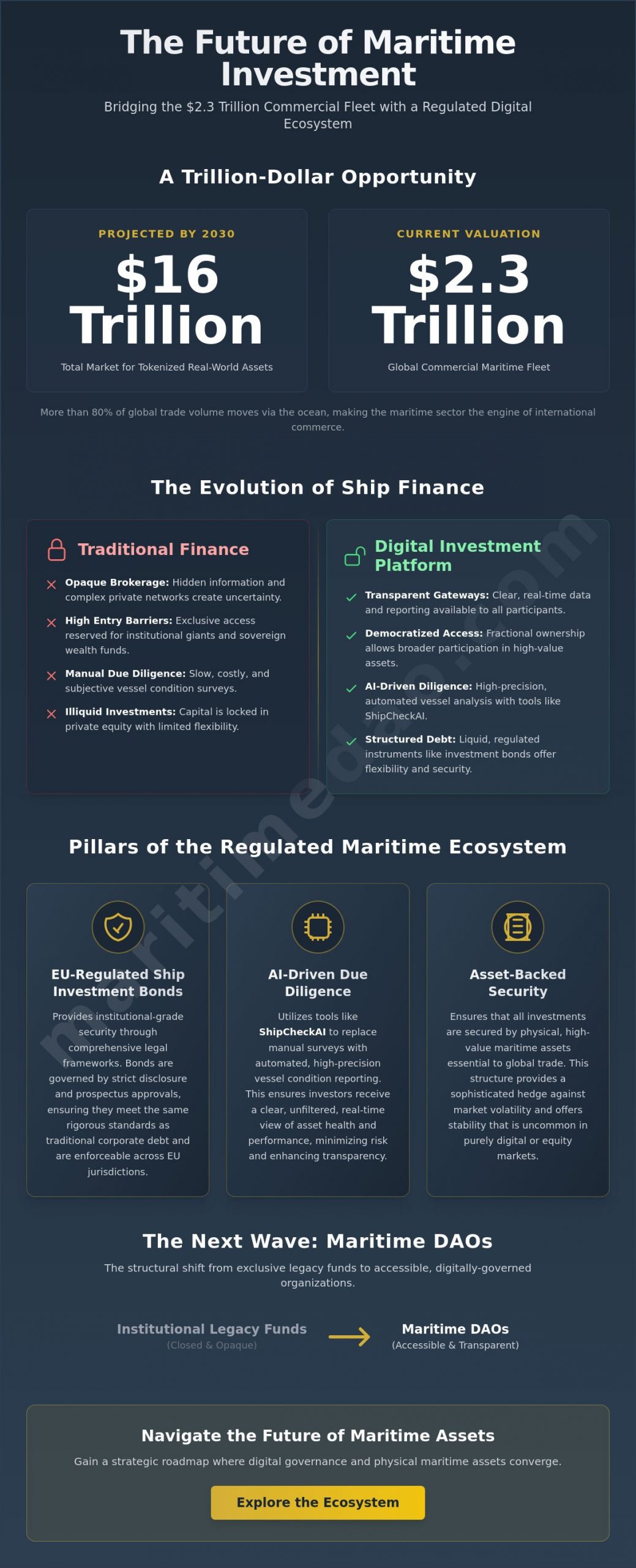
Comparing Traditional Ship Finance and Digital Platforms
The structural divide between legacy institutional funds and a modern global maritime investment platform is defined by how they manage capital, risk, and governance. Traditional ship finance has historically functioned through private equity networks and Limited Partnership (LP) structures that require massive capital outlays. These systems are often characterized by high minimum entry requirements and opaque reporting cycles that leave investors waiting months for performance data. A unified digital ecosystem replaces these barriers with a methodical framework that prioritizes accessibility without compromising the sober reliability of institutional finance.
Efficiency in capital deployment remains a primary differentiator. While legacy funds may take weeks to finalize a project finance structure and distribute dividends, digital platforms utilize automated protocols to ensure rapid, precise execution. This doesn’t just improve liquidity; it transforms how capital moves through the maritime sector. By integrating EU-regulated Ship Investment Bonds into a digital gateway, these platforms allow for fractional participation in high-value assets, ensuring that global shipping finance is no longer a closed circle for the ultra-wealthy.
Legacy Funds vs. Regulated DAOs
Traditional LPs often lack the real-time transparency that modern investors demand. In these legacy models, governance is centralized and often discretionary, which can lead to significant inefficiencies. A regulated global maritime investment platform adopts a “Visionary Architect” model, where Decentralized Autonomous Organization (DAO) protocols automate the governance layer. This shift replaces high, manual management fees with platform-driven efficiency. It’s a system where code-based rules govern, unite, and distribute value, ensuring that every participant’s rights are protected by immutable legal and digital frameworks.
Transparency and Reporting Standards
We’ve moved beyond the era of manual quarterly reports and entered the age of real-time digital dashboards. Trust is no longer built on periodic audits alone; it’s reinforced by the permanent auditability of blockchain technology. This level of transparency standardizes data across diverse maritime jurisdictions, providing a unified view of asset performance. When tools like ShipCheckAI are integrated into this reporting flow, investors receive continuous updates on vessel condition rather than relying on outdated annual surveys. It’s a transition from reactive reporting to proactive asset management, ensuring that the relationship between physical assets and digital governance is clear at every stage of the investment lifecycle.
Essential Resources for Maritime Asset Due Diligence
Due diligence in the shipping sector has historically been a slow, manual process prone to human error and subjective interpretation. Within a modern global maritime investment platform, this legacy approach is being systematically replaced by high-precision automated intelligence. This shift isn’t just a technical upgrade; it’s a fundamental requirement for securing capital in a market where the global commercial fleet is valued at approximately $2.3 trillion. By integrating technical data directly into financial risk modelling, the platform ensures that every asset-backed security is grounded in verifiable physical reality.
The evolution from manual surveys to AI-driven assessments provides the structural integrity that institutional investors demand. We’ve moved beyond the era of relying on a single surveyor’s opinion. A unified ecosystem now utilizes continuous data streams to monitor hull integrity, engine performance, and maintenance history. This level of transparency allows a global maritime investment platform to mitigate the “unmanaged” transition risks that often plague older, less efficient fleets. It’s a methodical process that protects capital by identifying systemic inefficiencies before they impact the balance sheet. For a broader view of how these trends are reshaping capital allocation, the rise of maritime alternative investments as a 2026 strategic trend offers essential context for understanding where the sector is headed.
AI-Powered Vessel Inspections
ShipCheckAI represents the cutting edge of this technological shift, enhancing the accuracy of pre-purchase assessments through high-resolution data capture and analysis. By utilizing machine learning, the tool can predict maintenance costs with far greater precision than traditional methods, allowing investors to account for future capital expenditure with confidence. This standardisation of inspection data is critical for the issuance of EU-regulated Ship Investment Bonds, as it provides a unified technical baseline that satisfies both regulatory bodies and institutional underwriters. It’s about replacing guesswork with governed, actionable intelligence.
The Due Diligence Checklist for 2026
Modern due diligence requires a tripartite focus on regulatory compliance, environmental efficiency, and commercial viability. Every maritime investor should prioritize the following checks:
- Regulatory Compliance: Verifying adherence to evolving IMO standards and the upcoming mandatory MASS Code for autonomous operations.
- Environmental Metrics: Assessing the Carbon Intensity Indicator (CII) and Energy Efficiency Existing Ship Index (EEXI) to ensure the asset remains competitive under green shipping mandates.
- Operational Performance: Analysing historical chartering potential and the vessel’s ability to operate within key trade routes without incurring excessive wharfage or SOLAS compliance fees.
To see how these technical insights are integrated into a broader governance framework, explore the Maritime DAO ecosystem and discover how AI-driven transparency de-risks global shipping finance. By centralizing these essential resources, the platform empowers investors to act as visionary architects of their own maritime portfolios.
Navigating the Future with the Maritime DAO Ecosystem
The Maritime DAO ecosystem represents the final, unified evolution of ship finance, functioning as a comprehensive global maritime investment platform that bridges the gap between traditional capital and decentralized technology. By consolidating once-disparate financial and operational pillars into a single digital gateway, the ecosystem enables a level of structural connectivity previously unseen in the shipping sector. This isn’t a speculative venture; it’s a methodical architecture designed to unify regulated debt, automated intelligence, and transparent governance into a single, high-stakes financial register.
This ecosystem acts as both a visionary architect and a reliable gatekeeper, identifying systemic inefficiencies in legacy finance and replacing them with a high-tech, asset-backed solution. It’s a system where code-based rules and legal frameworks work in tandem to protect capital while opening the doors to an industry that was once the exclusive enclave of institutional giants. For the modern investor, the global maritime investment platform provides the necessary tools to deploy capital with the sober reliability of institutional finance while benefiting from the efficiency of the digital frontier.
The Unified Maritime DAO Framework
Building a high-performance portfolio within this ecosystem requires a tripartite focus on security, monitoring, and active participation. Investors can begin by integrating EU regulated ship investment bonds into their holdings, ensuring their capital is protected by institutional-grade legal frameworks recognized across global jurisdictions. Once capital is deployed, the ecosystem leverages ShipCheckAI for continuous asset monitoring, providing a stream of real-time data that safeguards the physical integrity of the vessel. Finally, participating in maritime DAO investment governance allows stakeholders to help shape the strategic direction of the fleet through transparent, code-governed protocols that ensure every voice is backed by verified equity.
The roadmap for decentralized ship ownership is built on the premise of capital growth through collective efficiency. By accessing institutional-grade maritime debt through a single gateway, participants bypass the fragmented, opaque brokerage networks of the past. To begin this journey, investors should align with a compliant maritime investment ecosystem that prioritizes order and security. This involves verifying accreditation, selecting specific asset-backed bond tranches, and engaging with the digital governance layer to ensure long-term alignment with the essential flow of global trade.
Conclusion: Securing Global Trade
The long-term outlook for maritime alternative investments is inextricably linked to the industry’s ability to modernize through regulated innovation. In 2026, regulation and technology have emerged as the twin pillars of finance, providing the grounded reliability needed to navigate a complex geopolitical landscape. As global trade continues to necessitate more efficient, green-compliant fleets, the unified platform stands as the reliable bridge between physical assets and digital governance. It’s a methodical, deeply serious approach to finance that empowers a global audience while maintaining the rigorous standards appropriate for significant capital investments. Explore the Maritime DAO platform today to discover how we’re securing the future of global commerce through transparent, asset-backed innovation.
Securing Your Position in the Future of Global Trade
We’ve explored how the intersection of heavy industry and digital governance is dismantling the high barriers of traditional ship finance. Success in 2026 requires a methodical approach that balances technological ambition with the sober reliability of institutional finance. By utilizing a global maritime investment platform, participants can finally bridge the gap between physical maritime assets and digital capital markets with absolute transparency.
This journey relies on three structural pillars: an EU-Regulated Financial Framework that provides capital security, proprietary ShipCheckAI technology for continuous asset monitoring, and a transparent DAO governance model that empowers every stakeholder. These components unite to create a resilient ecosystem where risk is governed and opportunities are democratized. It’s time to transition from observer to active participant in this new frontier. Access the Global Maritime Investment Platform today to explore a compliant ecosystem built for the next era of maritime innovation. The engines of global commerce are evolving; ensure your portfolio is ready to lead the way.
Frequently Asked Questions
What is a global maritime investment platform?
A global maritime investment platform is a unified digital gateway that enables the fractional ownership of commercial vessels through regulated debt instruments. It replaces traditional, opaque ship finance networks with a transparent ecosystem that integrates asset management, capital deployment, and regulatory oversight. By centralizing these functions, the platform ensures that investors can participate in the $2.3 trillion global fleet with the same reliability found in institutional bond markets.
Are maritime investment platforms regulated in the EU?
Yes, modern platforms are governed by strict EU financial frameworks to ensure capital security and institutional compliance. These regulations mandate that all investment instruments, such as bonds, undergo rigorous prospectus approval by competent authorities. This “regulated innovation” approach protects participants by providing a recognized legal structure that is enforceable across multiple jurisdictions, distinguishing these platforms from speculative, unregulated digital asset markets.
How does a DAO improve maritime investment transparency?
A Decentralized Autonomous Organization (DAO) improves transparency by automating governance through immutable digital protocols. Instead of relying on centralized management’s discretion, the DAO handles dividend distributions and voting rights via transparent code. This ensures that every transaction and governance decision is permanently auditable, creating a unified record that standardizes trust across the entire global maritime investment platform.
What are EU-regulated ship investment bonds?
EU-regulated ship investment bonds are institutional-grade debt instruments that are legally tethered to the physical equity of commercial ships. These bonds provide a structured way to participate in maritime finance while benefiting from the oversight of European financial regulators. They offer a superior security layer compared to private equity, as the bond’s terms and the vessel’s performance are subject to continuous disclosure requirements.
How does AI technology like ShipCheckAI reduce investor risk?
AI technology reduces risk by replacing subjective manual surveys with high-precision, automated condition reporting. ShipCheckAI monitors hull integrity and engine performance in real-time, allowing the system to predict maintenance costs before they impact the vessel’s commercial viability. This continuous stream of data ensures that the asset-backed nature of the investment remains grounded in verifiable technical reality throughout the ship’s lifecycle.
Can retail investors access global shipping assets in 2026?
Retail investors can now access global shipping assets through fractional participation models that were previously reserved for institutional giants. By 2026, digital platforms have lowered minimum capital requirements, allowing for investments in regulated maritime debt starting at accessible thresholds. This democratization of ship finance provides a stable, asset-backed hedge against traditional market volatility for a much broader global audience.
What is the difference between ship equity and maritime debt bonds?
Ship equity represents direct fractional ownership in a vessel’s hull, whereas maritime debt bonds are structured loans secured by that vessel. Equity holders typically take on more operational risk in exchange for potential appreciation, while bondholders receive fixed interest payments. Within a unified ecosystem, these bonds offer a more predictable return profile, as they’re protected by both the ship’s physical value and a robust legal framework.
How do I verify the condition of a vessel before investing?
You can verify a vessel’s condition by reviewing standardized technical reports generated by proprietary tools like ShipCheckAI. These reports provide a comprehensive overview of the ship’s regulatory compliance, environmental efficiency, and historical performance. By accessing this data through the platform’s digital dashboard, you don’t have to rely on outdated annual surveys or the opaque reporting cycles common in traditional ship brokerage.