
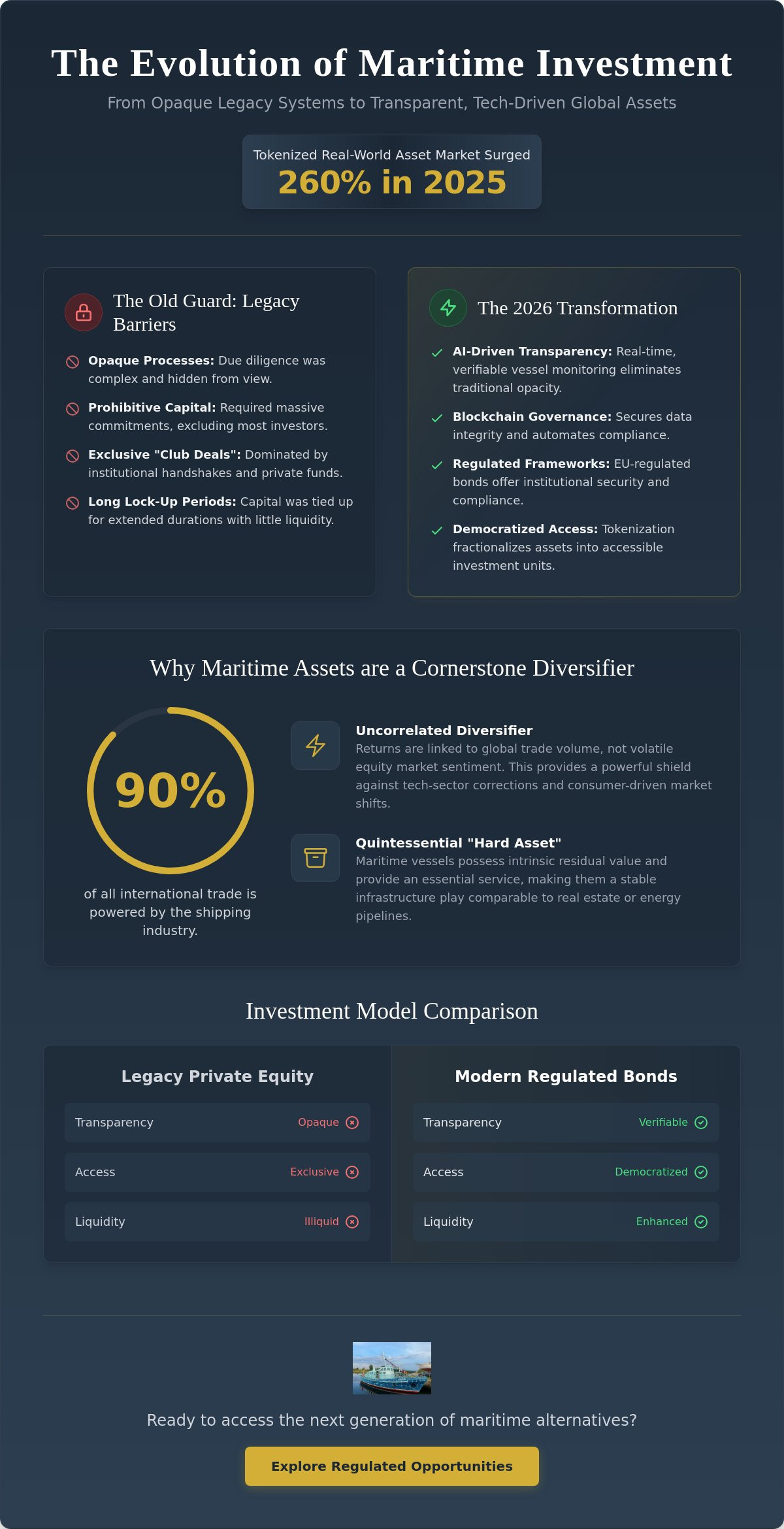
While traditional equity markets grapple with systemic volatility, the tokenized real-world asset market surged by 260% throughout 2025, positioning maritime alternative investments as a cornerstone of the modern strategic portfolio. You’ve likely encountered the frustration of opaque due diligence processes and the prohibitive capital requirements that once defined shipping finance. It’s a sector that remained historically exclusive, governed by legacy systems and high-level institutional handshakes that left individual and mid-market investors on the shore.
We recognize that the primary barrier hasn’t been a lack of interest, but a lack of transparency and regulated entry points. This analysis promises to reveal how 2026 has become a pivotal year where technological innovation and stringent EU regulations have transformed maritime assets into a resilient, uncorrelated powerhouse. We’ll examine how AI-driven inspection protocols, blockchain governance, and unified regulatory frameworks provide a secure gateway for capital. You’ll learn how these pillars integrate to reduce investment risk and open up high-yield opportunities within the global trade ecosystem.
Key Takeaways
- Understand the transition from capital-intensive physical ship ownership to modern, asset-backed financial instruments that provide liquid exposure to the global trade ecosystem.
- Learn why maritime alternative investments serve as a critical diversifier, offering returns linked to global trade volumes rather than volatile equity market sentiment.
- Discover how AI-driven tools like ShipCheckAI and blockchain-based governance eliminate traditional opacity by providing real-time, verifiable vessel condition monitoring.
- Navigate the 2026 regulatory landscape to identify how EU-regulated frameworks and tokenization bridge the gap between digital innovation and institutional security.
- Identify the specific entry points, such as EU-regulated Ship Investment Bonds, that democratize access to a sector once reserved for global shipping conglomerates.
What are Maritime Alternative Investments in 2026?
Maritime alternative investments are no longer defined by the opaque, high-barrier structures that once limited the sector to a handful of global shipping conglomerates. In 2026, they represent a sophisticated class of asset-backed financial instruments that derive their value from the physical movement of goods across the global ocean. This sector has evolved from the direct, capital-intensive ownership of vessels into a unified ecosystem of regulated debt and equity instruments. The shift is driven by the fractionalization of heavy industry, where digital finance meets the tangible reality of global trade to create a new frontier for disciplined capital. This transformation is governed by a commitment to transparency, replacing the “club deals” of the past with a methodical, tech-enabled approach to asset management.
The Categorization of Shipping as a Real Asset
Shipping is the critical infrastructure of the global economy, powering 90% of international trade. Much like traditional real estate or energy infrastructure, maritime assets are quintessential “hard assets” that possess intrinsic residual value. They provide essential services that remain necessary regardless of digital market fluctuations or consumer sentiment shifts. While shipping investments were once perceived as volatile bets on freight rates, the 2026 market treats them as stable infrastructure plays. These assets offer a unique combination of physical security, long-term utility, and predictable cash flows. They are increasingly viewed as a superior alternative to traditional property investments due to their mobile nature and the global demand for trade capacity.
The Shift from Private Equity to Regulated Bonds
The historical model of shipping finance relied heavily on closed-end private equity funds. These structures often lacked transparency, had long lock-up periods, and required massive minimum commitments that excluded most investors. Today, the landscape has shifted toward regulated bonds and debt instruments. EU regulations have standardized these offerings, ensuring they meet rigorous compliance, reporting, and governance standards. This evolution allows for greater liquidity and wider participation within a secure framework. By utilizing a global maritime investment platform, investors can access these regulated instruments through a unified gateway. This modern model unites regulatory compliance, technological transparency, and asset-backed security into a single, accessible ecosystem.
The tokenization of maritime alternative investments has matured from a speculative concept into a regulated reality. This process involves the digital representation of debt interests, allowing for the fractionalization of multi-million dollar vessels into accessible units. In 2026, this transformation is governed by established legal frameworks, ensuring that every digital unit corresponds to a verified, physical stake in a maritime asset. For investors seeking a structured entry point, understanding how to invest in maritime assets through EU-regulated Ship Investment Bonds provides a systematic framework that replaces the staggering capital requirements of the past with accessible, compliant instruments. It’s a system designed to democratize access while maintaining the sober reliability required by institutional finance.
Why Maritime Assets are the Ultimate Uncorrelated Diversifier
Maritime assets offer a rare shield against the volatility of consumer sentiment and tech-sector corrections. While traditional equity markets might plummet based on a quarterly earnings miss, the physical demand for iron ore, grain, and energy remains constant. Uncorrelated returns in the maritime supply chain are financial gains derived from the physical necessity of global commodity movement, functioning independently of the speculative fluctuations found in traditional equity or bond markets. This fundamental independence makes maritime alternative investments a structural necessity for diversified portfolios in 2026. The shipping industry moves with global trade volume, not market sentiment, providing a grounded alternative to the hype-driven cycles of the digital age.
Global Trade Resilience and Megatrends
The energy transition is no longer a distant goal; it’s an operational reality that’s reshaping fleet compositions. The demand for specialized tonnage, such as LNG, Ammonia, and Hydrogen carriers, has ignited a “super-cycle” of fleet renewal. This shift is accelerated by regulatory milestones, including the upcoming October 2026 decision on the IMO’s Net Zero Framework. Even as traditional sectors face uncertainty, the strategic importance of sea power is reflected in high-level policy shifts like America’s Maritime Action Plan. Ships function as floating infrastructure. They can be redeployed across the globe to meet shifting demand, ensuring they aren’t trapped by regional economic dips. Geopolitical tensions often drive demand for specialized tonnage, as trade routes lengthen and ton-mile requirements increase.
Predictable Yield in a Volatile World
Predictability in this sector is built upon the fixed-charter model, where vessels are leased to reputable charterers for extended periods. This creates a steady, contractually obligated stream of operating cash yields that are largely insulated from day-to-day market noise. These yields are now more accessible than ever. By utilizing EU regulated ship investment bonds, these operational cash flows are converted into transparent investor distributions. These hard assets also serve as a natural inflation hedge. As the costs of labor, steel, and fuel rise, the replacement value of the global fleet increases accordingly. The global dry bulk shipping market alone is projected to reach $181.57 billion in 2026, signaling a robust foundation for long-term growth. If you’re seeking to anchor your capital in a tangible, productive ecosystem, exploring the governed opportunities at Maritime DAO provides a sophisticated entry point into this resilient asset class.
The Role of AI and Blockchain in Modern Maritime Finance
The primary objection to maritime alternative investments has historically been their lack of transparency. For decades, the physical condition and operational efficiency of a vessel were known only to its crew and owners, creating a “black box” that deterred institutional capital. By 2026, this barrier has been dismantled through a unified ecosystem where automated intelligence and decentralized ledgers provide an audit trail for every asset. This technological integration ensures that the relationship between physical tonnage and digital governance is clearly understood, providing the structural integrity required for high-stakes capital. These systems unite, govern, and open up opportunities by replacing subjective human estimates with real-time, verifiable data streams.
ShipCheckAI: Automating Due Diligence
ShipCheckAI represents a critical shift from subjective human surveys to objective, data-driven assessments. By utilizing multiple inspection types, this tool provides a comprehensive condition report that monitors, validates, and reports on vessel integrity with granular precision. This is particularly vital for securing bond-backed assets, as it ensures the underlying collateral is maintained to institutional standards. Shipping companies utilizing AI for fleet optimization have reported fuel savings of up to 15%, a metric that directly impacts the profitability of the asset. For the investor, these automated systems reduce human error and ensure that risk-adjusted returns are based on verifiable operational performance rather than optimistic projections. Qualified investors seeking a structured framework for evaluating these opportunities can benefit from reviewing the comprehensive ship investment for accredited investors due diligence checklist, which details how to assess vessel health and regulatory compliance in the current market.
Blockchain as the Governance Layer
The governance of these assets is now managed through a sophisticated maritime DAO investment structure, which acts as a bridge between the physical world of global trade and the digital world of finance. A Decentralized Autonomous Organization (DAO) utilizes smart contracts to automate the distribution of yields, govern capital allocation, and ensure total transparency in asset management. This transition to regulated tokenized assets has led to significant operational efficiencies; the implementation of blockchain technology can reduce administrative costs by as much as 30%. Blockchain converts a physical ship into a digital, tradable security by recording its fractional ownership, legal title, and operational history on an immutable ledger that is accessible to all authorized participants. With 60% of major shipping carriers now utilizing Digital Bills of Lading, the industry has reached a digital tipping point that ensures every transaction is governed by a unified system of order and security.
Navigating the 2026 Regulatory Landscape for Shipping
The landscape of maritime alternative investments has undergone a fundamental shift toward institutional-grade oversight, marking the definitive end of the “unregulated crypto” era. As of January 1, 2026, the EU Carbon Border Adjustment Mechanism (CBAM) has become an enforceable financial obligation for importers, signaling a new era where regulatory compliance is inextricably linked to asset value. This transition to regulated tokenized assets prioritizes legal certainty and structural integrity over the speculative hype that once characterized digital finance. In this environment, a compliant maritime investment is no longer a matter of choice but a prerequisite for institutional participation. A methodical approach to governance ensures that every asset is backed by a transparent legal framework, providing the sober reliability required for significant capital commitments.
To identify a compliant maritime investment in 2026, investors should utilize the following checklist:
- Registration under recognized EU financial frameworks for debt or equity instruments.
- Mandatory ESG disclosure aligned with the fundamental requirements now set by European banks.
- Verifiable asset-backed security through digital registries and smart contract audits.
- Transparency in governance via a methodical DAO structure that automates compliance.
EU Regulated Ship Investment Bonds vs. Unregulated Tokens
EU-regulated Ship Investment Bonds provide a level of investor protection that unregulated tokens cannot match. These instruments are governed by strict disclosure requirements and standardized legal protections, making them the preferred vehicle for institutional capital seeking uncorrelated returns. While unregulated tokens often lack clear legal recourse, regulated bonds offer a transparent path to asset recovery and yield distribution. European banks have made ESG compliance a fundamental condition for shipping finance in 2026, a standard that these regulated bonds are specifically designed to meet. This shift ensures that capital is directed toward efficient, modern vessels that align with global decarbonization goals. For those conducting formal capital allocation reviews, the 2026 due diligence checklist for ship investment for accredited investors provides a structured methodology for evaluating EU ETS compliance and structural integrity across maritime debt instruments.
The Global Impact of EU Compliance Standards
EU regulations are currently setting the “gold standard” for global maritime fintech, creating a ripple effect that benefits non-EU investors seeking stability. By utilizing EU-compliant structures, platforms like Maritime DAO ensure that global capital is governed by the same rigorous standards applied to traditional institutional finance. This unified approach to governance provides long-term stability and protects against the regional economic dips that can disrupt less regulated markets. Non-EU investors increasingly favor these platforms because they offer a secure gateway into a traditionally exclusive industry, backed by the structural integrity of European law. To participate in these governed structures, you can explore the EU-regulated opportunities at Maritime DAO, where innovation meets institutional security.
Conclusion: How to Access Maritime Alternatives with Maritime DAO
The evolution of global shipping from a closed-door industry to an accessible asset class marks a significant milestone in the history of finance. By 2026, the barriers that once restricted maritime assets to the “Maersks” of the world have been dismantled through systematic technological and regulatory integration. Maritime DAO serves as the visionary architect of this new era, acting as the bridge between the physical world of global trade and the digital certainty of institutional finance. This platform transforms complex, heavy-industry assets into transparent, asset-backed opportunities for a global audience. It’s a unified ecosystem where the excitement of a new frontier is tempered by the sober reliability of legal frameworks and automated intelligence. The democratization of this sector ensures that sophisticated capital can now participate in the essential movement of global commodities.
The Maritime DAO Advantage
The core of this advantage lies in a tripartite approach that unites cutting-edge technology, rigorous regulation, and deep maritime expertise. This synergy ensures that every investment is not merely a digital entry but a stake in a physically verified and legally governed asset. Within this framework, AI in maritime due diligence has become the non-negotiable prerequisite for any serious capital allocation. By combining AI-powered condition assessments with EU-regulated Ship Investment Bonds, the platform eliminates the traditional opacity that once plagued shipping finance. This methodical integration provides the structural integrity required to transform maritime alternative investments into a cornerstone of a resilient, uncorrelated portfolio.
Final Steps for the Modern Investor
Accessing these opportunities is a streamlined, methodical process designed for the sophisticated investor. It begins with reviewing the current bond offerings on the platform, each backed by granular vessel data and verified operational histories. Investors can examine how ShipCheckAI provides ongoing asset monitoring, ensuring that the collateral for their bonds maintains its value and efficiency throughout the investment term. This real-time visibility replaces the “buy and hope” mentality of legacy shipping deals with a data-driven approach to risk management. By joining this ecosystem of regulated maritime innovation, you’re positioning your capital within a global trade network that is increasingly governed by transparency and security. If you’re ready to anchor your 2026 portfolio in the resilient world of global trade, exploring the current offerings at Maritime DAO is your first step toward institutional-grade diversification.
Anchoring Your Portfolio in the Future of Global Trade
The transformation of the shipping industry into a transparent, tech-governed asset class is now a realized strategic shift. We’ve explored how the intersection of physical tonnage and digital governance has redefined maritime alternative investments for the 2026 market. By replacing opaque legacy systems with real-time data and institutional-grade legal frameworks, the sector provides a unique shield against traditional equity volatility. This evolution ensures that capital is no longer subject to the black-box risks of the past.
The infrastructure for this transition is built upon three essential pillars: a robust EU-regulated compliance framework, ShipCheckAI proprietary inspection technology, and decentralized governance for maximum transparency. These systems work in unison to protect capital while ensuring that every asset is verified, monitored, and governed with precision. It’s a unified ecosystem designed to bridge the gap between heavy industry and modern finance, providing the structural integrity required for high-stakes participation.
Explore EU-Regulated Ship Investment Bonds on Maritime DAO
The opportunity to participate in the bedrock of global trade has never been more secure or accessible. We invite you to step into this new frontier of regulated innovation and build a more resilient financial future today.
Frequently Asked Questions
What makes maritime investments ‘alternative’?
Maritime investments are classified as alternative because they represent asset-backed instruments linked to physical shipping infrastructure rather than traditional public equities or fixed-income markets. These investments derive their value from the movement of global commodities and the long-term utility of vessels. They offer a unique risk-return profile that is primarily driven by trade volumes and fleet supply dynamics, providing a tangible hedge against the fluctuations of consumer sentiment and interest rate shifts.
Are maritime alternative investments high risk?
Like any asset-backed class, maritime alternative investments carry operational and market risks; however, these are significantly mitigated in 2026 through technological governance. The integration of AI-driven inspections and EU-regulated frameworks has replaced the “black box” nature of legacy shipping finance. Risk is now manageable through real-time data monitoring and transparent legal structures that prioritize capital protection and asset-level security for every participant.
How does ShipCheckAI improve investment security?
ShipCheckAI improves security by providing objective, data-driven vessel condition monitoring that replaces subjective human surveys. It utilizes multiple inspection types to validate the physical integrity of the underlying asset throughout the entire investment lifecycle. This automated intelligence ensures that the collateral for bonds is maintained to institutional standards, reducing the likelihood of unforeseen operational failures that could impact investor distributions.
Can retail investors access EU regulated ship investment bonds?
Retail investors can access EU-regulated ship investment bonds through unified digital platforms that offer fractionalized entries into maritime debt. While shipping finance was once restricted to institutional heavyweights, modern tokenization allows for lower entry points under a secure, compliant framework. These instruments provide the same legal protections and transparency standards as those offered to large-scale asset managers, effectively democratizing access to institutional-grade shipping finance.
What is the typical yield for maritime debt instruments in 2026?
Yields in the maritime debt sector are currently driven by high demand for specialized tonnage and efficient, eco-friendly vessels. While specific returns vary by vessel type and charter duration, the global dry bulk shipping market’s projected growth to $181.57 billion in 2026 supports robust cash flow generation. Investors typically see yields derived from fixed-charter agreements, which provide more stability than the volatile spot market rates often seen in tanker routes.
How does a Maritime DAO differ from a traditional shipping fund?
A Maritime DAO differs from a traditional shipping fund by utilizing blockchain-based governance and smart contracts to automate distributions and ensure total transparency. Unlike legacy funds that often have opaque management structures and high administrative costs, a DAO provides an immutable record of every transaction and asset-level decision. This decentralized model reduces overhead and allows for more inclusive, governed participation in the maritime ecosystem.
Is maritime investment affected by stock market crashes?
Maritime investments are largely uncorrelated with stock market crashes because they’re driven by the physical necessity of global commodity movement. While a tech-sector downturn might impact consumer sentiment, the fundamental need for iron ore, grain, and energy remains constant. This independence ensures that maritime assets maintain their utility and cash-generating potential even when traditional equity markets face systemic volatility or corrections.
What types of ships are currently the best alternative investments?
The most resilient investments in 2026 are found in specialized tonnage and dual-fuel vessels that align with new decarbonization standards. LNG, Ammonia, and Hydrogen carriers are in high demand as the energy transition accelerates and the global fleet undergoes renewal. Additionally, modern dry bulk carriers with AI-optimized fleet management systems are preferred because they offer superior fuel efficiency and lower operational costs in a high-regulation environment.