
Decarbonizing the global maritime fleet by 2050 requires a staggering $1.9 trillion in cumulative capital, yet much of this remains locked behind high barriers to entry and technical opacity. As the EU Emissions Trading System (ETS) reaches full implementation in 2026, the search for high-integrity green shipping investment opportunities has shifted from speculative ESG trends to a hunt for regulated, asset-backed stability. Most professionals recognize that while the transition to alternative fuels like green methanol and ammonia is accelerating, the lack of transparent, institutional-grade entry points makes it difficult to commit significant capital with confidence.
You’re right to be cautious about the pervasive threat of greenwashing and the complexity of vessel technical assessments. This guide demonstrates how to navigate the transition through regulated financial instruments and AI-driven asset verification to ensure portfolio reporting remains accurate and compliant. We’ll examine how EU-regulated ship investment bonds and ShipCheckAI provide a unified, governed, and transparent gateway into the maritime sector. By the end, you’ll understand how to secure stable yields while meeting the rigorous IMO and EU standards that now define the industry.
Key Takeaways
- Understand the $1.9 trillion capital requirement driving the transition from voluntary ESG goals to mandatory green shipping investment opportunities in a post-ETS regulatory landscape.
- Identify and mitigate the dual risks of maritime greenwashing and technical obsolescence through rigorous, data-driven vessel assessments.
- Discover how ShipCheckAI serves as a transparent truth layer by automating the verification of energy-saving devices and actual fuel consumption.
- Evaluate the structural advantages of EU-regulated Ship Investment Bonds compared to volatile shipping equity for achieving stable, asset-backed yields.
- Explore how a DAO-governed ecosystem provides a unified, transparent gateway for global stakeholders to participate in institutional-grade maritime finance.
The $1.9 Trillion Green Shipping Opportunity in 2026
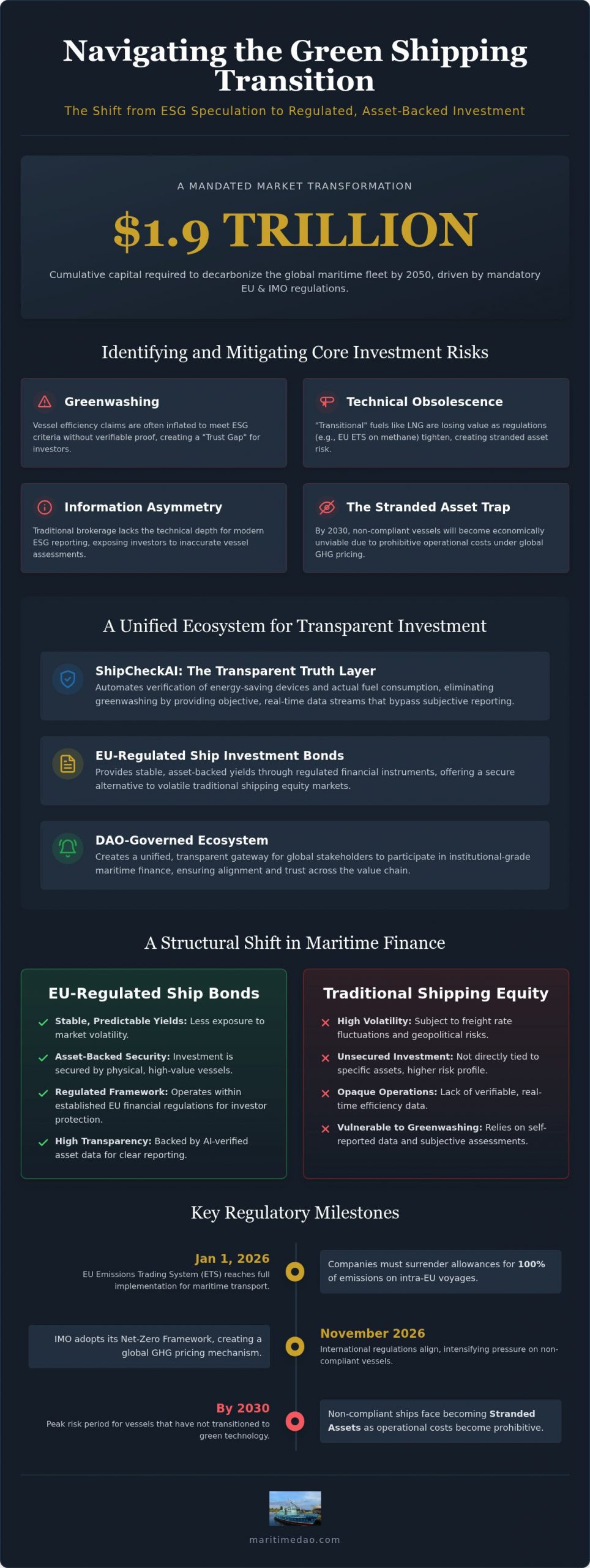
The global maritime industry is currently undergoing a structural transformation that replaces legacy carbon-intensive operations with a unified, high-efficiency framework. We define green shipping as the integration of sustainable propulsion and AI-driven operational efficiency. This shift represents one of the most significant green shipping investment opportunities of the decade, as the sector moves from voluntary ESG goals to a mandatory regulatory environment. By 2026, the cumulative capital required for the Decarbonization of shipping has reached an estimated $1.9 trillion, creating a massive entry point for institutional capital to fund the transition to zero-carbon fuels, energy-efficient hull designs, and digital optimization.
The Decarbonization Mandate: IMO and EU Drivers
As of January 1, 2026, the EU Emissions Trading System (ETS) is fully implemented for the maritime transport sector. Shipping companies must now surrender allowances for 100% of verified emissions for voyages within the EU and 50% for those starting or ending outside the region. This mandate now includes carbon dioxide, methane, and nitrous oxide. Simultaneously, the International Maritime Organization (IMO) is scheduled to adopt its Net-Zero Framework in November 2026. These combined pressures mean that non-compliant vessels face a legitimate stranded asset risk by 2030, as their operational costs become prohibitive under global GHG emissions pricing mechanisms.
Market Segments: Laggards vs. Frontrunners
The market is bifurcating into distinct categories of frontrunners and laggards. Frontrunner carriers, those who have invested in methanol dual-fuel ships or ammonia-ready hulls, are securing higher willingness-to-pay premiums from cargo owners who must report their scope 3 emissions. Identifying high-alpha green shipping investment opportunities requires a deep understanding of this shift from brown to green asset yields. While older vessels suffer from depreciating value and rising compliance costs, green assets benefit from long-term offtake agreements and preferential port access. Investors are increasingly targeting three specific pillars: alternative fuel infrastructure, vessel retrofitting, and digital optimization systems. This tripartite approach allows for a diversified exposure to a market projected to grow at a CAGR of 17.35% through 2034.
Identifying Risks: Greenwashing and Technical Obsolescence
The scale of the $1.9 trillion green shipping investment opportunity is matched only by the severity of its information gaps. For many institutional actors, the primary barrier to entry isn’t a lack of capital but a lack of verifiable data. Greenwashing remains a systemic threat, where vessel efficiency claims are frequently inflated to meet ESG criteria without the mechanical or operational proof to back them up. This “Trust Gap” is exacerbated by a fragmented landscape of global fuel standards, making manual inspections and traditional brokerage reports insufficient for identifying viable green shipping investment opportunities.
Technical obsolescence represents another critical frontier of risk. As regulatory frameworks tighten, “transitional” fuels that seemed viable in 2024 may be regulated out by the end of the decade. For instance, the full implementation of the EU ETS in 2026 now accounts for methane emissions, directly impacting the valuation of LNG-fueled assets. Investors must distinguish between short-term retrofits and long-term propulsion longevity to avoid the financial pitfalls of legacy technology.
The High Cost of Information Asymmetry
Traditional ship brokerage often lacks the technical depth required for modern ESG reporting, leaving investors exposed to significant information asymmetry. When vessel condition assessments are inaccurate, the resulting impact on bond yields and asset-backed security valuations can be severe. Institutional-grade green shipping investment opportunities require real-time, objective data streams that bypass subjective human reporting. This level of transparency ensures that the physical reality, the operational efficiency, and the regulatory standing of the asset align within a unified ecosystem.
The Stranded Asset Trap
In the context of 2026 maritime regulations, a stranded asset is a vessel that becomes economically unviable due to its carbon intensity or inability to meet new IMO GHG pricing mechanisms. Evaluating a vessel’s propulsion technology is no longer just a technical exercise; it’s a core financial requirement. Utilizing a comprehensive maritime asset due diligence framework is essential for identifying which assets are prepared for the zero-carbon transition and which are liabilities in disguise. For those seeking to mitigate long-term risk, implementing a methodical assessment of fuel flexibility and engine efficiency is the only way to ensure portfolio resilience. You can strengthen your oversight by reviewing our latest asset assessment checklist to verify vessel compliance.
Verifying Assets: The Role of AI in Green Due Diligence
The transition toward a sustainable maritime economy requires a shift from subjective reporting to objective verification. In this new paradigm, we position AI-driven vessel assessment as the “Truth Layer” for institutional actors. By deploying automated intelligence, the industry can finally bridge the gap between reported ESG claims and physical reality. This technological pillar is essential for those evaluating green shipping investment opportunities, as it provides a standardized, incorruptible baseline for asset performance.
ShipCheckAI automates the verification of energy-saving devices and actual fuel consumption, transforming how due diligence is conducted. It moves the industry away from periodic manual surveys toward continuous, AI-monitored condition reports that provide a granular view of operational health. AI eliminates human bias in vessel efficiency grading by applying objective, data-driven algorithms to physical asset condition. This ensures that every data point, from engine performance to hull integrity, is verified against real-world operational benchmarks rather than self-reported estimates.
ShipCheckAI: A New Standard for Vessel Assessment
The deployment of AI ship inspection tools has established a first-of-its-kind benchmark for identifying structural and mechanical efficiency. These systems utilize multiple inspection types to build a comprehensive “Green Score,” which serves as the foundational data for bond issuance. This methodical approach significantly reduces the cost and time of pre-purchase inspections for maritime investors. By integrating high-resolution imaging with predictive analytics, ShipCheckAI identifies latent inefficiencies that traditional surveyors might overlook, ensuring that capital is only deployed toward truly sustainable assets.
Data Transparency for Institutional Compliance
Securing the secondary market value of green shipping assets depends on verifiable data transparency. AI inspection data integrates seamlessly into EU-regulated reporting frameworks, providing the “Proof of Green” required by increasingly stringent ESG funds. These automated surveys act as a reliable gatekeeper, ensuring that green shipping investment opportunities remain compliant with the latest EU ETS and IMO mandates. In an environment where AI-optimized routing has demonstrated fuel savings of 10% to 15% compared to conventional navigation, the ability to verify these gains in real-time is what separates high-performance portfolios from those at risk of technical obsolescence.
Structured Investment Vehicles: Bonds vs. Traditional Equity
The 2026 landscape for green shipping investment opportunities is defined by three distinct pillars: asset-backed security, regulatory oversight, and technological verification. Shipping equity has historically been defined by volatility and cyclicality, making it a challenging entry point for non-specialist institutional capital. As the industry pivots toward decarbonization, the risk-reward profile of traditional equity is being reconsidered in favor of more stable, asset-backed debt instruments. This shift allows investors to participate in the $1.9 trillion transition without direct exposure to the unpredictable fluctuations of global charter rates.
The Case for Maritime Debt Instruments
Debt is uniquely suited for the capital-intensive nature of vessel retrofitting and newbuild programs. Unlike equity, which sits at the bottom of the capital stack, structured debt provides a senior secured position on the physical asset. This security package ensures that the investment is backed by the vessel itself, which remains a critical component of global trade infrastructure. The rise of tokenized real-world assets (RWAs), a market that grew by 260% in 2025, has introduced a new layer of liquidity to this traditionally illiquid sector. By fractionalizing high-value ship bonds, the ecosystem can now offer institutional-grade access to a global audience while maintaining the structural integrity of the underlying debt.
EU Regulation: The Gold Standard for Investor Protection
The transition to sustainable maritime finance requires a framework of trust and legal certainty. We’ve seen a decisive move toward EU regulated ship investment bonds as the preferred vehicle for 2026. These instruments operate under rigorous standards such as MiFID II and the Prospectus Regulation, providing a level of transparency and investor protection that offshore or unregulated structures cannot match. This regulated innovation ensures that all stakeholders benefit from clear governance, audited reporting, and defined legal recourse.
Institutional adoption is fundamentally driven by maritime investment compliance, which serves as a bridge between decentralized technology and traditional asset management. By adhering to established financial laws, these vehicles provide the sober reliability required for significant capital allocations. If you’re ready to diversify your portfolio with verified, asset-backed debt, you can explore our EU-regulated bond offerings to secure a position in the green transition.
Navigating the Maritime DAO Ecosystem for 2026
Maritime DAO serves as the unified gateway for institutional and private capital to access the decarbonization frontier. It synthesizes the technical rigor of ShipCheckAI with the structural reliability of EU-regulated debt, creating a first-of-its-kind ecosystem. This framework is designed to capture green shipping investment opportunities with a level of precision previously unavailable in the maritime sector. By centralizing these pillars into a single, governed environment, we’ve identified a solution to the technical and legal complexities that have historically hindered large-scale sustainable finance.
Regulated Innovation: The DAO Advantage
The Maritime DAO investment model represents a significant evolution in how heavy industry assets are managed and governed. It utilizes a hybrid control model where professional execution teams are balanced by community oversight, ensuring that every vessel acquisition meets stringent environmental benchmarks. This structure reduces traditional administrative overhead by replacing manual intermediaries with automated governance protocols. It’s a system that effectively bridges the gap between blockchain efficiency and maritime law, ensuring that every digital action remains grounded in established legal frameworks. Token holders play a critical role in this ecosystem, as they govern the green criteria that define the portfolio’s expansion into zero-carbon propulsion and energy-efficient designs.
Getting Started with Green Shipping Bonds
Deploying capital into the sustainable maritime transition is a methodical process designed to prioritize security and transparency. Investors can move from due diligence to allocation through a structured three-step protocol:
- Step 1: Review AI-verified condition reports. Access the platform’s data room to examine ShipCheckAI’s objective assessments of engine performance, fuel consumption, and structural integrity.
- Step 2: Assess regulatory compliance. Review the bond’s alignment with EU Prospectus Regulations and MiFID II standards to confirm the presence of institutional-grade investor protections.
- Step 3: Allocate capital through the secure gateway. Execute the investment within a unified environment where the relationship between physical assets and digital governance is transparently documented.
This systematic approach ensures that green shipping investment opportunities are no longer speculative ventures. Instead, they’re transformed into transparent, asset-backed securities that empower a global audience to participate in the $1.9 trillion transition. By combining automated intelligence with regulated financial instruments, the ecosystem provides the structural integrity required for long-term portfolio growth in an increasingly carbon-constrained world.
Securing Your Position in the Maritime Decarbonization Frontier
The transition to a zero-carbon maritime economy is no longer a speculative future; it’s a regulated reality driven by the $1.9 trillion decarbonization mandate. By integrating AI-verified vessel due diligence with an EU-regulated framework, institutional and private investors can finally bypass the systemic risks of greenwashing and technical obsolescence. These structural pillars ensure that green shipping investment opportunities are grounded in physical reality and legal certainty, offering a stable, asset-backed alternative to the historical volatility of shipping equity.
Success in this new era requires a unified approach to asset management where decentralized governance transparency and institutional rigor coexist. The Maritime DAO ecosystem provides the methodical architecture necessary to navigate this high-stakes landscape with absolute confidence. It’s time to bridge the gap between the physical world of global trade and the digital world of regulated finance. Explore EU-Regulated Green Shipping Bonds on Maritime DAO today and take your place at the forefront of sustainable industrial finance. The future of global trade is being built now, and the tools for professional participation are finally within your reach.
Frequently Asked Questions
What makes a shipping investment “green” in 2026?
A shipping investment is classified as green in 2026 based on its alignment with the EU ETS full implementation and the IMO Net-Zero Framework. It involves the integration of zero-carbon propulsion, such as green methanol or ammonia, alongside AI-driven operational efficiency. Verified green shipping investment opportunities require documented proof of emissions reduction, specifically targeting carbon dioxide, methane, and nitrous oxide to meet institutional ESG reporting standards.
Are EU regulated ship investment bonds safer than traditional shipping stocks?
EU regulated ship investment bonds provide a more stable, asset-backed alternative to the inherent volatility of traditional shipping stocks. While stocks represent equity exposed to fluctuating charter rates, bonds occupy a senior secured position on the physical vessel. These instruments operate under MiFID II and the Prospectus Regulation, ensuring a transparent, governed, and unified framework that prioritizes capital preservation and legal recourse for all global stakeholders.
How does ShipCheckAI prevent greenwashing in maritime finance?
ShipCheckAI serves as an automated truth layer that replaces subjective manual surveys with objective, continuous data streams. By verifying the presence and performance of energy-saving devices and actual fuel consumption, it eliminates the human bias often found in traditional brokerage reports. This systematic verification process ensures every vessel in the ecosystem meets its stated efficiency claims, effectively closing the trust gap for institutional investors and bondholders.
What is the minimum investment for green shipping opportunities on Maritime DAO?
The minimum investment threshold for green shipping investment opportunities on Maritime DAO is designed to facilitate broader market access while maintaining the rigor of institutional finance. Because the platform utilizes a fractionalized debt model, it allows for a more inclusive entry point compared to traditional maritime private equity. Specific allocation requirements depend on the individual bond issuance and the investor’s jurisdictional compliance with EU-regulated financial frameworks.
How do IMO 2025/2026 regulations affect existing ship bond yields?
The 2025 and 2026 IMO regulatory updates directly impact bond yields by defining the operational viability of the underlying assets. Compliance with the upcoming IMO Net-Zero Framework ensures that vessels maintain their market value and avoid the GHG emissions pricing that targets carbon-intensive fleets. Assets that fail to meet these standards face depreciating valuations and rising compliance costs, which can fundamentally alter the risk-return profile of the debt.
Can retail investors access green shipping bonds, or is it only for institutions?
Retail investors can access green shipping bonds through the Maritime DAO ecosystem, which positions a traditionally exclusive industry as an accessible asset class. The integration of blockchain technology allows for the fractionalization of large-scale maritime debt, enabling a global audience to participate alongside institutional stakeholders. However, all participants must undergo standard KYC and AML procedures to ensure the platform remains a governed, secure, and compliant financial environment.
What happens if a vessel in the bond portfolio fails an environmental inspection?
If a vessel fails an environmental inspection, the DAO-governed ecosystem triggers a systematic remediation protocol. ShipCheckAI identifies the specific mechanical or operational failure, and the management team is required to implement technical retrofits or energy-saving optimizations to restore compliance. This methodical oversight protects the structural integrity of the bond portfolio, ensuring that the underlying assets remain within the green classification required by rigorous institutional and regulatory standards.
How does tokenization improve liquidity in green shipping investments?
Tokenization improves liquidity by fractionalizing high-value maritime assets into smaller, tradeable units on a secure blockchain. This process transforms traditionally illiquid ship bonds into assets that can be exchanged more efficiently within a global ecosystem. By creating a transparent secondary market, tokenization allows investors to manage their portfolio exposure with greater flexibility while maintaining the sober reliability and legal protections of a regulated, asset-backed financial instrument.