
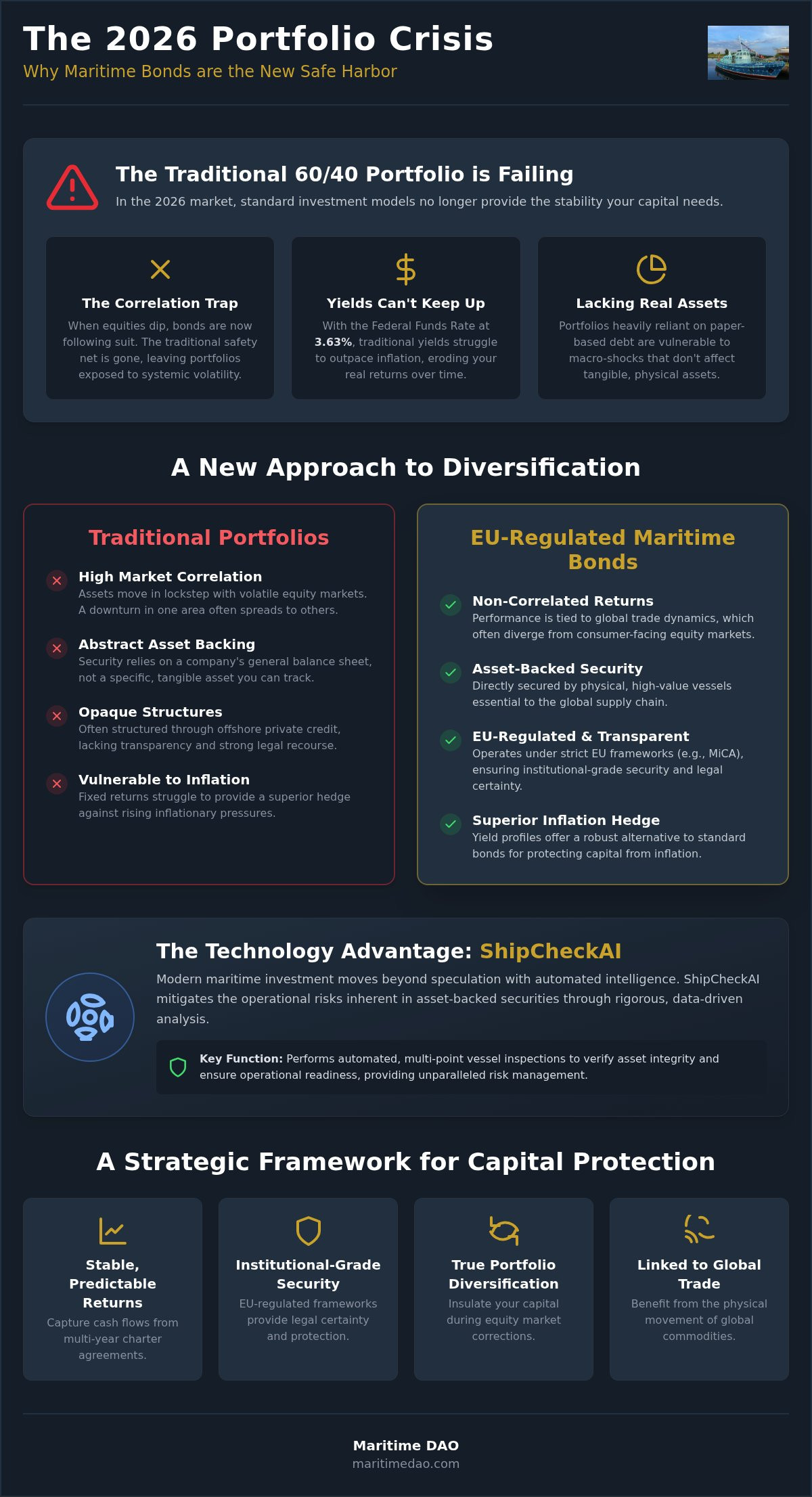
In 2026, the traditional 60/40 portfolio hasn’t just slowed down; it’s effectively broken. You’ve likely noticed that when equities dip, your supposedly “safe” bonds often follow suit, leaving you exposed to systemic volatility and yields that struggle to outpace the current 3.63% federal funds rate. Achieving true portfolio diversification with maritime bonds is no longer a niche strategy reserved for institutional giants. It’s a necessary move for those seeking a unified ecosystem that governs, secures, and democratizes access to the physical assets driving global trade.
This article provides a clear roadmap to securing non-correlated, asset-backed returns through EU-regulated maritime debt. You’ll discover how the integration of MiCA-compliant frameworks and ShipCheckAI technology provides the transparency and legal certainty previously missing from private maritime credit. We’ll break down the 2026 regulatory environment and explain how our approach unites physical shipping, institutional finance, and automated intelligence to stabilize your holdings in a high-volatility market.
Key Takeaways
- Learn why the systemic breakdown of traditional 60/40 models necessitates portfolio diversification with maritime bonds to capture stable, non-correlated returns in 2026.
- Understand how EU-regulated legal frameworks ensure institutional-grade security and transparency for ship investment bonds, moving beyond the opacity of traditional offshore private credit.
- Discover how ShipCheckAI utilizes automated intelligence to perform multi-point vessel inspections, effectively mitigating the operational risks inherent in maritime asset-backed securities.
- Compare the yield profiles of maritime debt against standard 10-year Treasuries and corporate bonds to identify a superior hedge against inflationary pressures and market volatility.
- Gain a strategic framework for determining the optimal allocation of maritime assets to ensure your capital remains protected during equity market corrections.
The 2026 Diversification Crisis: Why Traditional Fixed Income Is Falling Short
The traditional 60/40 portfolio is no longer a reliable anchor for capital preservation. In July 2026, institutional and retail investors face a systemic challenge where traditional fixed income fails to buffer equity volatility. With the U.S. Federal Reserve effective rate at 3.63% and the ECB main refinancing operations at 2.40%, the yield environment remains tight while inflation continues to erode real returns. This environment has forced a massive shift toward “real assets” that offer structural integrity and tangible value. Achieving portfolio diversification with maritime bonds emerges as a sophisticated response to this crisis, moving beyond paper-based debt to provide an asset-backed hedge fundamentally linked to the physical movement of global commodities.
The Correlation Trap in Modern Portfolios
Traditional government and corporate bonds have lost their status as negative beta assets. We’ve seen a persistent correlation trap where rising interest rates and inflationary pressures cause both stocks and bonds to decline simultaneously. Global supply chain shifts have introduced new layers of volatility into traditional markets; this makes standard corporate debt increasingly sensitive to the same macro shocks affecting equity valuations. Investors now require hard-asset backing to ensure their fixed-income allocations remain resilient. By focusing on vessels that facilitate essential trade, investors can escape the unified downward pressure of the broader financial markets. It’s a move from speculative credit toward a governed ecosystem of physical security.
The Rise of Maritime Alternative Investments
The shipping sector operates on a distinct economic cycle that often diverges from regional consumer sentiment. While domestic retail sectors might struggle, the demand for raw materials and energy continues to drive maritime trade volumes across borders. This independence makes alternative investment in shipping a compelling pillar for modern wealth management. Maritime debt is governed by global trade dynamics, unified by international demand, and secured by the physical vessels themselves. This tripartite foundation of value ensures that portfolio diversification with maritime bonds offers a transparent, regulated gateway to yields that remain insulated from localized volatility. Unlike traditional private credit, which often lacks transparency, these EU-regulated instruments provide a high-tech solution to identify and capture non-correlated returns in an increasingly interconnected world.
Maritime Bonds Explained: A Non-Correlated Alternative for Modern Portfolios
Maritime bonds represent a fundamental bridge between heavy industry and sophisticated capital markets. In the 2026 economy, these are structured as institutional-grade debt instruments where capital is deployed for vessel acquisition, refinancing, or green-tech retrofitting. Unlike traditional corporate debt that relies on a company’s general balance sheet, maritime bonds are asset-backed securities. Their performance is tied directly to the vessel’s operational revenue. With the ship finance market now exceeding USD 400 billion in outstanding debt, these instruments have become essential for maintaining global trade fluidity. Portfolio diversification with maritime bonds allows investors to capture predictable cash flows generated by multi-year charter agreements, which remain largely independent of the volatility found in consumer-facing equity markets.
EU Regulated Ship Investment Bonds vs. Traditional Debt
The primary differentiator for modern investors is the shift toward “regulated innovation.” Historically, maritime debt was often confined to opaque private placements or offshore structures that lacked transparency. Today, EU regulated ship investment bonds operate under strict financial oversight, providing a level of legal protection previously unavailable to a broader audience. These bonds are often governed by the MiCA framework (Regulation EU 2023/1114), which ensures that digital and tokenized representations of debt meet rigorous compliance standards. This institutionalization of maritime credit eliminates the “black box” nature of ship finance, allowing both institutional and accredited retail investors to participate in a unified, transparent ecosystem. If you’re looking to upgrade your fixed-income strategy, you can explore our current bond offerings to see how these regulations protect your capital.
The Role of Physical Assets in Capital Preservation
A core advantage of maritime debt is the “floor” provided by the physical asset itself. Ships possess an inherent residual value, often referred to as scrap or demolition value, which provides a final layer of security for bondholders. As detailed in the authoritative textbook on maritime economics, the secondary market for vessels is global and liquid. This means that even in periods of market stress, the underlying collateral—the vessel—retains significant worth. Bondholders are typically protected by first-preferred ship mortgages, which grant them a priority claim on the asset. The risk profile of these bonds is further refined by the vessel type. Dry bulk carriers, tankers, and containerships each respond differently to market cycles, allowing for precise portfolio diversification with maritime bonds based on specific risk tolerances. By securing the principal against a steel asset that facilitates global trade, investors gain a level of structural integrity that paper-backed assets simply cannot match.
The Role of AI in Securing Maritime Asset-Backed Securities
Traditional maritime finance often stumbled at the inspection phase. Manual surveys were the weak link, prone to human error, localized bias, or inconsistent reporting standards. In 2026, achieving portfolio diversification with maritime bonds requires a more rigorous, data-centric approach to risk mitigation. Automated intelligence now serves as the primary gatekeeper, ensuring that the physical vessel’s condition matches the financial projections provided to bondholders. This shift from subjective reporting to objective validation provides the structural integrity necessary for institutional-grade debt. By integrating ShipCheckAI into the due diligence process, we identify, quantify, and mitigate operational risks before they can impact bond performance.
Standardizing Vessel Assessments for Bondholders
The integration of AI in maritime due diligence has created a transparent, universal risk score for every asset in our ecosystem. Instead of relying on a single surveyor’s opinion, ShipCheckAI processes thousands of data points to generate an objective assessment of a ship’s health. This standardization is critical for bond pricing and investor confidence. Our multi-type inspection protocol includes:
- Pre-purchase Analytics: Comprehensive data mining of historical maintenance and incident reports.
- Condition Monitoring: Real-time assessment of hull integrity and machinery efficiency.
- Valuation Modeling: AI-driven comparisons against global market trends to ensure collateral accuracy.
These objective data points allow for more precise coupon structuring, ensuring that portfolio diversification with maritime bonds is grounded in technical reality rather than optimistic estimates.
Protecting Capital through ShipCheckAI Accuracy
Capital preservation is the cornerstone of our bond framework. ShipCheckAI identifies structural fatigue or maintenance lapses that human eyes might overlook, effectively reducing the likelihood of “black swan” operational failures. High-accuracy inspections do more than just protect the asset; they lower insurance premiums and increase net yield for bondholders by optimizing the vessel’s Carbon Intensity Indicator (CII) rating. In 2026, a “Tier 1” rating can result in significant margin reductions, directly benefiting the bond’s underlying cash flow. This automated intelligence is also essential for maintaining EU-regulated compliance standards, providing a unified audit trail that satisfies both regulators and institutional auditors. By replacing uncertainty with automated precision, we’ve built a bridge between the physical world of global trade and the digital world of secure, non-correlated finance.
Comparative Analysis: Maritime Debt vs. Traditional Private Credit
Standard private credit often lacks the tangible collateral floor found in the shipping sector. In 2026, the yield on 1-year Treasuries sits at approximately 3.96%, while top-tier shipowners frequently secure credit margins between 100 and 150 basis points over the Secured Overnight Financing Rate (SOFR). This creates a significant “maritime premium” for investors seeking portfolio diversification with maritime bonds. While traditional small-cap corporate debt is vulnerable to regional economic contractions, maritime assets are governed by global trade volumes, providing a unified hedge against localized equity market corrections. Historical data suggests that maritime default rates for well-structured, asset-backed debt remain lower than those of unsecured high-yield corporate bonds, primarily due to the liquidity of the underlying vessel in the global secondary market.
Yield Profiles and Non-Correlation Benefits
The shipping market operates on a distinct frequency from traditional capital markets. We’ve observed a persistently low correlation coefficient between the Baltic Dry Index and the S&P 500, which underscores why maritime bonds are an ideal “Third Pillar” for any resilient portfolio. Unlike traditional fixed income, which saw a total return of 7.30% in 2025 via the Bloomberg Aggregate Bond Index, maritime debt offers a yield profile linked to physical utility and global demand. This non-correlated nature ensures that your capital remains productive even when equity markets face systemic downturns. By integrating these bonds, you’re not just adding another debt instrument; you’re accessing a global infrastructure play that is fundamentally detached from consumer sentiment and regional inflation spikes.
Regulatory and Transparency Frameworks
The shift from “shadow banking” to regulated innovation is the most significant development in 2026 ship finance. For decades, maritime credit was an opaque world of private deals and offshore structures. Today, EU-regulated maritime bonds provide a transparent, governed ecosystem that adheres to MiCA (Regulation EU 2023/1114) standards. This framework ensures that every tokenized asset is auditable, secure, and legally recognized. Maritime DAO acts as the bridge in this ecosystem, providing a unified platform where institutional and retail investors can access the same high-stakes opportunities with full regulatory protection. Our commitment to transparency means that bondholders don’t have to guess about the status of their collateral; they can verify it through an immutable audit trail. To see how these regulated frameworks can stabilize your holdings, you can review our current maritime bond structures today.
Tokenization has also transformed the liquidity profile of these assets. Historically, maritime debt was a “buy and hold” instrument with zero secondary market for smaller investors. By fractionalizing these bonds within a decentralized governance model, we’ve enabled a level of accessibility that traditional private credit simply cannot match. This accessibility, combined with the structural integrity of EU oversight, makes portfolio diversification with maritime bonds a superior choice for those who value both security and liquidity in an uncertain financial landscape.
Strategic Implementation: Navigating the Maritime DAO Ecosystem
Transitioning from traditional fixed income to a model that incorporates portfolio diversification with maritime bonds requires a methodical approach to allocation and governance. In the 2026 financial landscape, the process is no longer restricted to specialized maritime desks at major investment banks. Instead, it’s governed by a unified ecosystem that brings transparency to every stage of the investment lifecycle. Institutional frameworks generally suggest an allocation of 5% to 10% for alternative maritime debt, providing enough weight to stabilize the portfolio during equity market corrections without compromising liquidity. By utilizing a decentralized governance model, investors can move beyond the limitations of legacy systems and access a first-of-its-kind bridge between global trade and digital asset security.
Accessing EU-Compliant Maritime Debt
The gateway to these assets is built on a foundation of regulatory reliability and technological precision. Investors seeking to understand how to invest in maritime assets must first navigate a rigorous KYC (Know Your Customer) and AML (Anti-Money Laundering) framework. This process ensures that the ecosystem remains compliant with MiCA standards, protecting the integrity of the tokenized bonds and the stakeholders involved. Once onboarded, the DAO structure provides a transparent mechanism for governance and profit distribution. Every bondholder has a clear view of the underlying vessel’s performance, with smart contracts automating the distribution of coupons generated by charter revenues. This eliminated the need for manual intermediaries, ensuring that the relationship between physical asset productivity and investor return is direct and secure.
Monitoring Your Maritime Diversification Strategy
Active management is the final pillar of a successful 2026 strategy. Rather than relying on annual audits, investors now use ShipCheckAI reports to continuously track the health and operational efficiency of the underlying vessels. These automated reports provide real-time transparency into maintenance schedules, fuel efficiency, and regulatory compliance. If a vessel’s Carbon Intensity Indicator (CII) rating fluctuates, the impact on the bond’s risk profile is immediately quantifiable. This level of data allows for sophisticated rebalancing; investors can shift their exposure between dry bulk, tankers, or containerships as global trade patterns evolve.
The future of this sector lies in the continued evolution of secondary markets. As tokenized ship ownership becomes more prevalent, the liquidity of maritime bonds will continue to increase, allowing for more dynamic entry and exit points. Portfolio diversification with maritime bonds has moved from a niche alternative to a cornerstone of modern wealth management. It offers a unique combination of steel-backed security, EU-regulated transparency, and non-correlated yields. By embracing this high-tech solution, you’re not just hedging against volatility; you’re anchoring your portfolio in the essential infrastructure of global commerce.
Anchoring Your Wealth in Global Infrastructure
The era of relying on correlated paper assets has ended. We’ve identified that the intersection of heavy industry and high finance offers a rare sanctuary from the volatility of traditional markets. By prioritizing portfolio diversification with maritime bonds, you’re securing capital against the physical reality of global trade. This approach replaces the opacity of legacy ship finance with a unified, transparent ecosystem governed by legal certainty and automated precision.
Our framework integrates EU-regulated compliance with AI-powered due diligence via ShipCheckAI to ensure every vessel provides a verified, asset-backed security. This isn’t just about accessing new yields; it’s about building a robust “Third Pillar” for your financial future. You can now participate in a traditionally exclusive market that’s finally democratized, auditable, and secure. Take the next step toward a more resilient strategy and Explore EU-Regulated Ship Investment Bonds on Maritime DAO. Your capital deserves the structural integrity of the global shipping lanes.
Frequently Asked Questions
What are maritime bonds and how do they differ from corporate bonds?
Maritime bonds are asset backed securities where the debt is secured by a physical vessel rather than a company’s general balance sheet. Unlike traditional corporate bonds that rely on a firm’s overall creditworthiness, maritime debt is tied to the specific revenue generated by a ship’s charters. If the borrower defaults, bondholders have a priority claim on the vessel itself, which provides a tangible layer of security that unsecured corporate debt lacks.
How do maritime bonds provide portfolio diversification?
These instruments offer low correlation with traditional equity and fixed income markets because shipping cycles are driven by global trade volumes rather than regional consumer sentiment. Achieving portfolio diversification with maritime bonds allows investors to hedge against localized inflation and interest rate hikes. Since the demand for raw materials and energy often moves independently of stock market trends, these bonds stabilize returns during periods of high market volatility.
Are maritime bonds regulated by the EU?
Yes, in 2026, maritime bonds issued through our ecosystem are governed by comprehensive EU frameworks, including the MiCA regulation. This provides a unified legal structure that ensures transparency, investor protection, and strict compliance standards. By operating within an EU regulated environment, these bonds move away from the opacity of offshore private credit, offering institutional grade reliability to a global audience of stakeholders.
What are the primary risks associated with investing in maritime debt?
The primary risks include operational vessel failure, fluctuations in global charter rates, and the natural depreciation of the asset over time. We mitigate these risks through a tripartite strategy of rigorous technical due diligence, first preferred ship mortgages, and comprehensive insurance coverage. Automated monitoring also helps identify potential issues before they impact the vessel’s productivity, ensuring that the underlying collateral remains secure throughout the bond’s duration.
How does ShipCheckAI improve the safety of maritime investments?
ShipCheckAI replaces subjective manual surveys with objective, data driven assessments of a vessel’s structural integrity and maintenance history. By processing thousands of data points, the tool identifies structural fatigue or technical lapses that human inspectors might overlook. This high tech approach ensures that the bond’s collateral is accurately valued and operationally sound, which directly reduces the “black swan” risks typically associated with maritime asset management.
Can retail investors access maritime bonds in 2026?
Yes, the democratization of ship finance through tokenization allows retail investors to participate in a market once reserved for massive institutional players. By fractionalizing these bonds, we’ve lowered the entry barriers while maintaining the same level of EU regulated security. This allows individuals to enhance their portfolio diversification with maritime bonds, accessing a high stakes industry through a transparent and governed digital gateway.
How do maritime bonds perform during a global economic recession?
Maritime bonds often show resilience during downturns because they are linked to essential global trade, such as the transport of grain, ore, and energy. While consumer spending might drop, the fundamental need for commodity movement persists. The physical scrap value of the vessel also provides a capital floor, ensuring that even in extreme market contractions, the underlying asset retains a liquid value in the global secondary market.
What is the typical yield expectation for EU-regulated ship investment bonds?
Yields for maritime debt typically offer a premium over standard government and corporate bonds to reflect the specialized nature of the asset class. These returns are usually structured as a margin over benchmarks like the Secured Overnight Financing Rate (SOFR). This “maritime premium” provides a compelling income stream for investors who require higher yields than traditional fixed income can offer in the current 2026 rate environment.