
For decades, the multi-trillion-dollar shipping industry functioned as a closed ecosystem, reserved exclusively for institutional giants and sovereign wealth funds. With the global fleet reaching approximately 116,000 vessels in 2026, the sector remains a cornerstone of global commerce that most individuals simply couldn’t touch. You’ve likely felt that the barriers to entry, from massive capital requirements to the opaque complexities of maritime law, made maritime investment for retail investors an impossible reach for a standard portfolio. It’s a valid concern; the industry has historically lacked the transparency and structural accessibility needed for individual participation.
This analysis demonstrates how the 2026 landscape has finally shifted through regulated innovation and AI-driven oversight. You’ll learn how the democratization of maritime debt and the rise of institutional-grade transparency tools are dismantling traditional obstacles. We will examine the emergence of EU-regulated ship investment bonds, the role of ShipCheckAI in mitigating technical risk, and the specific pathways you can use to secure a position in global trade finance without the institutional price tag.
Key Takeaways
- Understand how the 2026 “democratization of debt” is creating a new landscape for maritime investment for retail investors by removing historical capital barriers.
- Learn why EU-regulated Ship Investment Bonds offer a more stable, asset-backed alternative to traditional shipping equities.
- Discover how ShipCheckAI provides institutional-grade transparency, allowing you to verify vessel conditions before committing capital.
- Master a practical framework for identifying high-performing maritime assets, from container feeder vessels to bulk carriers.
- Explore how a unified ecosystem of digital governance and physical trade creates secure gateways to global maritime yield.
The 2026 Shift: Why Maritime Investment for Retail Investors is Surging
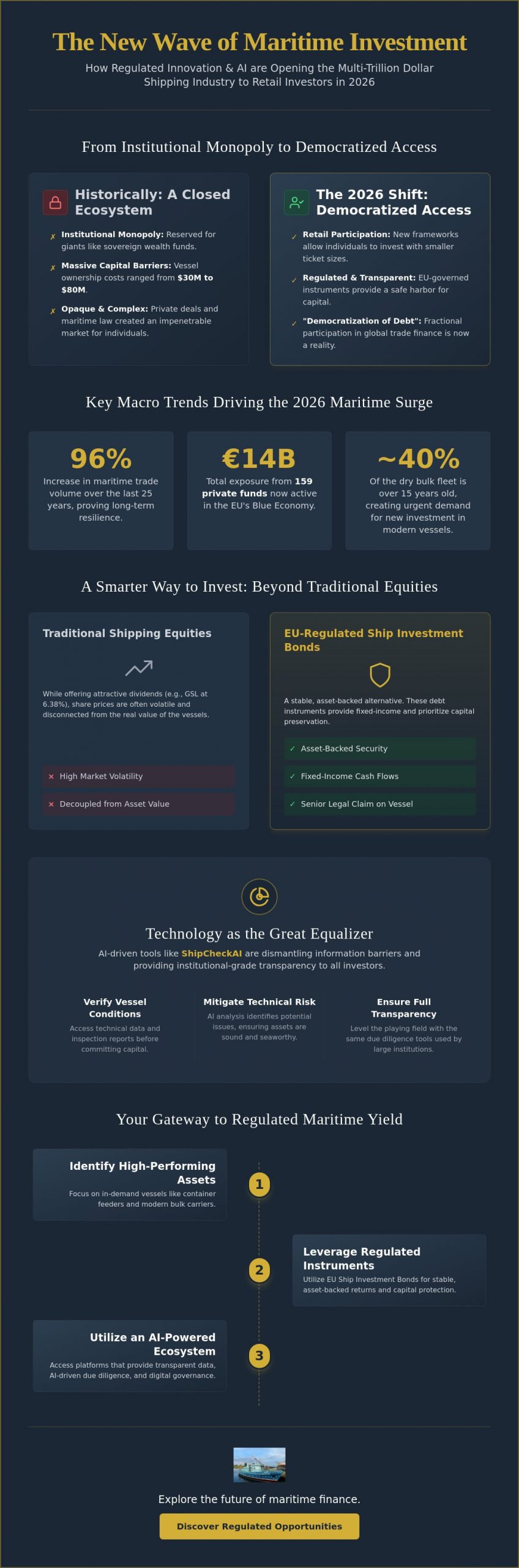
The modern Blue Economy has evolved into a sophisticated ecosystem where sustainable trade, port infrastructure, and advanced logistics converge to drive global growth. By mid-2026, the European Commission’s adoption of the EU Industrial Maritime Strategy has solidified this sector as a primary pillar of economic security. This strategic focus has catalyzed a significant influx of capital; there are now 159 private funds active in the EU’s blue economy, representing approximately €14 billion in total exposure. Maritime retail investment is the fractional participation in global trade finance through regulated instruments. This surge isn’t merely a trend but a structural realignment of how capital enters the global maritime transport industry.
Traditionally, the high capital requirements of vessel ownership served as a formidable barrier, with commercial ships often costing between $30 million and $80 million. These entry costs effectively locked out individual participants, leaving the yields of global trade to institutional players. However, 2026 marks the point where these barriers are dissolving through regulated innovation. New frameworks provide a safe harbor for individual capital, ensuring that maritime investment for retail investors is governed by the same rigorous standards as traditional financial products.
From Institutional Monopoly to Retail Access
Shipping was historically a closed-door asset class defined by opaque private deals and massive minimum commitments. The 2026 BlueInvest Investor Report changed market sentiment by identifying shipping and shipbuilding as the most financially attractive sectors within the blue economy. As a result, maritime capital markets have evolved to support smaller ticket sizes, allowing individuals to participate in the financing of specific vessels or fleets. This shift from monolithic institutional lending to a more inclusive, distributed model provides the industry with a more resilient and diverse capital base.
Macro Trends Driving the 2026 Maritime Surge
Global trade resilience continues to underpin this growth, with maritime trade volume increasing by nearly 96% over the last quarter-century. Current demand is particularly high for modern, efficient feeder vessels that can navigate the complexities of regional supply chains. Additionally, the decarbonization of shipping acts as a powerful catalyst for new investment. With nearly 40% of the existing dry bulk fleet over 15 years old, there’s an urgent need for capital to fund the transition to alternative fuels like methanol and ammonia. Many individuals are now choosing to exit volatile tech sectors in favor of these tangible, asset-backed yields. The stability of a physical vessel, combined with the transparency of 2026 regulatory standards, makes maritime investment for retail investors a compelling alternative to traditional equities.
Beyond Equities: The Rise of EU Regulated Ship Investment Bonds
The traditional route for individual participation in the shipping sector has centered on public equities, yet the 2026 market presents a more structured alternative. While dividends from major carriers remain attractive; for example, Global Ship Lease recently reported a 6.38% yield and Star Bulk Carriers reached 4.12%; share prices are often decoupled from the underlying value of the vessels themselves. This volatility has led to a surge in interest for EU regulated ship investment bonds. These debt instruments function as asset-backed securities, providing a fixed-income cushion that protects capital from the erratic swings of the public stock markets. By mid-2026, these bonds have emerged as a cornerstone for maritime investment for retail investors who prioritize capital preservation alongside yield.
The mechanics of these bonds rely on the steady cash flows generated by long-term vessel charters. Unlike equity, where returns are discretionary and dependent on board decisions, debt instruments are governed by strict contractual obligations. Ship-backed bonds prioritize retail investor repayment over equity holders by establishing a senior legal claim on the vessel’s earnings and residual value. This structural integrity ensures that even in periods of market correction, bondholders maintain a privileged position in the capital stack. As global authorities invest nearly $800 million into port infrastructure to assist in strengthening supply chains, the underlying value of these maritime assets continues to find support from robust industrial demand.
Equity vs. Debt: A Retail Risk-Reward Analysis
Publicly traded shipping stocks on the NYSE or NASDAQ offer liquidity, but they also expose portfolios to systemic market risks. In contrast, private debt through ship financing bonds offers a more predictable trajectory. Retail investors benefit from a ‘liquidation preference,’ meaning that in any adverse scenario, the proceeds from a vessel sale must satisfy bondholder claims before a single cent is distributed to shareholders. This hierarchy of payment transforms maritime investment for retail investors from a speculative bet into a methodical wealth-building tool. Understanding how maritime bond yield is structured and evaluated is essential for making informed decisions within this capital stack. You can explore these structured opportunities further through the Maritime DAO ecosystem.
The Regulatory Framework for 2026
Protection for individual capital has been significantly enhanced by the AIFMD II deadline in April 2026, which standardized reporting and liquidity management across the EU. These regulations prevent the type of ‘black box’ investment structures that previously led to retail losses in less transparent sectors. By utilizing regulated frameworks, investors can verify that their capital is allocated to specific, high-performing assets in safe maritime jurisdictions. This level of transparency is essential for maintaining trust in a multi-trillion-dollar industry that was once entirely opaque to the public.
Technology as the Great Equalizer: AI and Transparency
The shipping industry has long suffered from a “Black Box” problem where retail participants were expected to commit capital without a clear understanding of the physical asset’s condition. Historically, individual investors feared hidden vessel defects or maintenance backlogs that could jeopardize their returns. This lack of visibility created a steep barrier, leaving maritime investment for retail investors as a high-risk venture compared to the highly scrutinized world of public equities. AI removes the information asymmetry between ship owners and retail investors by providing objective, high-fidelity data that was once the exclusive domain of institutional surveyors.
Modern technology has transitioned from a supporting role to a core pillar of risk management. Real-time data streams now allow bondholders to monitor the operational health of a vessel, linking the security of their investment directly to the physical performance of the asset. This technological layer ensures that the multi-trillion-dollar maritime sector is no longer a closed book, but a transparent ecosystem where data governs every transaction.
ShipCheckAI: Standardizing Due Diligence
ShipCheckAI acts as a technical gatekeeper, utilizing automated intelligence to conduct multi-layered vessel inspections. This tool analyzes structural integrity, engine performance, and compliance history to generate a comprehensive risk profile. By implementing AI in maritime due diligence, the system creates a verifiable audit trail that persists for the life of the investment. We’ve moved beyond subjective human surveys, which were often prone to oversight or bias, toward an objective assessment model. This standardization is crucial for maritime investment for retail investors, as it provides a level of technical assurance that matches the regulatory rigor of EU-regulated bonds.
Blockchain and the DAO Governance Model
The integration of a Decentralized Autonomous Organization (DAO) provides the structural framework for transparent capital deployment. Within this model, smart contracts automate the distribution of yields to retail bondholders, ensuring that payments are executed precisely as outlined in the bond’s terms. This eliminates the risk of corporate mismanagement or administrative delays that often plague traditional finance. Governance isn’t just about voting; it’s about a unified, governed system where the relationship between physical shipping assets and digital finance is managed through immutable code. This decentralized approach builds a bridge between the physical world of global trade and the digital world of secure, high-stakes investment.
Practical Guidance: How to Invest in Maritime Assets Safely
Transitioning from understanding the technology to executing a strategy requires a methodical approach to risk assessment. For those exploring maritime investment for retail investors, safety is found in the intersection of legal compliance and technical verification. You must first distinguish between asset types; container feeder vessels are the agile workhorses of regional trade, whereas bulk carriers handle the massive volume of raw commodities. Each asset class reacts differently to economic shifts, meaning your choice should align with your specific risk appetite and the current global trade cycle.
The first step in any evaluation is confirming the regulatory status of the issuing platform. A secure entry point will typically offer EU-regulated Ship Investment Bonds, which provide a unified framework for investor protection. By mid-2026, the maturity of these regulated gateways has made it easier to verify that an instrument is governed by institutional-grade standards rather than speculative offshore rules. Once the legal structure is confirmed, you must pivot to the physical asset’s health by reviewing its “Inspection Score” through ShipCheckAI. This score provides an objective snapshot of the vessel’s structural integrity and engine performance, ensuring you aren’t financing a liability.
The Retail Investor’s Due Diligence Checklist
A rigorous checklist is your best defense against market opacity. Before committing capital, ensure you can answer the following questions:
- Regulatory Standing: Is the bond officially registered as an EU-regulated instrument? Check for the relevant prospectus or ISIN.
- Charter History: What is the vessel’s employment history and current charter rate? Stable, long-term contracts with reputable charterers provide the most predictable yields.
- Technical Health: Does the AI-driven condition report from ShipCheckAI confirm that the vessel meets modern operational standards?
If you’re ready to begin your assessment, you can access our regulated bond listings to see how these criteria are applied in real-time.
Portfolio Integration Strategies
Effective allocation is key to long-term success. Most financial architects suggest that maritime investment for retail investors should occupy a specialized “real asset” slice of a portfolio, typically ranging from 5% to 15% depending on individual goals. One of the primary benefits of maritime debt is its low correlation with the S&P 500. While tech stocks might fluctuate based on interest rate sentiment, ship-backed bonds are tied to the physical movement of goods and global supply chain demand. This makes them an excellent hedge against inflation and equity downturns, as the world’s need for global trade remains a fundamental constant even when digital markets are volatile. For a deeper understanding of how returns are calculated and benchmarked, reviewing the mechanics of maritime bond yield performance in 2026 can sharpen your allocation strategy.
The Maritime DAO Ecosystem: Your Gateway to Regulated Yield
The Maritime DAO ecosystem represents the final convergence of heavy industry and high finance. It serves as the visionary architect and reliable gatekeeper for a new era of global trade participation. By bridging the gap between physical shipping assets and digital financial structures, the platform provides a unified environment where capital can flow securely into the maritime sector. The emergence of Maritime DAO has fundamentally altered the landscape of maritime investment for retail investors, transforming what was once a siloed, institutional monopoly into a transparent, inclusive ecosystem. This isn’t about speculative digital assets; it’s about regulated innovation grounded in the sober reliability of maritime law and EU financial frameworks.
ShipCheckAI provides the technical foundation for this ecosystem, acting as a persistent shield for your capital. It delivers the multi-layered inspections and real-time data necessary to maintain a high-stakes emotional register of security. When you engage with the platform, you’re entering a governed space where every vessel is scrutinized and every yield is backed by a tangible, physical asset. For those ready to move from theory to action, the how to invest in maritime assets roadmap provides the precise, step-by-step guidance needed to navigate this 2026 landscape safely.
Unified Governance and Inclusive Finance
The vision of Maritime DAO is built upon a tripartite relationship between the physical asset, the automated intelligence of ShipCheckAI, and the individual investor. This structure ensures that as EU financial regulations evolve, the ecosystem remains in full compliance, particularly with the rigorous reporting standards set by AIFMD II. Governance is managed through a decentralized model that prioritizes transparency over corporate opacity. By utilizing smart contracts to automate yield distribution, the platform removes the risk of administrative mismanagement, ensuring that maritime investment for retail investors remains a methodical and secure pursuit. It’s a unified system designed to protect the integrity of your portfolio while opening doors to the multi-trillion-dollar shipping industry.
Getting Started with Maritime DAO
Entering the ecosystem is a streamlined process designed for the modern retail participant. You can start by navigating the platform to view current regulated bond offerings, each accompanied by a comprehensive risk profile and technical assessment. Understanding the subscription model for ShipCheckAI insights is also crucial, as it allows you to access deeper technical analytics before committing capital. We invite you to join the Maritime DAO investment community to help shape the future of ship finance. This is your opportunity to participate in a first-of-its-kind project that values order, security, and the democratization of global trade finance. The future of maritime yields is no longer a distant horizon; it’s a regulated reality accessible today.
Navigating the Future of Global Trade Finance
The 2026 maritime landscape has officially transitioned from a restricted institutional arena into a transparent, multi-layered ecosystem. We’ve seen how the combination of EU-regulated debt structures and AI-powered verification has dismantled the traditional barriers to entry. By prioritizing asset-backed security and objective data over speculative market sentiment, maritime investment for retail investors has become a methodical reality for the modern portfolio. This shift ensures that the yields of global trade are no longer reserved for the few, but are accessible to a global audience through secure, governed gateways.
As a 2026 innovation leader in maritime finance, Maritime DAO provides the structural integrity needed to participate in this multi-trillion-dollar industry with confidence. Every bond is governed by a robust EU regulated framework, every vessel is scrutinized by our AI-powered ShipCheckAI verification system, and every investor is empowered by transparent digital governance. This unified approach ensures that the relationship between physical global trade and digital finance remains secure and reliable. You don’t have to wait for the next market cycle to access institutional-grade yields.
Explore EU-Regulated Ship Investment Bonds on Maritime DAO and position your capital at the heart of global commerce today.
Frequently Asked Questions
Is maritime investment safe for retail investors in 2026?
Maritime investment is safe when it’s conducted through regulated frameworks and supported by technical oversight. Safety in 2026 is anchored by the AIFMD II regulatory standards and the transparency provided by AI-driven technical audits. These systems mitigate the risks of information asymmetry and corporate mismanagement that previously defined the sector. By utilizing a governed ecosystem, you can ensure your capital is protected by both law and technology.
What are EU regulated ship investment bonds?
These are debt instruments issued under European Union financial oversight that are secured by physical maritime assets. Unlike speculative digital tokens, these bonds represent a senior claim on a vessel’s earnings and residual value. This structural hierarchy ensures that retail participants are positioned ahead of equity holders in the capital stack. They offer a unified, transparent way to access global trade finance while adhering to institutional-grade compliance standards.
How much money do I need to start investing in shipping?
The 2026 landscape allows for fractional participation, often starting at much lower thresholds than traditional ship ownership. While specific entry points depend on the platform’s minimum subscription, the shift toward fractionalization means you don’t need the millions required for direct vessel acquisition. This accessibility is a core pillar of modern maritime investment for retail investors, opening a multi-trillion-dollar industry to a global audience for the first time.
What is the difference between a shipping stock and a maritime bond?
A shipping stock represents equity ownership in a company, whereas a maritime bond is a debt instrument secured by a specific asset. Stock prices fluctuate based on market sentiment and management decisions; however, bonds provide fixed-income yields governed by charter contracts. Bondholders enjoy a senior legal claim, offering a more stable trajectory compared to the volatility of public equities. It’s a choice between market-driven growth and asset-backed reliability.
How does AI improve the safety of my maritime investment?
AI improves safety by providing objective assessments of a vessel’s structural and operational health. Tools like ShipCheckAI eliminate reliance on subjective human surveys, which were historically prone to oversight or bias. By creating a verifiable audit trail of a ship’s condition, AI ensures that investors have a clear understanding of technical risks before committing capital. This technological layer acts as a reliable gatekeeper for every maritime investment for retail investors.
Can I sell my maritime bond before it matures?
Liquidity depends on the specific terms of the bond and the presence of a secondary market within the ecosystem. Many 2026 regulated platforms utilize digital governance models to facilitate the transfer of fractional interests. However, investors should view these as mid-to-long-term commitments tied to the underlying vessel’s charter duration. Always verify the platform’s secondary market rules to understand how and when you can exit your position.
What happens if a ship in the bond portfolio is damaged?
Vessels are typically covered by comprehensive insurance to protect the underlying value of the asset. The use of AI oversight allows for proactive maintenance, reducing the likelihood of operational failure. In the event of damage, insurance proceeds and the senior claim held by bondholders provide a layer of financial protection. This structural integrity ensures that the physical risks of the sea don’t translate directly into financial loss for the bondholder.
Why is the 2026 Blue Economy report important for retail investors?
This report identified shipping and port infrastructure as the most financially attractive sectors within the broader blue economy. It signaled a shift in institutional sentiment that has paved the way for broader retail access. For those evaluating maritime investment for retail investors, the report provides the macroeconomic data needed to justify the sector’s growth trajectory. It serves as a foundational roadmap for capital allocation in a resilient, global industry.