
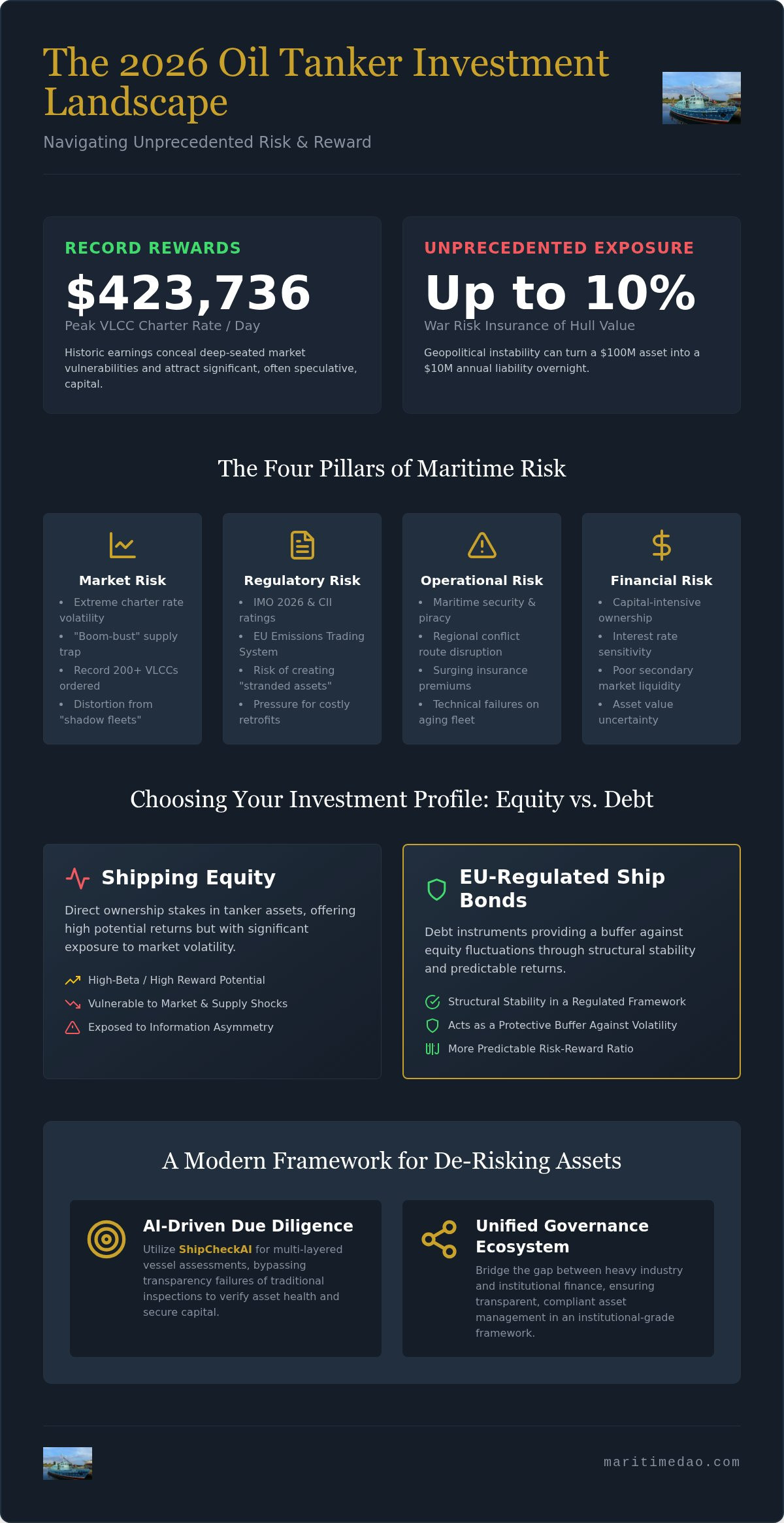
In July 2026, war risk insurance premiums for tankers transiting the Strait of Hormuz surged to as much as 10% of hull value, which effectively turned a $100 million asset into a $10 million annual insurance liability overnight. You’ve likely watched VLCC charter rates climb to record highs of nearly $400,000 per day, yet you also understand that these historic rewards come with unprecedented exposure. The primary risks of investing in oil tankers in this climate are no longer just about market cycles; they’re about information asymmetry and the weight of complex environmental mandates like the IMO 2026 safety regulations.
We’ll analyze the current risk landscape to show how the traditional maritime volatility of 2026 can be mitigated through structural innovation. This article explores a strategic framework for comparing equity and debt instruments, specifically focusing on how EU-regulated ship investment bonds provide a necessary buffer against equity fluctuations. You’ll discover how AI-driven inspection tools now allow for multi-layered vessel assessments, providing the transparency needed to verify asset health and secure your capital within a governed, institutional-grade ecosystem.
Key Takeaways
- Analyze how the “boom-bust” supply trap and record-breaking VLCC orders in 2026 create specific risks of investing in oil tankers that demand a sophisticated entry strategy.
- Identify the four primary pillars of maritime risk, ranging from extreme charter rate volatility to the mounting financial burdens of IMO 2026 and FuelEU compliance.
- Evaluate the high-beta nature of shipping equity compared to the structural stability of EU-regulated ship investment bonds to determine the optimal risk-reward ratio for your portfolio.
- Mitigate operational uncertainty by utilizing ShipCheckAI to conduct multi-layered vessel assessments, bypassing the transparency failures of traditional inspections.
- Discover how a unified governance ecosystem bridges the gap between heavy industry and institutional finance to ensure transparent, compliant asset management.
The Volatile Nature of Oil Tanker Investments in 2026
The maritime sector is currently defined by a paradox where charter rates for VLCCs have peaked at $423,736 per day while extreme capital vulnerability remains a constant threat. In the first half of 2026, close to 200 VLCCs were ordered, marking a historic surge that threatens to disrupt the delicate balance of global tonnage supply when these vessels enter service. This “boom-bust” trap is a central component of the risks of investing in oil tankers, as capital committed during periods of peak earnings often faces a market glut upon delivery. Contrary to common assumptions, high crude oil prices don’t always correlate with increased tanker demand; in fact, sustained high prices often trigger production cuts or legislative windfall taxes that reduce the actual volume of oil entering the sea.
The ‘ton-mile’ effect represents the total demand for shipping capacity, calculated by multiplying the volume of cargo by the distance traveled, and stands as the primary driver of tanker profitability.
Cyclicality and the Supply-Side Challenge
Market participants must navigate the significant lag between capital commitment and asset deployment. While newbuild VLCC contracts reached $131 million in July 2026, five-year-old secondhand vessels commanded a premium at $138 million due to the immediate need for modern tonnage. This inverted asset value reflects a market where the global fleet age averages over 13 years, creating a temporary supply floor. Scrapping rates remain low as owners squeeze every possible day of service out of aging hulls, yet the looming delivery of record-breaking orders suggests a sharp correction is inevitable once the current scarcity abates.
Geopolitical Disruptions and Trade Route Elasticity
Geopolitical volatility in the Strait of Hormuz and the Red Sea has fundamentally restructured global trade routes. Prolonged rerouting around the Cape of Good Hope has increased voyage lengths, artificially inflating demand while driving war-risk insurance premiums to as high as 10% of hull value. Investors must also account for the “shadow fleet” of vessels operating outside standard oil tanker classifications and regulatory frameworks. These unregulated assets create indirect risks of investing in oil tankers for institutional players by distorting market rates and increasing the likelihood of environmental incidents that could trigger broader, industry-wide sanctions. Success in this environment requires a unified framework to verify, govern, and secure assets against these systemic shifts.
Identifying the Four Pillars of Maritime Risk
Understanding the risks of investing in oil tankers requires a departure from traditional commodity analysis. In 2026, the landscape is defined by four distinct pillars: market, regulatory, operational, and financial risk. Market volatility remains acute; for instance, the Baltic Exchange’s TD3C index for VLCCs fell from a March peak of $423,736 per day to $397,753 by late May. These fluctuations directly impact asset residual values, creating a high-stakes environment where timing is everything. Financial risk further complicates this, as the capital intensive nature of ship ownership meets interest rate sensitivity and a notorious lack of secondary market liquidity for older hulls.
Operational hazards represent a persistent threat to capital preservation. Beyond technical failures, investors must account for maritime security risks including piracy and regional conflicts that disrupt primary transit corridors. These threats aren’t merely theoretical; they manifest as tangible costs through surging insurance premiums and potential environmental liabilities. To navigate these complexities, sophisticated participants are moving toward a unified investment ecosystem that prioritizes transparency and automated intelligence over manual, error-prone reporting.
Environmental Compliance: The CII and EEXI Squeeze
The regulatory pillar has become the most significant driver of asset obsolescence. Under the IMO 2026 framework, vessels with poor Carbon Intensity Indicator (CII) ratings face becoming “stranded assets” that are effectively uncharterable by major oil majors. Compliance with the EU Emissions Trading System (ETS) adds a direct financial penalty to carbon-heavy operations, forcing owners to choose between expensive dual-fuel retrofits or early decommissioning. This regulatory squeeze ensures that only the most efficient, technologically advanced tonnage remains profitable in the long term.
Operational Hazards and Environmental Liability
Operational risk management has evolved into a data-driven discipline. War risk insurance in the Bab al-Mandeb Strait has reached peak levels, with premiums increasing by approximately 900% during periods of high tension. An environmental catastrophe, such as a major oil spill, carries long-term liabilities that can exceed the vessel’s entire lifecycle earnings. We mitigate these operational risks of investing in oil tankers by utilizing ShipCheckAI, which provides multi-layered vessel assessments and standardized health checks to identify structural flaws before they escalate into systemic failures. This rigorous due diligence transforms maritime finance from a speculative venture into a governed, institutional-grade asset class.
Equity vs. Debt: Comparing Risk Profiles for Investors
The capital structure of a maritime portfolio determines whether an investor captures sustainable yield or absorbs catastrophic volatility. Publicly traded tanker stocks operate as high-beta instruments, essentially serving as a leveraged bet on global crude movements and geopolitical stability. While the record-breaking charter rates of 2026 offer attractive dividends, the underlying share price remains hypersensitive to rumors of de-escalation or shipyard delivery surges. These risks of investing in oil tankers via equity are magnified by the “lender of last resort” problem; traditional banks frequently retract liquidity during market troughs, leaving equity holders to bear the full weight of refinancing challenges. While equity positions carry a total loss potential during industry-wide bankruptcies, senior-secured bonds prioritize investor repayment through asset-backed security and a governed legal framework.
The Vulnerability of Direct Ship Ownership
Directly owning a vessel introduces operational complexities that often surprise institutional entrants. Maintenance Capex represents a massive hidden cost, particularly the “Special Surveys” required every five years that can cost millions in dry-docking fees and lost operational time. Information asymmetry also plagues the secondary market, where buyers often lack the technical data to distinguish a well-maintained asset from a “lemon” with structural fatigue. These factors, combined with severe liquidity constraints, make exiting a physical vessel position a slow and potentially loss-heavy process during a downturn.
Ship Investment Bonds: A Regulated Buffer
In contrast, EU regulated ship investment bonds offer a sophisticated alternative that shifts the risk profile from speculative to institutional. These debt instruments are structured to prioritize investor repayment over shareholder dividends, creating a protective layer within the capital stack. By anchoring the investment to asset-backed securities, the bondholder gains exposure to the maritime industry’s upside without the 100% downside exposure of equity. This model links risk directly to yield, providing more predictable maritime bond yields through a unified, transparent ecosystem that enforces compliance and reduces jurisdictional uncertainty. This structural integrity ensures that capital is governed by law rather than market sentiment.
De-risking Assets with AI and Advanced Due Diligence
Traditional maritime due diligence is often compromised by human subjectivity and the practice of “surveyor shopping,” where owners seek the most lenient reporting to maintain asset liquidity. These manual inspections provide only a static snapshot of a vessel’s health, frequently missing subsurface structural fatigue or engine irregularities that lead to catastrophic failures. Such opacity represents one of the most significant risks of investing in oil tankers, as unforeseen maintenance can instantly erode the high charter yields seen in 2026. By implementing AI in maritime due diligence, the industry is moving toward a model of continuous, data-driven oversight that eliminates the “due diligence gap” for institutional capital.
Standardized, machine-verified reporting ensures that every participant in the ecosystem operates from a single version of the truth. This transition from periodic surveys to real-time monitoring allows investors to identify structural flaws before they manifest as operational disasters, transforming a historically opaque industry into a transparent, governed asset class.
Beyond Visual Inspections: The ShipCheckAI Advantage
Modern AI ship inspection tools like ShipCheckAI revolutionize pre-purchase assessments by analyzing hull integrity and engine performance data with granular precision. This technology identifies patterns of wear that the human eye cannot detect, predicting potential failures before they occur. To prevent reporting fraud, the system utilizes blockchain-verified logs to create an immutable record of vessel condition. This unified approach ensures that every asset assessment is grounded in objective data, significantly reducing the operational risks of investing in oil tankers.
Standardizing Vessel Assessment for Bond Issuance
Within the Maritime DAO ecosystem, every EU-regulated ship investment bond requires a mandatory ShipCheckAI verification. This process creates a “digital twin” of the physical asset, allowing for transparent risk monitoring throughout the bond’s lifecycle. Verified asset health data doesn’t just protect the principal; it also serves to reduce insurance premiums by proving to underwriters that the vessel is maintained to institutional standards. This methodical integration of technology and finance provides the structural integrity necessary for significant capital deployments. Explore how AI-driven due diligence secures your maritime investments.
Navigating Tanker Risks through the Maritime DAO Ecosystem
The convergence of heavy industry and institutional finance represents a fundamental shift in how maritime capital is governed. Managing the inherent risks of investing in oil tankers requires more than just capital; it demands a unified ecosystem where every participant operates from a baseline of verified data. Through the Maritime DAO, we’ve built a framework that identifies systemic inefficiencies and replaces them with a high-tech governance model. This approach to maritime DAO investment democratizes access to a traditionally exclusive asset class while enforcing the same rigorous compliance standards expected by top-tier financial institutions. By decentralizing access to vessel data, we ensure that every investor, regardless of their position size, has access to the same granular asset information in real time.
Integrating regulated ship bonds into a 2026 portfolio involves moving away from the speculative volatility of equity and toward the structural reliability of asset-backed debt. This transition allows investors to capture maritime yield while maintaining the security of a governed, transparent legal framework. By leveraging decentralized technology, we’ve removed the gatekeepers that once restricted this market, creating a methodical pathway for global capital to participate in the backbone of international trade.
EU-Regulated Frameworks for Secure Capital Allocation
Legal recourse is the cornerstone of any institutional-grade alternative investment. Our ecosystem is meticulously structured to ensure compliance with MiCA and broader EU financial regulations, offering a level of security that traditional ship brokerage cannot provide. This bridges the gap between the physical reality of global trade and the digital world of blockchain governance. It creates a methodical pathway for capital allocation where the relationship between the physical asset and the digital bond is legally binding, transparently managed, and protected by established jurisdictional law.
Leveraging ShipCheckAI for Real-Time Risk Monitoring
ShipCheckAI acts as the primary gatekeeper for the ecosystem, utilizing automated intelligence to filter for institutional-grade assets. Before committing capital, investors should evaluate the comprehensive risk score that aggregates hull integrity, engine performance, and regulatory compliance data. This “Regulated Innovation” approach ensures that the risks of investing in oil tankers are quantified and mitigated before a single bond is issued. To begin, investors can review verified risk assessments of current offerings, ensuring their capital is anchored in assets that meet the highest technical standards. This methodical precision transforms maritime finance from a speculative venture into a stable pillar of a modern, 2026-ready investment strategy.
Securing the Future of Maritime Capital
The maritime landscape of 2026 demands a fundamental departure from the speculative habits of the past. While the risks of investing in oil tankers remain inherent to the physical nature of global trade, they’re no longer unmanageable for the modern investor. By transitioning from high-beta equity positions to senior-secured debt and utilizing automated intelligence for asset verification, you can effectively insulate your capital from the most severe market shocks. Success in this new era depends on the convergence of technical transparency and rigorous legal frameworks that prioritize investor security over speculative hype.
The Maritime DAO ecosystem provides the structural integrity needed to navigate this complex transition. It unites an EU-regulated financial framework with AI-powered asset verification via ShipCheckAI and transparent blockchain-based governance to create a first-of-its-kind investment gateway. This methodical approach ensures that every vessel is treated as a verified asset rather than a potential liability. You now have the tools to bypass traditional maritime volatility and participate in the growth of global trade with institutional-grade confidence.
Explore EU-Regulated Ship Investment Bonds with Maritime DAO and join a community of forward-thinking investors at the intersection of heavy industry and high finance.
Frequently Asked Questions
Is investing in oil tankers safe for retail investors in 2026?
Investing in this sector has traditionally been reserved for institutional players due to high capital barriers and technical complexity. It becomes accessible and safer for retail participants only when structured through regulated debt instruments that mitigate the inherent risks of investing in oil tankers. Without a governed legal framework and transparent asset data, the volatility of the spot market remains too high for most individual portfolios.
What is the biggest operational risk for oil tanker investments?
Technical failure resulting from poor hull integrity or engine fatigue stands as the primary operational threat. These failures lead to immediate downtime, lost charter revenue, and potential environmental liabilities. While geopolitical tensions in corridors like the Strait of Hormuz drive insurance costs, the underlying physical condition of the vessel is the most critical variable that investors must verify through rigorous due diligence.
How do IMO 2030 regulations affect the value of older tankers?
The Carbon Intensity Indicator (CII) creates a tiered market where inefficient vessels face becoming stranded assets. Older tankers that can’t meet these stringent efficiency benchmarks suffer from reduced charter demand and lower residual values. Owners must often choose between expensive dual-fuel retrofits or early decommissioning, which significantly impacts the long-term ROI for assets approaching their 15th year of service.
What is the difference between investing in tanker stocks and ship bonds?
Tanker stocks represent equity ownership and act as a high-beta, leveraged bet on oil prices and charter rates. This structure carries 100% downside risk during market downturns. Ship investment bonds are debt instruments that provide senior-secured exposure to the asset. These bonds prioritize investor repayment and offer a predictable yield, functioning as a protective buffer against the extreme volatility found in public equity markets.
Can AI really predict vessel failures or structural risks?
AI identifies structural flaws by analyzing vast datasets from engine sensors, hull stress monitors, and historical maintenance logs. Unlike manual surveys that are prone to human error, tools like ShipCheckAI detect subtle wear patterns and anomalies before they escalate into systemic failures. This transition to continuous, data-driven oversight reduces the risks of investing in oil tankers by eliminating the information gap between owners and investors.
What happens to my investment if a tanker is involved in an oil spill?
An environmental catastrophe triggers massive legal and financial liabilities that can exceed the vessel’s value. In an equity-based investment, this often results in a total loss of capital. However, when capital is deployed through senior-secured bonds within a regulated ecosystem, the asset-backed structure and mandatory insurance layers provide a critical safeguard for the principal investment, though market value may still fluctuate.
How does the ton-mile effect influence tanker profitability?
The ton-mile effect measures demand by multiplying the volume of cargo by the distance it travels. When geopolitical disruptions force tankers to take longer routes, such as circumnavigating the Cape of Good Hope instead of using the Suez Canal, ton-mile demand spikes. This artificial tightening of supply drives charter rates higher, directly increasing the profitability of available tonnage regardless of actual oil consumption levels.
Why are EU-regulated bonds considered safer than traditional maritime debt?
EU-regulated bonds operate within a transparent legal framework that offers clear recourse and strict compliance with MiCA standards. Traditional maritime debt is often opaque, governed by varying international jurisdictions, and lacks standardized asset verification. A regulated ecosystem ensures that every bond is backed by verified vessel health data and governed by a unified system of oversight, providing the structural integrity required for institutional-grade finance.