
In the current maritime economy, a vessel’s carbon intelligence has become as critical to its valuation as its deadweight tonnage. As of 2026, the full implementation of the EU Emissions Trading System requires ships over 5,000 gross tonnage to surrender allowances for 100% of their emissions, fundamentally redefining the math of maritime equity. Understanding how environmental regulations affecting ship value dictate market liquidity is no longer a secondary concern; it’s the primary driver of asset performance in a transparent, unified ecosystem.
The fear of holding a stranded asset is a rational response to a landscape where Poseidon Principles signatories now control 80% of global shipping finance. You likely recognize that the era of speculative acquisition is over, yet calculating the precise green premium for modern fleets remains a complex, shifting challenge. This guide provides a clear framework for assessing vessel liquidity, governing operational risk, and identifying high-yield opportunities in regulated maritime debt. We will examine the convergence of IMO mandates and EU frameworks while introducing the automated tools necessary to protect your capital from regulatory depreciation.
Key Takeaways
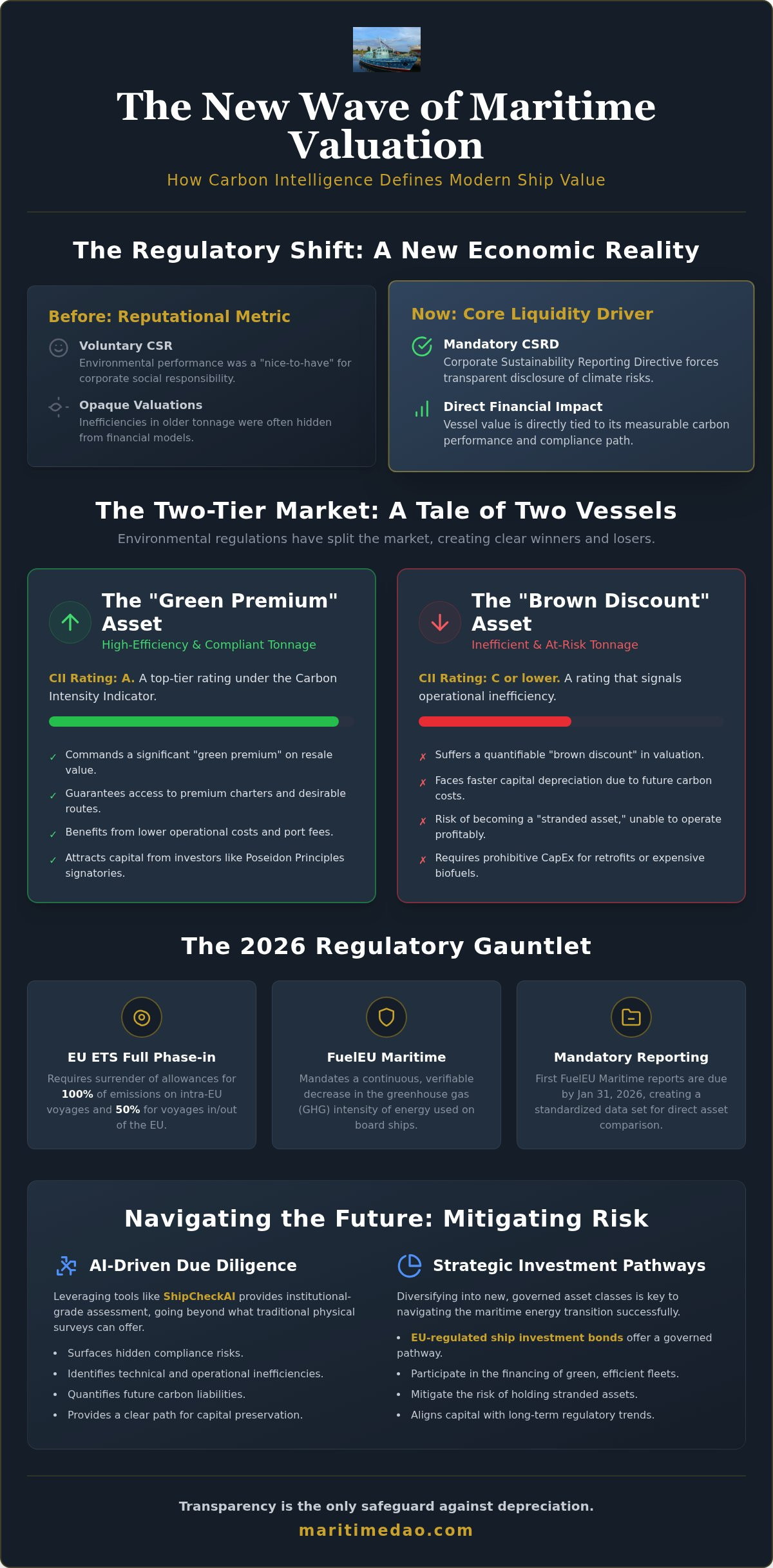
- Mandatory financial disclosures under CSRD have transformed environmental performance from a reputational metric into a core driver of vessel liquidity.
- The Carbon Intensity Indicator (CII) serves as a critical price-adjustment mechanism, enabling investors to quantify the “brown discount” applied to inefficient tonnage.
- Evolving environmental regulations affecting ship value now dictate a tiered market where dual-fuel and high-efficiency assets command significant “green premiums.”
- Leveraging ShipCheckAI allows for institutional-grade due diligence, surfacing compliance risks and technical inefficiencies that traditional physical surveys often miss.
- Diversifying into EU-regulated ship investment bonds provides a governed pathway to participate in the maritime energy transition while mitigating the risk of stranded assets.
The Regulatory Shift: Why Environmental Mandates Now Dictate Ship Value
The valuation of maritime assets has entered a period of structural realignment. Regulatory Value Erosion describes the systemic decline in a vessel’s market price as its technical specifications fall behind tightening carbon thresholds. In 2026, this isn’t a theoretical risk; it’s a balance sheet reality. The shift from voluntary Corporate Social Responsibility (CSR) to the mandatory Corporate Sustainability Reporting Directive (CSRD) has stripped away the opacity that once protected older tonnage, forcing a transparent disclosure of climate-related financial risks.
Institutional investors now use the IMO’s 2030 and 2050 targets as immediate benchmarks for asset longevity. A vessel that cannot demonstrate a clear path to compliance is no longer just less efficient. It’s a potential stranded asset. These frameworks unite, govern, and open up new pathways for capital preservation by identifying high-risk tonnage early. Understanding the Environmental Impact of Shipping is now a prerequisite for basic financial due diligence in any serious maritime portfolio.
The 2026 Regulatory Landscape: IMO vs. EU Mandates
The interplay between global IMO standards and regional EU rules has created a fragmented, two-tier global ship market. While the IMO provides the global framework, the EU’s aggressive enforcement through the Emissions Trading System (ETS) applies immediate financial pressure. Consider these key drivers of the current market split:
- EU ETS Full Phase-in: As of 2026, the system requires 100% coverage of emissions for intra-EU voyages and 50% for voyages entering or leaving the EU.
- FuelEU Maritime: This initiative mandates a steady decrease in the greenhouse gas intensity of energy used on board, directly impacting long-term asset liquidity.
- Reporting Convergence: The first FuelEU Maritime emissions reports are due by January 31, 2026, providing a standardized data set for asset comparison.
From Operational Cost to Capital Depreciation
The link between operational expenses and capital value has never been more direct. As carbon taxes increase OpEx, the discounted cash flow models used for valuation show immediate CapEx drops. Regulatory Obsolescence occurs when a vessel, typically built before 2015, becomes economically unviable due to its inability to meet mandatory efficiency thresholds without prohibitive capital expenditure.
Consider a case study of two similar bulk carriers. An A rated vessel under the Carbon Intensity Indicator (CII) maintains its resale value because it guarantees access to premium charters and lower port fees. Conversely, a C rated peer faces a brown discount. The latter’s value depreciates faster as buyers factor in the inevitable cost of engine power limitation or expensive biofuel transitions. These environmental regulations affecting ship value have effectively turned carbon performance into a liquid asset class, where transparency is the only safeguard against depreciation.
Quantifying the Impact: CII, EEXI, and the ‘Brown Discount’
Ship valuation is no longer solely a function of age, deadweight tonnage, and engine hours. The International Maritime Organization environmental regulations have introduced the Carbon Intensity Indicator (CII) and the Energy Efficiency Existing Ship Index (EEXI) as hard financial filters. These metrics function as price-adjustment mechanisms that directly influence the Net Present Value (NPV) of a vessel by quantifying its future carbon liabilities. In the 2026 market, a ship’s technical efficiency is a primary determinant of its capital recovery profile.
The “Brown Discount” is a quantifiable reduction in a vessel’s second-hand value. Buyers calculate the aggregate cost of carbon allowances over the asset’s remaining life and subtract that sum from the purchase price. Since the EU ETS now mandates 100% surrender of allowances for intra-EU voyages, a ship’s daily earnings potential is tied directly to its emission profile. These environmental regulations affecting ship value transform operational inefficiencies into immediate capital losses, as carbon costs can erode a significant portion of a vessel’s daily Time Charter Equivalent (TCE) earnings. For those looking to hedge these risks, exploring regulated maritime debt offers a way to participate in the market without the direct liability of hull ownership.
CII Ratings and Charterparty Liquidity
Charterers have become the primary gatekeepers of market liquidity. Major commodity traders and energy majors increasingly shun ‘D’ and ‘E’ rated vessels to meet their own Scope 3 emission targets. This creates a liquidity trap where non-compliant ships are relegated to the spot market at lower rates. There’s a documented correlation between poor CII ratings and higher ship bond yields, reflecting the increased risk of cash flow disruption. Investors must integrate carbon price volatility into their valuation models. A sudden spike in carbon credit prices can render a marginally efficient vessel unprofitable overnight.
EEXI Compliance and Retrofitting Costs
EEXI compliance requires a rigorous technical appraisal. Owners must decide between the ROI of Energy Saving Devices (ESDs), such as rotor sails or hull coatings, and the inevitable asset depreciation of doing nothing. For many older vessels, the default solution is Engine Power Limitation (EPL). While EPL is a cost-effective compliance route, it permanently reduces a ship’s commercial speed, making it less attractive for time-critical routes. Integrating these retrofitting or operational costs into maritime asset due diligence is the only way to avoid overpaying for legacy tonnage.
Green Premiums vs. Stranded Assets: A Comparative Analysis
Asset valuation in 2026 has bifurcated into a clear hierarchy. The “Green Premium” represents the tangible price gap between dual-fuel or high-efficiency vessels and their conventional counterparts. This premium isn’t merely a speculative addition; it’s a reflection of reduced carbon liability and superior charter attractiveness. As environmental regulations affecting ship value become more stringent, the market is aggressively devaluing assets that lack a clear decarbonization pathway. For institutional investors, future-proofing a maritime portfolio now requires a shift from simple hull ownership to a strategy focused on technical longevity and regulatory resilience.
The contrast between LNG-ready vessels and conventional fuel oil ships illustrates this divergence. An LNG-ready vessel offers a bridge to lower-carbon operations, effectively capping its exposure to the EU ETS and FuelEU Maritime mandates. In contrast, conventional hulls face a mounting risk of becoming stranded assets. These are vessels that can no longer be chartered by top-tier energy majors or sold without substantial price concessions. Modern secondary markets now prioritize ships equipped with verified electronic logbooks, as these digital records provide the transparent, immutable data required to prove compliance during a sale or refinancing event.
Valuation Divergence in the 2026 Market
The gap between eco-modern vessels and legacy tonnage continues to widen. Rating systems like RightShip now influence bank financing terms as directly as a vessel’s physical condition. A high environmental rating can secure lower interest rates, while a poor score can trigger a “brown discount” that erodes equity overnight. The Poseidon Principles, now adopted by 35 major financial institutions representing 80% of the global shipping finance market, have institutionalized this trend. Lenders use these principles to align their portfolios with IMO targets, meaning that a vessel’s carbon intensity now dictates its access to capital and its ultimate market value.
The Institutional Case for Compliant Fleets
The transition toward greener fleets has changed how maritime capital is structured. Institutional investors are moving away from equity-heavy positions in older hulls, favoring instead the stability of debt-structured investments in compliant assets. This is why EU regulated ship investment bonds have gained traction; they provide a governed, transparent vehicle for financing vessels that meet strict environmental criteria. By focusing on compliant fleets, investors can mitigate “greenwashing” risk through rigorous, AI-driven vessel assessments that verify actual fuel efficiency against reported figures, ensuring that the asset’s value is grounded in operational reality rather than optimistic projections.
Mitigating Risk: AI-Driven Due Diligence and Vessel Assessment
Traditional physical surveys are a legacy tool in a digital age. While they effectively identify corrosion or structural fatigue, they frequently overlook the subtle data discrepancies that signal future carbon liabilities. In 2026, an asset’s “Environmental Health” is determined by its operational efficiency over time, not just its physical condition at the dock. AI-driven due diligence has emerged to unify disparate data streams, governing the risk of regulatory non-compliance through automated verification and predictive modeling. This technological shift ensures that transparency, reliability, and precision are at the core of every maritime transaction.
Integrating real-time sensor data into asset valuation models allows investors to move beyond static, historical reports. AI systems analyze engine performance, fuel consumption, and emission output to verify that a vessel actually meets its reported carbon rating. This technical transparency ensures that environmental regulations affecting ship value are factored into the purchase price with mathematical precision, protecting capital against hidden depreciation. For those seeking to secure their portfolios, it’s essential to leverage institutional-grade assessment tools before finalizing any maritime debt acquisition.
ShipCheckAI: Automating Environmental Compliance Audits
Maritime DAO has pioneered the use of the AI ship inspection tool known as ShipCheckAI to solve the transparency gap in vessel assessments. This platform automates the verification of hull fouling and engine efficiency, two factors that directly dictate a ship’s carbon intensity. By standardizing inspection reports, the system provides institutional-grade clarity that traditional surveys cannot match. It effectively eliminates the “human error” factor, ensuring that pre-purchase assessments are governed by objective data rather than subjective observation. This unified approach allows for rapid, multi-inspection cycles that verify compliance across an entire fleet in days rather than months.
Due Diligence Checklist for the 2026 Investor
To safeguard maritime capital, investors must follow a methodical assessment framework. This process moves from high-level regulatory compliance to granular technical verification, ensuring that every asset is fit for the 2026 regulatory environment:
- Verification of SEEMP Part III Implementation: Ensure the vessel has a robust, approved Ship Energy Efficiency Management Plan that outlines specific, actionable pathways for carbon reduction through 2030.
- Analysis of Historical CII Performance: Review at least 24 months of operational data to confirm that the vessel’s rating isn’t a result of temporary weather conditions or optimized routes.
- Technical Audit of Subsystems: Utilize AI to audit ballast water treatment systems and scrubbers, ensuring they meet the latest North-East Atlantic ECA standards and PFOS-free fire extinguishing requirements.
This structured approach allows capital providers to identify “brown” risks before they manifest as financial losses, ensuring the long-term integrity of the maritime ecosystem. By prioritizing assets with verified technical performance, investors can maintain liquidity even as global mandates continue to tighten.
Strategic Investment: Maritime DAO and Regulated Innovation
The traditional shipping finance model often struggles to keep pace with the velocity of the 2026 regulatory landscape. As capital requirements for green retrofitting increase, a systemic gap has emerged between vessel valuation and actual compliance status. This is where Maritime DAO investment provides a critical solution, acting as a bridge between heavy industry and institutional-grade digital finance. By utilizing a unified ecosystem, investors can finally align their capital with the technical realities of modern decarbonization mandates.
Investing in fractionalized, compliant maritime debt offers a sophisticated pathway to diversify away from the risks of direct hull ownership. Transparency and governance are no longer just buzzwords; they’re the ultimate shields against the environmental regulations affecting ship value. When an asset’s performance is continuously monitored by AI and governed by a transparent legal framework, the risk of “regulatory surprise” is virtually eliminated. This approach ensures that every bond is backed by an asset that not only meets current standards but is technically prepared for the escalating requirements of the 2030s.
Unified Governance and Asset Security
Decentralized governance plays a pivotal role in ensuring long-term vessel compliance. Unlike traditional structures where operational data is siloed, a DAO-governed ecosystem ensures that maintenance records, fuel consumption data, and emission reports are transparent and immutable. Maritime DAO bonds provide direct exposure to high-efficiency, “green” shipping without the operational overhead of physical management. This system unites physical maritime assets with the security of digital finance, creating a governed environment where asset integrity is prioritized. It’s a first-of-its-kind model that protects bondholders from the value erosion typical of non-compliant, legacy fleets.
Next Steps for the Compliance-Conscious Investor
For those looking to safeguard their capital, the path forward requires a methodical shift toward regulated innovation. Evaluating how to invest in maritime assets with a strict focus on ESG criteria is the only way to ensure long-term portfolio liquidity. Investors should prioritize platforms that offer automated due diligence and continuous technical monitoring. Requesting a ShipCheckAI demo for upcoming vessel acquisitions is a practical first step in verifying the environmental health of your potential holdings. In the 2026 market, the inevitability of environmental regulation has become the ultimate filter, separating high-performing capital from assets destined for the scrap yard.
Navigating the New Era of Maritime Equity
The maritime industry has reached a point of no return where technical efficiency and capital liquidity are inextricably linked. By 2026, the data-driven reality of the EU ETS and IMO mandates means that environmental regulations affecting ship value act as the ultimate market arbiter. Investors who rely on legacy physical surveys risk exposure to stranded assets that can’t be chartered or sold without significant concessions. Conversely, those who utilize automated intelligence can identify and secure high-performing tonnage with institutional precision.
You can bridge the gap between traditional heavy industry and cutting-edge finance through a unified ecosystem designed for maximum transparency. Secure your maritime capital with EU-regulated ship investment bonds from Maritime DAO. This first-of-its-kind framework combines AI-powered assessment via ShipCheckAI with fully compliant EU financial regulations and institutional-grade governance. The energy transition isn’t just a regulatory hurdle; it’s a generational opportunity to redefine how global trade is financed and governed. By positioning your portfolio within a transparent, regulated ecosystem, you aren’t just avoiding depreciation; you’re leading the maritime frontier with confidence.
Frequently Asked Questions
How do IMO 2030 targets specifically affect ship resale value in 2026?
IMO 2030 targets function as a technical filter that dictates the long-term capital recovery profile of a maritime asset. In 2026, resale values reflect the anticipated cost of achieving a 40% reduction in carbon intensity, meaning ships without a clear compliance pathway face accelerated depreciation. These targets have effectively shortened the economic life of older tonnage, as buyers factor in the prohibitive capital expenditure required to avoid regulatory obsolescence.
What is a ‘Brown Discount’ in maritime finance?
A ‘Brown Discount’ is a quantifiable reduction in a vessel’s market price triggered by its poor environmental performance and high carbon liability. Investors apply this discount to account for the increased operational expenses of carbon credits and the restricted chartering opportunities available to inefficient hulls. It’s a risk-mitigation mechanism that aligns an asset’s price with its future cash flow potential in a decarbonizing market.
Can older ships be retrofitted to maintain their market value under CII rules?
Older vessels can be retrofitted with Energy Saving Devices (ESDs) or engine power limitations, but the economic viability of these upgrades depends on the remaining life of the hull. While retrofitting can mitigate the impact of environmental regulations affecting ship value, the high capital cost often makes it difficult to achieve a positive return on investment compared to younger tonnage. Investors must conduct a rigorous technical appraisal to determine if the cost of compliance exceeds the asset’s projected market value.
How does the EU ETS affect the valuation of ships operating outside of Europe?
The EU ETS affects any vessel that docks at an EU port, regardless of its primary operating region or flag state. Since 50% of emissions from voyages between EU and non-EU ports are now taxable, global vessels with high carbon intensity face significant earnings erosion when entering European trade lanes. This regional mandate has created a tiered global market where a ship’s flexibility to trade in premium European routes is a primary driver of its valuation.
What is the difference between EEXI and CII for an investor’s due diligence?
EEXI is a one-time technical certification focused on a ship’s design and equipment, while CII is an ongoing annual operational rating based on actual carbon intensity. For a robust due diligence process, EEXI confirms the vessel’s legal right to trade, whereas CII indicates its commercial attractiveness and long-term liquidity. Investors must monitor both to ensure an asset is not only technically compliant but also operationally efficient enough to avoid “brown” discounting.
How can AI tools like ShipCheckAI improve vessel valuation accuracy?
ShipCheckAI improves valuation accuracy by replacing subjective physical observations with objective, institutional-grade technical data. The platform utilizes automated intelligence to verify engine efficiency and hull condition, ensuring that environmental regulations affecting ship value are calculated with mathematical precision. This unified approach provides the transparency required to surface hidden technical risks that traditional surveys often miss, protecting capital from unforeseen regulatory depreciation.
Are green-certified ships easier to finance through traditional banks?
Yes, green-certified ships benefit from superior access to capital and more favorable financing terms due to the institutional adoption of the Poseidon Principles. Over 35 major financial institutions now prioritize assets that align with global decarbonization targets to manage their own portfolio risk. This shift means that compliant, high-efficiency vessels typically secure lower interest rates and longer tenors than their conventional counterparts.
What happens to the value of a ship that receives an ‘E’ rating on its CII audit?
A ship receiving an ‘E’ rating faces immediate liquidity risks and a substantial drop in its secondary market value. Under IMO regulations, vessels with an ‘E’ rating must implement a mandatory corrective action plan to improve their efficiency. Failure to demonstrate progress can lead to the loss of a vessel’s Statement of Compliance, effectively turning the ship into a stranded asset that top-tier charterers and lenders will no longer support.