
Why should a $400 billion debt market remain the exclusive playground of legacy banks and sovereign funds? For decades, the maritime asset financing ecosystem has been defined by high barriers to entry and a frustrating lack of real-time transparency into vessel conditions. You’ve likely felt the sting of legal uncertainty when looking at decentralized projects or felt sidelined by the massive capital requirements typical of global trade. It’s a common frustration for those who recognize the value of shipping but cannot find a secure, regulated entry point that provides the structural integrity necessary for significant capital investment.
This article reveals how the integration of AI-driven due diligence and EU-regulated financial instruments is redefining global ship finance for institutional and retail investors. You’ll learn how a unified framework of automated intelligence, legal compliance, and transparent governance can transform a traditionally opaque industry into an accessible, high-yield asset class. We’ll preview the essential roles of ShipCheckAI for vessel integrity and EU-regulated ship investment bonds in building a more inclusive financial frontier. By bridging the gap between physical assets and digital governance, this evolution offers the confidence and diversification you need to navigate the 2026 maritime market.
Key Takeaways
- Define the modern maritime asset financing ecosystem as a unified network that integrates institutional capital, AI-driven transparency, and robust EU-regulated frameworks.
- See how ShipCheckAI utilizes automated intelligence to provide multi-type vessel assessments, ensuring that bondholders have access to reliable, real-time asset condition reports.
- Evaluate the advantages of EU-regulated ship investment bonds, which provide a secure and legally grounded alternative to traditional, high-barrier maritime debt instruments.
- Understand how decentralized governance and smart contracts automate essential functions like bond coupon payments and ensure continuous maritime investment compliance.
- Learn how to participate in this first-of-its-kind ecosystem by leveraging independent vessel inspections to make informed, data-backed investment decisions.
What is a Maritime Asset Financing Ecosystem?
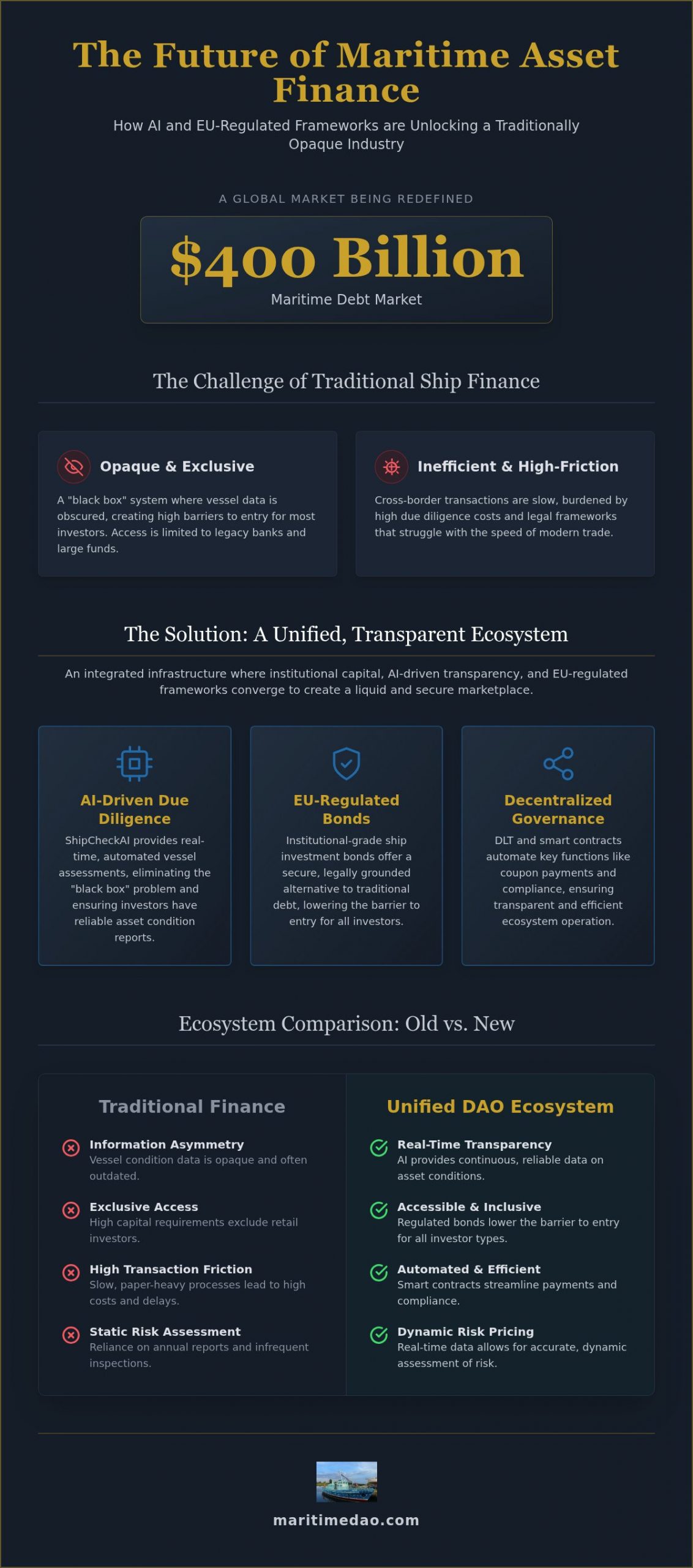
A modern maritime asset financing ecosystem represents far more than a collection of isolated ship mortgages or bilateral lending agreements. It’s a unified, high-tech infrastructure where institutional capital, automated intelligence, and stringent regulatory frameworks converge to create a liquid and secure marketplace. To grasp the scope of this transformation, we must first understand the foundational mechanics of asset finance, where physical equipment serves as the primary security for capital deployment. In 2026, the industry has decisively moved away from siloed, paper-heavy lending toward an integrated digital asset management model that prioritizes real-time transparency and legal certainty.
Maritime DAO serves as the visionary architect of this new era, acting as the bridge between the physical world of global trade and the digital world of regulated finance. By unifying disparate components—such as vessel inspections, debt issuance, and compliance protocols—into a single governance structure, it identifies systemic inefficiencies and provides high-tech solutions to fix them. The ecosystem identifies, governs, and opens up opportunities that were previously restricted to the largest global players.
The Core Components of Global Shipping Finance
The 2026 landscape is characterized by a sophisticated blend of legacy and innovation. While regional banks and Chinese leasing houses remain significant players in the $400 billion maritime debt market, their dominance is being challenged by more agile structures. The ecosystem now relies on three distinct pillars: private credit originations, EU-regulated ship investment bonds, and a digital infrastructure powered by Distributed Ledger Technology (DLT). This digital backbone provides the essential record for asset tracking, while private credit funds now account for nearly 25% of all new maritime debt originations, offering the flexibility that traditional lenders often lack.
Why Traditional Models are Failing Modern Investors
The legacy ship finance model is often criticized for its “black box” nature, where vessel condition and operational data are obscured from the ultimate capital provider. This information asymmetry creates high barriers to entry, effectively excluding retail and mid-market institutional investors who cannot afford the high due diligence costs. Transactional friction in cross-border capital markets remains a significant hurdle, as traditional legal frameworks often struggle with the speed of modern trade. Investors today demand a transparency-first model that eliminates these inefficiencies. Without real-time asset condition reports, such as those provided by ShipCheckAI, the risks of decentralized projects remain too high for the sober reliability required by institutional finance.
The Pillars of the 2026 Ecosystem: AI and Regulated Bonds
The structural integrity of the modern maritime asset financing ecosystem rests upon two technological and legal pillars: automated intelligence and institutional-grade debt instruments. These pillars don’t operate in isolation; they form a symbiotic relationship that eliminates the information asymmetry traditionally plaguing ship finance. By replacing static, annual reports with dynamic data, the industry achieves a level of “regulated innovation” that welcomes a broader spectrum of capital. This connectivity ensures that asset condition directly informs financial risk, creating a transparent bridge between the engine room and the boardroom.
The synergy between these components is what defines the 2026 market. When an AI-driven inspection reports a high maintenance score, it directly enhances the creditworthiness of the associated ship bonds. This real-time feedback loop allows for dynamic pricing of risk, a feat impossible under traditional bank-led models. It’s a tripartite system where data, law, and capital unite to govern the high-stakes world of global trade. This methodology ensures that every dollar invested is backed by a transparent, verifiable physical asset, effectively lowering the barrier to entry for a global audience.
ShipCheckAI: Automating Maritime Due Diligence
Shipowners and investors have historically operated with a significant knowledge gap regarding a vessel’s true operational state. ShipCheckAI solves this “black box” problem through multi-type vessel assessments that utilize machine learning and historical data to increase inspection accuracy. Whether performing a pre-purchase inspection, a condition survey, or a compliance audit, the AI ship inspection tool framework ensures that every data point is verified and accessible. This transition from annual physical surveys to continuous AI-assisted monitoring allows for a proactive approach to maintenance and risk management, fundamentally altering the due diligence process for modern capital providers.
EU-Regulated Ship Investment Bonds: Security and Compliance
While AI provides the transparency, the legal framework provides the protection. The structure of EU regulated ship investment bonds creates a standardized, asset-backed security that institutional players trust. These instruments reduce the risk profile of maritime assets by ensuring that debt is governed by established European financial regulations, providing a layer of legal certainty that decentralized projects often lack. This alignment with institutional standards reflects a broader movement toward innovative and equitable finance, where technology democratizes access to high-yield assets. By integrating real-time inspection data into the bond’s credit profile, the maritime asset financing ecosystem can offer higher confidence to investors who prioritize structural reliability over speculative gains. To explore how these pillars can fortify your portfolio, you can examine our current bond offerings.
Traditional Ship Finance vs. The Unified DAO Ecosystem
Traditional maritime finance has long been characterized by exclusivity and opacity. For decades, shipowners relied on a small circle of European and Asian banks to secure debt through bilateral mortgages. This siloed approach created a market where only the largest institutional players could participate, leaving mid-market owners and individual investors on the sidelines. In contrast, the 2026 maritime asset financing ecosystem operates as a unified network that democratizes access to capital while maintaining the sober reliability of institutional finance. By replacing fragmented legacy systems with a methodical, tech-driven infrastructure, the industry has moved from a “club deal” mentality to a transparent, global marketplace.
The shift from static to dynamic data represents a fundamental change in how risk is assessed. Legacy models depend on annual physical surveys that are often outdated the moment they’re published. The unified DAO ecosystem replaces these “black box” reports with real-time, AI-driven data, ensuring that every participant has a transparent view of the asset’s condition. This transparency is governed by EU-wide bond frameworks rather than fragmented national mortgage laws, providing a consistent legal layer for cross-border investments. This structural integrity is what allows the maritime asset financing ecosystem to bridge the gap between heavy industry and high-tech capital markets.
Breaking the Barrier: Retail Access to Maritime Debt
Historically, the high capital requirements for ship ownership made the industry inaccessible to most. Today, maritime investment for retail investors is a practical reality through bond participation. Instead of requiring millions for a single vessel, investors can participate in regulated debt instruments with significantly lower capital requirements. This shift from fractional physical ownership to bond participation allows for the democratization of yield, enabling a global audience to profit from the backbone of international trade. It’s an inclusive model that respects the high-stakes nature of the industry while opening doors that were previously locked.
The Liquidity Advantage of Tokenized Assets
Traditional ship sales are notoriously illiquid, often taking months to settle due to complex legal and technical inspections. The integrated ecosystem leverages Distributed Ledger Technology (DLT) to reduce settlement times from weeks to hours. By representing maritime debt as tokenized securities, the market gains a secondary liquidity layer that attracts a broader class of alternative asset investors. This liquidity doesn’t just benefit the investor; it provides shipowners with more efficient access to capital, creating a steady and methodical flow of funds. The role of DLT here is to act as a reliable gatekeeper, ensuring that every transaction is settled with the precision and security that institutional finance demands.
Governance and Compliance in a Regulated DAO
The structural integrity of any financial network relies on the quality of its oversight. In the 2026 maritime asset financing ecosystem, governance has evolved from subjective board decisions to objective, code-based execution. This transition ensures that the relationship between physical assets and digital capital is governed by a transparent and methodical framework. By utilizing a Decentralized Autonomous Organization (DAO) as a reliable gatekeeper, the industry can unify, govern, and secure capital flows while providing the legal certainty required by institutional finance. This isn’t about lawless decentralization; it’s about using technology to enforce the highest standards of accountability.
This “Regulated Innovation” model acts as a blueprint for institutional trust. It balances the cutting-edge ambition of decentralized technology with the sober reliability of established law. The maritime asset financing ecosystem doesn’t just issue debt; it governs the entire lifecycle of the investment through a unified compliance layer. It’s a first-of-its-kind approach that positions a traditionally exclusive industry as something accessible to a global audience, yet it maintains the high-stakes emotional register appropriate for significant capital investments. By acting as both a visionary architect and a reliable gatekeeper, the DAO ensures that the democratization of shipping finance doesn’t come at the expense of security.
Smart Contract Governance for Bondholders
Smart contracts serve as the functional pillars of the ecosystem, automating complex tasks that once required weeks of manual processing. These digital agreements handle the distribution of ship earnings directly to bondholders, ensuring that coupon payments are settled with mathematical precision. Beyond payments, the DAO structure grants voting rights to participants, allowing them to have a say in major asset management decisions. This isn’t speculative; it’s a transparent system where every governance vote and financial transaction is recorded on a public ledger. This creates an audit trail that traditional bank-led models simply can’t match, providing a level of connectivity and breadth that defines the modern era.
EU Regulatory Frameworks for Decentralized Finance
Compliance is the non-negotiable bedrock of maritime DAO investment. To attract institutional capital, the ecosystem must operate within strict legal guardrails, particularly those set by the European Union. This includes robust KYC (Know Your Customer) and AML (Anti-Money Laundering) protocols for every global investor. By adhering to maritime investment compliance standards, the DAO ensures that its debt instruments are recognized as legitimate securities. This alignment with EU-regulated frameworks reduces the risk profile for investors and provides the legal certainty necessary for long-term participation in global trade. To see how these compliance layers protect your capital, you can review our governance documentation.
Investing in the Future: Navigating the Maritime DAO Ecosystem
The transition into a high-yield, regulated maritime portfolio requires a methodical approach. The maritime asset financing ecosystem of 2026 isn’t just a platform for capital allocation; it’s a sophisticated environment where automated data and institutional law protect every transaction. Navigating this space means moving beyond the reactive strategies of the past and adopting a proactive, tech-enabled investment philosophy. By 2030, the fragmented, bank-centric models of traditional ship finance will likely be obsolete, replaced by unified ecosystems that offer the transparency, liquidity, and security that modern investors demand. This evolution represents a fundamental shift in how the physical world of trade interacts with the digital world of finance.
This “regulated innovation” model positions the shipping industry as a newly accessible frontier for those who value structural integrity. It identifies systemic inefficiencies in legacy lending and replaces them with a high-tech solution that bridges the gap between heavy industry and global capital. The ecosystem doesn’t just democratize access; it governs it through a rigorous framework of automated intelligence and legal compliance. It’s a visionary architecture designed for the long-term, providing the order and security necessary for significant capital investments in a complex global market.
Risk Mitigation through AI and Regulation
Investors no longer have to choose between high yield and security. By combining the technical precision of ShipCheckAI with the legal strength of EU-regulated bond structures, the ecosystem minimizes the “black box” risks that once plagued ship finance. Diversification within the maritime sector becomes a systematic process rather than a gamble. You can allocate capital across different vessel types and trade routes, all while maintaining a consistent due diligence standard. ShipCheckAI provides bondholders with a continuous, data-driven verification layer that replaces static due diligence with real-time operational transparency. This tripartite synergy of data, regulation, and capital ensures that the underlying asset condition is always visible, verified, and governed.
Getting Started with Maritime DAO
The path to participation begins with a methodical evaluation of current bond offerings. Each bond in the ecosystem is backed by physical assets and governed by strict European financial standards, ensuring that legal certainty is never compromised. Institutional and accredited investors can access the full ShipCheckAI inspection suite to perform independent, multi-type due diligence on any vessel within the portfolio. This transparency allows for a significantly higher level of confidence before committing capital, as every operational detail is verified through machine learning and historical data. The process is designed to be inclusive yet rigorous, reflecting the professional standards of the global maritime industry. By integrating these high-tech gateways into your investment workflow, you can secure a position in a traditionally exclusive industry that is now accessible through regulated innovation. We invite institutional partners and professional investors to examine our active bond issuance and comprehensive vessel assessment reports to begin their diversification into the future of maritime debt.
The Future of Regulated Maritime Capital
The 2026 maritime asset financing ecosystem has reached a critical inflection point where data integrity and legal compliance are no longer optional. By unifying AI-powered vessel inspection via ShipCheckAI with a robust EU-regulated financial framework, the industry has successfully bridged the gap between physical operations and institutional capital. This shift from opaque legacy mortgages to transparent DAO governance ensures that every participant, from retail investors to global institutions, operates within a secure and methodical marketplace. It’s a first-of-its-kind architecture that identifies systemic inefficiencies and replaces them with a high-tech solution designed for long-term reliability.
The era of the “black box” ship investment is over, replaced by a system that prioritizes real-time transparency and structural reliability. As global trade finance continues its steady transition toward digital governance, these integrated frameworks will define the standard for capital allocation. You now have the tools to navigate this high-stakes frontier with the confidence and precision of an industry leader. We invite you to Explore the Maritime DAO Ecosystem and Regulated Bond Offerings and secure your position in the next generation of global shipping finance.
Frequently Asked Questions
What is a maritime asset financing ecosystem?
A maritime asset financing ecosystem is a unified infrastructure that integrates capital providers, technological layers, and regulatory frameworks to facilitate the funding of global shipping assets. It identifies and bridges the gap between the physical requirements of maritime trade and the digital requirements of modern finance. By combining automated intelligence with institutional-grade governance, it creates a transparent environment where asset condition directly informs financial risk and capital deployment.
Are EU regulated ship investment bonds safe for retail investors?
EU-regulated ship investment bonds provide a high degree of structural security by operating within established legal frameworks that protect bondholder rights. These instruments are governed by strict European financial standards, ensuring that the debt is backed by physical assets and subject to rigorous oversight. While all capital investments carry inherent market risks, this “regulated innovation” model minimizes legal uncertainty and provides a level of transparency previously unavailable to retail participants.
How does ShipCheckAI improve vessel inspection accuracy?
ShipCheckAI improves inspection accuracy by utilizing machine learning and historical data to analyze multi-type vessel assessments with mathematical precision. It replaces subjective, paper-heavy reporting with a standardized digital framework that identifies structural anomalies and maintenance trends. This automated intelligence acts as a reliable gatekeeper, providing investors with real-time condition reports that reflect the true operational state of the asset without the bias of traditional manual surveys.
Can a DAO be legally compliant with EU financial regulations?
A DAO can achieve full legal compliance by integrating robust KYC and AML protocols and operating within established EU-regulated debt frameworks. This model ensures that decentralized governance doesn’t bypass institutional standards but rather automates them through secure smart contracts. By acting as a visionary architect, the DAO provides a methodical system that respects legacy legal guardrails while opening up global trade to a wider, more diverse audience of investors.
What are the primary risks of investing in maritime debt?
Primary risks in this sector include global market volatility, vessel depreciation, and unforeseen operational accidents that may impact a shipowner’s ability to service debt. Investors must also consider geopolitical shifts and changing environmental regulations that can affect asset values over time. The maritime asset financing ecosystem mitigates these risks by providing real-time transparency and asset-backed security, though participants should always maintain a diversified portfolio to manage exposure effectively.
How do tokenized ship bonds differ from traditional ship mortgages?
Tokenized ship bonds differ from traditional ship mortgages by offering secondary market liquidity and fractional participation through Distributed Ledger Technology. While traditional mortgages are siloed, illiquid agreements between a single bank and an owner, tokenized bonds allow for a broader class of investors to trade their positions. This connectivity reduces settlement times from weeks to hours, creating a more agile and inclusive capital market that benefits both owners and investors.
What is the minimum investment for maritime DAO bonds?
Minimum investment thresholds are determined by the specific requirements of each regulated bond issuance within the ecosystem. These levels are designed to be significantly lower than traditional maritime debt entry points, which often require millions in capital for participation. By lowering these barriers, the ecosystem democratizes access to shipping yields while ensuring that all participants meet the necessary accreditation and compliance standards required for institutional-grade finance.
How does AI-powered vessel survey automation reduce costs for financiers?
AI-powered vessel survey automation reduces costs by eliminating the need for redundant manual inspections and streamlining the due diligence process. It identifies maintenance issues before they become critical failures, preserving the value of the underlying collateral and reducing insurance premiums. For financiers, this methodical approach provides a steady flow of verified data, reducing the administrative overhead associated with risk management and asset oversight in the complex global shipping market.