
In 2025, the shipping sector secured approximately $55 billion in bank and bond debt, yet the structural barriers of traditional finance continue to isolate this $400 billion market from a broader range of participants. You’ve likely encountered the systemic friction of capital market fragmentation, where high entry thresholds and opaque vessel condition assessments make institutional-grade maritime debt feel out of reach. It’s a landscape where the lack of standardized transparency often forces a choice between significant risk and total exclusion.
This article reveals how a unified ecosystem of EU-regulated instruments and ShipCheckAI technology is finally democratizing maritime bond market access. By integrating legal frameworks with automated intelligence, we’re witnessing a shift toward a governed, inclusive, and transparent financial frontier. We’ll examine the roadmap for regulated maritime bond investment, the tools necessary for verifying asset integrity, and the specific strategies required to diversify into maritime debt with institutional security in 2026. This is the transition from legacy shipping finance to a first-of-its-kind digital architecture that unites, governs, and opens global trade opportunities.
Key Takeaways
- Understand the structural shift from traditional bank lending toward a unified ecosystem of non-bank capital markets to enhance liquidity and resilience.
- Identify how to eliminate the “black box” of vessel integrity through ShipCheckAI, ensuring high-precision due diligence for every asset-backed instrument.
- Discover how EU-regulated ship investment bonds are democratizing maritime bond market access by removing high-entry barriers and fragmentation.
- Review the essential steps for navigating the regulated bond framework, from analyzing prospectuses to verifying asset integrity with multifaceted AI reports.
- Explore the role of the Maritime DAO in governing this new financial frontier, where decentralized technology meets the rigorous standards of institutional finance.
The Evolution of Maritime Bond Market Access in 2026
Maritime bond market access defines the specialized gateways through which capital flows from global markets into maritime debt. It’s the infrastructure that connects institutional liquidity with the physical requirements of global trade. For decades, this access was restricted to a handful of tier-one banks, creating a closed loop of bilateral lending. Today, we’re seeing a fundamental migration from these legacy silos toward a unified, regulated ecosystem that prioritizes transparency and accessibility.
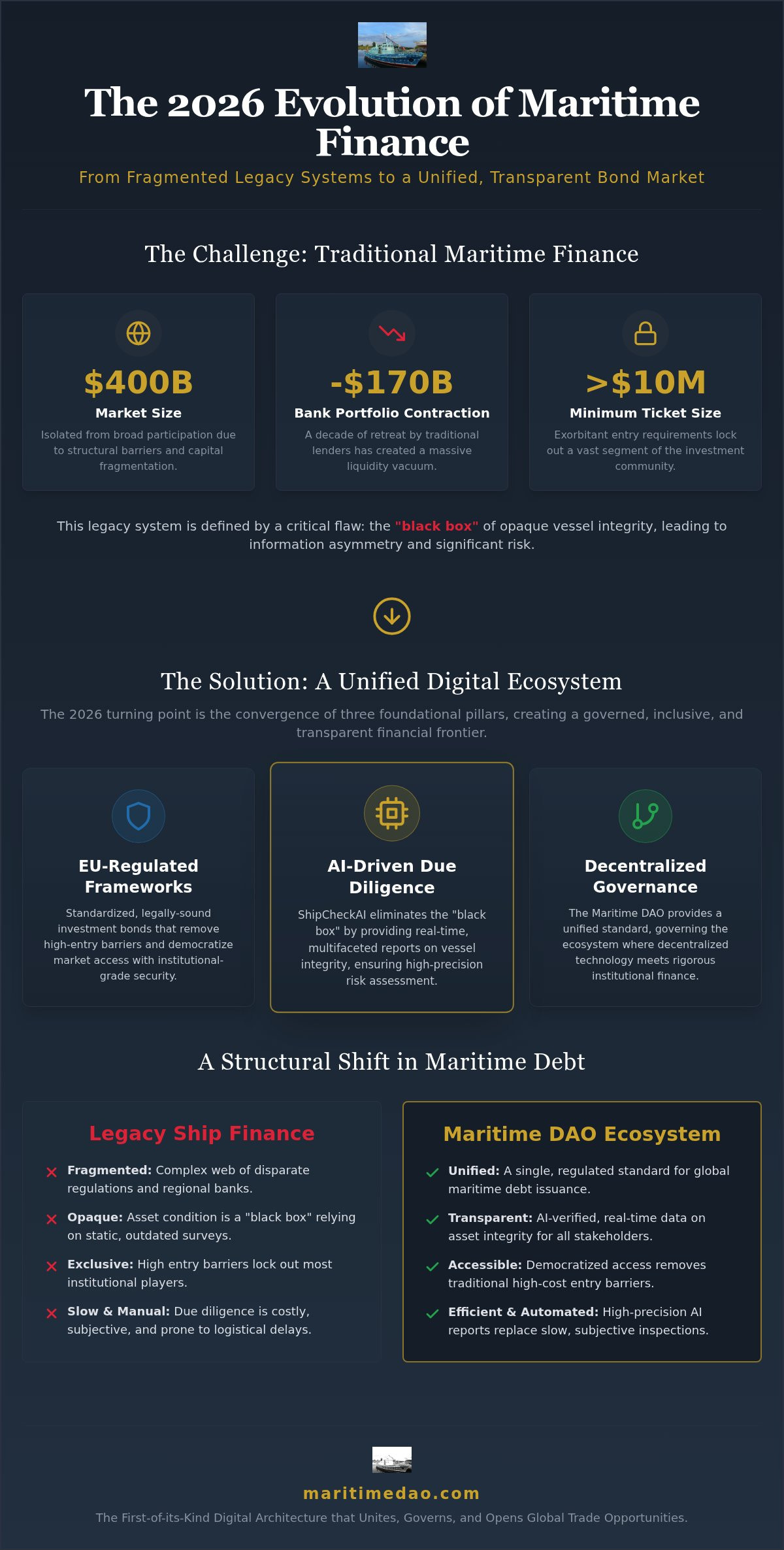
The catalyst for this change is a significant $170 billion contraction in global shipping bank portfolios over the last decade. As traditional lenders retreat to manage their balance sheets and satisfy stringent capital requirements, a liquidity vacuum has formed. 2026 represents a definitive turning point because it marks the convergence of three pillars: clear EU regulatory frameworks, sophisticated AI-driven due diligence, and the rise of decentralized governance. This transition isn’t a mere trend; it’s a structural realignment of how the world’s fleet is financed.
The Fragmentation of Traditional Ship Finance
Legacy lending models often fail because they’re built on fragmentation. The structural barriers established after the 2008 financial crisis have made it nearly impossible for mid-tier institutional players to participate in maritime debt. High minimum entry requirements often exceed $10 million per ticket, effectively locking out a vast segment of the investment community. This exclusivity creates a high-stakes environment where liquidity is trapped and entry is governed by gatekeepers rather than market merit.
When finance is fragmented, stakeholder costs rise and the speed of execution slows down. Shipowners find themselves navigating a complex web of disparate regulations and regional banking quirks. This lack of a unified standard is the primary reason why maritime debt has historically been viewed as an opaque asset class. The fragmentation doesn’t just limit capital; it obscures the true condition of the underlying assets, making risk assessment a manual and prone-to-error process.
Emergence of Non-Bank Capital in Shipping
The emergence of non-bank capital is transforming the industry’s financial DNA. Private debt funds and bond issuance platforms are now offering the flexibility that traditional banks simply can’t match. These instruments provide non-amortizing structures and bullet maturities, allowing shipowners to preserve cash flow for operational expenses and fleet expansion.
As participants look for alternative investment in shipping, maritime bond market access provides a transparent bridge to high-yield opportunities with institutional-grade security. These bonds are essential for fleet renewal programs. In 2026, with the full implementation of the EU ETS for maritime transport requiring 100% allowance surrender, the demand for capital to fund green vessel upgrades has reached a fever pitch. Regulated bonds offer a methodical way to finance these transitions while providing investors with verified asset integrity and transparent governance. This new frontier doesn’t just replace bank lending; it expands the entire maritime ecosystem.
Structural Barriers and the Demand for Institutional Transparency
The primary obstacle to scaling maritime bond market access is the historical “black box” of vessel asset condition. While a traditional corporate bond relies on a balance sheet, a maritime bond is anchored to a physical hull moving across global waters. In the past, investors had to rely on static, paper-based surveys that were often months out of date by the time a deal reached finality. This creates a dangerous information asymmetry where the vessel owner possesses deep operational knowledge while the bondholder operates in a data vacuum. To solve this, the market requires a system that can verify, validate, and secure asset data in real time.
Traditional due diligence is simply too slow for the velocity of 2026 capital markets. Manual inspections involve high costs, logistical delays, and a high degree of subjectivity. One surveyor’s “fair condition” might be another’s “critical risk.” Institutional investors now demand standardized, real-time data to justify their capital allocations. They’re no longer satisfied with anecdotal evidence; they require multifaceted assessments that unite technical, operational, and environmental metrics into a single, transparent record.
The Due Diligence Bottleneck
Traditional ship surveys represent a significant bottleneck because they’re built on legacy processes. These surveys are expensive to coordinate and often result in reports that reflect a single point in time rather than the continuous health of the asset. This subjectivity creates risk for bondholders who need to know the exact state of their collateral. In 2026, the demand for transparency has moved beyond basic seaworthiness. Investors now look for granular data on fuel efficiency, maintenance history, and compliance with evolving environmental standards to ensure their investments remain viable over the long term.
EU Regulatory Requirements for Maritime Bonds
EU financial regulation has stepped in to transform maritime debt from a niche alternative into a standardized asset class. The role of the EU Green Bond Standard (EuGB) is particularly critical, as it requires at least 85% of capital to be allocated to activities aligned with the EU Taxonomy. Compliance is no longer a checkbox; it’s a fundamental requirement for asset-backed securities in the shipping sector. These standards ensure that every bond is governed by a framework that protects the investor while promoting environmental sustainability.
For a deeper look at the legal landscape, consult our guide on maritime investment compliance. This shift toward a more regulated environment is what finally allows institutional capital to enter the market with confidence. By utilizing a unified finance ecosystem, stakeholders can navigate these barriers while benefiting from the security of a governed marketplace. The goal is to create a transparent bridge that connects the physical world of global trade with the digital world of institutional finance.
Evaluating Vessel Integrity: The Role of AI in Bond Issuance
Expanding maritime bond market access requires more than just legal frameworks; it demands a technological layer capable of verifying the physical reality of the assets in question. AI-driven assessments transform maritime due diligence by replacing subjective manual surveys with objective, high-precision data. This shift is critical because the stability of a bond yield is directly tethered to the operational health of the underlying vessel. When an asset’s integrity is verified through automated intelligence, the risk of unforeseen maintenance downtime and subsequent cash flow disruption is significantly mitigated. By providing a transparent view into the ship’s bilge, hull, and machinery, AI ensures that the collateral backing the bond isn’t a “black box” but a verifiable, high-performing asset.
ShipCheckAI and Automated Vessel Assessment
ShipCheckAI serves as the essential gateway for this transition, providing a multifaceted AI ship inspection tool that consolidates various data streams into a single, actionable record. Instead of disparate reports from multiple regional surveyors, global maritime stakeholders can now access high-precision inspections through a unified interface. This tool manages everything from hull integrity to engine performance, ensuring that every vessel in a portfolio meets the rigorous standards required for institutional-grade debt issuance. By automating these assessments, the ecosystem eliminates human error and drastically reduces the time required to bring a bond to market. It’s about building a bridge between physical maintenance and financial performance, ensuring every stakeholder has the same high-resolution view of the asset.
Standardizing Data for Bondholders
The creation of a “digital twin” represents the pinnacle of modern asset-backed security, allowing bondholders to monitor ship condition in real time through a governed digital interface. These AI-driven surveys don’t just record current status; they pre-emptively identify maintenance risks before they escalate into structural failures or regulatory breaches. For instance, with the new IMO 2026 mandates regarding lost containers and electronic inclinometers for vessels over 3,000 gross tonnage, AI systems can instantly verify compliance across a global fleet of 116,000 vessels. This level of granular oversight ensures that the physical asset remains a viable, income-generating collateral throughout the bond’s lifecycle, protecting both the principal and the coupon. By standardizing this data, the maritime debt market achieves the same level of transparency found in traditional fixed-income markets.
Automated data integrity provides the immutable proof required to transform speculative maritime debt into a reliable, institutional-grade asset class.
Navigating the EU-Regulated Bond Framework
Securing maritime bond market access in 2026 requires a methodical approach to the European Union’s evolving regulatory landscape. It isn’t a simple transaction. It’s an entry into a governed ecosystem where legal compliance and physical asset integrity converge. Investors must move beyond the fragmented models of the past and adopt a four-step roadmap to ensure their capital is both protected and productive. This process begins with identifying instruments that carry the EU Green Bond (EuGB) label, ensuring that at least 85% of the capital is allocated to activities aligned with the EU Taxonomy.
- Step 1: Identify Regulated Bonds. Focus on instruments issued under a transparent, EU-compliant framework that specifies asset backing.
- Step 2: Review Technical Data. Examine the prospectus alongside ShipCheckAI condition reports to verify the physical state of the collateral.
- Step 3: Evaluate Yield Performance. Compare the bond’s coupon rate against current benchmarks, such as the 2.50% coupon seen in the July 15, 2026, Seaspan Panda Bond issuance.
- Step 4: Execute on Regulated Platforms. Use a unified digital interface to complete the investment, ensuring all governance and reporting requirements are met automatically.
Understanding Regulated Maritime Debt Instruments
The legal architecture of EU regulated ship investment bonds often utilizes Special Purpose Vehicles (SPVs) to isolate the asset from the parent company’s broader liabilities. Investors must distinguish between asset-backed bonds, where the vessel acts as direct collateral, and unsecured debt. In the 2026 market, the preference has shifted heavily toward asset-backed structures because they provide a tangible recovery path in the event of default. This structural integrity is what allows maritime debt to compete with traditional fixed-income products for institutional capital.
Risk Management in Maritime Capital Markets
Mitigating market volatility in shipping requires a combination of structured debt and real-time oversight. While shipping cycles can be aggressive, bonds offer a stabilizing force by providing fixed returns and non-amortizing structures. ShipCheckAI plays a pivotal role here by ensuring that the collateral’s value doesn’t decay due to maintenance neglect or regulatory obsolescence. By diversifying into a global fleet of 116,000 vessels through a regulated bond platform, you can achieve a balanced portfolio that benefits from global trade without the direct operational risks of ship ownership. Execute your strategy by exploring the unified shipping finance platform today to bridge the gap between traditional reliability and digital innovation.
The Maritime DAO Ecosystem: A Unified Standard for Shipping Finance
Maritime DAO serves as the visionary architect of a new financial frontier, where the physical world of global trade meets the digital precision of blockchain governance. It unifies three critical pillars: EU-regulated bond issuance, AI-driven asset verification, and decentralized oversight. This tripartite structure ensures that maritime bond market access is no longer a privilege of the few but a transparent gateway for global capital. By automating the relationship between asset performance and financial returns, the ecosystem eliminates the systemic inefficiencies that have long plagued traditional maritime lending. It’s a methodical transition from legacy silos to a governed, inclusive, and highly liquid marketplace.
The benefits of this decentralized governance model extend to every stakeholder in the maritime value chain. For shipowners, it provides a streamlined path to non-bank capital. For investors, it offers a reliable gatekeeper that prioritizes asset integrity and regulatory compliance. The DAO doesn’t just facilitate transactions; it governs the standards by which those transactions occur. This ensures that every bond issued within the ecosystem is backed by verified data and protected by a robust legal framework, effectively democratizing an industry that manages over $400 billion in outstanding debt.
A First-of-its-Kind Unified Ecosystem
The integration of ShipCheckAI data directly into the bond issuance framework is what sets this ecosystem apart. Every Maritime DAO investment is informed by high-precision inspections that are updated in real time. This creates a structured, transparent vehicle for capital allocation, where the “black box” of vessel condition is replaced by a digital twin of the asset. By linking physical maintenance directly to financial governance, Maritime DAO ensures that collateral value remains intact throughout the lifecycle of the debt. It’s a unified approach that brings the sober reliability of institutional finance to the cutting edge of technological innovation.
Future Outlook: The 2026 Maritime Fintech Landscape
The 2026 landscape is defined by the shift toward tokenized ship ownership within a strictly regulated environment. This evolution is solving the capital market fragmentation problem by allowing for fractional participation in high-value maritime assets. As more of the 116,000 vessels in the global fleet move toward digital governance, the friction of traditional due diligence will continue to dissipate. Investors looking to secure maritime bond market access should focus on platforms that prioritize this blend of legal structural integrity and automated intelligence. The next step for the institutional investor is to move beyond observation and join the ecosystem, leveraging these first-of-their-kind tools to build a diversified, secure, and transparent maritime portfolio.
The Future of Governed Maritime Finance
The transition from fragmented legacy lending to a unified ecosystem is a structural necessity for the 2026 maritime landscape. By integrating an EU-regulated compliance framework with AI-powered ShipCheckAI transparency, we’ve replaced the “black box” of vessel condition with a high-resolution digital twin. This convergence ensures that asset integrity is no longer a variable but a verifiable constant. We’ve moved beyond the limitations of manual surveys to a system where data governs risk and transparency drives capital.
Expanding maritime bond market access through these governed frameworks allows capital to flow with institutional-grade security and unprecedented speed. This unified maritime investment ecosystem provides the methodical precision required to navigate global trade’s complexities. It’s time to move toward a future where inclusive finance and structural integrity are the standard. Secure your access to the maritime bond market with Maritime DAO and position your portfolio at the intersection of heavy industry and high finance. The bridge between global trade and digital innovation is now open, offering a reliable path to sophisticated maritime investment.
Frequently Asked Questions
What is maritime bond market access?
Maritime bond market access refers to the regulated channels that enable capital to flow from non-bank lenders into the global shipping debt market. These pathways allow participants to bypass traditional bank portfolios, which have contracted by $170 billion over the last decade. By utilizing a unified ecosystem of debt instruments, investors can gain exposure to maritime assets through a structured and transparent financial architecture.
Are EU-regulated ship investment bonds safe for retail investors?
These instruments are designed with institutional-grade security, though all financial participation involves risk management. By adhering to the EU Green Bond Standard, issuers must allocate 85% of capital to taxonomy-aligned activities. This creates a governed environment where retail participants benefit from the same legal safeguards and external reviews as institutional players, ensuring the investment is anchored in a strictly regulated framework.
How does ShipCheckAI improve the security of maritime bonds?
ShipCheckAI enhances the security of maritime bond market access by providing an objective, AI-driven verification layer for the underlying collateral. It eliminates the subjectivity of manual surveys by generating a digital twin of the ship’s condition. This real-time data ensures that bondholders aren’t exposed to hidden maintenance risks or structural failures, maintaining the bond’s stability through continuous, high-precision asset monitoring.
What are the typical yields for maritime debt instruments in 2026?
Yields in 2026 are influenced by market demand and the specific risk profile of the vessel. For example, the Seaspan Panda Bond issued on July 15, 2026, carried a coupon rate of 2.50% per annum. While high-yield shipping bonds often offer more aggressive returns, the focus for regulated instruments is on providing a stable, non-amortizing structure that balances competitive yields with institutional-grade security and reliability.
Can I invest in shipping bonds through a DAO structure?
You can participate in the market through a Decentralized Autonomous Organization that integrates regulated bond structures with blockchain governance. This model unifies physical asset management and digital finance, providing a transparent gateway for global capital. By joining a DAO, you’re entering a first-of-its-kind ecosystem that automates compliance and capital deployment, ensuring that every stakeholder operates within a governed and inclusive standard.
How do AI vessel inspections differ from traditional ship surveys?
AI inspections utilize automated intelligence to provide multifaceted, real-time assessments that are far more precise than traditional, paper-based surveys. While legacy surveys are often subjective and logistical nightmares, AI-driven tools like ShipCheckAI deliver standardized data streams across a global fleet. This ensures that every report is objective, verifiable, and capable of pre-emptively identifying maintenance risks before they impact the asset’s financial performance.
What is the minimum capital required for regulated maritime bond access?
The minimum capital requirement is shifting as digital platforms democratize maritime bond market access. Traditionally, entry thresholds exceeded $10 million, effectively isolating the market to tier-one institutions. However, through unified ecosystems and regulated digital instruments, these barriers are being dismantled. This allows a broader range of participants to diversify their portfolios into maritime debt with significantly lower entry requirements than legacy banking models allowed.
How does tokenization impact maritime bond liquidity?
Tokenization fundamentally improves liquidity by enabling fractional ownership of debt instruments within a regulated environment. It allows for the rapid execution of trades on digital platforms, bypassing the delays associated with fragmented traditional banking systems. By converting a ship’s debt into digital units, the ecosystem creates a more liquid and accessible marketplace where capital can be deployed and redeployed with methodical precision.