
The global maritime industry moves over 80% of world trade by volume, yet this massive engine of commerce has long remained a private vault reserved for institutional titans. You likely view ship finance as a labyrinth of opaque regulations and inaccessible capital requirements. It’s a valid concern, as the fear of hidden vessel defects and the perception that maritime assets are only for the ultra-wealthy have kept many investors on the sidelines. However, the rise of regulated innovation is finally dismantling these traditional barriers.
This guide provides a clear path to investing in shipping bonds for beginners by leveraging a new standard of transparency and legal integrity. You’ll learn how to master the fundamentals of maritime finance through EU-regulated debt instruments that offer a sophisticated alternative to traditional corporate bonds. We’ll explore how ShipCheckAI serves as a digital gatekeeper to verify asset quality, ensuring you don’t have to guess about a vessel’s condition. By the end of this guide, you’ll understand how to use technology to diversify your portfolio with a unified, governed, and institutional-grade maritime ecosystem.
Key Takeaways
- Learn why maritime debt instruments provide a high-yield, lower-risk alternative to traditional equity for those entering the global trade market.
- Master the fundamental process of investing in shipping bonds for beginners through a structured framework focused on regulatory compliance and asset transparency.
- Leverage ShipCheckAI to access multi-layered vessel assessments, moving beyond opaque brokerage reports to institutional-grade data.
- Identify the most resilient 2026 investment strategies, including the “Yield-First” approach focused on long-term time charters.
- Understand how EU-regulated frameworks ensure that decentralized maritime ecosystems maintain the structural integrity required for significant capital allocation.
Navigating the Waters: What is Maritime Asset Investment?
Maritime asset investment is the strategic allocation of capital into the global shipping industry, primarily through debt or equity instruments. This sector underpins the global economy, moving over 80% of all traded goods by volume. Historically, this asset class was a closed ecosystem, limited to sovereign wealth funds and ultra-high-net-worth families who could manage the immense capital requirements. The industry operates as the backbone of international commerce, ensuring the flow of energy, raw materials, and manufactured goods across every continent.
The landscape has shifted. We’ve moved from opaque private syndicates toward a unified, transparent framework of regulated digital bonds. For 2026, this represents a definitive turning point for retail participants. Investing in shipping bonds for beginners has transitioned from a theoretical concept into a practical reality, driven by institutional-grade compliance and technological accessibility. This evolution allows individual investors to access the same high-stakes financial structures that were once the exclusive domain of global banks.
The Shift from Physical Ownership to Fractional Assets
Acquiring a physical vessel is impractical for most individuals. A new container ship can cost tens of millions of dollars, requiring specialized technical management, complex insurance coverage, and constant regulatory oversight. Fractional participation models solve this by breaking down these massive industrial assets into manageable units. Through tokenization and decentralized governance, platforms like Maritime DAO are systematically lowering entry barriers. This allows you to hold a stake in a vessel’s revenue stream without the operational burden or the liability of direct ownership.
Key Terms Every Maritime Investor Should Know
Understanding the source of your returns is essential for any disciplined investor. Asset ownership involves the physical title to the ship, while chartering refers to the contractual hiring of the vessel by a third party to transport cargo. Most debt instruments are secured by a ship mortgage, which provides a legal claim against the asset to protect the lender’s capital. This legal framework ensures that bondholders have a prioritized position in the capital stack, offering a layer of security that equity holders don’t typically enjoy.
You must also distinguish between vessel classes to understand market dynamics. Bulkers transport raw commodities like grain or ore; Tankers move liquid energy; and Containerships carry manufactured goods in standardized units. Deadweight Tonnage (DWT) is a precise measure of a ship’s total carrying capacity including cargo, fuel, and crew, serving as a primary indicator of its earning potential.
Maritime Debt vs. Equity: Finding the Safest Entry Point
Equity ownership in a vessel involves high-stakes speculation on freight rates and resale values. While the upside of owning a physical ship can be significant during a market peak, the downside exposure is absolute. For those just starting, debt instruments offer a far more stable entry point. Investing in shipping bonds for beginners focuses on predictable yield rather than the volatile fluctuations of the shipping cycle. By acting as a lender rather than an owner, you secure a prioritized position in the capital stack.
The risk profile of maritime debt is fundamentally different from equity because it’s typically structured as an asset-backed security. If a shipowner faces financial distress, bondholders have a legal claim against the physical asset. This structural integrity is supported by academic research on shipping finance, which highlights how debt seniority provides a buffer against the industry’s inherent cyclicality. Unlike equity holders who only see returns after all operational costs and debts are cleared, bondholders are satisfied first. This creates a sober, reliable environment for capital preservation.
Why Ship Bonds are the Preferred Beginner Strategy
Ship bonds transform a complex industrial operation into a manageable fixed-income product. You aren’t betting on the ship’s daily performance; instead, you’re participating in a structured loan with defined interest payments. This priority of payment ensures that even in leaner years, your capital is protected by the vessel’s intrinsic value. Diversification also becomes achievable. Instead of committing massive capital to a single hull, you can spread your exposure across multiple vessel classes and routes through curated portfolios, reducing the impact of a downturn in any specific shipping sector.
Understanding Regulated Maritime Debt Instruments
Institutional-grade finance requires a rigorous legal framework. In 2026, an EU-regulated bond signifies that the issuance complies with strict transparency and governance standards. This oversight prevents the “black box” reporting that once plagued the industry. It creates a unified ecosystem where retail participants and institutional lenders operate under the same rules. For a deeper look at these structures, explore the EU Regulated Ship Investment Bonds guide. If you’re ready to evaluate specific opportunities, you can examine current bond issuances within our governed ecosystem.
The 2026 Playbook: Core Strategies for Shipping Bond Success
Success in the 2026 maritime market demands a departure from speculative guesswork. It requires a methodical integration of three core pillars: long-term yield stability, technical data intelligence, and environmental compliance. By adopting a structured approach, you can navigate the complexities of global trade while maintaining the security of institutional-grade debt. Investing in shipping bonds for beginners is no longer about chasing volatile peaks; it’s about building a resilient portfolio grounded in physical assets and governed by transparent data.
The ‘Yield-First’ strategy prioritizes reliability by focusing on vessels secured under long-term time charters. These contracts ensure that the revenue generated to pay bond coupons remains consistent regardless of daily freight market volatility. This is a foundational pillar for new participants, as it anchors the portfolio in predictable cash flows. Conversely, a ‘Tech-Driven’ strategy utilizes automated intelligence to identify operational efficiencies that traditional brokerage reports often overlook. By analyzing real-time performance data, you can select bonds backed by vessels that maintain lower operational costs and higher earning capacity. Finally, the ‘Sustainable Shipping’ strategy aligns capital with the rigorous environmental standards of 2026, investing in modern, eco-friendly fleets to reduce the risk of assets becoming obsolete due to rising carbon taxes.
Risk Mitigation through AI Due Diligence
The primary risk in maritime finance has historically been the information asymmetry regarding a vessel’s physical state. Hidden defects can lead to unexpected dry-docking costs or catastrophic failures that jeopardize your capital. ShipCheckAI transforms this process by moving vessel assessment from a manual, subjective ‘black box’ to a transparent, multi-layered data report. This system provides a unified view of asset quality, governance, and operational history. AI-powered vessel surveys provide a competitive edge for retail investors by offering deep technical insights that were previously the exclusive domain of institutional surveyors.
Cycle-Aware Investing: When to Enter the Market
Maritime markets move through four distinct stages: recovery, peak, recession, and trough. While equity investors often suffer during the trough, debt strategies perform remarkably well during these periods. Because bondholders have a prioritized claim on the vessel’s value, their capital is protected by the physical asset even when freight rates are low. Using global trade data to inform your maritime asset allocation ensures you aren’t entering the market at a cyclical peak without the proper defensive structures in place. This cycle-aware approach allows you to maintain steady returns while the rest of the market grapples with volatility.
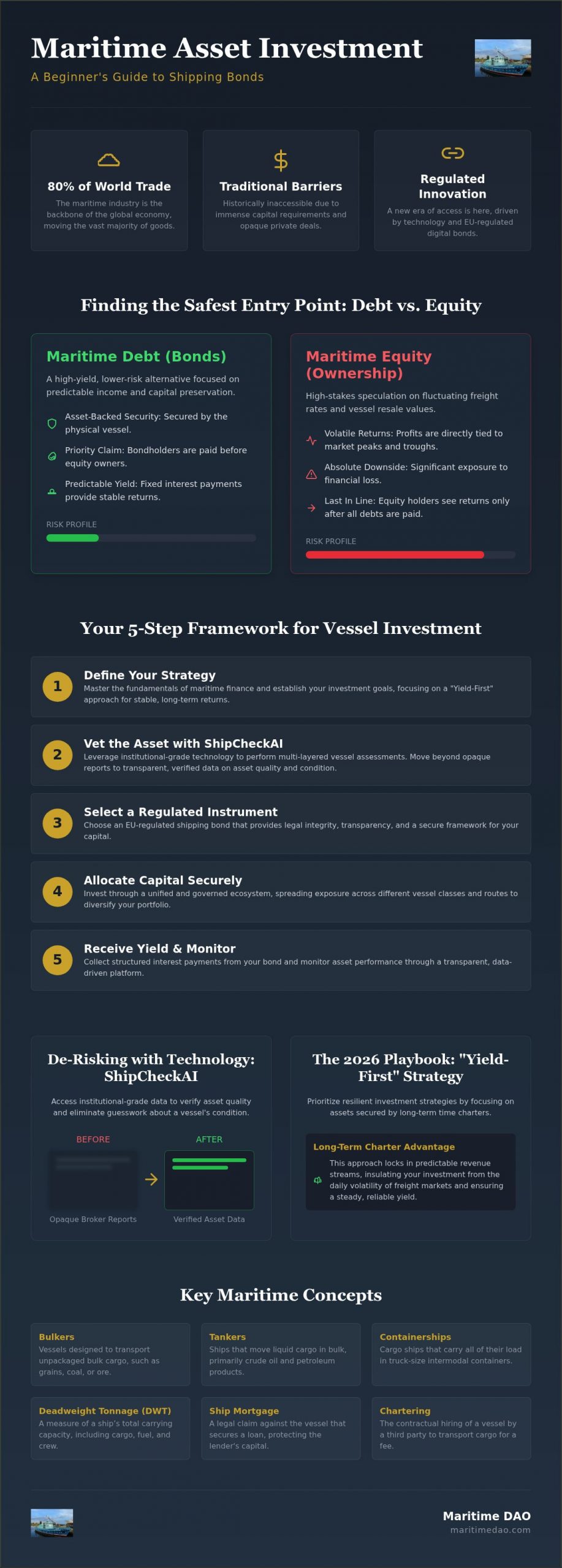
The 5-Step Framework for Your First Vessel Investment
Investing in shipping bonds for beginners requires a methodical, step-by-step approach to ensure capital security and operational transparency. The transition from observer to participant is governed by five critical gateways. A robust framework unites regulatory compliance, technical precision, and financial transparency to protect your capital in the high-stakes maritime environment.
- Step 1: Define your capital commitment. Traditional ship ownership demands millions; however, bond-based models allow you to enter the market with significantly less capital. This democratization of maritime finance is the first pillar of your strategy.
- Step 2: Verify the regulatory framework. In 2026, institutional reliability is non-negotiable. You must ensure the platform operates under a recognized legal body, such as the EU-regulated frameworks that govern modern maritime debt.
- Step 3: Conduct technical due diligence. This is where you move beyond marketing materials. Use AI-driven condition reports to identify potential operational risks before committing funds.
- Step 4: Analyze the charterer profile. A ship is only as profitable as the entity paying for its use. Investigate the creditworthiness and track record of the charterer to understand the stability of the vessel’s revenue.
- Step 5: Execute via a compliant platform. Finalize your investment through a unified, transparent ecosystem that provides real-time reporting and professional asset management.
If you’re ready to begin your journey, you can evaluate our institutional-grade bond offerings to see how these steps integrate into a single, governed platform.
Step 3 Deep-Dive: The Technical Inspection
Beginner investors often struggle to interpret traditional, hundred-page surveyor reports. You should look for clear indicators of structural integrity, engine maintenance history, and compliance with 2026 environmental regulations. Modern AI in maritime due diligence automates ‘red flag’ detection by cross-referencing multi-layered inspection data against global fleet benchmarks. This technology identifies anomalies that human eyes might miss, providing a competitive edge. Historical inspection data is equally vital, as it allows you to project future asset value and anticipate maintenance costs that could impact bond performance.
Evaluating the Governance of a Maritime DAO
A Decentralized Autonomous Organization (DAO) must act as a reliable gatekeeper for your capital. You need to ensure the transparency of fund flows through on-chain accounting and professional, third-party asset management. Tokenized governance plays a critical role here; it protects the interests of minority investors by giving them a transparent voice in major operational decisions. This structural integrity is the core of The Future of Ship Finance, where technology and law unite to create an inclusive, high-stakes investment ecosystem.
Regulated Innovation: The Maritime DAO Investment Ecosystem
Maritime DAO serves as a visionary architect, bridging the physical world of global trade with the digital precision of blockchain governance. By uniting institutional finance with decentralized technology, the platform eliminates the systemic inefficiencies that once barred smaller participants from the industry. For those investing in shipping bonds for beginners, this creates a unified environment where capital is governed by transparency and legal integrity. Every issuance is structured within an EU-regulated framework, ensuring that global capital deployment meets the highest standards of institutional compliance. This ecosystem doesn’t just offer an investment; it provides a regulated gateway into a traditionally exclusive world.
ShipCheckAI: The Gatekeeper of Asset Quality
Transparency is the bedrock of our ecosystem. Every bond issuance is secured by a physical vessel that has undergone a rigorous, multi-layered assessment via ShipCheckAI. This tool provides retail bondholders with the same depth of data once reserved for institutional underwriters. It automates the detection of structural red flags, engine performance anomalies, and regulatory non-compliance by cross-referencing real-time data against global benchmarks. You can explore the technical pillars of this system in our AI Ship Inspection Tool: The 2026 Guide. Because every Maritime DAO bond is backed by this data-driven report, you don’t have to rely on subjective brokerage summaries to verify the quality of your underlying asset.
Next Steps for Your Maritime Portfolio
Transitioning from a casual observer to a sophisticated maritime investor begins with a methodical onboarding process. After creating your account and completing the necessary compliance checks, you gain access to a professional dashboard designed for real-time monitoring. Here, you can track the performance of your vessels, monitor charterer payments, and analyze yield distributions with surgical precision. Investing in shipping bonds for beginners becomes a scalable strategy when you leverage compound growth by reinvesting your yields into new, eco-friendly vessel debt. This methodical approach allows you to build a diversified, high-stakes portfolio that respects legacy maritime systems while embracing the efficiency of modern finance. You can begin your journey by setting up your dashboard and exploring the current bond offerings today.
Charting Your Course in the 2026 Maritime Economy
The transition from a closed industrial vault to a democratized financial landscape is now complete. Investing in shipping bonds for beginners has evolved from a complex hurdle into a streamlined, tech-enabled strategy that prioritizes asset-backed security and legal transparency. By shifting focus from volatile equity to regulated debt, you position your capital within a unified ecosystem that values structural integrity over speculative hype. You now have the tools to verify vessel condition through ShipCheckAI and the protection of EU-regulated frameworks that ensure institutional-grade governance.
This new era of maritime finance offers a sophisticated path to diversification, allowing you to participate in the engine of global trade with unprecedented clarity. The information asymmetry that once plagued this sector has been replaced by multi-layered data and professional oversight. You’re no longer an outsider; you’re a participant in a high-stakes, global infrastructure. It’s time to leverage these innovations to secure your financial future through a methodical and governed approach.
Take the first step toward a resilient maritime portfolio today. Explore EU-Regulated Ship Investment Bonds at Maritime DAO and gain global access to institutional-grade maritime debt backed by AI-driven vessel inspection.
Frequently Asked Questions
Is ship investment safe for beginners in 2026?
Ship investment has become significantly more secure through the transition from speculative equity to regulated debt instruments. In 2026, the primary safety mechanism for those investing in shipping bonds for beginners is the EU-regulated framework that governs every issuance. This structure ensures that capital is protected by physical assets and institutional-grade oversight. While no investment is entirely without risk, the use of AI-driven due diligence and legal recourse provides a protective buffer that was previously unavailable to retail participants.
What is the minimum amount needed to start investing in maritime assets?
Maritime DAO leverages fractionalization to lower entry barriers that once required millions in capital. While traditional vessel ownership remains out of reach for most, bond-based participation models allow you to commit much smaller amounts to the global shipping industry. You should review the specific terms of each issuance on our platform to determine the current minimum commitment. This approach ensures that institutional-grade maritime debt is accessible to a global audience without the need for significant initial capital.
How do EU-regulated ship bonds differ from traditional stocks?
Ship bonds represent a debt obligation rather than an ownership stake in a company. Unlike traditional stocks, where returns depend on corporate profitability and share price appreciation, bonds provide a fixed income stream with a prioritized claim on physical assets. Bondholders are satisfied before equity owners in the capital stack, offering a more stable and predictable return profile. This structural integrity makes bonds a preferred choice for those seeking to mitigate the inherent volatility of the maritime market.
What happens if a ship I invested in through a bond is damaged?
Your investment is protected by the asset-backed nature of the bond and the underlying insurance requirements of the vessel owner. If a ship suffers damage, the owner’s hull and machinery insurance typically covers repairs to maintain the asset’s value. Because the bond is a legal claim against the vessel, the physical ship serves as collateral. Our ecosystem ensures that only vessels with rigorous maintenance records and comprehensive coverage are eligible for bond issuance, protecting your capital from operational accidents.
Can I sell my maritime investment before the bond matures?
The Maritime DAO ecosystem is designed to provide greater liquidity than traditional private maritime syndicates. While bonds have a defined maturity date, the tokenized nature of these instruments often allows for secondary market participation. You can potentially exit your position by selling your bond tokens to other participants within the governed platform. This flexibility is a key advantage for those investing in shipping bonds for beginners, as it provides a path to liquidity that physical ship ownership simply cannot offer.
How does ShipCheckAI actually verify a vessel’s condition?
ShipCheckAI utilizes a multi-layered assessment protocol to move beyond the limitations of subjective manual surveys. The tool aggregates data from physical inspections, historical maintenance logs, and real-time performance sensors to create a unified condition report. By cross-referencing this information against global fleet benchmarks, the AI identifies structural red flags or engine anomalies that human eyes might miss. This rigorous process ensures that every bond in our ecosystem is backed by a vessel that meets strict institutional quality standards.
What are the tax implications of investing in a Maritime DAO?
Tax obligations for maritime investments vary significantly based on your local jurisdiction and the specific structure of the bond. Generally, interest earned from shipping bonds is treated as taxable income, similar to other fixed-income instruments. Because Maritime DAO operates as a decentralized autonomous organization with global reach, you should consult with a qualified tax professional to understand how these returns integrate with your personal filings. We provide transparent reporting on your dashboard to assist with your necessary compliance and documentation.