
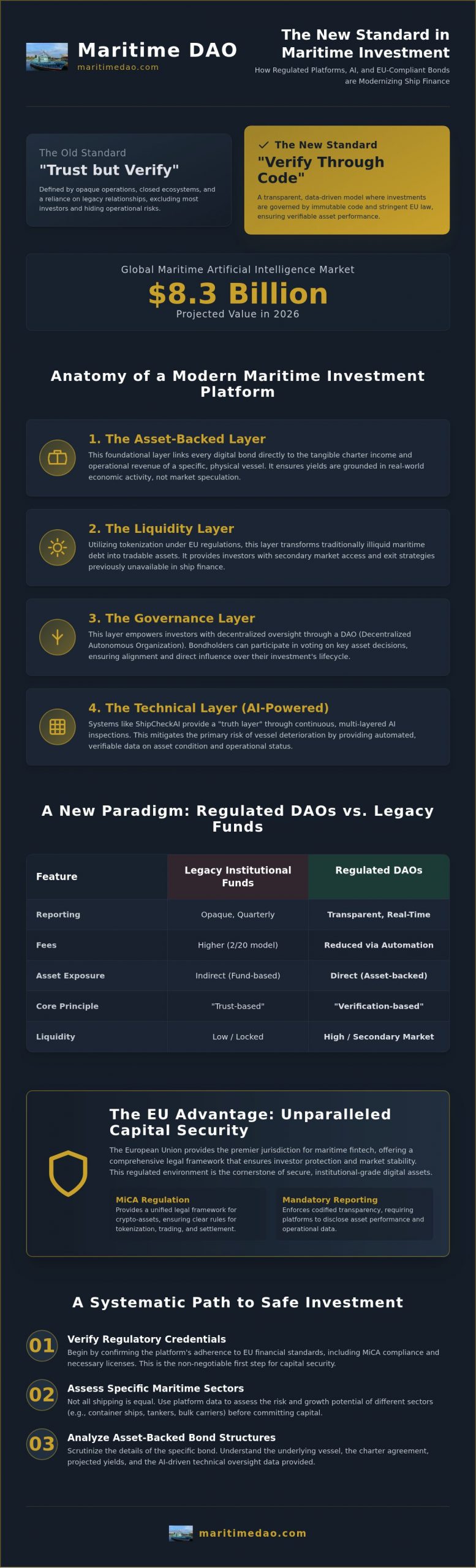
With the global maritime artificial intelligence market projected to reach $8.3 billion in 2026, the era of “trust but verify” has been replaced by a new standard of “verify through code.” For too long, the maritime sector remained a closed ecosystem, defined by opaque operations and capital requirements that excluded all but the most elite institutional players. You likely recognize the frustration of dealing with inaccurate vessel data or the legal ambiguity that often plagues digital asset markets. We’re entering a period where sophisticated technology finally meets the sober reliability of institutional finance.
This guide demonstrates how a regulated maritime investment platform modernizes ship finance through EU-compliant bonds and AI-driven asset transparency. You’ll discover how to access stable maritime yields while mitigating the risks of regulatory uncertainty. We’ll detail how a unified framework of decentralized governance, multi-layered AI inspections, and strict adherence to EU financial standards creates a first-of-its-kind gateway for global investors. By the end of this analysis, you’ll understand how ShipCheckAI and regulated bond structures provide the “truth layer” that traditional funds have lacked, ensuring your capital is governed by both code and law.
Key Takeaways
- Learn how a regulated maritime investment platform provides a secure, EU-compliant framework that distinguishes institutional-grade assets from speculative digital tokens.
- Understand the structure of asset-backed maritime bonds, which link investor yields to the operational performance of specific vessels while providing secondary market liquidity.
- Compare the advantages of regulated DAOs over legacy institutional funds, focusing on real-time reporting, reduced fees, and direct asset exposure.
- Identify how AI-driven technical oversight mitigates the primary risk of vessel deterioration through multi-layered, automated inspection data.
- Follow a systematic process for safe investment, beginning with the verification of regulatory credentials and the assessment of specific maritime sectors.
What is a Regulated Maritime Investment Platform?
A regulated maritime investment platform functions as a unified ecosystem that integrates capital markets, legal frameworks, and physical vessel oversight. Unlike the speculative volatility associated with unregulated shipping tokens, these platforms operate under the strict governance of financial authorities to facilitate capital flow into high-value global trade assets. This model represents a fundamental evolution in maritime investments, moving away from opaque, private deals toward a transparent, digital-first environment. By 2026, the convergence of the Markets in Crypto-Assets (MiCA) regulation and new IMO guidelines for AI integration has established a standardized architecture for maritime asset-backed securities. These platforms unite institutional capital, automated intelligence, and sovereign legal oversight to ensure every bond issued is grounded in physical reality rather than market hype.
The structural integrity of this model relies on three distinct pillars. First, digital interfaces provide global investors with seamless access to debt instruments. Second, regulatory compliance layers manage KYC, AML, and jurisdictional legalities. Third, technical asset oversight, powered by systems like ShipCheckAI, ensures that the underlying vessel maintains its value and operational status. This tripartite approach replaces the “trust-based” legacy model with a “verification-based” system, where data is as valuable as the steel it monitors.
The Shift from Traditional Ship Finance to Digital Platforms
Traditional ship finance has long been the domain of a few elite European banks. However, as these institutions tightened lending criteria to meet ESG requirements, a $2.3 trillion accessibility gap emerged in the maritime sector. Digital platforms have stepped into this void, democratizing access to institutional-grade debt by breaking down massive capital requirements into manageable, bond-based units. At its core, a regulated maritime platform is a fusion of MiCA-compliant frameworks and physical asset backing. This shift is accelerated by the August 2026 MARAD revisions and the global push for carbon pricing, which demand more agile and transparent financing structures than legacy banks can typically provide.
Key Regulatory Standards: The EU Advantage
The European Union has positioned itself as the premier jurisdiction for maritime fintech through comprehensive legal frameworks. Utilizing EU-regulated ship investment bonds provides a level of capital security that unregulated markets cannot replicate. Understanding maritime investment compliance is essential for any participant, as it ensures that every asset is governed by codified transparency and mandatory reporting standards. The implementation of MiCA has unified the digital asset landscape, providing a clear roadmap for how maritime debt can be tokenized, traded, and settled without compromising on investor protection or market stability.
The Anatomy of a Modern Maritime Bond Investment Platform
The architecture of a regulated maritime investment platform is defined by its ability to synthesize physical asset performance with digital financial efficiency. This infrastructure isn’t a simple interface; it’s a multi-layered stack designed to protect capital through structural integrity. By integrating four distinct operational pillars—the asset-backed, liquidity, governance, and technical layers—the platform creates a unified environment where every investment is governed by code and law. This system ensures that bondholder yields are directly tied to the operational revenue of specific vessels, transforming global trade into a transparent asset class that’s accessible to a global audience.
- The Asset-Backed Layer: Links bond performance to the tangible charter income of the underlying fleet, ensuring yields are grounded in real-world economic activity.
- The Liquidity Layer: Utilizes tokenization to enable secondary market trading of traditionally illiquid maritime debt, providing investors with exit strategies that were previously non-existent.
- The Governance Layer: Empowers investors with decentralized oversight and voting rights on key asset decisions, ensuring the ecosystem remains transparent and methodical.
- The Technical Layer: Maintains a constant “truth layer” through continuous AI inspections and vessel monitoring, bridging the gap between physical conditions and financial valuations.
This comprehensive design allows for a level of transparency that legacy funds cannot match. It positions the platform as both a visionary architect of new finance and a reliable gatekeeper of physical assets, ensuring that capital, compliance, and condition are unified into a single governed stream.
Asset-Backed Debt vs. Traditional Equity
Debt instruments offer a stable, fixed-income entry point that equity often lacks in the volatile maritime sector. While equity investors bear the brunt of market downturns, those holding EU regulated ship investment bonds occupy a senior position in the capital stack. These debt structures are designed for resilience, prioritizing capital security through frameworks recognized by international bodies like the Federal Maritime Commission (FMC). Investors can examine these bond structures to understand how fixed yields are protected through legal seniority and operational transparency even during periods of geopolitical instability.
Tokenization and Fractional Ownership
Fractionalization has fundamentally altered the capital requirements of ship finance by eliminating the high barriers that once restricted the market to institutional giants. By leveraging a regulated maritime investment platform, investors can access these fractional units with significantly lower entry requirements, moving from multi-million dollar outlays to accessible thousands of Euros. Smart contracts handle the complexity of this democratization, automating yield distribution and enforcing compliance in real-time without the need for manual intervention. This automation ensures that fractional ownership remains secure, liquid, and fully compliant with EU financial standards, providing an educational and steady pace for investors to grow their portfolios.
Comparing Platform Models: Institutional Funds vs. Regulated DAOs
The landscape of ship finance is currently divided between the legacy structures of private equity and the emerging efficiency of decentralized governance. Traditional institutional funds have long served as the primary vehicle for maritime capital, yet they remain tethered to high management fees, opaque reporting cycles, and restrictive 5 to 10 year lock-up periods. These models often prioritize the fund manager’s incentives over investor liquidity. By contrast, a regulated maritime investment platform utilizing a DAO structure provides direct asset exposure, governed by smart contracts that automate compliance and reporting. This model eliminates the “truth gap” inherent in traditional finance, where investors must rely on lagging, quarterly PDF reports to understand asset performance. Instead, regulated DAOs offer a unified, real-time view of the fleet’s operational health.
Modern platforms often adopt a hybrid approach, combining the rigorous legal standards of institutional finance with the technical agility of blockchain. This evolution is part of a broader movement of Innovation On The High Seas, where technological adoption is no longer optional for maintaining competitive yields. While legacy funds demand trust in centralized intermediaries, regulated DAOs rely on verifiable data and decentralized oversight. This shift ensures that every stakeholder has access to the same “truth layer,” grounding the investment in physical reality rather than administrative projections.
Transparency and Real-Time Reporting
The transition from quarterly reporting to on-chain data feeds represents a paradigm shift in investor relations. In a traditional fund, information is siloed and delayed, making it difficult for bondholders to react to market shifts or vessel condition changes. Utilizing a framework for maritime DAO investment ensures that all operational data, from charter revenue to AI-verified inspection results, is available in real-time. This level of transparency bolsters secondary market confidence, as bond pricing can reflect the actual, current state of the underlying asset rather than stale accounting data.
Cost Structures and Investor Yields
Legacy maritime private equity is notorious for multi-layered fee structures that erode net returns. Between management fees, performance hurdles, and administrative overhead, a significant portion of a vessel’s revenue never reaches the end investor. A regulated maritime investment platform minimizes these costs by automating the compliance and management layers. By replacing manual administrative processes with smart contracts, platforms can direct a higher percentage of operational revenue back to bondholders. This reduction in operational overhead directly translates into more competitive yields and a more sustainable financial ecosystem for global trade.
Technical Due Diligence: Protecting Capital with AI Inspections
The physical condition of a vessel is the primary risk factor influencing the performance of maritime debt. In a regulated maritime investment platform, technical due diligence serves as the non-negotiable “truth layer” that protects investor capital from the hidden liabilities of asset deterioration. Manual ship surveys, once the industry standard, are increasingly viewed as insufficient in the digital age due to their inherent subjectivity, human bias, and limited frequency. To maintain structural integrity within a financial ecosystem, platforms must move beyond one-off inspections toward continuous, data-driven life-cycle tracking. A regulated maritime investment platform that integrates these technical insights ensures that capital is never blind to the condition of the steel it finances.
Objective Risk Scores, generated through automated intelligence, provide a methodical foundation for every asset in the fleet. This architecture transforms the vessel from a “black box” into a transparent ledger of physical performance, allowing investors to monitor their interests with institutional-grade precision. By grounding financial valuations in physical reality, the platform mitigates the risk of sudden operational failure or regulatory non-compliance.
ShipCheckAI: The New Standard in Vessel Assessment
The deployment of an AI ship inspection tool fundamentally redefines how due diligence is conducted by removing human bias from the assessment process. ShipCheckAI facilitates a comprehensive suite of inspections, including pre-purchase evaluations, condition assessments, and regulatory compliance audits, to ensure a unified standard of asset health. AI identifies structural anomalies that manual inspectors often miss, such as microscopic hull fatigue or internal corrosion patterns. This level of precision allows for a sophisticated understanding of a vessel’s remaining useful life, providing a reliable foundation for long-term capital allocation and risk management.
Integrating Technical Data into Financial Smart Contracts
The true power of this technology lies in its connectivity to the platform’s financial architecture. By utilizing AI in maritime due diligence, technical data is fed directly into smart contracts to link bond performance to the physical health of the ship. If a vessel’s condition drops below a predefined threshold, the system can automatically trigger risk alerts for bondholders or adjust maintenance schedules to prevent operational downtime. In the near future, this data stream will likely govern automated insurance adjustments, where premiums fluctuate based on real-time maintenance compliance rather than annual estimates. This integration ensures that the relationship between physical assets and digital governance remains secure and transparent. You can access the Maritime DAO dashboard to view the real-time technical status of currently bonded vessels.
Getting Started: How to Invest in Maritime Assets Safely
Transitioning from an observer to an active participant in ship finance requires a methodical approach that prioritizes structural integrity over speculative gains. Engaging with a regulated maritime investment platform ensures that your capital is protected by both sovereign law and automated oversight. To navigate this ecosystem successfully, you must follow a systematic due diligence process that bridges the gap between physical global trade and digital financial governance. By integrating technical verification with regulatory compliance, you can build a resilient portfolio that withstands the inherent volatility of the maritime sector.
- Step 1: Verify Regulatory Status. Confirm the platform holds valid EU compliance certificates and adheres to MiCA standards for digital asset issuance.
- Step 2: Evaluate the Asset Class. Assess the underlying fleet, whether it comprises dry bulk carriers, tankers, or vessels optimized for the IMO’s October 2026 Net Zero Framework.
- Step 3: Review AI Technical Reports. Utilize ShipCheckAI data to examine the physical health and maintenance history of the specific vessel tied to the bond.
- Step 4: Understand Governance Rights. Analyze the DAO’s structure to determine your voting power regarding asset management and operational oversight.
- Step 5: Diversify Your Exposure. Mitigate operational risk by spreading capital across multiple maritime debt instruments with varying charter durations.
Evaluating Platform Credibility
Identifying a truly regulated maritime investment platform requires a keen eye for structural transparency. A credible gateway must function as a unified ecosystem, handling both the financial issuance of bonds and the technical monitoring of the assets. Red flags in maritime fintech often include vague legal descriptions, a lack of verifiable technical data, or the absence of a clear link between the bond and a specific physical vessel. Transparency is the new collateral. You should prioritize platforms that provide an open ledger of compliance and technical audits, ensuring that the “truth layer” is accessible to all stakeholders at all times.
Building a Diversified Maritime Portfolio
A sophisticated long-term strategy involves balancing yields between different shipping sectors to hedge against geopolitical fluctuations. Understanding how to invest in maritime assets allows you to position maritime bonds as a stable, fixed-income component within a broader alternative investment portfolio. For instance, while bulk carriers may offer steady returns during infrastructure booms, green-shipping bonds provide a hedge against tightening emissions regulations. By diversifying across these segments, you ensure that your capital remains productive throughout the various cycles of global trade, governed by a framework that values order, security, and institutional reliability.
The Future of Maritime Yield Protection
The maritime industry is undergoing a structural transformation where data-driven transparency and legal rigor are no longer optional for the sophisticated investor. You now have a clear, methodical path to participate in global trade through a regulated maritime investment platform that bridges the gap between physical assets and digital finance. By uniting an EU-Regulated Financial Framework with AI-Powered ShipCheckAI Oversight and Transparent DAO Governance, the barriers of high capital requirements and operational opacity are finally dissolving. This unified approach ensures that every bond is anchored in verified technical reality and sovereign compliance, providing a level of security that legacy models cannot replicate.
As the trillion-dollar accessibility gap in ship finance continues to close, those who prioritize regulated innovation will be best positioned to capture stable yields in an evolving market. The integration of real-time technical data and decentralized oversight creates a resilient ecosystem where capital is governed by both code and law. It’s time to move beyond speculative digital assets and embrace a future where industrial-grade debt is accessible, transparent, and secure. Explore Regulated Ship Investment Bonds on Maritime DAO and secure your position in the next generation of global ship finance. The era of speculative trust has ended; the age of verifiable, regulated innovation has arrived.
Frequently Asked Questions
Is a regulated maritime investment platform the same as a crypto exchange?
No, a regulated maritime investment platform is a sophisticated financial ecosystem governed by EU law, specifically designed for asset-backed debt instruments. Unlike a crypto exchange that often deals with speculative utility tokens, these platforms focus on MiCA-compliant frameworks and institutional-grade bonds. They integrate multi-layered technical oversight and legal compliance to bridge the gap between digital asset efficiency and the physical reality of global trade.
How do EU-regulated ship investment bonds protect my principal capital?
These bonds protect capital through a seniority structure in the capital stack and physical asset backing. Each bond is tied to the operational revenue and scrap value of a specific vessel, ensuring your investment is grounded in tangible collateral. The EU-regulated framework mandates strict transparency and reporting standards. This legal architecture provides bondholders with senior claims on assets, significantly reducing the risks associated with unsecured or unregulated digital investments.
What role does AI play in the due diligence process for maritime bonds?
AI serves as the truth layer by providing objective, real-time data on a vessel’s physical condition. Tools like ShipCheckAI perform multi-layered assessments that identify structural anomalies, such as hull fatigue or corrosion, which manual inspectors might miss. This technology generates a methodical Risk Score that informs financial smart contracts. By moving from one-off surveys to continuous life-cycle tracking, AI ensures that technical due diligence is both accurate and free from human bias.
Can retail investors access these maritime investment platforms in 2026?
The democratization of ship finance is a core feature of a regulated maritime investment platform in 2026. Fractionalization allows investors to access institutional-grade debt with much lower capital requirements than traditional ship finance models. While legacy systems often required multi-million dollar commitments, modern platforms enable participation for thousands of Euros. This inclusivity is governed by smart contracts that automate compliance, ensuring that even smaller allocations benefit from the same level of security and transparency.
What happens to my investment if the underlying vessel is damaged?
Bondholders are protected through a combination of mandatory insurance requirements and technical monitoring. While Maritime DAO doesn’t sell insurance, its ecosystem ensures every bonded vessel maintains comprehensive coverage. If damage occurs, smart contracts can trigger risk alerts for bondholders while AI data facilitates faster claims processing and maintenance scheduling. The bond’s senior position in the capital stack ensures that insurance payouts or asset recovery proceeds are prioritized for debt repayment.
How does the liquidity of tokenized ship bonds compare to traditional bonds?
Tokenization significantly enhances liquidity by enabling secondary market trading on digital platforms. Traditional maritime debt is often illiquid, requiring investors to commit capital for five to ten years without an exit strategy. In contrast, tokenized bonds can be traded in fractional units, allowing for more frequent price discovery and easier portfolio rebalancing. This digital liquidity layer operates within a regulated framework, ensuring all secondary trades remain compliant with EU financial standards.
What are the typical yields for regulated maritime debt instruments?
Yields for maritime debt typically reflect the fixed-income nature of the bonds and are influenced by the vessel’s charter rates and operational efficiency. While equity investments might target an IRR of 20% or above over three years, regulated bonds offer more stable, predictable returns. These yields are protected by the vessel’s operational revenue and are often more competitive than traditional corporate debt due to the specialized nature of the maritime asset-backed security ecosystem.
How does a DAO govern a physical asset like a cargo ship?
A DAO governs maritime assets through decentralized oversight and smart contract automation. Bondholders exercise voting rights on critical operational decisions, such as maintenance schedules or asset disposals, ensuring the ecosystem remains transparent and methodical. This governance model replaces centralized intermediaries with a unified framework of code and law. It ensures every stakeholder has a voice in the management of the physical vessel while maintaining strict adherence to EU regulatory compliance.