
In 2026, a vessel’s worth isn’t defined strictly by its steel and machinery, but by the digital integrity of the ecosystem that governs it. As the maritime industry moves toward deeper financial integration, the traditional reliance on fragmented technical reports has become a liability for those seeking institutional capital. You’ve likely experienced the frustration of the Compliance Trap, where maritime asset risk assessment software satisfies basic safety audits but fails to provide the transparency required for sophisticated asset valuation or bond issuance.
It’s a common struggle to bridge the divide between technical vessel inspections and the rigorous demands of financial reporting. We’ll show you how to evaluate and implement a unified risk framework that aligns operational reality with institutional expectations. You’ll discover how to move beyond minimum standards to achieve seamless alignment with EU financial regulations, ensuring your fleet is positioned for growth in a transparent, data-driven market. This guide provides the strategic roadmap for selecting software that unites risk, governance, and opportunity.
Key Takeaways
- Learn why modern maritime asset risk assessment software must bridge the gap between isolated technical inspections and institutional financial reporting to ensure asset liquidity.
- Identify how to move beyond the “Compliance Trap” of minimum regulatory standards to meet the more rigorous transparency demands of global capital markets.
- Discover the essential role of automated, AI-driven vessel assessments in providing the granular due diligence required for EU-regulated ship investment bonds.
- Understand the transition to a model where data, governance, and capital converge, making financial risk the primary KPI for maritime asset ecosystems.
- Evaluate how unified data platforms unite, govern, and open up opportunities by creating a transparent bridge between physical operations and maritime finance.
The Paradigm Shift in Maritime Asset Risk Assessment for 2026
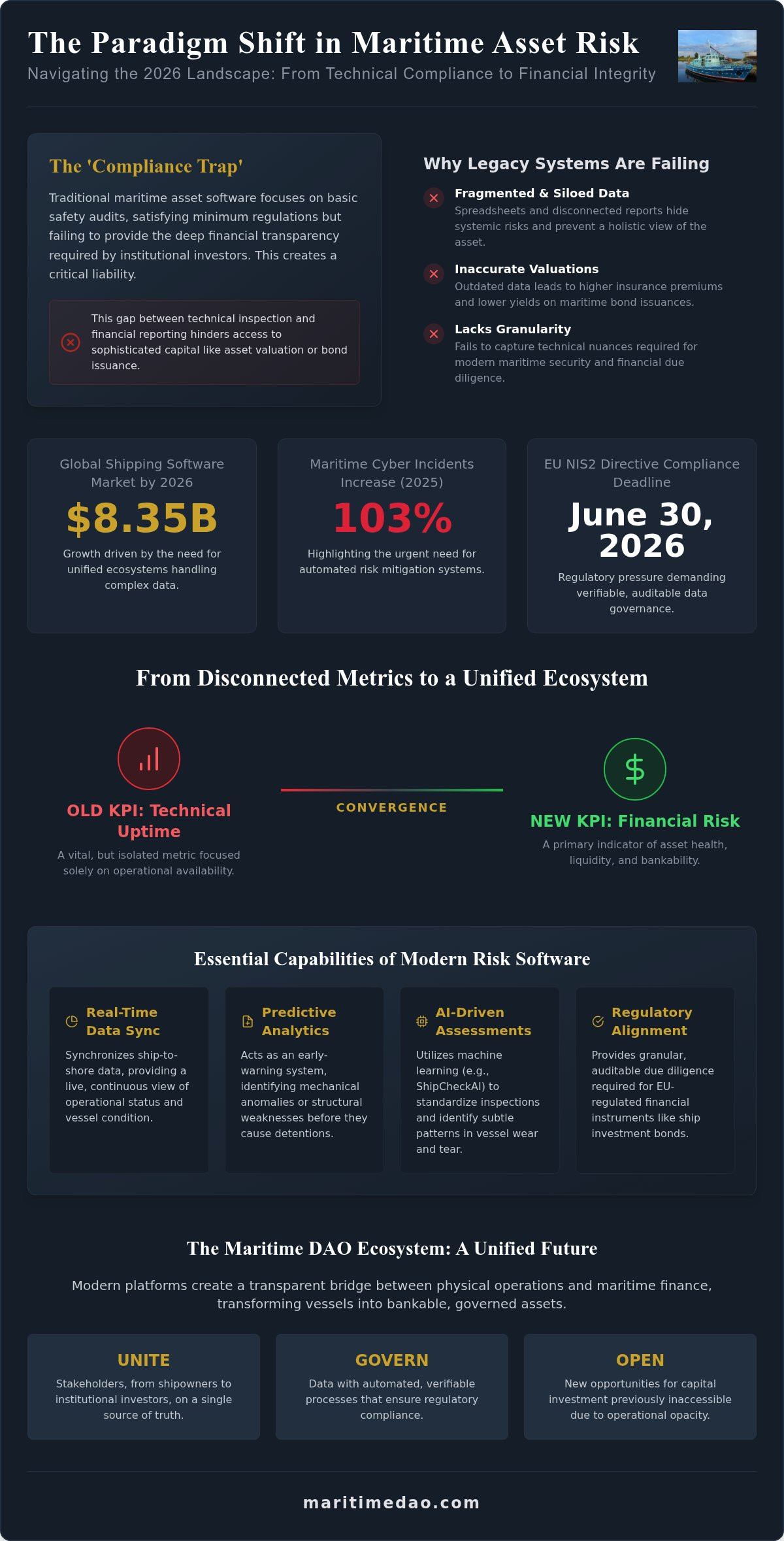
Maritime asset risk assessment has evolved from a localized technical exercise into a core institutional imperative. In 2026, the definition of risk encompasses technical integrity, financial transparency, and regulatory governance. While technical uptime remains a vital metric, it’s no longer the sole KPI for modern risk managers. They now prioritize the convergence of vessel condition data and financial debt instruments to ensure asset liquidity. This shift marks the transition from simple administrative compliance to strategic operational intelligence, where data serves as the foundation for high-stakes capital decisions.
The global shipping software market is projected to reach USD 8.35 billion in 2026, a growth driven by the need for unified ecosystems that can handle complex data sets. Modern maritime asset risk assessment software acts as the architect of this new reality, providing a transparent view of risk that satisfies both shipowners and institutional investors. By integrating automated intelligence with physical reality, these platforms transform vessels into bankable, governed assets that can thrive in a regulated market.
Why Legacy Systems Are Failing Modern Fleets
Spreadsheets and siloed data repositories are no longer sufficient to manage the complexities of 2026. They hide systemic risks that are invisible to fragmented reporting structures. Legacy systems often lack the granularity needed for modern maritime security protocols and fail to capture the technical nuances required for accurate asset valuation. This data fragmentation has a direct financial cost. Inaccurate or outdated data leads to higher insurance premiums and can significantly lower the yields on maritime bond issuances. Generic ERP platforms simply don’t possess the specialized logic to bridge the gap between a vessel’s engine room and a financier’s boardroom.
The Institutional Case for Regulated Innovation
The regulatory environment in 2026 is uncompromising and demands absolute transparency. With the first compliance audit deadline for the EU NIS2 Directive having passed on June 30, 2026, software must do more than record data; it must verify it. Institutional capital is drawn to clarity and structural integrity. High-performance maritime asset risk assessment software provides the necessary due diligence for EU-regulated ship investment bonds, ensuring that every data point is governed and auditable. This level of regulated innovation allows stakeholders to unite, govern, and open up opportunities that were previously inaccessible due to the opacity of traditional maritime reporting.
Essential Capabilities of Modern AI-Driven Risk Software
The transition to modern maritime asset risk assessment software replaces static, manual checklists with dynamic intelligence. These systems synchronize ship-to-shore data in real-time, providing management with a live view of operational status. Predictive analytics now serve as an early-warning system, identifying structural weaknesses or mechanical anomalies before they result in detention. By integrating these capabilities, operators can maintain the high-stakes reliability required for institutional backing. In an era where maritime cyber incidents increased by 103% in 2025, reaching 828 cases, the ability to monitor and mitigate risk through automated systems is no longer optional.
ShipCheckAI: Enhancing Inspection Accuracy and Efficiency
ShipCheckAI represents a significant advancement in ship inspection accuracy by utilizing machine learning algorithms to identify subtle patterns in vessel wear and tear. While human inspectors are limited by physical access and fatigue, AI processes thousands of data points to ensure every assessment is standardized and comparable across a global fleet. This technology reduces total inspection time by automating data entry and preliminary analysis, allowing surveyors to focus on critical high-risk areas. By following a structured maritime security risk assessment methodology, the software ensures that pre-purchase, statutory, and routine inspections maintain the highest levels of integrity. Capital follows clarity. When your inspections are powered by automated intelligence, you build an ecosystem of trust that is both transparent and auditable.
Interoperability and Ecosystem Integration
For a risk assessment to be valuable in 2026, it must speak the language of financial markets. API-first architectures are essential because they connect technical vessel data directly to bond issuance platforms and regulatory reporting hubs. This creates a unified system of truth where all stakeholders, from technical managers to institutional bondholders, can access the same verified information. Modern software must identify, standardize, and verify risk parameters to bridge the gap between physical assets and digital governance. When risk software integrates seamlessly with financial ecosystems, it reduces the friction of capital allocation and improves the accuracy of asset valuation. If you’re looking to enhance your fleet’s transparency, you can explore how our integrated tools support this transition. This connectivity ensures that vessel data isn’t just stored, but actively utilized to govern and optimize maritime investments.
Navigating the ‘Compliance Trap’ in Maritime Safety
Many operators fall into the “Compliance Trap,” believing that meeting minimum Flag State requirements is synonymous with asset security. It’s not. In 2026, minimum standards are merely the baseline for entry, not the ceiling for protection. Relying on “check-box” compliance software creates a false sense of security while leaving the asset exposed to institutional capital withdrawal. When maritime asset risk assessment software is used purely for administrative box-ticking, it fails to protect the underlying financial value of the vessel, leading to hidden costs such as increased insurance premiums or unexpected detentions.
Strategic risk management offers a distinct competitive advantage in ship finance. Lenders and bondholders prioritize fleets that demonstrate operational intelligence beyond the bare minimum. A vessel that only meets statutory requirements represents a higher risk for detention, which directly impacts cash flow and debt servicing capabilities. By transforming incident reporting from a bureaucratic burden into actionable intelligence, owners can lower their risk profile and attract superior financing terms. This approach ensures that technical data isn’t just recorded but is actively utilized to govern, protect, and optimize the asset’s lifecycle.
Proactive vs. Reactive Risk Identification
Transitioning from a reactive posture to a proactive one is the hallmark of regulated innovation. ShipCheckAI enables this shift by identifying systemic risks across a fleet before they manifest as incidents. By analyzing data from multiple inspection types, the system moves beyond documenting “what happened” to predicting “what might happen.” This allows for fleet-wide predictive maintenance and targeted risk mitigation, ensuring that physical assets remain secure. Leveraging fleet-wide data provides a unified view of risk that manual checklists simply cannot achieve, allowing for more precise capital allocation and operational planning.
Ensuring Regulatory Transparency
Transparency is the bridge between maritime operations and institutional finance. Modern tools ensure that maritime investment compliance is an inherent part of the data ecosystem. With the Italian Maritime Cybersecurity Circular (Circolare 177) becoming binding on November 1, 2026, having instant, accurate documentation for audits is critical. This level of transparency strengthens maritime debt security by providing bondholders with verified proof of safety and regulatory adherence. Institutional investors demand a system that is transparent, methodical, and deeply serious about governance, ensuring that the relationship between physical assets and digital compliance is clearly understood at every step of the investment lifecycle.
Due Diligence Frameworks for Investors and Bondholders
Institutional investors and bondholders require a specialized lens through which to view maritime assets. In 2026, investability is dictated by the quality and transparency of an asset’s data layer. Traditional due diligence, often reliant on subjective human judgment, is being superseded by a more rigorous, systematic approach. High-performance maritime asset risk assessment software acts as the gatekeeper, providing a unified view of risk that satisfies the stringent requirements of capital markets. Capital follows clarity.
A robust 5-step assessment process for bond issuance typically includes:
- Asset Baselining: Establishing a comprehensive technical and operational starting point for the vessel.
- Compliance Mapping: Verifying adherence to IACS UR E26 and NIS2 cybersecurity standards.
- Technical Due Diligence: Utilizing AI to identify latent structural or mechanical risks.
- Financial Alignment: Translating technical risk into predictable cash flow and debt-service metrics.
- Ongoing Governance: Implementing real-time monitoring to protect capital throughout the bond’s tenure.
This framework is essential for quantifying technical risk for EU regulated ship investment bonds. By replacing fragmented reports with a transparent data ecosystem, issuers can secure capital with greater confidence and lower financing costs.
Vessel Assessment for Bondholders
Bondholders prioritize the preservation of capital above all else. A pre-issuance condition report provides the necessary baseline, but ongoing monitoring is what maintains the security of the debt. ShipCheckAI delivers the granular transparency required by institutional investors, moving beyond the limitations of periodic third-party inspections. It creates a continuous audit trail that unites physical reality with digital governance, ensuring that the asset remains bankable and compliant at every stage of its operational life. This systematic approach ensures that the relationship between physical assets and digital governance is clearly understood, managed, and optimized.
Mitigating Financial Risk in Maritime Alternative Investments
The rise of fractional ship investment has democratized maritime finance, yet it demands a more sophisticated approach to risk. By utilizing advanced maritime asset risk assessment software, these platforms allow investors to identify, quantify, and mitigate risk in real-time, providing a level of visibility previously reserved for industry insiders. AI-driven due diligence directly impacts bond yields by reducing the uncertainty associated with vessel maintenance and regulatory detention. When risk is governed and transparent, the cost of capital decreases, opening up new frontiers for maritime alternative investments. You can learn how our bond issuance framework operates to see these principles in action.
The Maritime DAO Ecosystem: Unified Risk and Capital
The convergence of physical maritime operations and institutional finance is no longer a theoretical ambition. It’s a functional reality. Within the Maritime DAO ecosystem, maritime asset risk assessment software serves as the connective tissue between a vessel’s technical state and its financial governance. By integrating ShipCheckAI directly into the capital deployment process, the ecosystem ensures that every investment is underpinned by verified, high-fidelity data. This integration reduces the friction typically associated with maritime due diligence, allowing for more efficient allocation of resources across a global fleet.
The future of maritime DAO investment lies in this ability to unite, govern, and open up opportunities through transparent data. Tokenized maritime assets are not merely digital representations of ships; they are governed financial instruments backed by real-time operational intelligence. This model transforms the traditionally opaque world of ship finance into a transparent environment where risk is quantified, monitored, and mitigated through automated systems. It creates a steady, predictable rhythm of capital flow that respects both legacy industry expertise and cutting-edge technological frameworks.
Regulated Innovation in Action
ShipCheckAI acts as the authoritative gatekeeper for bond-eligible vessels within the ecosystem. It establishes a standard of technical integrity that must be met before an asset can be integrated into a debt issuance platform. By utilizing blockchain technology, the system creates immutable risk assessment records that are accessible to all authorized stakeholders. This ensures a level of structural integrity that legacy systems cannot match. We’re democratizing maritime investment by providing a bridge between the physical world of global trade and the digital world of regulated finance, making high-stakes capital investments accessible to a broader institutional audience while maintaining a serious, high-stakes emotional register appropriate for significant assets.
Next Steps: Modernizing Your Risk Strategy
Adapting to the 2026 risk landscape requires a critical evaluation of your current technological infrastructure. If your existing systems still rely on siloed data or manual checklists, you’re likely exposed to the “Compliance Trap” discussed earlier. Transitioning to a unified model involves integrating AI-driven inspections into your standard due diligence workflow. This shift doesn’t just improve safety; it enhances the investability of your fleet. By adopting maritime asset risk assessment software that speaks the language of both engineers and financiers, you position your organization at the forefront of regulated innovation. You can discover how Maritime DAO secures maritime assets with ShipCheckAI and begin the journey toward a more transparent, data-driven future.
Architecting the Future of Maritime Capital
The landscape of ship finance has transformed into a transparent ecosystem where data governs capital. You now understand that selecting the right maritime asset risk assessment software isn’t just a technical procurement decision; it’s a strategic move to secure institutional trust. By moving beyond the compliance trap and embracing AI-powered vessel assessment accuracy, you bridge the gap between physical vessel integrity and financial regulatory requirements.
The integration of ShipCheckAI within the Maritime DAO framework provides the structural integrity needed to attract global investors. This ecosystem offers an institutional-grade maritime bond infrastructure and an EU-regulated compliance framework that ensures every asset is bankable and transparent. You’ve seen how automated intelligence provides a unified view of risk, allowing you to optimize fleet valuation while maintaining rigorous safety standards. This approach ensures that the relationship between physical assets and digital governance is clearly understood at every step.
Now is the time to modernize your approach and lead the transition toward regulated innovation. Secure your maritime investments with the ShipCheckAI assessment platform and unlock the full potential of your fleet in the global capital markets. We’re here to help you navigate this new frontier with precision and reliability.
Frequently Asked Questions
What is the difference between generic EAM and maritime asset risk assessment software?
Generic Enterprise Asset Management (EAM) systems often lack the specialized logic required to manage the unique technical and regulatory nuances of the shipping industry. High-performance maritime asset risk assessment software is built specifically to integrate vessel condition data with international maritime standards and institutional financial requirements. While EAM focuses on broad maintenance schedules, maritime-specific platforms prioritize hull integrity, engine performance, and compliance with the 2026 regulatory landscape to ensure asset investability.
How does AI improve the accuracy of ship inspections compared to traditional methods?
AI improves inspection accuracy by identifying subtle structural and mechanical patterns that remain invisible to the human eye. By processing thousands of data points from previous assessments, AI algorithms can predict potential failures and standardize reports across a global fleet. This technology eliminates the subjectivity of manual checklists, ensuring that every vessel assessment is grounded in objective data and adheres to a rigorous, systematic methodology required for high-stakes capital investments.
Is ShipCheckAI compliant with EU maritime financial regulations?
ShipCheckAI is explicitly designed to function within an EU-regulated compliant framework, ensuring all data meets the transparency standards required for institutional finance. The platform assists operators in preparing for the rigorous audits associated with the NIS2 Directive and other 2026 maritime cybersecurity mandates. By maintaining immutable records of vessel integrity, it provides the level of governance and structural reliability that European regulators and financial institutions demand from modern maritime ecosystems.
Can risk assessment software help in lowering maritime insurance premiums?
Comprehensive risk assessment software can significantly lower insurance premiums by providing underwriters with transparent, verifiable evidence of a vessel’s operational health. When insurers can access real-time data and predictive analytics, the uncertainty surrounding asset risk is greatly reduced. This transparency allows for more accurate risk pricing, as it proves that the operator is moving beyond minimum compliance toward a proactive, data-driven safety and maintenance strategy.
How does ShipCheckAI support the issuance of EU-regulated ship investment bonds?
ShipCheckAI serves as the primary due diligence tool for the issuance of EU-regulated ship investment bonds by providing a transparent baseline of vessel condition. It creates a continuous audit trail that protects the capital of maritime debt holders through ongoing monitoring and verified technical reports. This level of granular visibility ensures that the physical asset’s integrity is directly linked to its financial performance, satisfying the strict transparency requirements of institutional bondholders.
What are the core capabilities to evaluate when choosing a maritime risk platform?
When selecting a platform, you should evaluate its AI-driven accuracy, its ability to support multiple inspection types, and its capacity for real-time ship-to-shore synchronization. An ideal maritime asset risk assessment software utilizes an API-first architecture to ensure seamless interoperability with existing financial and operational systems. You must also prioritize software that can quantify technical risk into financial metrics, allowing for a unified view of the asset’s performance within a governed ecosystem.
How does decentralized governance impact maritime asset risk management?
Decentralized governance enhances maritime risk management by creating a transparent and immutable record of asset data that all stakeholders can trust. Within a DAO structure, risk assessments are governed by collective protocols rather than siloed corporate interests, which ensures that technical integrity remains the primary driver of capital allocation. This model democratized access to maritime investments while maintaining a methodical, high-stakes register of governance that protects both physical and digital assets.
Can I integrate ShipCheckAI with my existing fleet management system?
ShipCheckAI is designed with an API-first architecture, allowing it to integrate seamlessly with your existing fleet management and ERP systems. This connectivity ensures that technical data flows directly into your operational workflow without creating new silos. By bridging the gap between your current legacy systems and our advanced AI-driven inspection tool, you can modernize your risk strategy while maintaining the continuity of your established maritime operations and financial reporting.