
For decades, the maritime industry operated as a closed loop where capital was committed on little more than a handshake and opaque paper trails. This era of blind trust has officially ended. In 2026, the landscape of investor protection in maritime finance has shifted from a trust-based model to a rigorous, verification-led architecture. You likely recognize the persistent frustration of information asymmetry, where ship owners hold all the data while you shoulder the risk. It’s a common struggle to feel disconnected from the physical reality of a vessel navigating halfway across the globe, making it difficult to verify the true condition of your collateral.
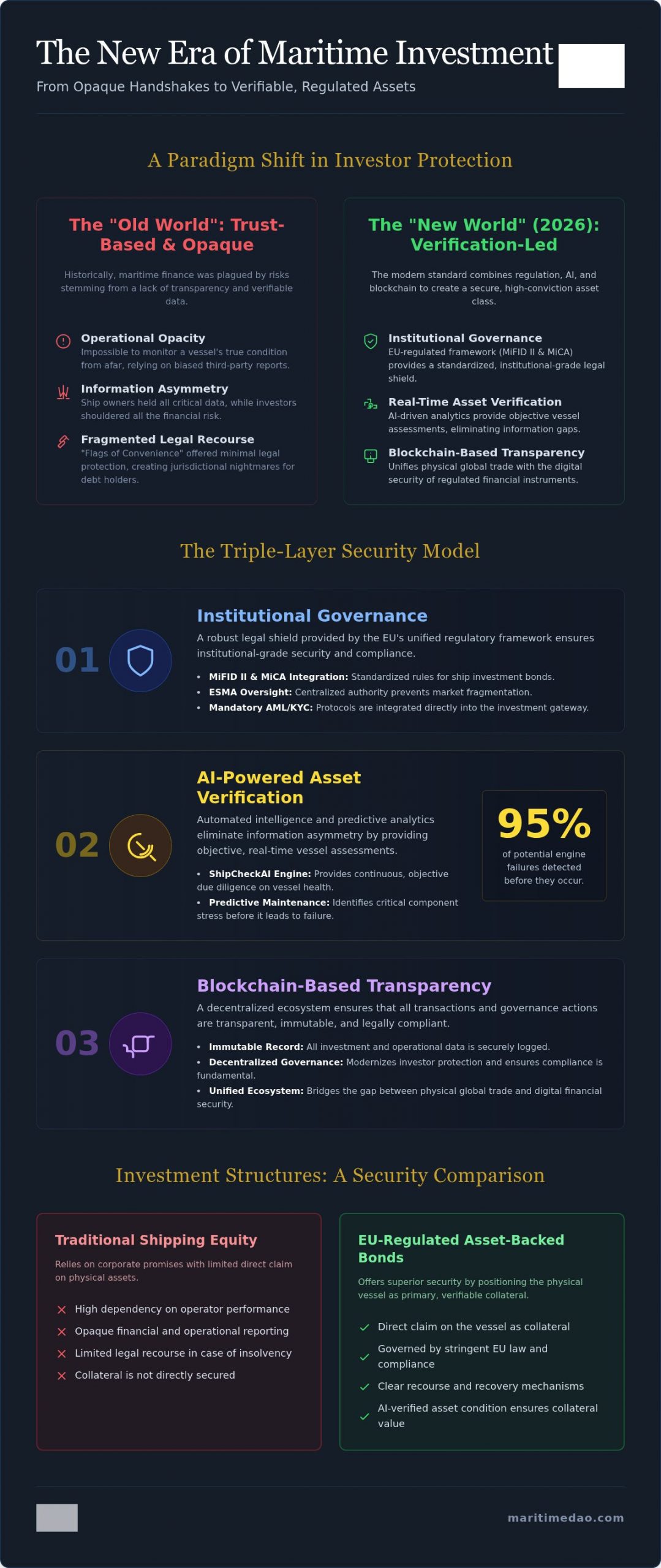
This article explores how the convergence of the 2026 EU regulatory surge and automated intelligence is finally leveling the playing field. We’ll demonstrate how EU-regulated ship investment bonds provide a robust legal shield, while ShipCheckAI utilizes predictive analytics to detect 95% of potential engine failures before they occur. You’ll gain a clear understanding of the new Triple-Layer Security model. This framework combines institutional governance, real-time asset verification, and blockchain-based transparency to transform maritime debt into a reliable, high-conviction asset class for global portfolios.
Key Takeaways
- Learn how the 2026 EU regulatory landscape integrates MiFID II and MiCA principles to create a standardized, institutional-grade framework for ship investment bonds.
- Understand why asset-backed debt structures offer superior security over traditional equity by positioning the physical vessel as primary, verifiable collateral.
- Discover how ShipCheckAI utilizes automated intelligence to provide objective vessel assessments, effectively eliminating the historic risks associated with information asymmetry.
- Explore the critical role of decentralized governance in modernizing investor protection in maritime finance, ensuring that transparency and legal compliance are fundamental to every transaction.
- Identify the strategic advantages of a unified ecosystem that bridges the gap between physical global trade and the digital security of regulated financial instruments.
The Evolution of Investor Protection in Maritime Finance
Investor protection in maritime finance represents the critical convergence of legal recourse, absolute asset transparency, and stringent regulatory oversight. Historically, this sector relied on private shipping syndicates where capital was often locked in opaque structures with limited visibility. The “New World” of 2026 replaces these handshake agreements with regulated digital finance. This transition addresses the industry’s most significant threat: information asymmetry. When an investor cannot verify the physical state of a vessel or the validity of its contracts, their capital is at risk. The 2026 standard solves this through a tripartite model that integrates institutional regulation, physical asset-backing, and AI-driven verification.
Historical Risks in Shipping Investment
The traditional model of an alternative investment into an asset related to worldwide shipping was plagued by operational opacity. Monitoring a vessel’s condition from a London or New York office was nearly impossible without relying on biased third-party reports. This lack of data created a fertile ground for fraud and mismanagement. International maritime law added another layer of complexity. Investors often faced jurisdictional nightmares when seeking recourse against owners operating under “Flags of Convenience.” These states provide low-cost registration but frequently offer minimal legal protection for debt holders, leaving capital stranded in a sea of fragmented regulations.
The 2026 Shift Toward Regulated Innovation
The maturation of digital asset frameworks has transformed the industry’s expectations. Institutional investors no longer accept the “black box” approach to maritime debt. They demand the same level of transparency found in public equities or sovereign bonds. This shift has forced the industry to modernize, adopting standards that ensure investor protection in maritime finance is no longer an afterthought. Investor protection in 2026 is a technology-enabled legal framework. By unifying these pillars, the industry has finally bridged the gap between the physical reality of global trade and the digital requirements of high finance. This evolution ensures that capital is governed by code and law, rather than just corporate promises.
The EU Regulatory Framework for Maritime Debt
The European Union has established itself as the primary architect for maritime financial security. By 2026, the integration of MiFID II (Markets in Financial Instruments Directive) and MiCA (Markets in Crypto-Assets) has created a unified framework for ship investment bonds. These regulations ensure that maritime debt isn’t just a speculative bet but a structured financial instrument. The European Securities and Markets Authority (ESMA) acts as the central gatekeeper, overseeing issuances to prevent the market fragmentation that once plagued the industry. This institutional oversight provides a “Safe Harbor” for global capital, offering a level of investor protection in maritime finance that was previously unattainable in private, unregulated markets.
Compliance Standards for Maritime Bonds
Rigorous transparency is the bedrock of EU-regulated instruments. Every bond issuance must adhere to strict prospectus requirements, mandating standardized risk disclosure that covers everything from vessel age to fuel efficiency under current EU ETS mandates. Even within a DAO ecosystem, compliance remains non-negotiable. AML and KYC protocols are integrated directly into the investment gateway, ensuring that all participants are verified against global sanctions lists. For a deeper look at these requirements, institutional investors should consult our comprehensive reference on Maritime Investment Compliance.
Recourse and Recovery Mechanisms
In the event of vessel arrest or operator insolvency, the legal standing of bondholders is clearly defined and protected. Unlike unregulated private placements, these bonds utilize EU-domiciled legal entities to manage asset recovery, ensuring that debt holders have a direct claim on the vessel as collateral. The shift toward maritime asset tokenization has further streamlined these processes by automating the distribution of recovery proceeds through smart contracts. This systematic approach to risk mitigation is why institutional funds are increasingly favoring these governed structures over traditional, opaque shipping debt. To explore how these frameworks secure your capital, you can review our latest EU-regulated ship investment bonds.
Comparing Asset-Backed Securities vs. Traditional Shipping Equity
In the landscape of capital allocation, the hierarchy of payment determines the resilience of an investment. Debt holders occupy a privileged position within the maritime capital stack, receiving interest and principal repayments before equity owners participate in any profit distributions. This structural seniority is a cornerstone of investor protection in maritime finance, as it insulates capital from the immediate volatility of spot market charter rates. By securing a “First Lien” position, bondholders ensure that their claims are satisfied first in the event of a liquidation, effectively using the physical vessel as high-quality collateral.
Risk-adjusted returns in this sector have evolved to balance maritime industry volatility with the predictability of fixed-income security. While equity represents a speculative bet on the residual value and operational success of a ship, asset-backed debt focuses on the intrinsic value of the steel and the reliability of the cash flow. This shift from “hope-based” equity to “contract-based” debt allows institutional investors to access the shipping markets without the uncapped downside risks historically associated with direct vessel ownership.
The Superiority of Regulated Maritime Debt
The transition from physical ship shares to tokenized bonds has fundamentally altered the liquidity profile of maritime investments. Traditional equity shares in a single vessel are notoriously difficult to exit, often requiring lengthy private negotiations and significant discounts. In contrast, regulated maritime debt instruments are designed for higher velocity. The “waterfall” of distributions is governed by automated protocols, ensuring that bondholders are paid with systematic precision. For those seeking a detailed breakdown of these structures, our EU Regulated Ship Investment Bonds guide provides a technical roadmap for 2026 debt instruments.
Risk Mitigation through Diversification
Fractional investment models have democratized access to cross-fleet risk spreading, a strategy previously reserved for the world’s largest shipowners. Instead of concentrating capital in a single hull, investors can now distribute their exposure across various vessel types, ages, and trade routes. The DAO ecosystem facilitates this by automating yield distribution and governance, removing the administrative burden of manual oversight. Asset-backed securities reduce downside risk in shipping by ensuring that capital is secured against a physical, liquid asset with intrinsic global value. This methodical approach to diversification ensures that a localized disruption in one sector doesn’t compromise the integrity of the entire portfolio.
AI and Due Diligence: The New Standard for Asset Verification
AI-driven vessel assessment has emerged as the ultimate anti-fraud mechanism for the modern era. While traditional due diligence once relied on static, often biased paper reports, automated intelligence now provides a dynamic window into the physical reality of a ship. This technological shift is a fundamental pillar of investor protection in maritime finance. It ensures that capital isn’t just backed by a legal contract, but by an asset whose condition is verified through objective, real-time data. By utilizing ShipCheckAI, investors can bypass the subjectivity of manual surveys, gaining a standardized view of the vessel’s operational integrity. This system identifies red flags in maintenance logs and operational history that human eyes might miss, such as recurring engine anomalies or inconsistent fuel consumption patterns.
Modernizing the Ship Survey
The transition from manual inspections to AI-powered surveys represents a paradigm shift in risk management. Traditional surveys are often subjective, influenced by the surveyor’s individual experience or, in some cases, their proximity to the ship owner. ShipCheckAI standardizes this process, offering multiple inspection layers that provide a comprehensive health profile. This standardization is critical for the issuance of EU-regulated bonds, as it provides a baseline of asset quality that all bondholders can trust. For a technical overview of how these assessments function, see our AI Ship Inspection Tool guide.
Continuous Monitoring as Protection
Protection doesn’t end once the investment is finalized. Real-time data monitoring ensures that the vessel’s health is maintained throughout the bond’s lifecycle. By integrating IoT sensors with centralized intelligence, ShipCheckAI provides quarterly asset health scores directly to bondholders. This continuous oversight prevents catastrophic asset devaluation by flagging maintenance issues before they escalate. AI-powered systems have already demonstrated the ability to detect 95% of potential engine failures before they occur, which reduces unplanned downtime by up to 50%. AI-driven due diligence is the digital twin of investor protection. This level of transparency ensures that the relationship between predictive analytics, IoT integration, and standardized reporting remains unbroken. To secure your portfolio with verified assets, explore our ShipCheckAI platform today.
Maritime DAO: A Unified Ecosystem for Secure Investment
Maritime DAO serves as the definitive intersection where EU regulatory compliance, AI-driven asset verification, and institutional-grade finance converge. By unifying these disparate pillars into a single ecosystem, the platform provides a cohesive solution for investor protection in maritime finance. This integrated approach ensures that the bond issuer, the inspection tools, and the governance layer operate in total alignment, removing the friction and risk traditionally found in fragmented shipping markets. It’s a first-of-its-kind model that bridges the gap between the physical reality of global trade and the digital security of governed financial instruments.
The “unified” advantage lies in the structural connectivity of the platform. When an investor engages with the ecosystem, they aren’t just buying a debt instrument; they’re entering a governed environment where every asset is continuously monitored and every transaction is legally protected. This synergy between technology and law creates a high-stakes emotional register of security, allowing global capital to flow into maritime assets with unprecedented confidence. By identifying systemic inefficiencies and building a high-tech solution to fix them, the DAO acts as both a visionary architect and a reliable gatekeeper for the industry.
Governance and Transparency
Smart contracts serve as the automated foundation of the ecosystem, executing compliance checks and protecting yield distributions with programmatic precision. This decentralized oversight eliminates the “single point of failure” inherent in traditional financial institutions, where human error or centralized mismanagement can jeopardize capital. By distributing governance across a network of stakeholders, the DAO ensures that investor interests remain the primary priority at all times. This commitment to order and security is explored further in our guide on The Future of Ship Finance.
Getting Started with Maritime DAO
Entering the maritime capital markets securely requires a methodical onboarding process designed for institutional and professional investors. The journey begins with a rigorous KYC and AML verification phase, ensuring all participants meet EU regulatory standards. Once verified, investors gain immediate access to the ShipCheckAI dashboard, where they can review real-time asset health scores and historical maintenance logs for every vessel in the portfolio. This level of transparency allows for high-conviction decision-making before committing capital to ship investment bonds. To secure your entry into this modernized asset class, visit the Maritime DAO investment gateway and begin your verification today.
Securing the Future of Maritime Capital
The transition from opaque shipping syndicates to a governed digital ecosystem marks a definitive milestone for global capital. By integrating institutional legal frameworks with real-time asset verification, the industry has finally established a standard for investor protection in maritime finance that prioritizes transparency over speculation. You now have the tools to move beyond the limitations of information asymmetry, utilizing asset-backed structures that offer senior security and verifiable collateral.
The 2026 framework succeeds by uniting three distinct pillars: a robust EU-Regulated Compliance Framework, AI-Powered Asset Verification via ShipCheckAI, and Decentralized Governance for Absolute Transparency. These components ensure that every investment is monitored, governed, and legally protected throughout its lifecycle. This unified model doesn’t just reduce risk; it transforms a traditionally exclusive industry into a transparent, institutional-grade asset class. It’s time to bridge the gap between physical trade and digital security.
Secure your capital with EU-regulated maritime bonds at Maritime DAO and lead the next era of regulated innovation.
Frequently Asked Questions
What is the primary legal protection for investors in EU-regulated ship bonds?
The primary legal shield is the alignment with established EU financial directives, including MiFID II and the Markets in Crypto-Assets (MiCA) framework. These regulations mandate standardized risk disclosures and institutional-grade prospectuses overseen by the European Securities and Markets Authority (ESMA). This structured environment ensures that investor protection in maritime finance is codified in law, providing debt holders with a clear path for legal recourse within the European judicial system if contractual obligations aren’t met.
How does ShipCheckAI protect investors from asset misrepresentation?
ShipCheckAI eliminates the subjectivity and potential bias inherent in manual vessel surveys by utilizing automated intelligence for asset verification. The platform performs multiple types of vessel assessments, cross-referencing real-time data with historical maintenance logs to flag anomalies. This technological gatekeeper ensures that the physical condition of the vessel matches the owner’s claims, preventing capital from being deployed into misrepresented assets. It provides a transparent, data-driven health profile that remains objective throughout the investment lifecycle.
Can retail investors access regulated maritime debt instruments in 2026?
Yes, the 2026 framework has successfully democratized access to maritime debt through the fractionalization of regulated bonds. While the industry was once restricted to institutional syndicates, tokenized structures now allow professional and retail investors to participate with significantly lower capital requirements. This inclusivity is governed by the same KYC and AML protocols required for institutional participants, ensuring that the ecosystem remains secure and compliant for all users regardless of their individual investment size.
What happens to my investment if the underlying vessel is damaged or lost?
Regulated maritime bonds are structured as asset-backed securities, meaning bondholders maintain a “First Lien” position on the vessel. If a vessel is damaged or lost, the investment is typically protected through mandatory hull and machinery insurance, with bondholders named as loss payees. The legal framework ensures that insurance proceeds or recovery values are distributed to debt holders before equity owners. This systematic approach to risk mitigation ensures that your principal remains secured against the vessel’s intrinsic value.
How does a DAO structure improve investor protection compared to traditional funds?
The DAO structure replaces centralized, opaque decision-making with transparent, blockchain-based governance. Smart contracts automate the distribution of yields and enforce compliance protocols without the need for manual intervention; this effectively removes the “single point of failure” risk associated with traditional fund managers. Every governance action is recorded on-chain, allowing investors to verify that their interests are prioritized. This decentralized oversight ensures that the platform operates with methodical precision and total operational transparency.
Are maritime bonds protected against inflation and currency fluctuations?
Maritime bonds typically operate in US Dollars, the global standard for international shipping, which provides a natural hedge against localized currency volatility. Many instruments are structured with floating interest rates or inflation-linked coupons to preserve the real value of capital in changing economic environments. While no investment is entirely immune to macro-economic shifts, the intrinsic value of the underlying vessel as a globally tradable asset provides a robust buffer against the devaluation of fiat currencies.
What is the difference between a regulated maritime bond and a shipping token?
A regulated maritime bond is a recognized financial instrument that complies with EU securities laws and provides debt-based protection for investors. In contrast, generic shipping tokens often lack a standardized legal framework and may represent unregulated equity or speculative interests. Maritime DAO focuses exclusively on regulated instruments that integrate MiCA principles, ensuring that every digital asset is backed by a physical vessel and governed by a transparent, technology-enabled framework for investor protection in maritime finance.
How does Maritime DAO ensure ESG compliance for its vessel fleet?
ESG compliance is integrated directly into the due diligence process through the monitoring of EU ETS and FuelEU Maritime requirements. ShipCheckAI tracks a vessel’s greenhouse gas intensity and carbon emissions in real-time, ensuring the fleet remains compliant with 2026 environmental standards. Vessels that fail to meet these targets are flagged, protecting investors from the financial penalties and asset devaluation associated with non-compliance. This proactive monitoring ensures that the fleet maintains its value in a green global economy.