
The traditional opacity of ship finance is finally collapsing under the weight of its own legacy inefficiency. For decades, institutional investors navigated a fragmented capital market where the physical asset was often dangerously disconnected from the financial instrument. To truly understand how are maritime bonds structured in 2026, you must look beyond old-world debt to a unified ecosystem where legal integrity, technical automation, and physical transparency converge. This is no longer a speculative frontier but a grounded reality of regulated innovation.
It’s understandable if you find the task of assessing maritime asset risk daunting in today’s volatile geopolitical climate. You deserve a clear view of the structural pillars that protect your capital. This guide promises to reveal the sophisticated architecture behind modern EU-regulated ship investment bonds, detailing the direct legal link between Special Purpose Vehicles and their underlying vessels. We’ll examine how the MiCA framework, ShipCheckAI risk scoring, and blockchain-based yield tracking unite to create a secure, transparent gateway for global trade finance. By the end of this analysis, you’ll possess the knowledge to evaluate these high-stakes assets with institutional precision.
Key Takeaways
- Master the foundational architecture of the industry by learning how are maritime bonds structured using Special Purpose Vehicles to ring-fence assets and mitigate corporate liability.
- Gain clarity on the 2026 regulatory transition, specifically how MiCA compliance provides a robust legal framework for tokenized Real World Assets in the maritime sector.
- Explore how ShipCheckAI integrates automated intelligence into the bond issuance workflow, effectively reducing due diligence risk through continuous, transparent asset monitoring.
- Evaluate the mechanics of fractionalization and tranche-based yields, which democratize access to high-stakes global trade while maintaining institutional security standards.
- Understand the governance role of the $MARGOT token in the Maritime DAO, enabling bondholders to participate in strategic fleet management through unified, on-chain voting.
The Core Architecture: Special Purpose Vehicles (SPVs) and Asset-Backing
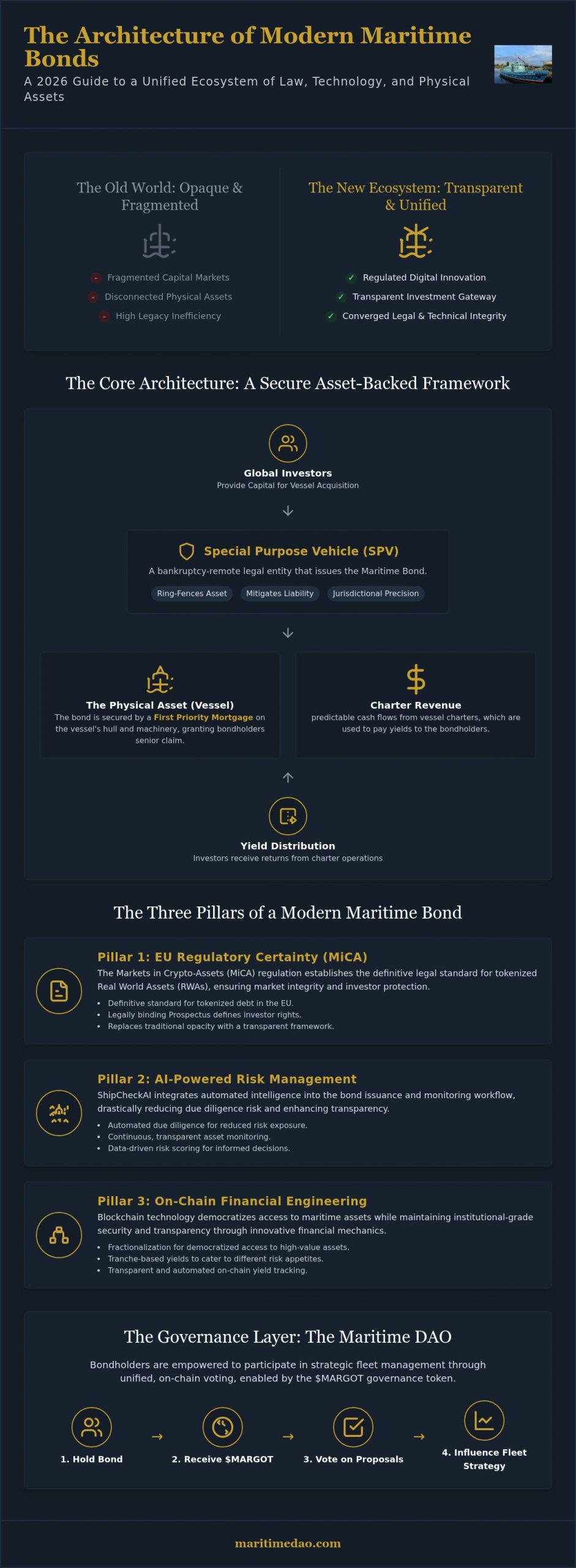
A maritime bond is a sophisticated debt security issued by a Special Purpose Vehicle (SPV) to facilitate the acquisition or operational scaling of a vessel. Unlike the three-party guarantees found in maritime surety bonds, which serve as performance insurance, these are yield-generating instruments designed for capital growth. To understand how are maritime bonds structured, you must shift your perspective from traditional corporate debt to a specific Asset-Backed Security (ABS) framework. In this model, the bond’s value is derived from the predictable cash flows of vessel charters rather than the general creditworthiness of a parent shipping company. These structures unite physical assets, govern investor rights, and open up global capital flows through a transparent, high-stakes financial architecture.
The physical ship serves as the ultimate backstop for the investment. In an ABS framework, the vessel is not just a tool for trade but a liquidatable asset that secures the debt. This differs fundamentally from maritime surety bonds, which are insurance products protecting against contract failure. Investment bonds, by contrast, are structural debt. They represent a direct claim on the vessel’s value and its ability to generate charter revenue, ensuring that the financial instrument is grounded in the heavy industry of global trade.
Why SPVs are Essential for Maritime Debt
The SPV acts as a vital gatekeeper in the 2026 maritime ecosystem. By ring-fencing a specific vessel within its own legal entity, the structure ensures that liabilities from a broader fleet can’t contaminate the security of individual bondholders. This ring-fencing protects the investor from cross-contamination where a legal dispute or operational failure on one ship could theoretically drain the resources of another. It’s also about jurisdictional precision. Modern issuers favor hubs like Malta or Luxembourg for their robust legal frameworks and tax efficiencies. In 2026, a maritime SPV is a bankruptcy-remote legal entity established solely to hold title to a maritime asset and issue debt against its projected earnings.
Collateralization and the First Priority Mortgage
Security is anchored by a first priority mortgage recorded against the vessel’s hull and machinery. This legal hierarchy places bondholders in a senior position within the capital stack, granting them primary claim over the asset in a liquidation scenario. This hierarchy is essential because it dictates the order of repayment; senior bondholders are paid before any equity holders or subordinated debt. The innovation lies in the connectivity between physical registration and digital issuance. By linking a vessel’s IMO number to a regulated bond structure, the industry replaces opaque management with a transparent, unified ecosystem. This link ensures that every digital unit of debt is governed by a real-world, enforceable mortgage. When examining how are maritime bonds structured, the integration of physical collateral with digital governance remains the most significant advancement in modern ship finance.
Navigating the Regulatory Waters: EU Compliance and MiCA Standards
The shift toward the Markets in Crypto-Assets (MiCA) regulation represents a watershed moment for Real World Assets (RWA) in the shipping sector. As of September 2026, the transitional period for compliance has concluded, establishing MiCA as the definitive standard for any tokenized debt instrument within the European Union. To understand how are maritime bonds structured in this new era, one must look past the technology and focus on the rigorous legal layers that now define the asset class. The “black box” of traditional shipping finance has been replaced by a standardized, transparent framework that prioritizes investor protection and market integrity.
A central pillar of this architecture is the Prospectus, a document that serves as the legally binding definition of investor rights and issuer obligations. It details the specific vessel’s operational history, the bond’s yield mechanics, and the legal hierarchy of the debt. EU financial regulations now mandate that these instruments provide real-time transparency, ensuring that the fragmented capital markets of the past are unified under a single, governed ecosystem. This structure ensures that every participant, from institutional desks to individual investors, operates with the same verified data set.
MiCA Title II and the 2026 Regulatory Landscape
MiCA Title II specifically governs the issuance and trading of asset-referenced tokens, a category that includes many modern maritime instruments. These bonds are typically structured as regulated security tokens, ensuring they fall under the oversight of European financial authorities. This classification is vital for cross-border investment because it allows for “passporting” across the Eurozone. Investors in Germany or France can participate in a bond issued by a Maltese or Luxembourgish SPV with full confidence in legal reciprocity. For a deeper look at these requirements, consult the Maritime Investment Compliance guide.
Investor Protection through Standardized Instruments
EU regulation has effectively eliminated the “wild west” scenarios of early, unregulated tokenization. By mandating independent audits and transparent vessel reporting, the framework ensures that the physical asset’s condition is always verifiable. In 2026, the distinction between “Qualified Investors” and “Retail” thresholds remains a key safeguard. While institutional players engage with larger tranches, the democratization of this sector allows retail participants to enter with as little as €200, provided the issuer meets MiCA’s strict disclosure standards. This automated intelligence reduces administrative friction and enhances the structural integrity of the bond. If you’re ready to explore these frameworks firsthand, you can evaluate current EU-regulated bond offerings to see this transparency in action.
Risk Management through AI: The Role of ShipCheckAI in Bond Structuring
Traditional due diligence has long been the primary bottleneck in maritime finance, relying on manual, lawyer-led processes that struggle to keep pace with modern market volatility. When considering how are maritime bonds structured, the integration of automated intelligence is no longer optional; it’s a structural necessity. By moving away from static, once-a-year “snapshot” inspections, the industry has embraced a model of continuous asset assessment. This transition ensures that the bond’s underlying value is not a historical estimate but a live, verifiable metric that protects capital from the physical risks of global trade. The resulting ecosystem is one where risk is identified, verified, and mitigated with institutional precision.
The integration of ShipCheckAI into the bond issuance workflow allows for real-time condition reports that were previously impossible to generate. This capability is critical in 2026, where geopolitical disruptions and environmental regulations like the EU ETS require constant operational vigilance. Instead of waiting for a quarterly report, bondholders can access data that reflects the actual state of the vessel’s hull, machinery, and emissions compliance. This shift creates a unified link between the physical Real World Asset (RWA) and the digital financial instrument, ensuring that the bond remains grounded in operational reality.
Automating Vessel Inspections for Bondholders
The implementation of AI ship inspection tools has fundamentally redefined how asset value is verified for both institutional and retail investors. These systems utilize multi-layered inspections to identify structural anomalies, engine wear, and maintenance lapses that human surveyors might overlook, effectively reducing the margin for error in pre-purchase and annual surveys. Automated risk scoring provides a dynamic quantitative foundation that allows issuers to calibrate bond coupon rates against real-time operational performance. This precision ensures that the bond’s financial yield is always commensurate with the physical asset’s risk profile, creating a governed environment where data dictates returns.
Transparency and ‘No Black Boxes’ Reporting
A “no black boxes” approach is essential for maintaining the integrity of maritime investment in 2026. ShipCheckAI provides bondholders with a digital window into the engine room, offering dashboards that display real-time condition reports and operational efficiency metrics. This level of transparency is achieved by anchoring inspection data directly to the bond’s smart contract on the Ethereum network, creating an immutable record of the vessel’s lifecycle. This integration is a core component of AI in maritime due diligence, where automated intelligence serves as the reliable gatekeeper between physical operations and digital finance. By removing the opacity of traditional ship management, these structures empower a global audience with the clarity needed to navigate complex, high-stakes maritime markets.
Financial Engineering: Tranching, Yields, and Fractionalization
The financial engine of modern maritime bonds is built on a rigorous hierarchy of risk and reward. While the legal SPV and AI-driven monitoring provide the foundation, the actual distribution of capital is governed by sophisticated financial engineering. To understand how are maritime bonds structured at a granular level, one must examine the capital stack, which typically divides debt into Senior, Mezzanine, and Equity tranches. This tripartite division allows different classes of investors to participate in the same vessel according to their specific risk tolerance and yield requirements. By converting a massive physical asset into a series of structured debt units, the ecosystem creates a unified gateway for both institutional desks and individual participants.
This structural precision extends to the creation of secondary markets, a feature traditionally absent in private shipping deals. By tokenizing these bonds as Real World Assets (RWA), the industry introduces liquidity into an historically illiquid sector. Investors no longer need to commit capital for the entire lifecycle of a vessel; instead, they can trade their positions on regulated exchanges. This flexibility, combined with the underlying security of a physical vessel, transforms maritime finance from a closed-door industry into a transparent, accessible marketplace.
The Waterfall Structure of Maritime Yields
Revenue distribution follows a strict “waterfall” protocol to ensure operational continuity and debt service reliability. In this model, vessel charter revenue is first allocated to Operating Expenses (OPEX), such as crew wages, fuel, and maintenance, ensuring the asset remains productive. Once OPEX is covered, the remaining cash flow is directed to Senior Debt holders. Junior tranches are compensated only after these primary obligations are met. In 2026, smart contracts on the Ethereum network automate this entire process, removing human intervention and ensuring that bond coupons are paid with mathematical certainty. Whether the bond utilizes a fixed-rate or a floating-rate structure, the automated governance layer maintains the integrity of the distribution waterfall at all times.
MicroShipOwner: The Democratization of Shipping Finance
The concept of the “MicroShipOwner” is the logical result of fractionalization, where a million-euro vessel is “wrapped” into a digital bond and split into accessible €200 units. This technical process lowers the barriers to entry, allowing a global audience to build a diversified maritime portfolio without the need for massive capital outlays. If you’re interested in participating, you can learn how to invest in maritime assets through our comprehensive 2026 guide. This democratization doesn’t just empower the investor; it increases systemic liquidity for ship operators by tapping into a broader, more resilient capital pool. If you’re ready to diversify your portfolio with asset-backed debt, you can browse current regulated bond tranches to find a structure that fits your investment strategy.
The Governance Layer: Integrating DAOs and Secondary Markets
The final layer of the architectural stack is the governance framework, which transforms a passive debt instrument into an active, governed asset. While the previous sections detailed the legal SPV and the AI-driven monitoring, the governance layer determines how the ecosystem responds to real-world operational shifts. To fully grasp how are maritime bonds structured in 2026, one must look at the interplay between decentralized autonomous organizations (DAOs) and the physical management of the vessel. This layer ensures that the bond’s lifecycle is not just a static agreement but a dynamic, transparent process where institutional security meets technological agility.
Governance is executed through the $MARGOT utility token, which serves as the primary engine for ecosystem participation. Unlike the bonds themselves, which are regulated financial instruments, the $MARGOT token facilitates the operational logic of the DAO. This structure allows for a unified, high-stakes environment where the relationship between physical Real World Assets (RWA) and digital governance is clearly defined. By integrating these systems, the industry moves away from the fragmented decision-making of the past toward a methodical, architected future.
Decentralized Governance in a Regulated Framework
Modern maritime finance requires a bridge between a DAO’s code and the SPV’s legal bylaws. This bridge ensures that on-chain voting results are legally enforceable within the jurisdiction of the vessel’s registration. Bondholders utilize this governance layer to influence critical fleet decisions, such as approving major refits, vessel sales, or shifts in chartering strategy. This level of involvement is a cornerstone of Maritime DAO investment models, which modernize corporate governance by removing administrative friction. In 2026, the outlook for DAO-led maritime asset management is one of increasing maturity, where automated intelligence and human oversight unite to protect the integrity of the capital stack.
Liquidity and the Secondary Market Layer
The introduction of secondary markets represents the logical conclusion of how are maritime bonds structured for a global audience. Historically, ship finance was a “buy-and-hold” endeavor with limited exit strategies before vessel maturity. Today, the integration of on-chain liquidity pools allows investors to liquidate their positions on regulated digital exchanges with institutional ease. This secondary market layer provides real-time pricing discovery based on the vessel’s performance and current market conditions. By creating a liquid environment for traditionally illiquid assets, the ecosystem empowers investors with the flexibility to manage their portfolios actively. This transition to a unified, transparent, and liquid marketplace marks the end of the “black box” era in shipping finance, opening the doors to a new frontier of regulated innovation.
Charting the Future of Institutional Maritime Capital
The architecture of maritime finance has moved from opaque, manual processes to a unified system of regulated innovation. By leveraging institutional-grade SPV structures and a MiCA-compliant framework, the industry has successfully bridged the gap between physical heavy industry and digital capital markets. You now have a clear view of how are maritime bonds structured, from the first priority mortgage on the vessel’s hull to the automated yield distribution governed by smart contracts. This evolution ensures that asset management is transparent, secure, and accessible to a global audience.
The integration of ShipCheckAI provides an essential layer of security, offering AI-verified asset conditions that protect bondholders from traditional due diligence failures. This methodical approach to risk management, combined with the liquidity of secondary markets, defines the new standard for ship finance in 2026. If you’re ready to transition from a spectator to a participant in this high-stakes frontier, the tools are now in place to support your journey.
Explore EU Regulated Ship Investment Bonds on Maritime DAO and discover how our ecosystem unites technical automation with legal integrity to open up new opportunities in global trade.
Frequently Asked Questions
Are maritime bonds the same as maritime surety bonds?
No, these are distinct financial instruments serving different purposes. Maritime surety bonds act as a three-party insurance guarantee to ensure contract performance, whereas maritime investment bonds are yield-generating debt securities. Understanding how are maritime bonds structured reveals that investment bonds provide a direct claim on vessel revenue and physical collateral. This makes them a vehicle for capital growth rather than a simple licensing or permit requirement.
How does the SPV structure protect my investment if the ship operator goes bankrupt?
The Special Purpose Vehicle (SPV) operates as a bankruptcy-remote legal entity that holds the title to a specific vessel. This structure ensures that the asset is ring-fenced from the operator’s broader corporate liabilities. If the operator fails, the vessel remains the property of the SPV, and bondholders maintain their senior position in the capital stack. This legal isolation protects your capital from being used to satisfy unrelated creditors.
What is the minimum investment for an EU-regulated ship investment bond?
The minimum entry point for these regulated instruments is €200. This low threshold is made possible through fractionalization, which breaks down million-euro maritime assets into accessible digital units. By lowering the barriers to entry, the ecosystem democratizes access to institutional-grade global trade finance. Every participant, regardless of their capital size, benefits from the same MiCA-compliant framework and automated risk management protocols. It’s a first-of-its-kind opportunity for retail investors.
How does ShipCheckAI verify the condition of a vessel for bondholders?
ShipCheckAI utilizes automated intelligence to perform multi-layered inspections and generate real-time risk scores. Instead of relying on static annual surveys, the system provides continuous asset assessment by analyzing operational data and physical condition reports. This data is anchored to the bond’s smart contract, creating an immutable record of the vessel’s maintenance history. It removes human error and provides bondholders with total transparency regarding the underlying collateral.
Can I sell my maritime bonds before the vessel is sold or scrapped?
Yes, you can liquidate your position through regulated secondary markets. These bonds are tokenized as Real World Assets (RWA), allowing them to be traded on digital exchanges with institutional ease. This feature provides an exit strategy that wasn’t historically available in traditional private shipping deals. On-chain liquidity pools ensure that pricing remains transparent and reflective of the vessel’s current operational performance and market demand.
How are yields calculated and distributed to bondholders?
Yields are calculated based on vessel charter revenue and distributed according to a strict waterfall protocol. Operating expenses are settled first to ensure the ship remains seaworthy, followed by payments to senior bondholders. Smart contracts on the Ethereum network automate this distribution, ensuring that coupons are paid with mathematical certainty. When evaluating how are maritime bonds structured, this automation is a key differentiator that removes administrative friction and human intervention.
What role does the $MARGOT token play in bond governance?
The $MARGOT token serves as the utility engine for the Maritime DAO ecosystem, enabling on-chain voting on strategic fleet decisions. While the bonds represent the debt itself, $MARGOT allows holders to participate in governance matters such as vessel sales or major refits. Investors don’t just hold debt; they participate in strategic oversight. This structure bridges the gap between decentralized code and legal bylaws, ensuring the ecosystem remains unified.
Is maritime bond investing regulated by the EU?
Yes, maritime bond investing is governed by the Markets in Crypto-Assets (MiCA) regulation and broader EU financial standards. These regulations mandate high levels of transparency, independent audits, and rigorous KYC/AML compliance. By operating within a regulated framework, issuers provide a level of security and legal reciprocity that was previously missing from digital asset markets. This oversight ensures that the instruments are recognized as legitimate financial debt across the Eurozone.