
In 2026, relying on a manual surveyor’s clipboard for a multi-million dollar maritime acquisition is no longer just antiquated; it’s an institutional liability. You’ve likely felt the persistent anxiety of receiving a subjective report that overlooks critical structural anomalies, only to face staggering capital loss when hidden defects surface after the deal closes. Utilizing AI for pre-purchase vessel inspection has evolved from a technological luxury into a foundational requirement for securing institutional-grade investment in a high-stakes global market.
This guide empowers you to master the transition from manual surveys to objective, automated assessments, ensuring your due diligence is both precise and compliant with the October 2026 IMO SafeStream mandates. We’ll explore how ShipCheckAI provides a unified truth layer for investors, bridging the gap between physical structural integrity, regulatory governance, and EU-regulated financial instruments. You will learn to leverage high-fidelity data to reduce due diligence timelines, mitigate compliance risks, and provide the rigorous justification required for modern asset-backed security pricing.
Key Takeaways
- Understand why manual surveying is now considered an institutional liability and how to transition toward quantified, data-driven risk assessments.
- Discover how to leverage computer vision and deep learning within AI for pre-purchase vessel inspection to identify sub-millimeter hull defects and structural anomalies.
- Compare the reliability and speed of real-time AI data streaming against traditional 48-hour manual report turnarounds to accelerate your acquisition timelines.
- Master a structured deployment workflow for selecting AI frameworks and utilizing autonomous hardware to ensure rapid, high-fidelity data ingestion.
- Explore how ShipCheckAI bridges the gap between technical condition reports and the governance requirements of EU-regulated Ship Investment Bonds.
The Strategic Role of AI in 2026 Pre-Purchase Vessel Inspections
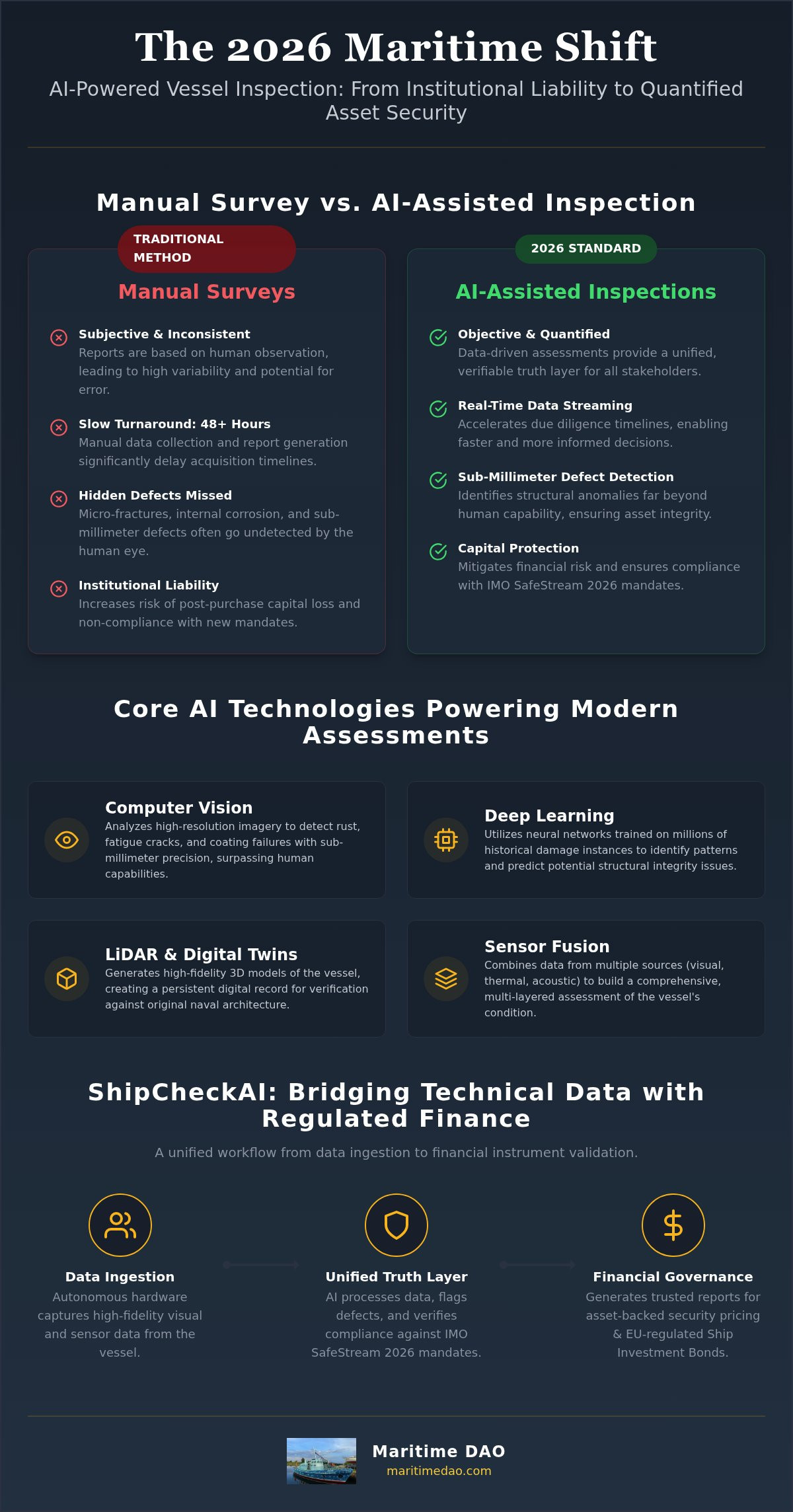
In the high-stakes environment of 2026 maritime finance, the transition from subjective observation to algorithmic precision is complete. Traditional manual surveys, once the cornerstone of due diligence, are now viewed as an institutional liability due to their inherent susceptibility to human error and inconsistent reporting standards. Today’s investors demand a unified truth layer that unites physical asset data, regulatory compliance, and financial governance into a single ecosystem. By utilizing AI for pre-purchase vessel inspection, capital providers can move beyond simple condition reporting toward a rigorous asset valuation verification. This shift effectively mitigates the “as-is, where-is” risks that have historically plagued vessel acquisitions, transforming a physical inspection into a quantified financial data point.
- Structural Integrity: Automated detection of corrosion and micro-fractures that escape the human eye.
- Financial Governance: Direct integration of technical data into asset-backed security pricing.
- Regulatory Alignment: Immediate verification against 2026 international maritime mandates.
Capital Protection through Technical Certainty
Structural integrity is the bedrock of maritime asset security. Manual assessments often miss micro-fractures or internal corrosion that compromise the principles of Naval architecture and long-term seaworthiness. AI-driven systems eliminate human bias, providing objective data that serves as critical leverage during price negotiations. Historically, the “as-is, where-is” clause shifted all structural risk to the buyer, often leading to catastrophic post-purchase discoveries. AI-driven assessments dismantle this information asymmetry by providing a transparent, high-fidelity view of the vessel’s internal and external state. AI for pre-purchase vessel inspection serves as the primary filter for maritime capital deployment, ensuring that every dollar invested is backed by verified technical certainty.
IMO SafeStream Compliance in the Transactional Phase
The implementation of the IMO SafeStream regulation in October 2026 has fundamentally altered the transactional phase of vessel transfers. Compliance is no longer a post-purchase checklist; it’s a prerequisite for the bill of sale. Modern inspection frameworks like ShipCheckAI integrate automated compliance flagging directly into the pre-purchase window. This ensures that any vessel under consideration meets the 2026 mandate for AI-assisted defect detection before any capital is committed. The IMO’s January 2026 guidelines for AI integration have set a rigorous bar for data processing, making digital twins the expected standard for institutional-grade investment. ShipCheckAI aligns with these standards by generating digital records that act as a persistent layer of compliance, which is essential for the security and issuance of EU-regulated Ship Investment Bonds.
Core AI Technologies Powering Modern Condition Assessments
The 2026 maritime landscape is defined by high-fidelity data streams that replace the fallibility of human perception with quantified technical certainty. Modern due diligence relies on a sophisticated ecosystem of automated intelligence that bridges the gap between physical reality and financial security. By integrating AI for pre-purchase vessel inspection, institutional investors can now access a granular level of detail that was previously impossible to achieve within traditional survey timelines. This technological shift is powered by four primary pillars: computer vision, deep learning, LiDAR integration, and sensor fusion.
Computer Vision and Structural Integrity
Computer vision has revolutionized hull assessments by providing sub-millimeter defect detection that surpasses the capabilities of the most experienced surveyors. Neural networks, trained on millions of historical damage instances, automatically identify rust, fatigue cracks, and coating failures by comparing current imagery against the vessel’s original digital twin. This process ensures that structural integrity is maintained according to the original naval architecture specifications. Experts suggest that AI-powered robotics could revolutionise boat inspections by accessing high-risk areas without endangering human personnel. AI identifies corrosion patterns by analyzing pixel-level spectral data and thermal anomalies invisible to the human eye, providing a transparent record of a vessel’s true physical state. For those managing complex portfolios, utilizing ShipCheckAI provides a unified platform to govern these technical insights within a regulated framework.
Predictive Analytics for Machinery Due Diligence
Predictive machinery failure analysis utilizes deep learning to interpret years of historical telemetry, identifying hidden engine room anomalies that would remain undetected during standard sea trials. Instead of a static “point-in-time” report, AI calculates the Remaining Useful Life (RUL) of critical components like main engines, generators, and scrubbers. This allows investors to:
- Identify irregular vibration patterns that signal imminent bearing failure.
- Analyze fuel consumption trends to detect internal combustion inefficiencies.
- Predict maintenance capital expenditure requirements for the first 24 months of ownership.
These algorithmic insights transform machinery due diligence from a reactive checklist into a proactive financial risk assessment.
The integration of LiDAR and autonomous drones further expands the scope of the inspection, reaching inaccessible areas such as ballast tanks and cargo holds with precision. Sensor fusion then unifies this visual data with real-time IoT telemetry, creating a comprehensive audit trail. This unified approach ensures that every structural and mechanical data point is validated, governed, and ready for inclusion in the transparency reports required for EU-regulated Ship Investment Bonds.
Manual Surveys vs. AI-Assisted Inspections: A Data-Driven Comparison
Traditionally, vessel acquisition relied on the individual expertise of a single surveyor. This legacy model is fundamentally limited by human subjectivity, physical constraints, and the inevitable fatigue of manual labor. In contrast, utilizing AI for pre-purchase vessel inspection offers an objective, algorithmic detection layer that standardizes condition reports across global networks. While a manual surveyor might require 48 hours to compile and deliver a comprehensive report, AI-driven systems provide real-time data streaming. This allows institutional investors to access, analyze, and verify asset conditions with instantaneous clarity, effectively removing the “black box” of traditional maritime due diligence.
The Reliability Gap in Pre-Purchase Reporting
Human-only structural surveys suffer from an inherent error rate driven by inconsistent environmental factors and limited physical access. AI eliminates these variables by applying consistent neural network analysis to every square centimeter of the hull and machinery. This standardization is critical when evaluating multiple vessels in a fleet purchase, as it ensures a uniform risk profile across the entire asset portfolio. The integration of AI in the maritime industry has transformed these reports from descriptive narratives into quantified technical audits. By removing human bias, these systems provide a transparent foundation for asset-backed security pricing.
Safety and Accessibility during Due Diligence
Safety remains a paramount concern during the high-stakes due diligence phase. Sending human surveyors into confined spaces like ballast tanks or high-altitude zones involves significant risk and often necessitates extensive vessel downtime. Autonomous drones and LiDAR scanners bypass these hazards, entering inaccessible areas to capture high-fidelity data without endangering personnel. This approach significantly reduces the time a vessel must remain out of service for inspection, protecting the asset’s operational schedule. For a detailed breakdown of these technical requirements, consult our AI in maritime due diligence framework. This transition toward autonomous entry is essential for maintaining the structural integrity and regulatory compliance expected by modern institutional lenders.
The financial argument for AI for pre-purchase vessel inspection centers on the mitigation of hidden liabilities. While manual surveys may appear more cost-effective upfront, they often fail to detect deep-seated structural fatigue that leads to multi-million dollar maintenance surprises. Investing in enterprise-grade platforms like ShipCheckAI provides a robust defense against post-purchase capital loss. These systems bridge the gap between physical reality, digital governance, and financial security, ensuring that the asset’s valuation is grounded in verifiable data rather than subjective opinion.
Integrating AI into the Pre-Purchase Due Diligence Workflow
Implementing a robust workflow for AI for pre-purchase vessel inspection requires a methodical transition from physical data collection to institutional financial governance. This process ensures that every technical finding is unified, transparent, and legally defensible within the 2026 regulatory framework. The integration follows a four-pillar sequence designed to maximize capital protection and operational readiness. By standardizing these steps, investors can eliminate the information asymmetry that often characterizes “as-is, where-is” transactions.
- Step 1: Selecting the AI inspection framework. Different vessel types demand specialized algorithmic parameters. Utilizing a specialized AI ship inspection tool allows investors to tailor these parameters to the specific asset class, ensuring that the most critical risk areas are prioritized.
- Step 2: Deploying autonomous hardware. Once the framework is set, drones and LiDAR scanners are deployed for rapid data ingestion. This stage replaces weeks of manual labor with hours of high-fidelity digital capture, reaching ballast tanks and high-altitude structures without human risk.
- Step 3: Real-time anomaly flagging. As data streams into the cloud, deep learning models flag structural or mechanical deviations instantly. This allows for immediate technical review while the vessel is still accessible, preventing costly follow-up inspections.
- Step 4: Finalizing the report. The output is a quantified, AI-verified condition report that serves as the “truth layer” for the final bill of sale and subsequent financing instruments.
Selecting the Right AI Inspection Framework
Institutional due diligence demands more than a generic checklist. Customizing AI parameters is essential for identifying the unique failure modes associated with specific hulls and machinery. Tankers require intense scrutiny of internal piping and corrosion-resistant coatings, whereas Bulk Carriers necessitate deep analysis of deck strength and hatch cover integrity. By defining these critical inspection zones early, investors ensure that the AI for pre-purchase vessel inspection captures the data most relevant to the asset’s long-term valuation. This precision allows for a more accurate calculation of future maintenance capital expenditures.
Data Synthesis and Final Decision Support
Interpreting the finalized report involves analyzing AI confidence scores, which provide a statistical measure of the certainty behind every flagged defect. These scores allow investment committees to distinguish between minor cosmetic issues and high-risk structural failures. Integrating these technical findings directly into the purchase agreement provides the necessary leverage for final price negotiations. For instance, if an AI report reveals a 92% confidence score for imminent machinery failure, the buyer can demand a specific price reduction or a pre-sale repair clause. To secure your capital through these data-driven insights, you can explore our EU-regulated investment ecosystem. This synergy between technical precision and financial governance is the new standard for maritime asset management.
ShipCheckAI: Bridging Technical Inspection with Regulated Finance
ShipCheckAI serves as the definitive bridge between physical maritime assets and the rigorous demands of institutional capital. By utilizing AI for pre-purchase vessel inspection, this platform generates a persistent, verifiable truth layer that unifies technical condition data with financial governance protocols. This integration is essential for the issuance and security of asset-backed securities, providing a transparent audit trail that mitigates the inherent risks of global trade. ShipCheckAI doesn’t merely report on a vessel’s state; it governs the relationship between structural integrity and financial valuation, ensuring that every data point is ready for institutional scrutiny.
- Institutional Transparency: Real-time audit trails provide bondholders with immutable proof of an asset’s condition.
- Unified Dashboard: Investors can scale fleet assessments by managing multiple vessel inspections through a single, expansive interface.
- Technical Foundation: High-fidelity data from ShipCheckAI acts as the primary collateral verification for debt instruments.
The ShipCheckAI Advantage for Investors
The primary advantage for modern investors lies in the conversion of raw, technical inspection data into institutional-grade due diligence. By removing the subjectivity of legacy surveys, ShipCheckAI provides the data certainty required to reduce the risk premium on maritime debt. This precision is a fundamental requirement for the security of EU regulated ship investment bonds, where transparency and regulatory compliance are non-negotiable. When AI for pre-purchase vessel inspection is integrated into the financing workflow, it creates a robust ecosystem that protects capital while opening up new opportunities for global maritime investment.
Future-Proofing Acquisitions for 2026 and Beyond
Securing a vessel in 2026 is only the beginning of the asset management lifecycle. ShipCheckAI facilitates continuous monitoring post-acquisition, ensuring that the vessel remains compliant with evolving international standards like the IMO SafeStream mandate. This ongoing technical governance maintains bondholder trust by providing regular, data-backed updates on the asset’s structural health. This methodical approach to asset management ensures that the relationship between physical trade and digital governance remains secure throughout the investment term. Empower your next acquisition with data-driven confidence by integrating ShipCheckAI into your institutional due diligence framework today.
Securing the Next Frontier of Maritime Capital
The shift from manual subjectivity to algorithmic certainty is no longer a choice; it’s a requirement for institutional survival. By adopting AI for pre-purchase vessel inspection, you eliminate the hidden structural risks that lead to post-purchase capital loss. This transition ensures your acquisitions are compliant with the 2026 IMO SafeStream mandates while providing the data-backed justification needed for asset-backed security pricing. You are now positioned to bridge the gap between physical assets and digital governance with total technical certainty.
ShipCheckAI serves as the foundational technology for EU-regulated Ship Investment Bonds, already utilized by institutional investors for rigorous global fleet due diligence. This ecosystem unifies technical precision, regulatory compliance, and financial transparency to create a secure environment for significant capital deployment. Secure your next maritime asset with ShipCheckAI and empower your portfolio with the reliability of regulated innovation. The future of maritime finance is objective, transparent, and waiting for your lead.
Frequently Asked Questions
Can AI completely replace a human surveyor in a pre-purchase inspection?
AI serves as a precision-enhancing tool rather than a total replacement for the human surveyor’s expert judgment. While algorithms excel at sub-millimeter defect detection and identifying corrosion patterns, the human professional provides the final interpretive layer for complex operational nuances. This hybrid approach ensures that technical certainty from data is combined with the strategic oversight necessary for high-stakes capital investments, fulfilling the governance standards expected by institutional lenders.
How long does an AI-assisted vessel inspection take compared to traditional methods?
Utilizing AI for pre-purchase vessel inspection significantly accelerates the due diligence timeline by replacing manual labor with autonomous data ingestion. While a traditional survey might require 48 hours for a physical walkthrough and several days for report compilation, AI-driven systems provide real-time data streaming and instant anomaly flagging. This efficiency allows investors to finalize technical condition audits within hours, facilitating rapid decision-making in competitive maritime acquisition environments.
Is ShipCheckAI compliant with the 2026 IMO SafeStream regulations?
ShipCheckAI is fully aligned with the October 2026 IMO SafeStream mandate, which requires AI-assisted defect detection for hull inspections. The platform integrates automated compliance flagging directly into its reporting framework, ensuring that all vessel assessments meet international regulatory standards before a transaction is finalized. This alignment provides a persistent layer of transparency, making ShipCheckAI the institutional standard for securing maritime assets within a regulated financial ecosystem.
What are the primary costs associated with implementing AI for vessel surveys?
The primary financial components of AI-driven due diligence include enterprise-grade software subscriptions and the operational deployment of autonomous hardware like drones or LiDAR scanners. While legacy compliance platforms often require significant annual investments, the cost-benefit analysis favors AI due to the mitigation of hidden structural liabilities. These expenditures are viewed as foundational investments in asset security, providing the technical certainty required to justify asset-backed security pricing.
How does AI detect hidden structural damage in ballast tanks?
AI identifies hidden structural anomalies in ballast tanks by deploying autonomous drones equipped with high-resolution sensors and computer vision. These systems analyze pixel-level spectral data and thermal signatures to detect corrosion, micro-fractures, and coating failures in areas inaccessible to human surveyors. By comparing this real-time capture against the vessel’s digital twin, the algorithm provides an objective, quantified assessment of internal fatigue, ensuring total structural integrity for the investor.
Can AI pre-purchase reports be used to negotiate ship investment bond rates?
High-fidelity reports generated through AI for pre-purchase vessel inspection serve as the technical foundation for negotiating favorable ship investment bond rates. By providing a verified, data-driven truth layer, these assessments reduce the risk premium typically associated with maritime debt. Institutional lenders value the transparency and technical certainty of AI-verified condition reports, as they provide a rigorous audit trail that strengthens the security of EU-regulated financial instruments.
What hardware is required to run an AI vessel inspection in 2026?
Executing a modern AI-driven inspection requires an integrated suite of autonomous hardware, including high-resolution camera drones, LiDAR scanners, and IoT telemetry sensors. These tools facilitate rapid data ingestion from both the internal hull structures and external machinery environments. This hardware ecosystem unifies with the ShipCheckAI software layer to process large datasets, creating a comprehensive digital twin that supports institutional transparency and regulatory compliance during the pre-purchase phase.
How does AI-driven due diligence improve maritime investment transparency?
AI-driven due diligence improves transparency by replacing subjective, manual observations with objective, algorithmic detection. Every flagged anomaly and structural assessment is recorded within a persistent digital audit trail, providing a unified view for investors, regulators, and bondholders. This methodical approach ensures that the relationship between physical assets and digital governance is clearly understood, democratizing access to complex financial structures through the provision of verifiable, institutional-grade technical data.