
The most resilient debt instruments in 2026 aren’t found within speculative digital ecosystems, but rather in the tangible, industrial steel of global shipping lanes. As corporate bond issuance exceeds $1.4 trillion this year, institutional investors are looking past traditional unsecured notes toward more robust, collateralized structures. Having asset-backed bonds explained through the lens of maritime finance reveals a sophisticated intersection of physical trade, legal governance, and regulated innovation.
You’re likely wary of the “black box” complexity that defined previous eras of securitization, where a lack of transparency regarding underlying collateral led to systemic instability. It’s a valid concern for any serious capital allocator who values structural integrity over speculative hype. This guide promises to provide a comprehensive mental model of the asset-backed security lifecycle, demonstrating how maritime assets are transforming the modern debt landscape. We’ll explore how rigorous vessel inspections, automated intelligence, and EU-regulated frameworks collaborate to ensure bond security, allowing you to confidently differentiate between high-risk vehicles and institutional-grade opportunities.
Key Takeaways
- Define the fundamental shift from credit-based lending to asset-based security by having asset-backed bonds explained through the lens of tangible maritime collateral.
- Examine the internal architecture of securitization, specifically how Special Purpose Vehicles (SPVs) create bankruptcy remoteness to isolate and protect investor capital.
- Evaluate the unique advantages of maritime assets, which underpin 90% of global trade, as a high-integrity alternative to volatile consumer-linked debt instruments.
- Identify how institutional-grade AI tools like ShipCheckAI provide a transparent, data-driven layer of due diligence that traditional, subjective inspection methods cannot match.
- Master the future of governance by understanding how EU-regulated frameworks and compliant DAO structures are unifying the world of heavy industry with high finance.
What Are Asset-Backed Bonds? Defining the Fundamentals
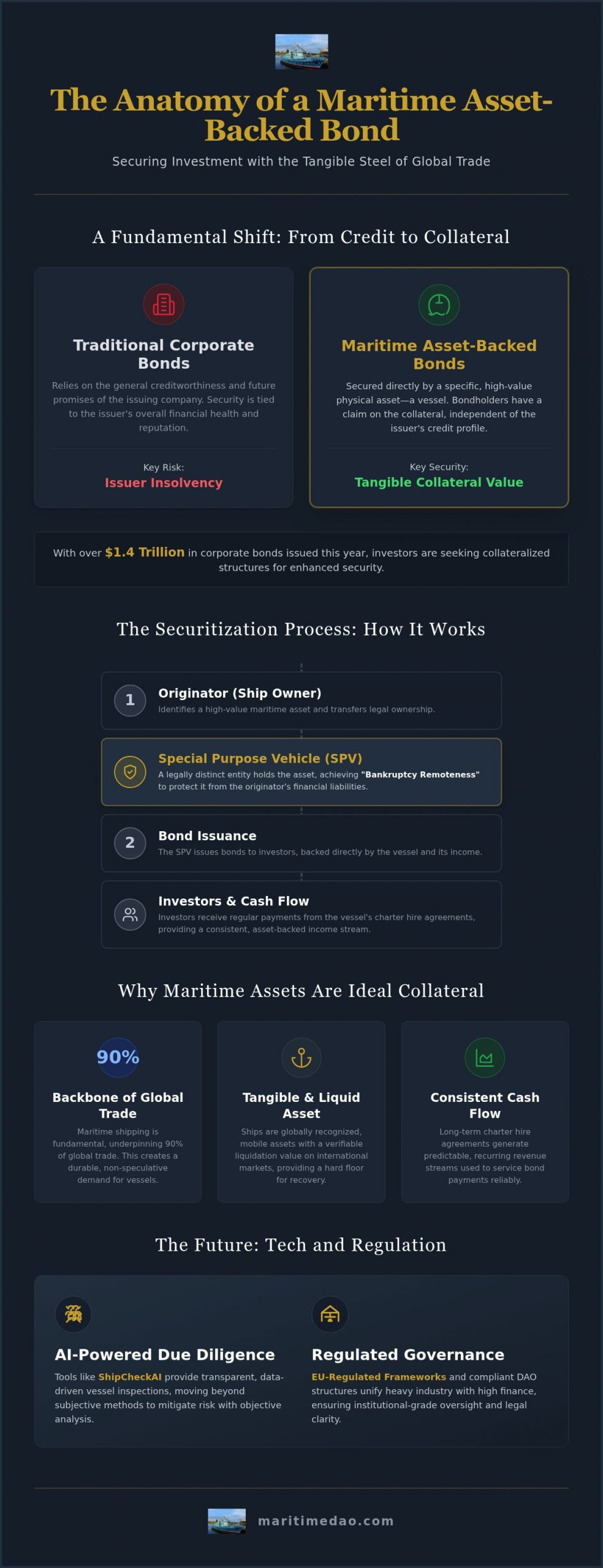
Asset-backed bonds are debt instruments secured by a specific pool of income-producing assets, providing a structured mechanism for capital recovery that remains independent of the issuer’s general credit profile. To have asset-backed bonds explained effectively, one must distinguish them from traditional corporate debt. While a standard corporate bond relies on the general creditworthiness of an issuing entity, an Asset-backed security is tied directly to the performance and liquidation value of a specific physical or financial asset. This distinction is critical in 2026. U.S. corporations have already issued over $1.4 trillion in investment-grade debt this year, leading many institutions to seek more secure, collateralized alternatives that offer protection beyond a simple corporate promise.
The Core Components: Collateral and Cash Flow
The structural integrity of these instruments rests on two pillars: the physical collateral and its associated revenue stream. In the maritime sector, the vessel acts as the primary collateral, providing a verifiable recovery value even in adverse market conditions. If an issuer faces financial distress, the bondholders’ claim is secured by the ship itself, which can be sold or chartered to recover capital. This physical “safety net” is supported by charter hire agreements, which generate the consistent cash flow required to service bond interest. For an investor, the income-producing nature of the asset is vital; it transforms a dormant piece of industrial equipment into a dynamic financial engine. When the underlying asset is a ship transporting essential global goods, the bond’s security is anchored in the fundamental necessity of international trade.
Why Investors Are Turning to Asset-Backed Securities in 2026
The current financial landscape is defined by a shift toward regulated innovation. Investors are increasingly moving away from speculative, asset-light models that dominated previous decades; they’re prioritizing tangible, real-world utility instead. Global shipping vessels are ideal for this because 90% of global trade remains seaborne, providing a level of fundamental demand that consumer-linked debt cannot match. By having asset-backed bonds explained through the lens of industrial collateral, institutions can access a traditionally exclusive industry with a renewed sense of order and transparency. This move toward heavy industrial assets reflects a broader desire for diversification in a market where long-term Treasury yields have reached their highest levels since 2007. Investors aren’t just looking for yield; they’re looking for debt that’s governed by physical reality and legal clarity.
The Internal Mechanics: How Asset-Backed Bonds Function
Securitization transforms a physical vessel into a tradable financial instrument. The process begins when an originator identifies a high-value asset, such as a bulk carrier or tanker, and transfers it to a legally distinct entity. This entity, known as a Special Purpose Vehicle (SPV), exists solely to hold the asset and issue the debt. By having asset-backed bonds explained through this lens, it’s clear that the bond’s value is derived from the vessel’s specific cash flows rather than the originator’s overall business health. The Asset-Backed Securities (ABS) framework ensures that these structures are governed by strict disclosure and operational rules, providing a layer of institutional oversight that protects the integrity of the investment.
Understanding the Role of the SPV
The primary function of an SPV is to achieve bankruptcy remoteness. This legal “ring-fencing” ensures that if the parent company or originator faces insolvency, the maritime assets held within the SPV remain protected and available to bondholders. It’s a critical safety mechanism that isolates the asset from the original owner’s balance sheet liabilities. Maritime DAO utilizes these regulated frameworks to ensure that every ship is held in a compliant, secure structure. For those seeking clarity on these legal protections, exploring EU-regulated ship investment bonds can provide a deeper understanding of how institutional-grade debt is structured in 2026. This isolation is what allows the bond to maintain its credit rating even if the parent company’s credit fluctuates.
Tranching: Tailoring Risk and Reward
Not all investors share the same appetite for risk, which is why asset-backed bonds are often divided into tranches. These tranches represent different levels of seniority within the payment hierarchy, commonly referred to as a “waterfall” system. Senior tranches are paid first from the vessel’s charter revenue, offering lower yields but higher security. Junior or “equity” tranches are paid last, carrying higher risk but potentially higher returns. When having asset-backed bonds explained, it’s vital to recognize that this granular structure allows investors to choose a position that aligns with their specific risk tolerance. From the initial issuance to the final maturity date, the entire lifecycle is governed by these predefined payment rules, ensuring that the relationship between physical asset performance and investor returns remains unified and transparent.
Why Maritime Assets Are Ideal for Bond Backing
Shipping vessels represent a tier of collateral that transcends the limitations of consumer-driven debt. When we have asset-backed bonds explained in this specific context, we see a transition from the volatility of personal liabilities to the stability of global infrastructure. While consumer loans are prone to mass default during economic downturns, maritime assets are essential to the 90% of global trade that travels by sea. These vessels operate within a disciplined lifecycle of 20 to 25 years, providing a durable, long-term foundation for institutional-grade debt that remains anchored in the physical movement of essential commodities.
Productive Utility vs. Consumer Liability
A cargo ship is a revenue-generating engine, distinguishing it from consumer assets like car loans which act as liabilities for the borrower. This distinction is vital because the bond’s security is tied to the ship’s productive output rather than an individual’s credit score. Global charter rates provide a predictable, structured income stream that services the bond interest with high-stakes reliability. Understanding how to invest in maritime assets requires a shift in perspective toward these essential infrastructure components that sustain global supply chains. By focusing on productive utility, investors can access a cash flow profile that is fundamentally linked to industrial demand.
The Tangibility Factor in Institutional Finance
Hard assets provide a definitive floor for valuation, offering a physical recovery path that unsecured instruments simply cannot provide. This tangibility is reinforced by international maritime law, which provides a unified legal framework for securing asset rights across global jurisdictions. Maritime DAO is modernizing this traditionally exclusive sector by acting as a bridge between legacy shipping and digital finance. We’re creating an ecosystem where structural integrity, regulatory compliance, and automated intelligence converge to protect capital. By combining these three pillars, we’re opening up a frontier where the relationship between physical trade and digital governance is clearly defined and protected, ensuring that the underlying collateral is as transparent as it is robust.
Mitigating Risk: The Role of AI and Due Diligence
Risk mitigation is the cornerstone of institutional-grade debt. While the structural isolation provided by SPVs is robust, investors must account for a tripartite risk profile: credit, operational, and asset risk. Credit risk involves the issuer’s cash flow stability, while operational risk concerns the technical management of the vessel. Asset risk is perhaps the most critical; it’s the physical condition and market value of the ship itself. Traditional due diligence often relies on manual, subjective reports that are frequently outdated by the time a bond is issued. In the 2026 financial landscape, these “snapshots” are no longer sufficient to protect significant capital investments.
ShipCheckAI: Enhancing Transparency for Bondholders
To bridge the gap between physical assets and digital finance, we’ve introduced the AI ship inspection tool known as ShipCheckAI. This platform automates vessel assessments by utilizing multi-type inspections, ranging from pre-purchase evaluations to detailed condition surveys, to provide a data-driven baseline for bond issuance. By having asset-backed bonds explained through this technological layer, it’s clear that AI accuracy significantly reduces information asymmetry. Investors no longer have to rely on the issuer’s internal reports. They have access to an objective, automated assessment of the collateral’s true state, ensuring that the “black box” of securitization is replaced by technical transparency.
Continuous Monitoring and Compliance
Modern risk management has shifted from periodic snapshots to continuous asset health monitoring. Real-time data streams provide an ongoing view of a vessel’s operational status. This ensures that the bond’s security remains intact throughout its lifecycle. This technical transparency directly informs maritime investment compliance, allowing for a proactive rather than reactive approach to asset management. When technical data is unified with financial governance, it creates a feedback loop that can positively influence credit ratings. Understanding asset-backed bonds explained in 2026 requires recognizing that technical transparency isn’t just a safety feature; it’s a structural requirement for modern finance. If you’re ready to explore how these technological safeguards protect your capital, visit Maritime DAO to review our current offerings.
The Future of Asset-Backed Bonds: Regulated DAOs
The evolution of finance is shifting toward decentralized governance models that prioritize transparency and legal clarity. A Decentralized Autonomous Organization (DAO) acts as the operational and governance layer for modern debt instruments, ensuring that every decision is recorded and verifiable. When we have asset-backed bonds explained in this contemporary context, it’s clear that the DAO doesn’t replace regulation; it automates it. By utilizing EU regulated ship investment bonds, investors gain access to a framework that satisfies institutional compliance requirements while leveraging the efficiency of blockchain technology. This marriage of legacy legal standards and cutting-edge governance is essential for the $25 billion currently managed across global DAO treasuries in 2026.
Tokenized Ship Bonds: Institutional Debt on the Blockchain
Tokenization simplifies the distribution of bond yields by replacing manual accounting with automated smart contracts. This reduction in administrative overhead allows for a more efficient flow of capital from the physical asset to the global investor. Tokenization enables fractional ownership, allowing a broader range of participants to access high-value maritime debt that was previously reserved for a small circle of institutions. In this ecosystem, “regulated” is the most significant word. It signals that the innovation is grounded in a robust legal framework, ensuring that the relationship between the digital token and the physical ship is governed by law. These systems don’t just move capital; they govern it with mathematical precision.
Governance and Transparency in a DAO Structure
In a DAO structure, members participate in the oversight of the maritime ecosystem, creating a level of transparency that traditional corporate structures cannot match. This isn’t about speculative voting; it’s about the methodical governance of a unified industrial and financial pillar. As a leader in this space, Maritime DAO serves as the bridge between legacy shipping operations and the digital future. By having asset-backed bonds explained as a component of a regulated DAO, it’s clear that the future of ship finance is transparent, methodical, and accessible. This structure identifies systemic inefficiencies and builds high-tech solutions to fix them, ensuring the democratization of complex financial structures. Explore the future of maritime finance today and discover how regulated innovation is redefining institutional debt.
Anchoring Your Portfolio in Physical Reality
Having asset-backed bonds explained within the 2026 maritime landscape reveals a strategic shift toward structural integrity and regulated innovation. By isolating high-value vessels within bankruptcy-remote vehicles and utilizing automated intelligence for continuous monitoring, investors can finally move past the “black box” of legacy finance. This transition isn’t just about accessing yield; it’s about participating in the fundamental infrastructure of global trade through a unified, transparent ecosystem. Our framework combines a robust EU-regulated compliance structure, rigorous AI-powered vessel inspections via ShipCheckAI, and a methodical DAO governance model to ensure every instrument meets institutional standards.
As the global trade landscape continues to expand, the demand for tangible, income-producing collateral has never been higher. You don’t have to settle for speculative digital assets when you can access secure, industrial-grade debt instruments that are anchored in physical reality. We’ve identified the systemic inefficiencies of the past and built a high-tech bridge to the future of finance.
Explore EU-Regulated Ship Investment Bonds with Maritime DAO and discover how our institutional-grade maritime debt instruments can strengthen your portfolio today. The bridge between the physical world of trade and the digital world of blockchain is now open.
Frequently Asked Questions
What is the main difference between an asset-backed bond and a corporate bond?
Asset-backed bonds are secured by a specific pool of income-producing assets, while corporate bonds rely on the issuer’s general creditworthiness. If the issuing entity faces financial distress, the asset-backed bondholder maintains a direct claim on the physical collateral, such as a shipping vessel. Having asset-backed bonds explained this way highlights the safety net provided by tangible assets. This structural isolation offers a layer of protection that unsecured corporate debt instruments simply aren’t able to match.
How does an SPV protect my investment in asset-backed securities?
A Special Purpose Vehicle (SPV) protects your investment by achieving bankruptcy remoteness. It’s a legally distinct entity that holds the maritime asset and its cash flows, isolating them from the originator’s balance sheet liabilities. If the parent company fails, the SPV remains intact, ensuring that the vessel and its charter revenue are preserved for bondholders. This ring-fencing is a fundamental pillar of structural integrity, providing a reliable gatekeeper between the physical asset and the digital world.
Are maritime asset-backed bonds regulated in the European Union?
Yes, Maritime DAO offers EU-regulated ship investment bonds that comply with stringent European financial standards. This regulatory framework provides the legal certainty and institutional oversight required for high-stakes capital investments in 2026. By operating within these governed structures, the platform ensures that maritime finance is no longer a black box but a transparent, compliant gateway for global capital. It bridges the gap between the physical world of trade and the digital world of regulated innovation.
What happens to the bond if the underlying ship is damaged or lost?
If an underlying vessel is damaged or lost, the bond’s security is supported by comprehensive maritime insurance policies. In the event of a total loss, the insurance proceeds are directed to the Special Purpose Vehicle to service the bond’s redemption. This process follows a predefined payment hierarchy, ensuring that bondholders receive their allocated capital. Rigorous operational oversight and real-time monitoring further mitigate these risks, maintaining the instrument’s overall structural reliability and protecting the investor’s interests.
Can retail investors access maritime asset-backed bonds in 2026?
The 2026 financial landscape has democratized access to maritime debt through the use of compliant DAO frameworks. While these instruments were once restricted to large institutional players, tokenization now allows retail participants to engage in fractional ownership of global shipping vessels. It’s an inclusive ecosystem governed by the same legal standards as traditional finance, ensuring that a global audience can participate in the high-stakes world of maritime trade without the previous, traditionally exclusive barriers to entry.
How does AI technology like ShipCheckAI improve bond security?
ShipCheckAI improves security by replacing subjective manual inspections with automated, multi-type vessel assessments. This tool provides a transparent, data-driven baseline for asset valuation, significantly reducing the information asymmetry between issuers and investors. By utilizing automated intelligence, the platform ensures that the physical condition of the ship is accurately monitored throughout the bond’s lifecycle. This technical transparency is a vital component of modern risk management, ensuring that the underlying collateral remains robust, verifiable, and unified with its financial governance.
What are the typical risks associated with asset-backed bonds?
The primary risks include credit risk, operational risk, and asset risk. Credit risk involves the stability of the vessel’s charter revenue, while operational risk concerns the technical management of the ship. Asset risk relates to the physical condition and market value of the collateral. Having asset-backed bonds explained through these three pillars allows investors to evaluate the structural integrity of the instrument. Effective risk mitigation relies on technical transparency and the use of regulated, bankruptcy-remote structures to protect capital.
How does tokenization change the way asset-backed bonds are traded?
Tokenization transforms trading by enabling fractional ownership and reducing administrative overhead through smart contracts. It doesn’t just move capital; it allows institutional-grade debt to be traded with greater efficiency and transparency on the blockchain. By automating yield distribution and compliance checks, tokenization removes the manual friction associated with legacy systems. This evolution ensures that the relationship between physical assets and digital governance is unified, making maritime finance more accessible and liquid for a global investment audience.