
What if a vessel’s trading history, obscured by the complexity of a 430-vessel shadow fleet, could derail your entire capital deployment strategy during a single regulatory audit? In the current maritime environment, acquisitions demand more than a cursory glance at balance sheets. They require a synthesis of real-time asset health, institutional-grade compliance, and automated intelligence. You’ve likely felt the frustration of inaccurate condition reports leading to unforeseen CAPEX surprises, or the difficulty of bridging technical survey data with precise financial valuations. Relying on an outdated ship financing due diligence checklist in 2026 is no longer just a risk; it’s a systemic vulnerability that threatens your structural integrity.
This guide empowers you to master the complexities of maritime asset assessment through an expert-led framework designed for the age of AI and regulated bonds. We provide a methodical path to achieving accurate ROI projections based on real-time asset health while ensuring regulatory certainty for EU-regulated investments. You’ll learn how a unified ecosystem of digital governance and physical asset verification can streamline your due diligence process. By the end of this article, you’ll understand how to integrate ShipCheckAI inspections with institutional finance to govern, protect, and optimize your maritime portfolio with absolute transparency.
Key Takeaways
- Shift your perspective from historical balance sheet audits to a real-time synthesis of technical health and regulatory compliance.
- Utilize a modern ship financing due diligence checklist to identify hidden sanctions exposure and bridge the gap between technical survey data and financial valuation.
- Leverage AI-powered vessel assessment tools to eliminate human error and secure precise data for future OPEX and CAPEX projections.
- Incorporate environmental performance and emissions compliance directly into your asset valuation to safeguard against evolving regulatory liabilities.
- Streamline capital deployment through a unified ecosystem that integrates EU-regulated ship investment bonds with transparent, digital governance.
The Evolution of Financial Due Diligence for Ship Acquisition in 2026
The landscape of maritime finance has moved beyond the static review of ledger entries. Institutional investors now require a unified, data-driven approach that integrates physical asset health with digital governance. This shift reflects the transition from manual, document-heavy audits to automated intelligence, where the goal is to eliminate the opacity of legacy systems. A modern ship financing due diligence checklist serves as the foundation for this transition, acting as a bridge between technical survey data and long-term financial viability.
We’re witnessing the rise of the Asset-as-a-Service (AaaS) model in modern ship finance. In this framework, a vessel is no longer just a physical hull; it’s a revenue-generating node within a transparent, regulated ecosystem. Assessing these assets requires tools that can synthesize vast amounts of data, from engine performance to emissions compliance, into a single, actionable valuation. By treating the vessel as a modular financial instrument, investors can better understand the relationship between asset health and projected cash flow.
Defining Maritime Financial Due Diligence
Maritime financial due diligence is the systematic verification of a vessel’s projected earning potential against its hidden operational, technical, and regulatory liabilities. While Buyer Due Diligence (BDD) focuses on uncovering latent CAPEX triggers and technical deficiencies, Vendor Due Diligence (VDD) has become a standard tool for sellers to provide institutional-grade transparency. In 2026, the independent consultant acts as a reliable gatekeeper, utilizing advanced platforms like ShipCheckAI to provide objective, tripartite reports that unite technical, financial, and legal perspectives into a single source of truth.
Why Traditional M&A Playbooks Fail in Shipping
Standard corporate M&A strategies often collapse when applied to maritime assets due to their inherent mobility and jurisdictional complexity. Unlike a factory or an office building, a ship operates across multiple borders, making it subject to a fragmented legal environment. Maritime liens are particularly dangerous because they attach to the vessel itself, regardless of ownership changes. An investor could acquire a ship only to find it arrested for the previous owner’s debts. Additionally, dark periods in a vessel’s trading history, where AIS signals are lost or sanctioned ports are visited, create severe financial risks that don’t appear on a standard balance sheet. A robust ship financing due diligence checklist must account for these invisible liabilities by integrating historical tracking with real-time asset analytics.
Core Pillars: Bridging Technical Integrity and Financial Liability
In the current maritime landscape, the physical condition of a vessel is the primary determinant of its long-term financial viability. Asset health is financial health. A vessel’s structural integrity directly dictates its future cash flow, operational expenditure (OPEX), and eventual scrap value. Sophisticated investors no longer view technical surveys as isolated reports; they recognize them as the fundamental data layer that informs institutional-grade valuations. This integration ensures that every capital deployment is protected by a transparent, methodical assessment of risk.
The relationship between classification status and insurance premiums remains a critical pillar of any robust ship financing due diligence checklist. A vessel that carries overdue surveys or numerous conditions of class represents a significant liability. These signals often indicate deferred maintenance, which leads to sudden CAPEX requirements and increased insurance costs. High-stakes investments require a unified view where technical integrity, regulatory standing, and financial liability are analyzed as a single, cohesive ecosystem.
Technical Health as a Financial Indicator
Predicting maintenance costs with precision requires moving beyond manual inspections. Leading firms now utilize AI in maritime due diligence to analyze engine logs, hull thickness measurements, and sensor arrays. This technology identifies patterns of wear that human surveyors might overlook, allowing for more accurate OPEX projections. Analyzing classification society records for deferred maintenance signals provides a window into the previous owner’s operational discipline. By utilizing advanced diagnostic tools like ShipCheckAI, investors ensure that technical integrity is never sacrificed for financial expediency.
The Financial Impact of Environmental Regulations
Regulatory compliance has evolved into a high-stakes financial burden. The expansion of the EU Emissions Trading System (EU ETS) and the implementation of FuelEU Maritime have fundamentally altered vessel profitability. Non-compliant older vessels face a significant risk of becoming stranded assets, as their carbon intensity makes them commercially unviable. When assessing an acquisition, investors must calculate the impact of these regulations on the vessel’s earning potential. This includes valuing green retrofits and decarbonization efforts directly within the purchase price. A modern ship financing due diligence checklist must account for the following environmental factors:
- Carbon Intensity Indicator (CII) ratings and their impact on charter rates.
- Projected costs for alternative fuel retrofits, such as LNG or methanol capability.
- Exposure to the Mediterranean SOx Emission Control Area (ECA) requirements effective since May 2025.
- Compliance with the updated MARPOL reporting standards for 2026.
By bridging the gap between technical data and financial modeling, investors can secure their portfolios against the volatility of the global energy transition.
AI-Driven Assessment: Enhancing Accuracy in Maritime Asset Valuation
The integration of automated intelligence into the due diligence process marks a departure from subjective, human-centric assessments. By utilizing advanced algorithms to extract data from engine logs and sensor arrays, investors can now achieve a level of granularity previously reserved for technical managers. This shift is a core component of a modern ship financing due diligence checklist, ensuring that every valuation is grounded in empirical reality rather than anecdotal reports. With the global maritime AI market projected to reach USD 8.3 billion in 2026, the adoption of these technologies is no longer an optional upgrade but a requirement for institutional-grade asset management.
ShipCheckAI plays a pivotal role in this transformation by standardizing vessel condition reports across diverse fleets. It creates a unified data layer that bridges the gap between the physical engine room and the financial boardroom. Instead of relying on a single snapshot in time, the industry is moving toward continuous asset monitoring. This transition allows for real-time risk mitigation, where potential technical failures are identified before they impact the vessel’s earning capacity. ShipCheckAI provides a system that standardizes inspection data, validates structural integrity, and secures investor confidence through a transparent, methodical framework.
Improving Ship Inspection Accuracy
AI vessel inspection software identifies structural anomalies invisible to the naked eye. By analyzing hull thickness measurements and thermal imaging, the system detects early signs of corrosion or fatigue that could lead to significant CAPEX surprises. This AI ship inspection tool standardizes data formats to ensure they’re ready for immediate financial auditing. Implementing this technology within your ship financing due diligence checklist ensures that technical integrity is verified with mathematical precision, removing the uncertainty often associated with manual surveys.
The Cost-Efficiency of Automated Surveys
The efficiency of automated surveys significantly reduces the time-to-close for high-stakes maritime M&A transactions. By minimizing the need for physical travel and reducing surveyor downtime, the acquisition process becomes leaner and more responsive to market opportunities. This technology creates a digital twin of the asset, providing bondholders with unprecedented transparency into the vessel’s operational life. It’s a system that unites technical precision, financial security, and regulatory compliance. This digital-first approach ensures that the relationship between physical assets and digital governance is clearly understood, allowing for more aggressive, yet secure, capital deployment strategies.
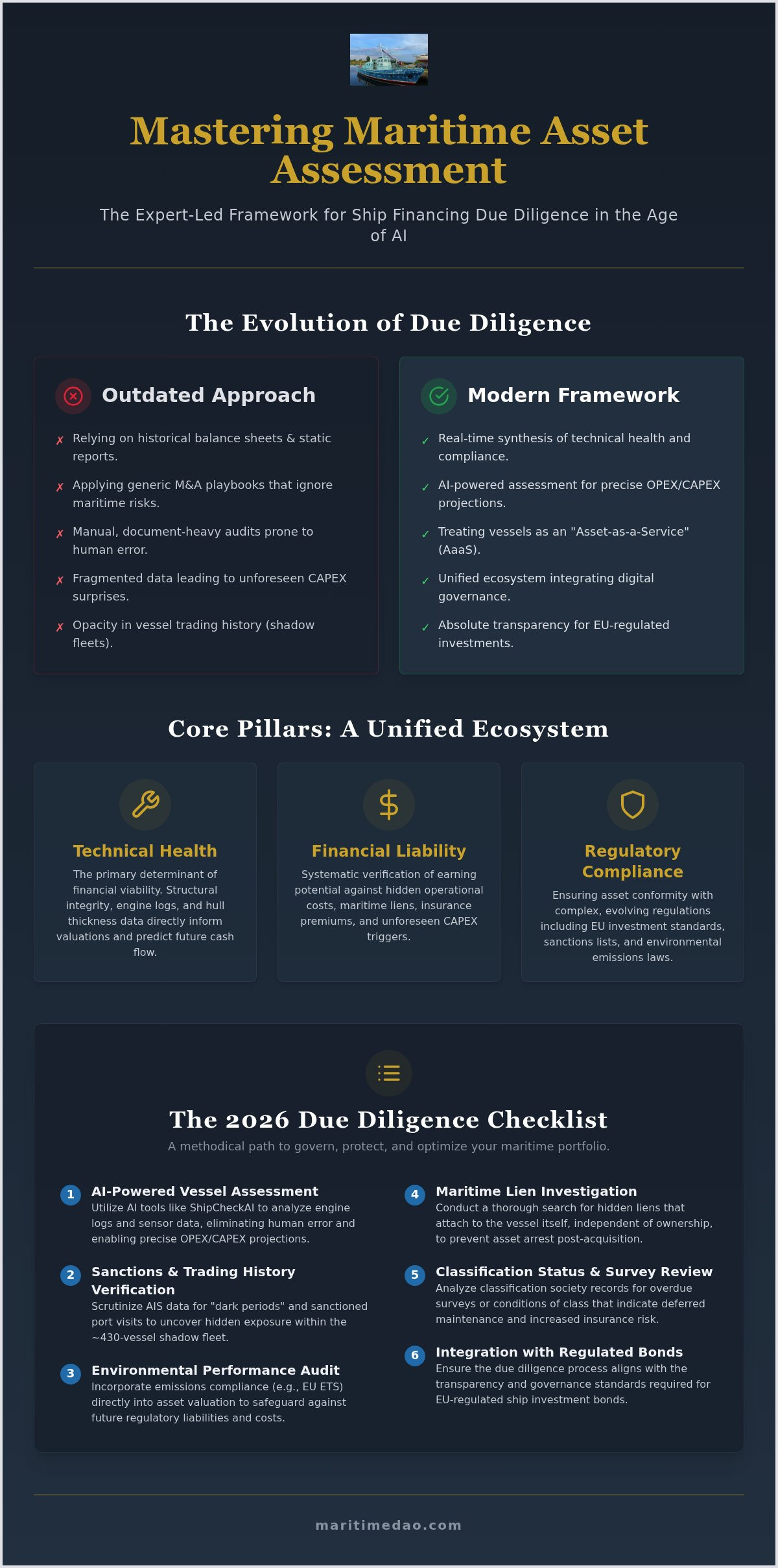
The 2026 Financial Due Diligence Checklist for Vessel Investors
The 2026 ship financing due diligence checklist is a rigorous, multi-layered protocol designed to isolate risk in an increasingly volatile global market. It moves beyond standard corporate audits by addressing the unique legal and operational complexities of maritime assets. Investors must verify five critical pillars to ensure structural integrity and financial security. This methodical approach transforms the acquisition process into a governed, transparent gateway for capital, where technical precision unites with institutional reliability.
Legal and Operational Compliance
Sanctions screening has become the most critical initial step in any acquisition. With over 430 tankers identified in the Iranian shadow fleet and 87% of those vessels under U.S., UK, or EU sanctions as of February 2026, the risk of accidental exposure is at an all-time high. A thorough review of a vessel’s entire trading history is required to identify dark periods or sanctioned port calls that could lead to asset seizure or loss of insurance. The presence of these vessels in global trade routes necessitates a granular approach to Ultimate Beneficial Ownership (UBO) verification.
Flag-state reputation also dictates the vessel’s employability and regulatory scrutiny. Investors should audit the flag-state’s enforcement of the July 2026 security training updates and the STCW amendments regarding electronic certificates. This legal audit must include a tripartite review of crewing contracts, P&I insurance coverage, and the status of any maritime liens. These liens are particularly dangerous because they follow the ship through ownership changes, potentially burdening the new owner with the previous operator’s debts.
Financial and Asset-Specific Audits
Financial due diligence requires a deep dive into historical OPEX to ensure it aligns with industry benchmarks. Undisclosed charterparty obligations or deferred maintenance can significantly erode the vessel’s earning potential. Verifying the validity of the vessel assessment for financing is essential to ensure that the asset’s physical state supports the projected cash flow. This audit must also account for future regulatory costs, including projecting Carbon Intensity Indicator (CII) ratings and the impact of the EU Emissions Trading System (ETS) on the acquisition price. To secure your capital deployment, you can leverage the Maritime DAO ecosystem to access a unified platform of regulated finance and AI-driven asset verification.
- Step 1: Sanctions and UBO screening to mitigate shadow fleet exposure and ensure compliance with OFAC updates.
- Step 2: Technical Condition Assessment via AI-powered tools like ShipCheckAI to identify latent structural anomalies.
- Step 3: Financial History and Maritime Lien verification to uncover hidden liabilities that attach to the hull.
- Step 4: Regulatory and Flag-State compliance audit, including the 2026 MARPOL amendments and STCW updates.
- Step 5: ESG and Carbon Intensity Indicator (CII) projection to assess the vessel’s long-term commercial viability.
Maritime DAO: Integrating Regulated Bonds with Precision Due Diligence
The convergence of institutional finance and decentralized technology has established a new standard for maritime capital deployment. Maritime DAO acts as a visionary architect, building a high-tech ecosystem that replaces fragmented legacy systems with a unified framework for asset management. By integrating EU regulated ship investment bonds into the acquisition process, investors gain access to a transparent financing vehicle governed by strict legal protocols. This structural integrity ensures every vessel in the portfolio is backed by a comprehensive ship financing due diligence checklist, where technical integrity and financial liability are no longer managed in silos.
ShipCheckAI serves as the trusted eye for bondholders, providing a real-time connection between the physical ship and its digital representation. This automated intelligence performs multiple inspection types with precision, ensuring the asset health reported to investors is accurate and verifiable. It’s a system that unites technical data, regulatory compliance, and financial governance into a single, high-stakes register of value. By bridging the gap between physical assets and digital governance, we’ve created a reliable gatekeeper for global maritime trade.
Transparency Through Tokenized Debt
Tokenization transforms a vessel’s debt into a granular, trackable financial instrument. This allows for the precise monitoring of asset performance, where every maintenance event or regulatory update is reflected in the bond’s data layer. By reducing the friction inherent in traditional maritime debt, tokenized structures facilitate more efficient secondary market trading while maintaining institutional-grade compliance. Within the Maritime DAO framework, these digital assets are governed by transparent legal structures that respect the sober reliability of traditional finance while embracing the efficiency of the blockchain. This ecosystem ensures that bondholders aren’t just investing in a hull, but in a verified, revenue-generating node.
Securing Your Maritime Investment
Regulated innovation is the primary catalyst for the 2026 maritime capital markets. This approach bridges the gap between the physical world of global trade and the digital world of asset-backed securities. Investors can now engage with a first-of-its-kind ecosystem that prioritizes order, security, and the democratization of complex financial structures. Getting started with Maritime DAO involves integrating your capital into a governed gateway where risk is mitigated through automated intelligence and verified through a rigorous ship financing due diligence checklist.
To ensure your portfolio meets the highest standards of institutional oversight, review our maritime investment compliance standards. This reference guide provides the technical and legal pillars necessary to protect your assets in a rapidly evolving regulatory environment. By adopting these standards, you align your capital with a methodical, expansive vision for the future of maritime finance.
Securing the Future of Maritime Capital Deployment
The 2026 maritime landscape demands a departure from legacy auditing methods. Success now requires a unified synthesis of technical integrity, regulatory compliance, and digital governance. By implementing a comprehensive ship financing due diligence checklist, you transform a traditionally opaque process into a transparent, data-driven gateway for investment. This evolution ensures that capital is protected by empirical reality rather than anecdotal reports, allowing for accurate ROI projections based on real-time asset health. You’ve seen how bridging the gap between technical data and financial modeling is the only way to mitigate the risks of a volatile global market.
Maritime DAO stands as the visionary architect of this new frontier. We bridge the gap between physical assets and digital finance through our ShipCheckAI proprietary technology and an EU-regulated financial framework. This ecosystem provides institutional-grade asset governance, ensuring structural integrity and financial security for every vessel in your portfolio. It’s time to move beyond the limitations of traditional models and embrace a more inclusive, governed approach to maritime debt. Explore EU-Regulated Ship Investment Bonds and secure your position in the future of global trade. We look forward to building this transparent ecosystem with you.
Frequently Asked Questions
What is the most critical risk in financial due diligence for ship acquisition?
The most critical risk is the hidden exposure to sanctioned entities and undisclosed maritime liens that attach to the hull. With the Iranian shadow fleet estimated at over 430 vessels as of February 2026, a buyer could inadvertently acquire an asset subject to international seizure. These liabilities don’t appear on standard balance sheets, making a thorough ship financing due diligence checklist essential for uncovering historical trading violations or debts that follow the vessel through ownership changes.
How does AI improve the accuracy of vessel condition assessments?
AI improves accuracy by synthesizing real-time data from engine sensor arrays and hull thickness measurements to identify structural anomalies invisible to human surveyors. By utilizing ShipCheckAI, investors can standardize vessel condition reports with mathematical precision, moving beyond subjective manual inspections. This technology detects early signs of corrosion or mechanical fatigue, allowing bondholders to project maintenance costs and future CAPEX with a level of granularity that protects the structural integrity of the investment.
What are maritime liens and why do they matter to buyers?
Maritime liens are legal claims against a vessel for unpaid debts, such as crew wages, repair costs, or salvage services. They are unique because they attach to the physical asset itself rather than the owner. This means a buyer can be held liable for the previous operator’s financial obligations. Identifying these liens is a vital step in the ship financing due diligence checklist to ensure the asset is transferred free of encumbrances and hidden liabilities.
How do EU emissions regulations affect vessel valuation in 2026?
EU emissions regulations, specifically the EU ETS and FuelEU Maritime, directly impact vessel valuation by increasing operational costs for carbon-intensive assets. In 2026, ships with poor Carbon Intensity Indicator (CII) ratings face significant commercial discounts or potential exclusion from EU ports. Investors must calculate these liabilities into the acquisition price, as non-compliant older vessels carry a high risk of becoming stranded assets that require expensive green retrofits to maintain their earning potential in a regulated market.
Can ship investment bonds be regulated under EU financial law?
Ship investment bonds can be issued within a transparent, EU-regulated financial framework to provide institutional-grade security. These instruments unite traditional debt structures with digital governance, ensuring that capital deployment is compliant with strict legal protocols. By utilizing regulated bonds, Maritime DAO bridges the gap between the physical maritime world and modern capital markets, offering investors a governed gateway to maritime assets that respects both legacy systems and technological innovation.
What is the difference between technical due diligence and financial due diligence?
Technical due diligence focuses on the physical condition and mechanical integrity of the vessel, while financial due diligence evaluates its earning potential and balance sheet liabilities. Technical surveys identify immediate CAPEX needs, such as engine repairs or hull maintenance. Financial due diligence synthesizes this data with market trends, insurance premiums, and regulatory costs to determine the asset’s net present value. Both pillars must be unified to create a comprehensive risk profile for institutional investors.
How long does a typical maritime due diligence process take with AI tools?
The maritime due diligence process typically takes significantly less time when utilizing AI-powered assessment tools compared to traditional manual audits. While conventional surveys can take weeks to coordinate and analyze, automated systems like ShipCheckAI can extract and process engine logs and sensor data within days. This efficiency reduces the time-to-close for high-stakes M&A transactions, allowing investors to respond more rapidly to market opportunities while maintaining a methodical and expansive approach to risk mitigation.
What are dark periods in a vessel’s trading history?
Dark periods refer to segments of a vessel’s history where its Automatic Identification System (AIS) transponder was intentionally deactivated to hide its location. These gaps are often associated with illicit activities, such as visiting sanctioned ports or engaging in ship-to-ship transfers within the shadow fleet. Auditing these periods is critical for regulatory compliance, as any link to prohibited trading networks can lead to the asset being blacklisted by global financial institutions and insurance underwriters.