
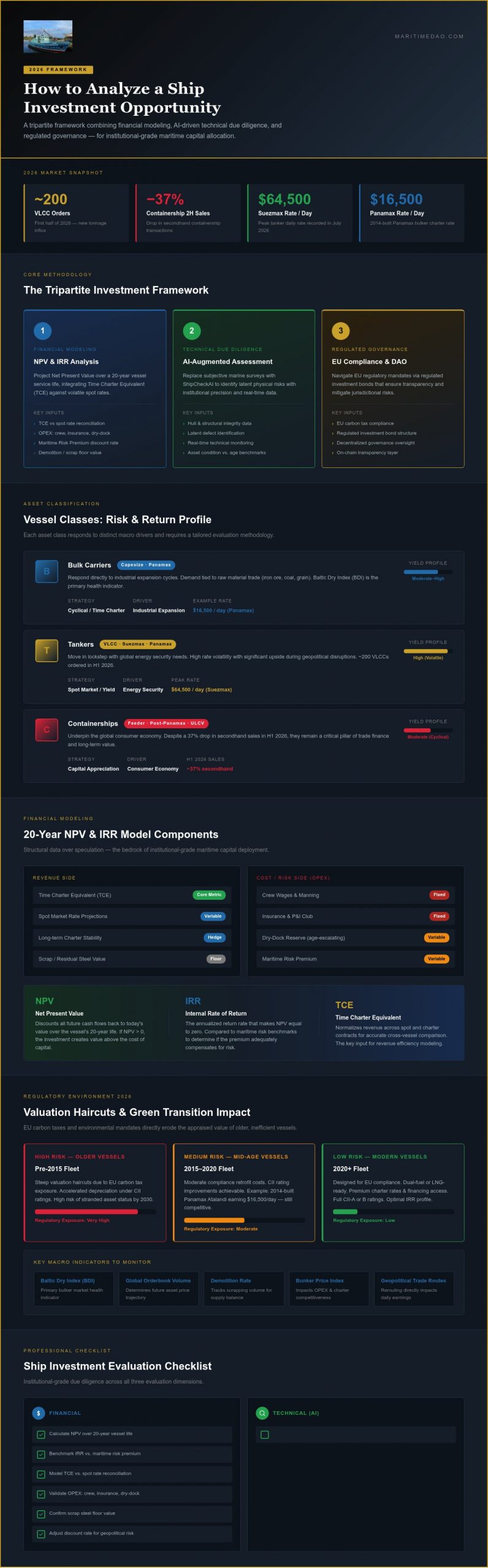
While nearly 200 VLCC orders flooded the market in the first half of 2026, a staggering 37% drop in secondhand containership sales underscores the fragmented and high-stakes nature of modern maritime finance. You likely recognize that traditional appraisal methods are struggling to keep pace with volatile freight rates and the tightening grip of EU environmental mandates. Understanding how to analyze a ship investment opportunity in this environment requires more than a standard spreadsheet; it demands a unified framework that bridges physical asset integrity with digital oversight and regulatory compliance.
This professional guide provides the blueprint for mastering maritime asset evaluation through a tripartite lens of financial modeling, AI-driven technical due diligence, and regulated governance. We’ll explore how to mitigate risk using EU-regulated instruments and leverage automated intelligence to solve the transparency issues that have historically plagued the industry. You’ll gain a comprehensive checklist to navigate the complexities of 2026 and secure predictable returns in a traditionally opaque ecosystem. By integrating these technological and operational pillars, you can move from speculative entries to institutional-grade capital allocation.
Key Takeaways
- Understand the critical interplay between global shipping cycles and asset classes to distinguish between long-term income generation and strategic capital appreciation.
- Master how to analyze a ship investment opportunity by applying rigorous financial modeling, specifically focusing on Net Present Value (NPV) and Internal Rate of Return (IRR) across a vessel’s 20-year service life.
- Transition from traditional, subjective marine surveys to AI-augmented technical due diligence using ShipCheckAI to identify latent physical risks with institutional precision.
- Navigate the evolving EU regulatory landscape by utilizing regulated investment bonds that ensure transparency and mitigate jurisdictional risks in a complex maritime environment.
- Discover how a unified ecosystem integrates real-time technical data with decentralized governance to provide a secure, transparent gateway for global capital allocation.
The Fundamentals of Maritime Asset Evaluation
Maritime assets represent a unique intersection of industrial utility and financial resilience. Unlike digital or purely paper assets, a vessel maintains a floor value through its intrinsic scrap weight. Even in the deepest market troughs, the steel itself remains a liquid commodity. When institutional players evaluate how to analyze a ship investment opportunity, they prioritize the Fundamentals of Shipping Investments to determine if the goal is immediate yield via time charters or capital appreciation through strategic asset flipping. This decision hinges on understanding the tripartite relationship between asset condition, market timing, and regulatory standing.
Distinct asset classes offer different gateways to profit. Bulkers like the Capesize or Panamax segments respond to industrial expansion, while tankers move in lockstep with energy security needs. Containerships, despite a 37% decrease in secondhand sales during the first half of 2026, still underpin the global consumer economy. Each class functions as a distinct pillar within the maritime ecosystem, requiring a methodical approach to supply and demand dynamics that respects legacy cycles while embracing modern transparency.
Market Sentiment and Macro Trends
Sentiment in 2026 is increasingly governed by the green transition. Older, less efficient vessels face steep valuation haircuts as carbon taxes and EU regulatory pressures intensify. Professional analysts use the Baltic Dry Index (BDI) as a primary indicator of market health, though they must also account for geopolitical shifts that reroute trade flows. These macro trends directly impact daily earnings. For instance, a 2014-built Panamax bulker like the Atalandi recently secured a charter rate of $16,500 per day, illustrating how specific vessel age and class intersect with current demand.
Tonnage Supply and Orderbook Analysis
The global orderbook serves as the ultimate arbiter of future asset prices. With nearly 200 VLCCs ordered in the first half of 2026, the influx of new tonnage is significant. Shipyard capacity remains tight, often pushing delivery dates out and increasing the premium on existing vessels. To master how to analyze a ship investment opportunity, you must also calculate the demolition rate. This metric tracks the volume of older tonnage being scrapped, which is essential for maintaining market equilibrium and preventing oversupply that could erode your internal rate of return.
Financial Modeling: NPV, IRR, and Revenue Efficiency
Financial modeling in the maritime sector is a rigorous exercise in predicting cash flows across a multi-decade horizon. To master how to analyze a ship investment opportunity, you must project the Net Present Value (NPV) over a typical 20-year vessel service life. This calculation isn’t static. It requires integrating the Time Charter Equivalent (TCE) against volatile spot market rates to determine revenue efficiency. By discounting future earnings back to the present, you can determine if the entry price aligns with the vessel’s earning potential. This methodical approach ensures that capital is deployed based on structural data rather than speculative trends.
Operating expenses (OPEX) form the bedrock of any reliable model. These include fixed costs like crew wages and insurance, alongside variable dry-docking reserves that escalate as the hull ages. In 2026, revenue projections must also account for market fluctuations, such as the Suezmax tanker rates reaching $64,500 per day in July. A successful model reconciles these daily earnings with the long-term Internal Rate of Return (IRR) relative to current market benchmarks. It’s a process of balancing the immediate yield of the spot market with the stability of long-term charters.
The Opportunity Cost of Capital
Comparing maritime yields to traditional equity or real estate benchmarks requires a nuanced understanding of liquidity and risk. Institutional investors adjust discount rates to reflect the unique volatility of global trade. The Maritime Risk Premium in 2026 represents the additional yield required to offset geopolitical instability, fluctuating bunker prices, and the accelerating transition toward carbon-neutral propulsion systems. This premium ensures that the risk taken is appropriately compensated when compared to more static asset classes.
Sensitivity Analysis for Charter Rates
Robust modeling demands stress-testing daily hire rates against ‘Best Case’ and ‘Stress Test’ scenarios. Sensitivity analysis must also factor in the cost of EU regulated ship investment bonds as a stable debt servicing metric. This approach allows for a unified view of how fuel price volatility, such as the spread between VLSFO and LNG, impacts net earnings. Modeling these variables helps identify the break-even charter rate necessary to maintain solvency during cyclical downturns. For those seeking to optimize their capital structure, utilizing structured maritime debt can provide the necessary leverage while maintaining regulatory compliance.
Technical Due Diligence: Modernizing Vessel Assessment with AI
Physical integrity is the ultimate arbiter of value. While financial modeling provides the theoretical framework for returns, technical due diligence grounds those projections in operational reality. A vessel’s structural condition remains the primary risk factor in any maritime transaction, as unforeseen hull degradation or engine failure can immediately erase projected IRR. When you look at how to analyze a ship investment opportunity, the technical assessment serves as a methodical gatekeeper. It ensures that the physical asset is capable of fulfilling its 20-year service life without catastrophic capital expenditures.
The evaluation process requires a rigorous review of Class Society records and Port State Control (PSC) detention histories. These logs provide a transparent window into the vessel’s maintenance discipline and historical reliability. In 2026, compliance with IMO carbon intensity regulations is no longer a secondary consideration; it’s a core financial metric. Vessels that fail to meet these evolving standards face restricted access to major trade lanes and significant valuation haircuts. A unified assessment strategy must reconcile these regulatory benchmarks with the physical state of the ship’s propulsion and hull systems.
Leveraging ShipCheckAI for Asset Transparency
Asset transparency is being redefined by AI ship inspection tools like ShipCheckAI. These platforms identify structural anomalies, such as micro-fractures and subsurface corrosion, that often remain invisible to the human eye during traditional manual surveys. By standardizing inspection reports, the technology allows for precise cross-fleet comparisons. This digital oversight significantly reduces the human error margin in pre-purchase assessments, ensuring that the physical reality of the asset is fully documented and governed by data rather than subjective opinion.
Maintenance and Life Cycle Costing
Maintenance quality correlates directly with residual asset value at the end of a charter period. Analyzing the schedule of Special Surveys is critical, as these events represent the largest recurring capital requirements in a vessel’s life cycle. Modern predictive analytics now allow investors to forecast engine wear and hull degradation based on real-time operational data. Understanding these long-term costs is essential for anyone learning how to analyze a ship investment opportunity with institutional rigor. It ensures that dry-docking reserves are adequately funded to protect the capital structure against the inevitable physical toll of global trade.
Regulatory Compliance and Risk Mitigation
The regulatory landscape in 2026 is no longer a peripheral concern; it’s a primary driver of asset liquidity and valuation. When determining how to analyze a ship investment opportunity, you must evaluate the legal framework governing the capital as rigorously as the vessel itself. Navigating the EU’s evolving maritime financial regulations requires a shift from speculative models to those grounded in institutional-grade compliance. Transparent governance in decentralized investment vehicles ensures that every stakeholder has a unified view of the asset’s standing, protecting against the opacity that often precedes financial distress. This methodical approach to risk mitigation involves a tripartite strategy of comprehensive insurance, regulated debt instruments, and adherence to international maritime law.
Mitigating ‘Black Swan’ risks, such as the ongoing geopolitical disruptions in the Red Sea, requires more than just standard hull and machinery insurance. It demands a sophisticated understanding of how legal protections are afforded by regulated debt instruments. These structures provide a reliable gatekeeper for capital, ensuring that investment vehicles remain solvent even during periods of extreme market volatility. By prioritizing assets governed by established legal frameworks, you can secure your position within the global trade ecosystem while maintaining the flexibility to respond to sudden shifts in trade lane accessibility.
EU-Regulated Ship Investment Bonds
Regulated bonds offer superior protection compared to the unregulated tokens often found in digital asset circles. The Prospectus Regulation plays a critical role here, ensuring investor transparency through mandatory, standardized disclosures that prevent the misrepresentation of asset health. By structuring maritime debt to meet these institutional compliance standards, issuers create a secure bridge between traditional finance and modern asset management. This framework provides the structural integrity needed to attract significant capital while ensuring that all governance remains methodical and transparent.
ESG and Green Finance Compliance
The EU Emissions Trading System (ETS) has fundamentally altered vessel profitability by internalizing the cost of carbon. Understanding maritime investment compliance is now essential for accessing low-cost capital, as lenders increasingly prioritize ‘green’ tonnage. ESG scores now directly influence ship bond yields by signaling the long-term viability of the underlying tonnage in a decarbonizing economy. To explore how these regulated instruments can strengthen your portfolio, you can review our current EU-regulated bond offerings. Mastering how to analyze a ship investment opportunity in this era means recognizing that environmental performance is no longer a checkbox; it’s a financial covenant.
The Maritime DAO Approach: A Unified Investment Ecosystem
Successful maritime finance in 2026 is no longer a series of isolated manual checks. It’s a unified ecosystem where technical data, financial modeling, and legal governance converge to protect capital. By integrating ShipCheckAI data directly into the decision-making process, we bridge the gap between physical asset reality and capital allocation. This methodical approach ensures that every bondholder is backed by high-fidelity technical due diligence. Understanding how to analyze a ship investment opportunity now requires this level of digital connectivity. It’s about moving away from fragmented spreadsheets and toward a single source of truth that defines the asset’s lifecycle.
A Decentralized Autonomous Organization (DAO) provides the structural integrity needed to manage complex physical assets across global jurisdictions. It acts as a visionary architect for the industry, replacing opaque legacy systems with transparent, rule-based governance. Fractional ownership through EU-regulated bonds lowers the entry barrier, allowing global investors to participate in high-value maritime trade without the massive capital requirements of direct hull ownership. This democratization is governed by strict legal frameworks, ensuring that innovation remains grounded in institutional reliability. The result is a system that maintains long-term liquidity through a unified maritime asset platform.
Transparency through Decentralized Governance
Maritime DAO investment models empower bondholders by providing a voice in major operational decisions. Smart contracts automate revenue distribution, ensuring that charter hire is allocated with mathematical precision and zero administrative delay. This reduces the overhead typically associated with traditional maritime management while increasing the speed of capital flow. It’s a unified system that governs, protects, and scales opportunities for a global audience.
Next Steps: Building Your Maritime Portfolio
Diversification is the final pillar of risk mitigation in any professional framework. A robust strategy involves spreading capital across various vessel ages, classes, and charter types to balance market volatility. You can learn how to invest in maritime assets using our framework to balance the high-yield potential of spot market tankers with the stable cash flows of long-term bulker charters. This multifaceted approach is the key to mastering how to analyze a ship investment opportunity in an era of rapid technological change. To see these systems in action, we invite you to request a demo of the ShipCheckAI platform for your next assessment.
Mastering the New Standard of Maritime Finance
Successful asset evaluation has evolved from a manual craft into a data-driven science. By integrating rigorous financial modeling with automated technical oversight, you secure a position at the intersection of heavy industry and high finance. You now have the framework required for how to analyze a ship investment opportunity with institutional precision, ensuring that every allocation is backed by structural integrity and regulatory transparency. The transition to a unified ecosystem isn’t just an operational upgrade; it’s a strategic necessity for long-term capital preservation in a volatile global market.
It’s time to move beyond the opaque practices of the past and embrace a governed approach to maritime wealth. You can leverage our ShipCheckAI platform for institutional-grade maritime asset assessments while utilizing a compliant framework for your capital. To begin your journey into a more transparent future, Explore EU-Regulated Ship Investment Bonds with Maritime DAO. We invite you to join a global network of investors who value security, innovation, and the democratization of one of the world’s most essential industries. Your path to a resilient maritime portfolio starts with the right architecture.
Frequently Asked Questions
How do I calculate the Net Present Value (NPV) of a ship?
NPV is determined by discounting the projected net cash flows over the vessel’s 20-year service life against the initial acquisition cost. You must account for daily charter earnings, voyage expenses, and recurring operating costs, while also factoring in the terminal scrap value of the hull. This calculation is a fundamental step for anyone learning how to analyze a ship investment opportunity, as it establishes the asset’s present value relative to current capital costs. It’s a methodical process that requires balancing immediate revenue with long-term maintenance requirements.
What are the biggest risks when investing in commercial shipping?
Market volatility remains the primary risk, as freight rates are susceptible to sudden geopolitical shifts and global demand fluctuations. Technical risk, involving latent structural defects or engine failure, can lead to unexpected capital expenditures or lengthy off-hire periods that erode returns. Finally, the evolving regulatory environment, particularly regarding carbon intensity, can render older vessels obsolete if they aren’t properly retrofitted to meet modern standards. Mitigating these risks requires a tripartite strategy of technical due diligence, comprehensive insurance, and regulated governance.
How does ShipCheckAI differ from a traditional marine survey?
ShipCheckAI utilizes predictive analytics and high-resolution data to identify structural anomalies that the naked eye often misses during traditional surveys. While a manual inspection relies on the subjective expertise of a single surveyor, ShipCheckAI standardizes the process across multiple inspections to provide a unified, data-driven report. This technical transparency is a cornerstone of how to analyze a ship investment opportunity in an era of digital asset governance. It reduces the margin for human error and provides a more accurate forecast of future maintenance costs.
Are EU-regulated ship investment bonds safer than shipping stocks?
EU-regulated ship investment bonds offer a different risk profile than shipping stocks by providing fixed income secured against physical assets. Stocks represent equity in a corporation and are subject to broader market sentiment and management decisions, whereas bonds are structured as debt instruments with defined legal protections under the Prospectus Regulation. This structure provides a more predictable yield and greater transparency for those prioritizing asset-backed security over speculative equity growth. It’s a bridge between the physical world of trade and the digital world of regulated finance.
What is the minimum capital required for ship investment in 2026?
Traditionally, direct ship ownership required tens of millions in capital, but modern fractional models have significantly lowered the entry barrier. While a newbuild VLCC might cost approximately $131 million in 2026, regulated bond structures allow participation at a much lower threshold. This democratization enables a broader range of investors to access institutional-grade maritime assets without the burden of full vessel acquisition or operational management. It opens up a traditionally exclusive industry to a global audience through a unified investment ecosystem.
How do IMO carbon regulations affect ship investment opportunities?
IMO regulations directly impact asset valuation by penalizing vessels with high carbon intensity through operational restrictions or financial levies. Ships that fail to meet Carbon Intensity Indicator (CII) standards face reduced marketability and may be restricted from certain trade routes. Investors must factor in the cost of future retrofits or potential early decommissioning when assessing the long-term viability of any maritime asset. Environmental performance is no longer a secondary consideration; it’s a core financial metric that dictates access to low-cost capital.
Can I invest in maritime assets as a retail investor?
Retail investors can now access the maritime sector through regulated decentralized platforms and fractional bond offerings. These instruments bridge the gap between traditionally exclusive industrial finance and the global public market, providing a secure gateway for non-institutional capital. By utilizing a unified ecosystem that handles technical due diligence and regulatory compliance, the platform ensures that individual investors benefit from the same level of oversight as major financial houses. It’s a transparent and methodical way to diversify a portfolio with hard assets.
What is the typical yield for a maritime asset-backed security?
Yields for maritime asset-backed securities typically reflect the underlying vessel’s charter earnings and the specific risk premium of the maritime sector. While these yields often outperform traditional fixed-income or real estate benchmarks, they are influenced by vessel class, charter duration, and current market cycles. Professional frameworks prioritize stable, asset-backed returns that are governed by legal covenants to ensure long-term capital preservation. This approach balances the excitement of global trade with the sober reliability of institutional-grade financial structures.