
In 2026, a vessel’s age is no longer measured by the year it was launched; it is measured by the carbon it emits. With the Carbon Intensity Indicator (CII) reduction factor now at 11% and the EU ETS carbon price hovering near €83 per ton, the IMO 2030 impact on vessel investment has moved from a distant policy goal to a hard financial reality. You’re likely feeling the weight of regulatory fragmentation between the EU and the IMO, fearing that assets lacking a clear green transition path will soon become stranded liabilities. It’s a high-stakes environment where traditional valuation models are failing to account for the true cost of compliance.
This article provides a clear framework for evaluating vessel value based on carbon efficiency, ensuring your portfolio remains resilient against tightening environmental mandates. You’ll discover how regulated green financing, specifically through EU-regulated ship investment bonds, offers a transparent vehicle for capital allocation in an uncertain market. We will also explore how ShipCheckAI utilizes automated intelligence to provide the rigorous due diligence required to identify 2030-ready assets. By the end of this guide, you’ll understand how a unified ecosystem of technology, finance, and governance can turn the 2026 green transition into a strategic advantage.
Key Takeaways
- Evaluate how the transition from physical age to carbon intensity creates a “brown discount,” fundamentally altering the risk profile and liquidity of legacy maritime assets.
- Identify why EU-regulated ship investment bonds have emerged as the institutional standard for capital allocation as traditional lenders withdraw from non-compliant tonnage.
- Quantify the IMO 2030 impact on vessel investment by examining how CII ratings directly influence charter rates and the long-term commercial viability of global fleets.
- Discover how ShipCheckAI provides a unified framework for due diligence, automating the verification of ESG data to prevent the acquisition of stranded assets.
- Master a strategic roadmap for 2026 that prioritizes AI-driven fleet audits and the diversification of capital into transparent, governed investment vehicles.
Understanding the IMO 2030 Framework in the 2026 Context
The maritime industry has moved decisively beyond the IMO’s initial GHG strategy established in 2018. The 2023 Revised GHG Strategy transformed what were once aspirational goals into a rigid framework of checkpoints and mandates. For institutional investors, the most critical of these is the 2030 checkpoint. It targets a 20% reduction in total annual greenhouse gas emissions by 2030, while “striving” for 30% compared to 2008 levels. This isn’t a suggestion; it’s a structural shift in how maritime assets are governed and valued.
2026 represents the functional point of no return for vessel investment cycles. Given that a standard commercial vessel has an operational life of 20 to 25 years, any asset financed today must remain viable through the 2040s. By then, the IMO’s trajectory demands near-zero emissions. Consequently, the IMO 2030 impact on vessel investment is felt most acutely in the secondary market, where older, inefficient tonnage is seeing a rapid erosion of liquidity as buyers prioritize future-proofed designs. The industry is witnessing a transition where carbon efficiency is as vital to a ship’s worth as its deadweight tonnage.
The 40% Carbon Intensity Mandate
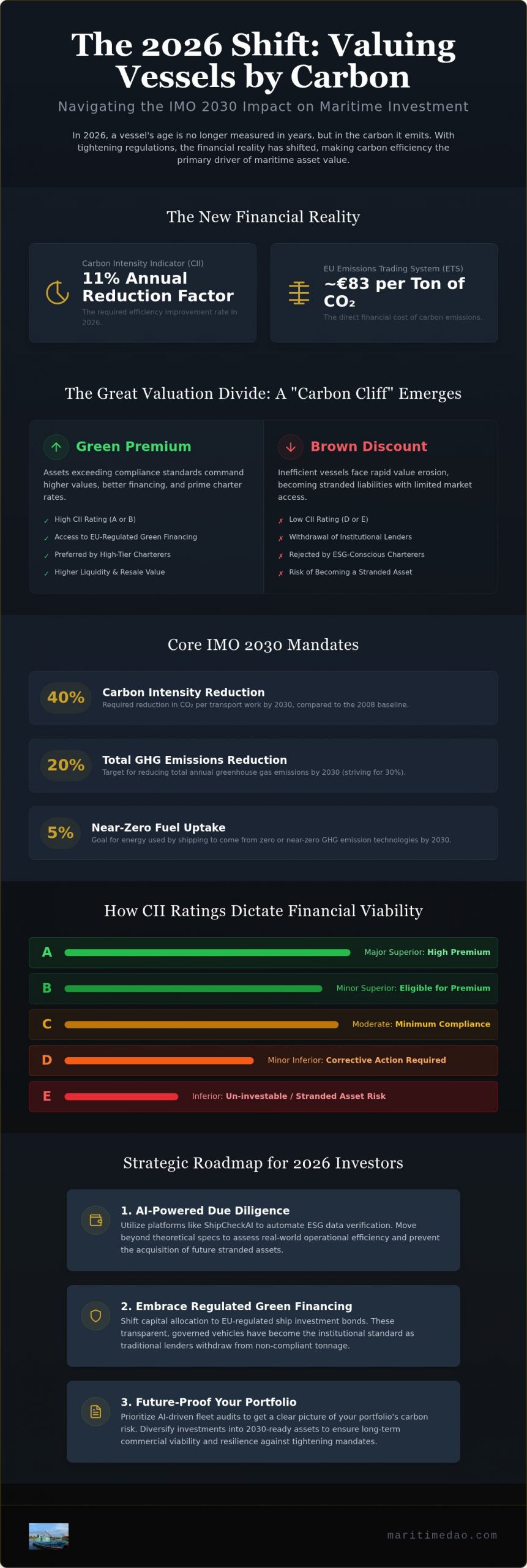
The primary mechanism driving this transition is the Carbon Intensity Indicator (CII), which measures how efficiently a ship transports goods in terms of CO2 per transport work. By 2030, the goal is a 40% reduction in carbon intensity across the global fleet. In 2026, we’ve reached a critical milestone where the annual reduction factor has climbed to 11% relative to the 2019 baseline. Ships that fail to maintain an operational rating of ‘C’ or better face mandatory corrective action plans. This regulatory pressure forces shipowners to choose between expensive retrofits or early decommissioning, fundamentally altering the risk profile of maritime equity.
Near-Zero Fuel Ambitions for 2030
The 2023 strategy also introduced a specific uptake goal for zero or near-zero GHG emission technologies, aiming for at least 5% of the energy used by international shipping to come from these sources by 2030. This mandate is accelerating the adoption of dual-fuel engines and driving massive capital into bunkering infrastructure for green methanol and ammonia. Near-zero fuels are defined as energy sources that achieve a minimum 65% reduction in well-to-wake greenhouse gas emissions compared to conventional fossil fuel benchmarks. For the investor, this means that “2030-ready” is no longer a marketing term; it’s a technical requirement for securing competitive financing terms.
How Carbon Efficiency Dictates Vessel Valuation and Risk
Vessel appraisal in 2026 has undergone a fundamental transformation, moving away from steel weight and age toward a data-driven assessment of environmental compliance. The market now recognizes a distinct “Green Premium” for vessels that exceed IMO standards, contrasted by a punitive “Brown Discount” for assets lagging in efficiency. This valuation shift is no longer theoretical. It is a direct result of the IMO 2030 impact on vessel investment, where carbon intensity is treated as a primary indicator of an asset’s future cash flow and terminal value.
The commercial reality is that a vessel’s Carbon Intensity Indicator (CII) rating now dictates its charter attractiveness and liquidity. High-tier charterers, driven by their own ESG mandates, are increasingly unwilling to contract ‘D’ or ‘E’ rated ships, leading to a bifurcated market. This trend is accelerating toward a “Carbon Cliff,” a point where legacy vessels lose access to competitive insurance and institutional refinancing. To mitigate this, investors are turning to ShipCheckAI to verify real-world operational efficiency, ensuring that a ship’s performance aligns with its reported data rather than relying on outdated theoretical design specs. You can gain a clearer perspective on these risks by utilizing a comprehensive AI ship inspection tool to audit prospective acquisitions.
CII Ratings as a Financial Metric
In the current financial ecosystem, ‘D’ and ‘E’ rated vessels are rapidly becoming un-investable for institutional players. There is a measurable correlation between high CII ratings and bond yield stability, as efficient vessels represent a lower regulatory risk. By integrating technical data, route history, and regulatory forecasting, automated intelligence now allows investors to predict rating degradation. This foresight is essential for maintaining the structural integrity of a maritime portfolio as the IMO’s annual reduction factors become more aggressive each year.
Stranded Asset Risk in the 2026 Market
Stranded asset risk is most pronounced in the dry bulk and older container segments, where the cost of retrofitting often exceeds the remaining economic value of the hull. The traditional 25-year lifespan of a ship has effectively been compressed to 15 or 18 years for non-compliant tonnage. To navigate this volatility, smart capital is moving toward fractional ship investment models. These models allow for greater diversification, spreading risk across a unified fleet of modern, governed assets rather than concentrating capital in a single, high-risk physical hull that may face regulatory obsolescence before the decade ends.
Comparing Financing Models: Equity vs. EU-Regulated Bonds
Traditional maritime finance is experiencing a tectonic shift as institutional lenders align their portfolios with the Poseidon Principles. With over 80% of the global ship finance market now governed by these climate alignment protocols, traditional bank lending has largely retreated from “non-green” assets. This withdrawal has created a functional “Carbon Cliff” where vessels failing to meet mid-term efficiency targets are effectively cut off from conventional debt. The IMO 2030 impact on vessel investment is most visible here; owners of legacy tonnage must now choose between high-cost, dilutive equity or modern, regulated debt instruments that reward environmental compliance.
In this landscape, the cost of capital is no longer uniform. Traditional equity remains an expensive and concentrated risk, often requiring significant collateral and offering limited protection against regulatory volatility. Conversely, green-linked securities and EU regulated ship investment bonds have emerged as the preferred vehicle for 2026. These instruments offer a transparency advantage that equity cannot match. They utilize a unified framework to structure, secure, and scale capital, ensuring that every euro invested is tied to a vessel with a verified path toward the 2030 checkpoints.
The Rise of Regulated Maritime Debt
Modern bond structures are specifically designed to accommodate the heavy retrofitting costs associated with IMO 2030 compliance. Unlike rigid bank loans, these asset-backed bonds provide the flexibility needed to install energy-saving technologies or dual-fuel systems. There’s a surging institutional demand for this type of debt. Institutional investors seek the predictable yields of maritime operations without the speculative risks of unregulated digital assets, finding security in the legal frameworks and structural integrity of EU-governed offerings.
Liquidity and Exit Strategies
The transition to digital governance has opened new avenues for liquidity through the secondary market for tokenized maritime bonds. These platforms allow investors to exit positions with a precision that physical ship sales don’t permit. Furthermore, maintaining a compliant fleet ensures a smoother asset disposal process as 2030 approaches; efficient ships remain liquid, while inefficient ones face a shrinking pool of buyers. DAOs play a pivotal role in this ecosystem by democratizing access to high-entry-cost ship finance, acting as a bridge between institutional-grade governance and a global pool of capital.
Due Diligence 2.0: Integrating AI and ESG Compliance
Traditional physical surveys focus on structural integrity and mechanical wear, yet they remain fundamentally insufficient for the complexities of modern carbon mandates. In 2026, an asset’s value is predicated on its ability to navigate a tightening regulatory net, making historical snapshots of hull condition secondary to real-time operational data. The IMO 2030 impact on vessel investment has effectively redefined due diligence as a continuous, tech-driven process rather than a periodic manual check. Investors now require a unified framework that integrates physical condition with carbon intensity and ESG compliance to avoid the acquisition of future liabilities.
By utilizing ShipCheckAI, stakeholders can automate the verification of carbon efficiency data, replacing the unreliability of manual logs with high-fidelity digital records. This transition to real-time monitoring represents the new investor standard, providing the transparency needed to secure capital in a market increasingly wary of stranded assets. Integrating AI in maritime due diligence into the standard investment workflow ensures that every acquisition is backed by a rigorous, data-led audit of its environmental trajectory.
The ShipCheckAI Advantage
The system performs multi-type inspections, including Technical, Environmental, and Regulatory assessments, to demonstrate a comprehensive ecosystem of asset health. By removing the subjectivity of human reporting, the platform eliminates the discrepancies often found in CII and EEXI documentation, which are critical for maintaining bond yield stability. ShipCheckAI audits vessel readiness for 2030 targets by simulating future operational scenarios against evolving IMO reduction factors. This allows for a precise identification of which vessels require immediate retrofitting and which are positioned for long-term commercial success.
ESG Reporting for Institutional Investors
Institutional confidence is built on the bedrock of standardized data, particularly concerning EU Taxonomy compliance and carbon pricing exposure. Transparent assessments act as a gateway for global capital, allowing traditionally exclusive maritime investments to be governed by the same rigorous standards as institutional finance. Automating ship surveys through AI reduces the operational overhead of continuous due diligence, ensuring that asset assessments are both scalable and cost-effective. For those seeking to secure their portfolios against regulatory obsolescence, you should leverage ShipCheckAI for your next vessel audit to ensure full alignment with 2030 standards.
Strategy for 2026: Future-Proofing Your Maritime Portfolio
Success in the 2026 maritime market is defined by structural agility and technical foresight. As the industry approaches the 2030 checkpoints, the distance between compliant assets and stranded liabilities continues to widen. The IMO 2030 impact on vessel investment has created a clear hierarchy of value where the most carbon-efficient ships command the highest liquidity and the lowest cost of capital. Navigating this environment requires a methodical three-step strategy designed to lead investors and owners through the complexities of regulated innovation.
- Step 1: Audit the existing fleet. Utilize AI ship inspection tools to perform a rigorous gap analysis of current CII ratings against the 11% reduction factor required in 2026.
- Step 2: Diversify capital allocation. Transition away from concentrated physical equity into regulated bonds to mitigate the risks of regional regulatory fragmentation.
- Step 3: Prioritize technical retrofits. Focus investment on vessels equipped with dual-fuel engines or wind-assist technologies, which provide a verified hedge against the €83 per ton EU ETS carbon price.
The Maritime DAO ecosystem simplifies 2030 compliance by uniting automated intelligence, institutional governance, and transparent debt structures into a single gateway. This unified approach ensures that every asset within the portfolio is governed by the same rigorous standards of accountability and environmental performance.
The Action Plan for Vessel Owners
Shipowners must secure the capital necessary for fleet modernization before the “Carbon Cliff” renders legacy tonnage un-financeable. Issuing EU-regulated ship investment bonds provides a transparent, asset-backed mechanism to fund essential retrofits without diluting ownership. Owners should leverage AI to optimize operational efficiency, using predictive data to maintain ‘A’ or ‘B’ CII ratings even as reduction factors tighten. This preparation is vital for the mid-term GHG measures arriving in 2027 and 2028, when the industry expects the full implementation of a global maritime carbon levy and the transition to 100% EU ETS allowance surrenders.
The Action Plan for Investors
Institutional and private investors should identify high-yield opportunities in compliant debt instruments rather than chasing speculative digital assets. Understanding the governance role of a Maritime DAO is essential; it acts as a reliable gatekeeper, ensuring that investments are legally sound and technically verified. By participating in a governed ecosystem, you gain exposure to the physical world of global trade through a secure, digital framework. The time to act is now. You can secure your maritime investment future with Maritime DAO and position your capital at the intersection of heavy industry and high finance.
Capitalizing on the 2026 Regulatory Pivot
The maritime industry’s transition toward a low-carbon future is no longer a distant policy goal; it’s a structural reality that dictates the flow of global capital. The IMO 2030 impact on vessel investment has fundamentally decoupled asset value from age, placing carbon intensity at the center of every appraisal and charter negotiation. Success in this landscape requires a unified approach that integrates technical efficiency, regulatory compliance, and transparent financing. By leveraging AI-driven ShipCheckAI assessments and institutional-grade debt instruments, you can protect your portfolio from the risk of stranded assets while capturing the “Green Premium” of the 2026 market.
Maritime DAO acts as a reliable gatekeeper, offering a first-of-its-kind bridge between traditional shipping and regulated innovation. Our platform provides a governed and methodical framework for those ready to lead the next era of global trade. You can Explore EU-Regulated Ship Investment Bonds on Maritime DAO to access a transparent vehicle for capital allocation backed by a robust EU-regulated compliance framework. The 2030 targets represent a generational opportunity to build a resilient, future-proofed fleet.
Frequently Asked Questions
What is the primary goal of the IMO 2030 strategy for vessel owners?
The primary goal is to achieve a reduction in total annual greenhouse gas emissions of at least 20%, while striving for 30%, by 2030 compared to 2008 levels. This strategy creates a structural mandate for shipowners to adopt near-zero emission technologies and improve operational efficiency. It serves as a critical checkpoint on the path toward full decarbonization, ensuring the global fleet remains aligned with international climate goals and institutional expectations.
How does the Carbon Intensity Indicator (CII) affect ship investment value?
The CII rating serves as a primary financial metric by linking a vessel’s operational efficiency directly to its market value. Ships with high ratings attract a green premium and better charter rates, while those in categories D or E suffer from a brown discount and reduced liquidity. This is a central component of the IMO 2030 impact on vessel investment, as carbon efficiency now determines an asset’s long-term commercial viability and its risk profile.
Can older vessels be retrofitted to meet IMO 2030 standards?
Retrofitting is possible through the installation of dual-fuel engines, wind-assist systems, or advanced hull coatings that improve performance. These upgrades can significantly extend a vessel’s economic life by improving its CII rating and reducing its carbon tax exposure. However, the decision depends on whether the projected fuel savings and regulatory compliance outweigh the capital expenditure. Investors must evaluate if the hull can support these technologies before the 2026 reduction factor makes operation too costly.
Why are EU-regulated ship investment bonds safer than traditional equity in 2026?
EU-regulated ship investment bonds provide a more secure, governed framework than traditional equity by utilizing asset-backed debt structures. These bonds are governed by strict transparency requirements and legal protections that shield investors from the speculative volatility of direct ownership. In 2026, the institutional reliability of these instruments makes them a preferred vehicle for those seeking predictable returns within a unified, transparent maritime ecosystem that prioritizes regulated innovation.
How does ShipCheckAI help in verifying IMO 2030 compliance?
ShipCheckAI utilizes automated intelligence to audit a vessel’s technical and environmental performance against current mandates. The tool provides a transparent verification of carbon efficiency data, reducing the risk of human error or manipulation in CII reporting. This allows investors to conduct rigorous due diligence, ensuring that any asset within their portfolio is technically capable of meeting the IMO 2030 impact on vessel investment standards before capital is committed.
What happens if a vessel fails to meet the 2030 carbon intensity targets?
Non-compliant vessels face mandatory corrective action plans and severe commercial penalties that erode their earning potential. Ships that fail to meet intensity targets often see their insurance premiums rise and their access to major EU ports restricted. As carbon taxes reach €83 per ton, the financial burden of operating an inefficient ship becomes unsustainable, leading to a rapid loss of charter attractiveness and eventual asset obsolescence.
Is maritime asset tokenization legal under EU financial regulations?
Maritime asset tokenization is legal when conducted through regulated financial frameworks that comply with EU securities laws. These digital instruments are structured as governed securities, providing a transparent and inclusive way to access institutional-grade maritime debt. By operating within a legal ecosystem, tokenized bonds offer the same level of protection as traditional finance while improving liquidity and democratization for a global audience of sophisticated investors.
What is the “Carbon Cliff” in maritime finance?
The “Carbon Cliff” describes the sudden loss of financing and insurance options for vessels that fail to meet climate alignment standards. Since 80% of ship finance is now governed by the Poseidon Principles, lenders are withdrawing from assets with poor environmental performance. Once a vessel hits this cliff, its market value collapses because it can no longer be legally or profitably operated in major trade routes, leaving owners with stranded liabilities.