
For decades, the high-yield world of maritime debt remained a closed ecosystem, accessible only to institutional banks and sovereign funds that could navigate its opaque complexities. You’ve likely felt that while global trade remains the backbone of the economy, the barriers to entry for ship financing are intentionally high; this often leaves individual professionals caught between inaccessible bank instruments and risky, unregulated offshore schemes. Understanding how to invest in maritime bonds shouldn’t require a legacy banking seat or a leap of faith into unverified markets.
It’s time to bridge the gap between traditional maritime expertise and the future of digital finance. This guide provides a systematic roadmap for acquiring EU-regulated ship investment bonds, ensuring your capital is protected by institutional-grade legal frameworks and physical asset verification. You’ll discover how we utilize ShipCheckAI to deliver rigorous vessel assessments, providing a level of transparency that was previously impossible. We’ll examine the regulatory safety nets of 2026, the mechanics of bond acquisition, and the way automated intelligence validates every hull and engine in our unified ecosystem.
Key Takeaways
- Maritime bonds provide a robust fixed-income alternative by securing capital against essential global trade assets within a professionally managed ecosystem.
- Discover the specific legal and operational steps for how to invest in maritime bonds while utilizing EU-regulated frameworks to ensure institutional-grade security.
- De-risk your portfolio by leveraging ShipCheckAI, an automated tool that provides transparent, multi-point vessel inspections to verify the physical integrity of maritime assets.
- Transition from traditional bank instruments to a democratized debt market that combines the reliability of heavy industry with the efficiency of decentralized technology.
- Gain a competitive advantage by understanding the 2026 regulatory landscape, including how emissions standards and mandatory reporting impact vessel valuations.
Understanding Maritime Bonds as a Fixed-Income Alternative
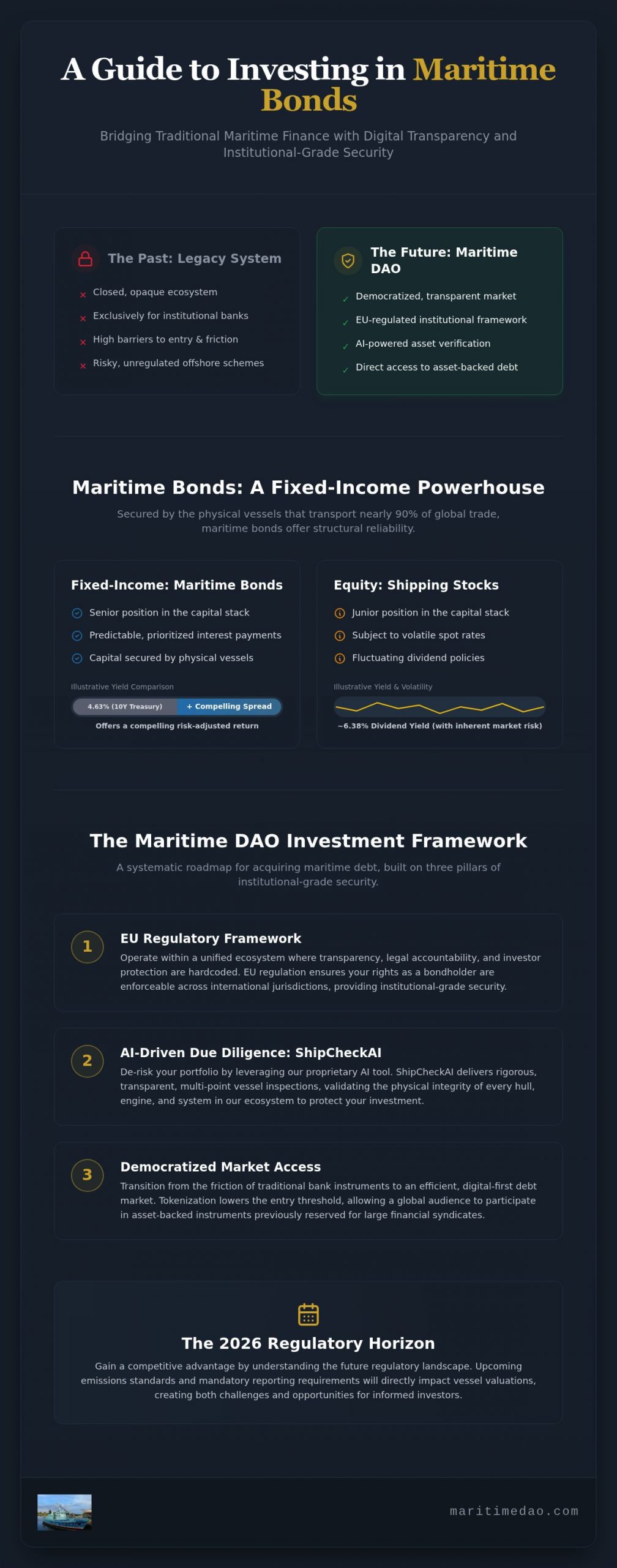
Maritime bonds are professional debt securities issued to finance the acquisition, modernization, or operational scaling of commercial vessels. These instruments serve as the financial engine for the global shipping industry, a sector responsible for transporting nearly 90% of international trade. While many market participants historically viewed shipping through the lens of volatile equity, the current landscape favors the structural reliability of maritime debt. Understanding how to invest in maritime bonds requires a fundamental shift in perspective; investors must view a vessel not just as a machine, but as a cash-flow producing asset governed by strict legal frameworks.
Traditional ship finance was once a closed loop of private bank loans. Today, maritime bonds offer a transparent alternative, allowing capital to flow directly into asset-backed instruments without the intermediary friction of legacy banking. These bonds represent a unified ecosystem where debt is secured by the physical vessel itself, providing a layer of protection that equity simply cannot match. This shift is creating a more inclusive market where institutional-grade debt is no longer the exclusive domain of global lending syndicates.
Fixed-Income vs. Equity in the Shipping Sector
The primary appeal of maritime bonds lies in the priority of payment. In the shipping sector, equity holders are often subject to the whims of spot rates and fluctuating dividend policies. For instance, while major carriers like Global Ship Lease showed dividend yields around 6.38% in mid-2026, those returns carry the inherent risk of market cycles. Bondholders, however, occupy a senior position in the capital stack. This seniority ensures that interest payments are prioritized, offering a predictable yield that is essential for a balanced portfolio. In an era where 10-year Treasury yields sit at approximately 4.63%, the spread provided by maritime debt offers a compelling risk-adjusted return for those who value asset-backed security.
The Evolution of Maritime Debt Instruments
Maritime finance has undergone a radical transformation from opaque private placements to accessible, digital-first offerings. This evolution is driven by the convergence of heavy industry, institutional finance, and decentralized technology. Tokenization has effectively lowered the entry threshold, allowing a global audience to participate in debt instruments that were previously reserved for institutional giants. A significant milestone in this journey was the launch of Seychelles’ sovereign blue bond, which proved that maritime-focused debt could be both innovative and highly regulated. By combining these legacy lessons with modern AI-driven due diligence, the current market provides a methodical, transparent gateway for anyone learning how to invest in maritime bonds.
The Regulatory Framework: Why EU-Regulated Bonds Matter
Security in maritime finance isn’t a luxury; it’s a structural requirement. When exploring how to invest in maritime bonds, the most critical variable is the regulatory umbrella governing the instrument. While offshore schemes often promise high yields with minimal oversight, they lack the institutional-grade compliance necessary to protect significant capital. EU-regulated bonds provide a unified ecosystem where transparency, legal accountability, and investor protection are hardcoded into the investment’s lifecycle. This framework ensures that your rights as a bondholder are enforceable across international jurisdictions, bridging the gap between digital innovation and legacy legal systems.
The complexity of global trade requires a sophisticated oversight model. For example, while the FMC bond requirements for OTIs establish financial responsibility for transport intermediaries in the United States, EU regulations like MiCA (Markets in Crypto-Assets) provide a comprehensive roadmap for digital debt instruments. Our ecosystem is designed to unify physical assets, govern digital debt, and protect investor interests through a single, transparent gateway. By operating within these established boundaries, issuers can offer a level of transparency that was previously unattainable in private ship finance. This regulated approach transforms the black box of maritime debt into a clear, auditable path for global investors.
EU Compliance Standards for Ship Finance
European regulatory bodies have established some of the world’s most rigorous standards for asset-backed securities. For the maritime sector, this means every bond issuance must adhere to strict disclosure requirements regarding the vessel’s operational status and financial health. The maturation of MiCA by 2026 has created a stable environment for tokenized maritime debt, ensuring that digital assets are held to the same sober standards as traditional finance. When you analyze how to invest in maritime bonds, prioritizing regulated status is the single most effective way to mitigate the risk of market volatility. You can explore our framework for compliant maritime debt to see how these standards are applied to every vessel in our fleet.
Governance and Investor Protections
Modern maritime finance utilizes the Decentralized Autonomous Organization (DAO) as a governed, legally-binding structure rather than a lawless experiment. By incorporating in jurisdictions that recognize DAOs as distinct legal entities, these organizations provide a reliable bridge to traditional maritime law. Smart contracts act as the digital custodian; they automatically enforce bondholder rights and ensure interest payments are distributed without human interference. As of January 1, 2026, the full implementation of the EU Emissions Trading System (ETS) mandates 100% emission coverage for voyages, adding another layer of mandatory reporting that regulated issuers must disclose. This synergy of law and technology ensures that every bond is governed by a transparent, immutable record of both performance and compliance.
Evaluating Vessel Health: How AI-Driven Inspections De-Risk Your Investment
A maritime bond is only as resilient as the physical hull that secures it. In the high-stakes world of global shipping, the vessel is the primary collateral; any degradation in its structural integrity or operational efficiency directly impacts the security of the debt. Traditional due diligence often relied on manual, paper-based surveys that were susceptible to human error or subjective interpretation. When you are learning how to invest in maritime bonds, it is vital to understand that modern asset assessment has moved beyond these legacy limitations. By integrating automated intelligence into the inspection process, we provide a unified, transparent, and data-driven view of vessel health that protects bondholders from unforeseen physical liabilities.
The transition to AI-driven due diligence removes the “black box” of traditional ship surveys. Automated systems don’t suffer from fatigue or overlook micro-corrosion in ballast tanks; instead, they provide a cold, methodical analysis of every critical system. This level of scrutiny is essential in a 2026 regulatory environment where the mandatory reporting of lost containers and the strict prohibition of PFOS in fire-fighting equipment are now standard. By digitizing the physical condition of the asset, we bridge the gap between the shipyard and the financial market, ensuring that every bond is backed by a verified, high-performing maritime asset.
ShipCheckAI: A New Standard for Due Diligence
Our proprietary AI ship inspection tools represent a fundamental shift in how we govern vessel quality. ShipCheckAI conducts multi-point vessel assessments that examine everything from structural thickness to engine performance metrics. This system identifies latent risks long before they manifest as operational failures or financial defaults. By sharing these granular inspection results directly with our community, we maintain a level of transparency that was previously impossible in private maritime finance. This methodical approach ensures that when you evaluate how to invest in maritime bonds, you aren’t just buying a security; you’re acquiring a stake in a physically validated ecosystem.
From Physical Survey to Digital Twin
The evolution of ship finance relies on the creation of a verifiable, digital audit trail. Utilizing AI in maritime due diligence allows us to maintain a “digital twin” of every vessel in the fleet, providing real-time condition assessments that go far beyond a yearly survey. This continuous monitoring enables predictive maintenance, which preserves the long-term yield of maritime bonds by preventing costly emergency repairs and minimizing off-hire time. For the modern investor, access to this digital condition data is not a luxury. It is a critical tool for verifying asset quality and ensuring that the underlying collateral maintains its value throughout the entire lifecycle of the bond.
A Step-by-Step Guide to Investing in Maritime Debt Instruments
In 2026, the process of acquiring maritime debt has transitioned from opaque institutional deals to a structured, digital-first experience. Investors no longer need to navigate fragmented brokerage services or private banking circles to access these assets. Instead, they enter a unified ecosystem where regulatory compliance and asset verification are prerequisite gates for participation. Learning how to invest in maritime bonds starts with identifying a platform that integrates heavy industry expertise with institutional-grade financial oversight. This transition ensures that every participant operates within a governed framework designed to protect capital and maximize transparency across the entire bond lifecycle.
The maturation of the maritime debt market means that the “how” is now as important as the “what.” A professional investment strategy requires a methodical approach to onboarding, asset selection, and long-term monitoring. By utilizing a regulated gateway, investors can move away from the speculative volatility of traditional shipping equities and toward the sober reliability of asset-backed debt. This systematic process is designed to bridge the gap between global trade’s physical reality and the efficiency of modern financial technology.
Onboarding and Verification
The first gate in this journey is a rigorous onboarding process designed to meet EU-level KYC (Know Your Customer) and AML (Anti-Money Laundering) standards. Unlike speculative digital asset platforms, regulated maritime debt marketplaces require comprehensive identity verification to ensure the integrity of the entire investment pool. During this phase, professionals select their bond tiers based on their capital requirements and risk appetite. Participants must also establish a secure digital wallet or an institutional custody solution. This infrastructure acts as the primary repository for your assets, ensuring that your digital bond certificates are held in a secure, auditable environment that respects legacy financial safety nets.
Selecting and Purchasing Bonds
Once verified, the focus shifts to asset evaluation. Investors must analyze specific offerings by examining vessel types, primary trade routes, and projected yields. The marketplace provides a transparent gateway to invest in maritime assets that have been pre-screened through our proprietary ShipCheckAI assessment tools. This selection process is methodical; you aren’t just selecting a ticker symbol, but a physically verified hull with a clear operational mandate. After confirming a purchase, the transaction is settled via smart contract, and the investor receives a digital certificate representing their senior position in the vessel’s debt. To begin your regulated investment journey today, you can access the Maritime DAO marketplace and explore our current bond offerings.
Monitoring and Portfolio Management
Managing a maritime portfolio in 2026 relies on real-time data integration. Bondholders shouldn’t just wait for quarterly reports to understand their exposure. Instead, they utilize a unified dashboard that tracks vessel location, operational efficiency, and regulatory compliance status. This continuous stream of information provides a clear view of the bond’s performance from issuance through to maturity. It ensures that the relationship between the physical asset and the financial instrument remains visible and governed at every stage, allowing for proactive decisions based on verified maritime intelligence.
The Future of Maritime DAO: Why Regulated Innovation Wins
The maritime industry stands at a historical inflection point where heavy industry, institutional finance, and decentralized technology converge into a single, high-performing ecosystem. This isn’t merely an incremental improvement; it’s a foundational shift in how the world’s most critical infrastructure is funded and governed. By moving beyond the experimental phase of blockchain, we’ve built a capital market that respects the sobriety of traditional maritime law while embracing the efficiency of digital governance. This architecture ensures that learning how to invest in maritime bonds leads to a transparent, asset-backed outcome rather than a speculative gamble. We act as both the visionary architect and the reliable gatekeeper of this new frontier.
Our long-term vision is the creation of a unified maritime capital market where liquidity is constant and asset quality is indisputable. Within this framework, EU regulated ship investment bonds are setting the global benchmark for security and compliance. By aligning with these institutional standards, we provide a gateway that bridges the physical world of global trade with the digital world of tokenized debt. This creates a resilient structure for the next generation of maritime finance, where the excitement of innovation is tempered by the reliability of legal frameworks.
Scalability and Global Accessibility
The DAO model is uniquely suited for the global nature of maritime operations, as it allows for the democratization of debt without compromising on regulatory integrity. Historically, retail investors were largely excluded from the $400 billion maritime debt market, but our ecosystem opens these doors through fractionalization and a 24/7 liquid market. This accessibility is particularly vital for funding the next generation of “green shipping,” such as vessels designed to meet the 100% emission coverage mandated by the EU Emissions Trading System in 2026. By lowering the entry threshold, we enable a broader base of capital to support the decarbonization of the global fleet, ensuring that the future of shipping is both environmentally sustainable and financially robust.
The Role of the Investor in DAO Governance
In this new paradigm, bondholders aren’t passive observers but participants in a governed, legally-binding structure. The Maritime DAO ecosystem balances professional management with community oversight, ensuring that strategic decisions are made with both expertise and transparency. Bondholders can participate in ecosystem-wide decisions, influencing the direction of the fleet while relying on institutional-grade custody and smart contract enforcement. This model provides a level of institutional resilience that traditional structures often lack, as it replaces opaque decision-making with an immutable audit trail. For those mastering how to invest in maritime bonds, this governance layer provides the ultimate assurance that their capital is protected by both code and law.
Securing Your Position in the Future of Global Trade
The transformation of maritime finance from a closed banking loop to a transparent digital ecosystem is now complete. By prioritizing an EU-regulated framework, investors gain the legal certainty required for significant capital allocation while benefiting from the efficiencies of modern technology. You’ve seen how ShipCheckAI de-risks these instruments by providing multi-point physical verification, ensuring that every bond is anchored by a high-performing asset. This unified approach combines structural integrity, automated intelligence, and inclusive governance to redefine the global shipping debt market.
Understanding how to invest in maritime bonds allows you to move beyond volatile equities and into the sober reliability of senior debt. This is more than a financial shift; it’s an opportunity to fund the modernization of global trade through a governed, institutional-grade gateway. The path to diversified, asset-backed yields is now open to a global audience of professionals who value order and security. Explore EU-Regulated Ship Investment Bonds on Maritime DAO and secure your stake in a first-of-its-kind maritime ecosystem. The future of maritime finance is regulated, transparent, and ready for your participation.
Frequently Asked Questions
Are maritime bonds safe for retail investors in 2026?
Maritime bonds issued within an EU-regulated framework provide a level of security that’s historically been reserved for institutional banks. The full implementation of MiCA in 2026 has established a clear legal roadmap, ensuring that digital debt instruments are held to the same sober standards as traditional finance. By combining transparency, legal frameworks, and asset-backed security, these bonds offer a regulated alternative to the volatility of shipping stocks or unregulated offshore schemes.
What is the typical yield for an EU-regulated ship investment bond?
Yields for maritime debt are generally positioned above sovereign benchmarks, often reflecting a margin of 100 to 150 basis points over the Secured Overnight Financing Rate (SOFR). This spread accounts for asset-specific risk while remaining competitive with dividend yields found in shipping equities, which averaged between 4.1% and 6.4% in mid-2026. While U.S. 10-year Treasury yields sit near 4.63%, maritime bonds provide a compelling risk-adjusted return for those seeking asset-backed fixed income.
How does ShipCheckAI actually protect my investment?
ShipCheckAI acts as a digital gatekeeper that performs rigorous, multi-point assessments of a vessel’s physical condition. By removing human bias and subjective reporting, it ensures that every bond is backed by a verified hull and engine system. This automated intelligence provides a level of transparency that’s essential when learning how to invest in maritime bonds with professional confidence. It identifies structural risks before they can impact bond performance, acting as a bridge between the shipyard and your digital portfolio.
Can I sell my maritime bonds before they reach maturity?
The digital nature of these instruments allows for a more liquid market compared to traditional private ship finance. Most regulated platforms facilitate secondary market trading, enabling bondholders to exit their positions if their liquidity needs change. This 24/7 ecosystem provides a level of flexibility that’s rare in heavy industry investments, ensuring that your capital isn’t locked in an opaque, illiquid structure for the entire duration of the bond term.
What are the tax implications of investing in maritime debt?
Tax treatment for maritime debt varies based on your specific legal jurisdiction and the structure of the bond issuance. Most EU-regulated instruments are treated as standard fixed-income securities, but it’s vital to consult a professional tax advisor to understand your specific obligations. The regulated nature of these bonds ensures that you receive the standardized reporting and disclosure documents necessary for accurate tax filing across international borders.
How does a DAO differ from a traditional maritime investment fund?
A DAO provides a unified, transparent, and governed ecosystem that differs fundamentally from the opaque structures of traditional maritime funds. While a traditional fund relies on centralized management with limited visibility, a DAO utilizes smart contracts to automate distributions and enforce bondholder rights. This model creates a more inclusive environment where governance is transparent and every transaction is recorded on an immutable ledger, providing institutional resilience through decentralized technology.
What is the minimum amount required to start investing in maritime bonds?
Tokenization has effectively democratized maritime finance by significantly lowering the entry threshold for global investors. This shift allows professionals to participate in ship financing without the multi-million dollar requirements typical of legacy institutional lending. By breaking down large maritime assets into smaller, accessible digital units, we’ve opened the doors to a broader audience that values the stability of maritime debt but requires a more flexible entry point.
What happens if the vessel associated with my bond is damaged?
Bondholders maintain a senior position in the capital stack, meaning their claims are prioritized if an asset is damaged or liquidated. Every vessel in our ecosystem is required to maintain comprehensive maritime insurance, providing a secondary safety net that complements the physical verification provided by our automated inspection tools. This tripartite protection of seniority, insurance, and AI-driven due diligence ensures that your investment is governed by multiple layers of security even in adverse conditions.