
The maritime financing market currently faces a 300 billion dollar funding gap, a direct consequence of European banks retreating to meet the finality of Basel IV standards. This structural shift has forced a total re-evaluation of maritime debt financing options, moving the industry away from legacy lending toward more resilient, technology-governed structures. You’ve likely felt the pressure of this liquidity gap and the mounting frustration of managing fragmented offshore regulations while trying to secure institutional-grade capital. It’s a challenging environment where traditional due diligence often fails to keep pace with the speed of global trade.
This guide provides the strategic clarity needed to secure funding through institutional private credit funds and EU-regulated bond frameworks that offer both downside protection and regulatory certainty. We will examine the integration of ShipCheckAI for multi-layered vessel monitoring, the rise of transparent debt instruments, and how unified digital asset frameworks are finally democratizing high-stakes maritime investment. By bridging the gap between physical assets and digital governance, you can achieve institutional-grade yields through a unified, transparent, and legally sound ecosystem.
Key Takeaways
- Understand how Basel IV compliance has created a 300 billion dollar liquidity gap, shifting the industry toward non-bank debt and private capital.
- Identify critical legal protections like the First Priority Ship Mortgage and “Hell or High Water” clauses that secure capital in maritime investments.
- Evaluate various maritime debt financing options by comparing the high-yield potential of private credit against the liquidity profile of regulated bonds.
- Leverage ShipCheckAI as a new industry benchmark to replace static surveys with real-time, multi-layered asset transparency and automated risk assessment.
- Discover how regulated DAOs and tokenized debt instruments solve historical illiquidity through unified digital governance and institutional-grade compliance.
The 2026 Maritime Credit Gap: Navigating Basel IV and Bank Retraction
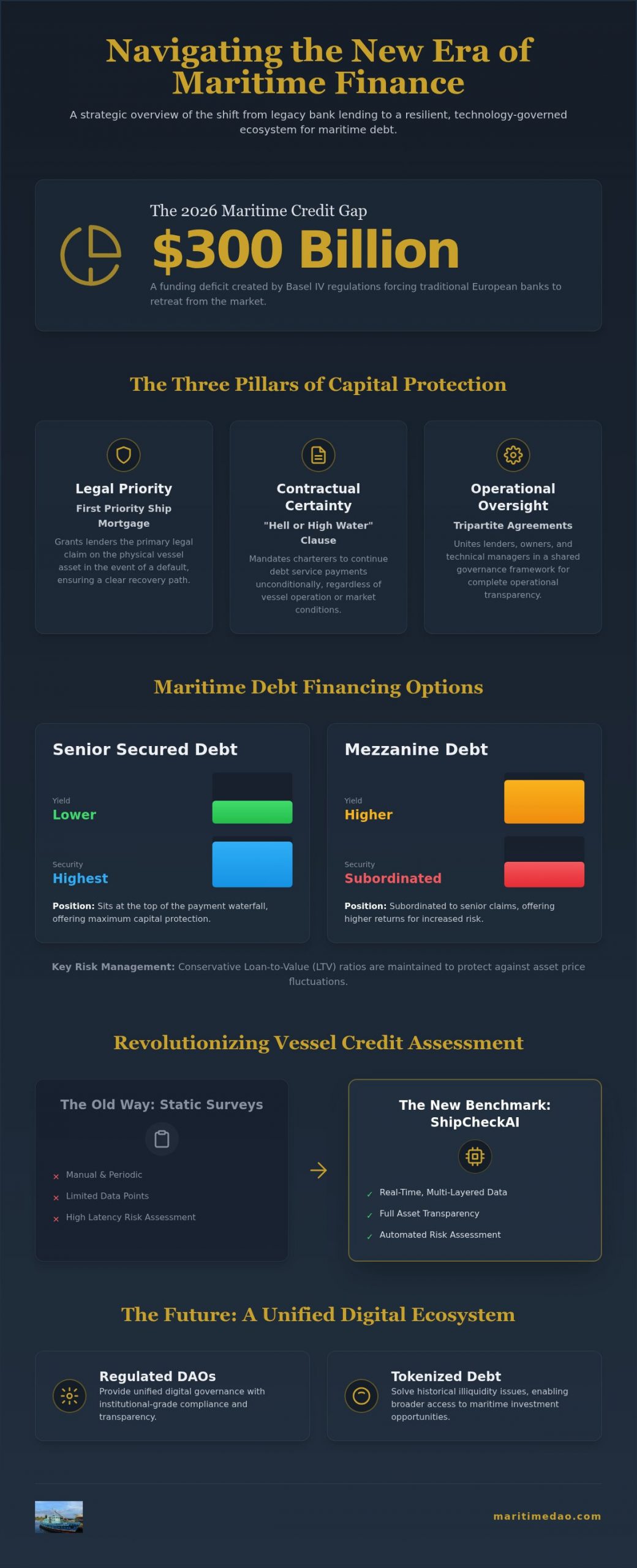
The landscape of global ship finance has undergone a structural transformation. Maritime private credit, defined as non-bank debt secured by physical vessel assets and freight cash flows, has emerged as a primary pillar of this new era. As of 2026, the industry faces a staggering $300 billion funding gap. This deficit is the direct result of Basel IV implementation, which mandated significantly higher capital requirements for traditional shipping loans. Banks haven’t just become more cautious; they’ve fundamentally changed their business models to avoid the capital charges associated with heavy industry assets.
Why Traditional Maritime Lending is Contracting
European banks, once the reliable backbone of the sector, have largely completed their retreat from the market. Under Basel IV, the risk-weighted asset (RWA) calculations for maritime portfolios became prohibitively expensive for commercial lenders. This created a “flight to quality” where banks now exclusively service the largest 1% of global shipowners. For the remaining 99% of the market, traditional relationship banking has been replaced by “relationship-lite” transactional lending. Private credit funds have stepped into this void, providing critical mid-market liquidity where legacy institutions can no longer compete. Shipping is increasingly viewed as a sophisticated alternative investment rather than a standard commercial banking product, requiring specialized governance and technical oversight.
The Institutional Case for Maritime Debt in 2026
Institutional investors are increasingly allocating capital to maritime debt because it functions as an uncorrelated asset class. It’s particularly effective in high-inflation environments where physical assets and global trade routes retain intrinsic value. Unlike traditional corporate bonds, maritime debt financing options often provide a significant yield premium. This premium isn’t just a risk marker; it’s a reflection of the technical barriers to entry and the specialized knowledge required to manage these assets effectively in a fragmented regulatory environment.
We define “maritime alpha” as the excess return generated from industry-specific technical complexity and the rigorous governance of physical assets. This alpha is protected by the tangible nature of the collateral, offering a level of downside protection that’s rare in digital or purely financial markets. The transition toward a transparent, data-driven credit ecosystem ensures that this asset class remains resilient. By utilizing automated intelligence, regulated frameworks, and transparent governance, investors can now access these yields with a level of clarity that was impossible in the previous decade’s bank-dominated era.
Structural Safeguards: How Modern Maritime Debt Protects Capital
Security in maritime debt is built on three pillars: legal priority, contractual certainty, and operational oversight. The First Priority Ship Mortgage serves as the primary legal safeguard, granting bondholders first claim on the physical asset in the event of default. This is reinforced by the “Hell or High Water” clause in charter agreements, which mandates that the charterer continues debt service payments regardless of vessel operation or market conditions. To ensure technical integrity, tripartite agreements unite lenders, owners, and technical managers in a shared governance framework. These mechanisms transform maritime debt financing options from speculative plays into institutional-grade credit instruments with clear recovery paths.
Senior Secured vs. Mezzanine Debt Structures
Investors typically choose between senior secured debt and mezzanine structures based on their risk appetite and yield requirements. Senior debt sits at the top of the payment waterfall, offering the highest security with lower yields. In contrast, mezzanine debt provides higher returns but is subordinated to senior claims. Managing Loan-to-Value (LTV) ratios is critical in the volatile 2026 market; most institutional funds maintain a conservative LTV to buffer against asset price fluctuations. This disciplined approach ensures that even during market corrections, the underlying value of the vessel remains sufficient to cover senior debt obligations.
The Regulatory Advantage of EU-Compliant Bonds
The shift toward EU regulated ship investment bonds provides a compliant recourse framework that offshore unregulated tokens simply cannot match. Institutional capital is increasingly prioritizing maritime investment compliance to meet strict internal mandates and modern European financial directives. These regulated instruments offer full transparency into the asset’s lifecycle, separating professional debt securities from the opaque structures often found in unregulated jurisdictions.
By operating within a governed ecosystem, lenders benefit from standardized disclosure requirements and clear legal standing under EU law. This transparency is not just a regulatory hurdle; it’s a competitive advantage that attracts stable, long-term capital. For those seeking to align their portfolios with these rigorous standards, exploring a governed debt ecosystem offers a clear path toward secure capital deployment in the global shipping sector.
Comparing Maritime Debt Financing Options: Private Funds vs. Public Bonds
Selecting the optimal path within maritime debt financing options requires a granular understanding of the trade-offs between yield, liquidity, and control. Private maritime debt typically commands a yield premium over public shipping bonds, primarily due to the complexity of the underlying transactions and the inherent illiquidity of the asset. While public bonds offer the convenience of secondary market trading, they’re often subject to broader market volatility and sentiment shifts that may not reflect the actual performance of the vessel. Private credit, by contrast, is characterized by a “covenant-heavy” structure; this allows lenders to impose strict operational and financial requirements on shipowners, serving as a powerful risk mitigation tool that public instruments often lack.
Understanding how to invest in maritime assets depends heavily on the investor’s profile. Institutional tiers often favor the bespoke nature of private funds, while retail or smaller accredited investors are increasingly drawn to fractionalized bond structures. This differentiation ensures that capital can be deployed across various levels of the capital stack, from senior secured positions to mezzanine debt, depending on the desired risk-return profile.
Yield and Risk Profiles in the 2026 Market
The 2026 market environment favors floating-rate debt, which protects investors against inflationary pressures and shifting interest rates. Institutional maritime credit funds typically target internal rates of return that reflect the maritime alpha mentioned previously, often managed through disciplined Loan-to-Value (LTV) thresholds. The logic remains firmly asset-backed; the physical value of the vessel provides a definitive floor for recovery. Because these loans are secured by tangible assets and contractual freight flows, they offer a level of downside protection that traditional unsecured corporate debt cannot match.
Accessibility and Minimum Investment Thresholds
Direct vessel ownership remains a capital-intensive endeavor reserved for the largest industry players. However, the emergence of maritime DAO investment has created a vital gateway for accredited investors to access fractional shares of high-value maritime debt. This digital evolution in bond issuance significantly reduces administrative friction, lowering the costs associated with legal documentation and asset monitoring. By utilizing unified digital frameworks, these platforms harmonize the relationship between physical trade and global finance, making sophisticated debt instruments accessible through transparent, governed ecosystems.
AI-Driven Due Diligence: Revolutionizing Vessel Credit Assessment
Traditional manual surveys, once the gold standard of vessel assessment, are no longer sufficient for the rigorous demands of institutional risk management in 2026. These “point-in-time” snapshots fail to capture the operational nuances and deteriorating health of a vessel between annual inspections. Modern maritime debt financing options now rely on sophisticated technological pillars to eliminate information asymmetry between borrowers and lenders. By integrating automated intelligence, credit managers move beyond historical data to analyze real-time technical performance, environmental compliance, and operational history. This evolution ensures that capital isn’t just deployed against a physical hull, but against a verified, high-performing asset within a transparent, governed, and unified ecosystem.
ShipCheckAI: A New Standard for Bond Issuers
The AI ship inspection tool has emerged as the definitive benchmark for institutional asset transparency. ShipCheckAI performs multi-layered assessments that verify physical integrity through automated computer vision, data cross-referencing, and structural health sensors. For bond issuers, the value lies in predictive maintenance analytics. These insights allow lenders to forecast debt service reliability by identifying potential technical failures before they result in off-hire periods or costly repairs. Bondholders receive continuous collateral monitoring reports, providing an unprecedented level of security that legacy survey methods simply can’t provide.
Continuous Condition Monitoring and Covenant Compliance
The industry is shifting from static, annual inspections toward dynamic, real-time health monitoring. This transition is critical for maintaining the structural integrity of the credit ecosystem. AI data feeds now integrate directly into management dashboards, allowing for the automatic triggering of covenant alerts the moment a vessel’s technical or safety metrics deviate from agreed-upon thresholds. Utilizing AI in maritime due diligence ensures that the underlying collateral maintains its value throughout the entire loan lifecycle. This granular oversight protects the capital stack and ensures that recovery paths remain viable even in volatile market conditions.
To implement these advanced standards in your own asset management strategy, you can access our governed inspection framework to secure high-fidelity data for every vessel in your portfolio.
The Future of Shipping Finance: Regulated DAOs and Tokenized Debt
The final evolution of maritime debt financing options lies in the convergence of established legal frameworks and decentralized governance. A Regulated Maritime DAO functions as a sophisticated vehicle designed for the systematic deployment of capital and the rigorous oversight of vessel-backed assets. By utilizing tokenized ship bonds, the industry has finally addressed the historical illiquidity that once deterred institutional allocators from the mid-market sector. This structure creates a robust Governance Layer where bondholders aren’t passive observers but active participants who oversee fund mandates and asset selection through a unified digital interface. This transparency ensures that every dollar of capital is governed by the collective interests of the lenders, backed by the physical reality of the global fleet.
Smart contracts provide the operational backbone of this ecosystem, automating interest distributions and ensuring continuous compliance with cross-border regulations. This automation removes the administrative burden of manual reconciliation and the risk of human error in complex payment waterfalls. It’s a system where compliance isn’t a periodic check but a constant, programmable state, allowing for a level of transparency that traditional bank-led syndicates cannot replicate.
Tokenization vs. Traditional Securitization
Tokenized bonds offer a fundamental improvement over traditional paper instruments by drastically reducing settlement times and minimizing administrative costs. While traditional securitization involves a dense web of intermediaries and significant legal overhead, digital assets utilize “programmable compliance” to ensure every transaction meets EU-regulated financial directives in real-time. This isn’t merely about technological speed; it’s about structural integrity. Fractional maritime debt can now be traded on regulated secondary markets, providing a liquidity profile that was previously impossible for private credit investments in the shipping sector. The result is a more inclusive market where institutional-grade assets are no longer locked behind the gates of legacy finance.
The Institutional Path Forward in 2026
For institutional allocators, the path forward involves a methodical transition toward governed digital ecosystems. The process begins with identifying high-quality debt offerings that meet the rigorous technical standards established by ShipCheckAI and EU-compliant frameworks. As maritime private credit becomes a core component of “alternative” allocations in 2026, the emphasis remains on transparency and downside protection. The long-term outlook suggests a hybrid future where the physical reliability of global shipping is perfectly mirrored by the efficiency of blockchain-based governance. To begin this transition, sophisticated investors should explore our current EU-regulated ship investment bonds to secure a position in the next generation of maritime finance.
Charting a Path Through the 2026 Credit Landscape
The structural transformation of ship finance is no longer a future projection; it’s the current reality for institutional allocators. As Basel IV continues to reshape the lending environment, the transition from legacy bank debt to sophisticated maritime debt financing options has become essential for maintaining mid-market liquidity. By integrating rigorous EU-regulated frameworks with the technical precision of ShipCheckAI, the industry has successfully bridged the gap between physical global trade and modern financial governance. This unified ecosystem ensures that every investment is underpinned by institutional-grade asset-backed securities and real-time operational transparency.
The convergence of decentralized technology and traditional legal safeguards provides a resilient foundation for long-term capital deployment. Investors who embrace these regulated innovations will find themselves at the forefront of a more inclusive, efficient, and transparent maritime market. It’s time to move beyond the constraints of outdated financial models and participate in a governed credit landscape that values security as much as yield. Secure your position in the future of shipping finance with Maritime DAO and leverage a first-of-its-kind platform built for the complexities of 2026 and beyond. The horizon of maritime investment has never been clearer.
Frequently Asked Questions
What are the primary risks associated with maritime private credit funds?
The primary risks include asset concentration, technical obsolescence, and the cyclicality of freight rates. Lenders manage these through first priority ship mortgages and “Hell or High Water” clauses that mandate payment regardless of vessel operation. While physical collateral provides a floor, the technical health of the ship remains a variable. Sophisticated maritime debt financing options mitigate these risks by using automated intelligence to monitor asset integrity and ensuring robust insurance coverage is maintained throughout the loan term.
How does Basel IV impact the availability of shipping finance in 2026?
Basel IV mandates higher capital ratios for banks holding shipping loans, effectively increasing the cost of lending for traditional institutions. This regulatory shift has caused a “flight to quality” where commercial banks only service the largest shipowners. Consequently, a 300 billion dollar funding gap has emerged in the mid-market. This contraction has accelerated the transition toward alternative lenders and private credit funds that operate with different capital structures, providing essential liquidity to the global fleet.
What is the typical yield expectation for an EU-regulated ship investment bond?
EU-regulated ship investment bonds generally offer a yield premium over traditional corporate debt to compensate for industry-specific technical complexity. These instruments target institutional-grade returns that are uncorrelated with broader equity markets. While exact percentages vary based on the vessel type and charter length, the returns are structured to provide downside protection through asset backing. Investors benefit from a transparent, governed ecosystem where yields are supported by consistent freight cash flows and rigorous operational oversight.
How does ShipCheckAI improve the due diligence process for lenders?
ShipCheckAI replaces static, point-in-time surveys with multi-layered, automated assessments of physical asset integrity. It utilizes computer vision and predictive maintenance data to identify structural issues before they impact the vessel’s earning potential. By providing lenders with continuous health monitoring, the tool significantly reduces information asymmetry between shipowners and bondholders. This real-time transparency ensures that the collateral remains viable and that technical performance metrics align with the financial covenants of the debt.
Is maritime private credit suitable for retail investors or only institutional allocators?
While maritime debt was historically reserved for institutional allocators, the emergence of tokenized bonds and regulated DAOs has increased accessibility for accredited investors. These digital structures allow for fractional participation in high-value assets that were previously out of reach. However, the technical nature of the asset class still requires a sophisticated understanding of global trade and maritime law. It remains a professional-grade alternative investment, focused on those seeking diversified, asset-backed yields with institutional governance.
How do maritime DAOs ensure regulatory compliance across global jurisdictions?
Maritime DAOs utilize programmable compliance to bake regulatory requirements directly into the smart contracts governing the debt. This approach ensures that every transaction adheres to EU-regulated frameworks and cross-border financial directives automatically. By operating within a unified digital ecosystem, the DAO can harmonize conflicting jurisdictional requirements through transparent, code-based governance. This method provides a level of legal certainty that traditional offshore structures lack, as the compliance layer is both constant and verifiable by all stakeholders.
What happens to the debt financing if a vessel is arrested or involved in a casualty?
If a vessel is arrested or involved in a casualty, the debt is protected by the First Priority Ship Mortgage and comprehensive hull and machinery insurance. The legal framework of an EU-regulated bond ensures that bondholders have a clear recovery path through the physical asset’s value. Tripartite agreements between the lender, owner, and technical manager facilitate rapid intervention. These structural safeguards are designed to isolate the financial instrument from operational disruptions, ensuring that debt service remains a priority.
Can tokenized maritime bonds be traded on secondary markets in 2026?
Yes, tokenized maritime bonds can be traded on regulated secondary markets in 2026, solving the historical illiquidity of the shipping sector. These digital instruments utilize blockchain-based settlement to reduce administrative friction and allow for near-instantaneous transfers. This liquidity provides investors with the flexibility to manage their exposure to various maritime debt financing options without the multi-year lock-up periods typical of traditional private credit. It transforms a historically opaque asset class into a transparent, tradeable institutional security.