
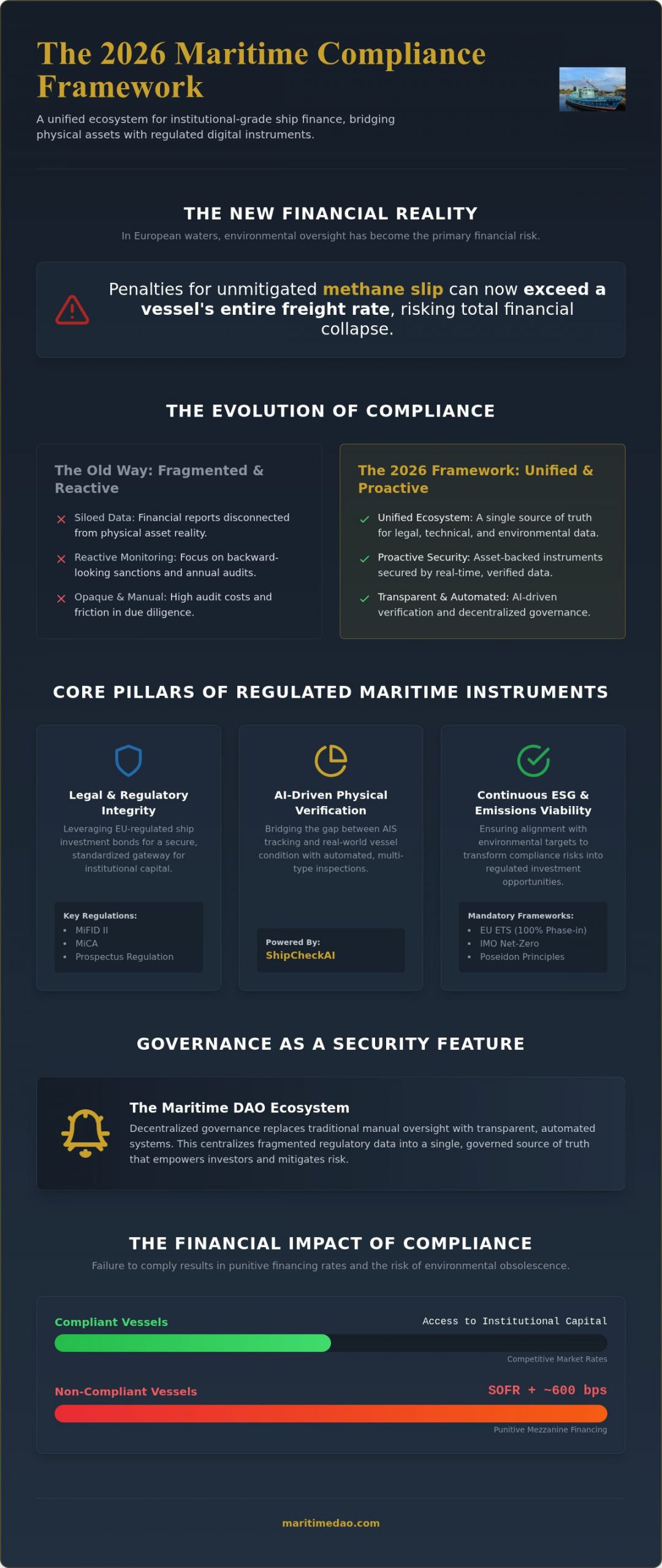
The penalty for unmitigated methane slip in European waters can now exceed a vessel’s primary freight rate, turning a technical oversight into a total financial collapse. You likely feel the mounting pressure of a fragmented regulatory landscape where the friction between IMO net-zero targets and EU ETS requirements makes a traditional maritime finance compliance framework feel obsolete. It’s a common struggle to reconcile opaque physical asset conditions with rigid financial reporting while manual audit costs continue to climb. We understand that the transition to a low-carbon economy requires more than just intent; it demands structural integrity, automated intelligence, and absolute transparency.
This article provides the blueprint to master modern maritime compliance by integrating EU-regulated financial structures with AI-driven asset verification. You’ll learn how to unify technical due diligence, regulatory governance, and capital allocation into a single, high-performance ecosystem. We’ll examine how ShipCheckAI assessments provide the ground truth for EU-regulated ship investment bonds, effectively bridging the gap between physical maritime operations and institutional finance. By the end, you’ll have the tools to transform environmental risks into regulated opportunities, ensuring your fleet remains a viable asset in an era of environmental obsolescence.
Key Takeaways
- Understand why the 2026 maritime finance compliance framework shifts the focus from reactive sanctions monitoring to proactive, asset-backed security.
- Discover how EU-regulated ship investment bonds offer a secure legal architecture for institutional capital by ensuring tangible vessel equity.
- Learn to bridge the gap between AIS tracking and real-world vessel conditions through automated, multi-type inspections with ShipCheckAI.
- Explore how decentralized governance models replace traditional manual oversight with transparent, automated systems that empower investors.
The Evolution of the Maritime Finance Compliance Framework in 2026
In 2026, the maritime finance compliance framework has matured into a unified system of legal, technical, and environmental protocols that govern every dollar of capital deployment in shipping. This isn’t a static checklist. It’s a dynamic ecosystem that bridges the centuries-old foundations of maritime law with real-time digital governance. Traditional siloed models fail because they can’t reconcile the physical reality of a vessel with its financial reporting. Institutional standards now demand a proactive approach to asset-backed security, moving beyond the reactive sanctions monitoring of previous decades. This shift ensures that capital isn’t only legally protected but also operationally viable in a market where technical defaults are increasingly triggered by environmental data.
Drivers of Change: ESG, Sanctions, and Digital Assets
The landscape shifted when the Poseidon Principles, now under the chairmanship of Paul Taylor as of January 2026, transitioned from voluntary disclosure to mandatory reporting. This regulatory tightening coincides with the full phase-in of the EU Emissions Trading System (EU ETS), which now covers 100% of regulated emissions as of January 1, 2026. Lenders don’t just look at balance sheets; they analyze real-time AIS data to assess behavioral risk and operational efficiency. Integrating EU financial regulations directly into maritime debt instruments ensures that capital remains compliant with both the IMO Net-Zero Framework and the stringent requirements of FuelEU Maritime. Compliance is now a continuous process of verification rather than an annual audit.
The Institutional Requirement for Transparency
Investors no longer accept financial audits in isolation. They demand technical truth, which is a verified account of a vessel’s physical condition and carbon intensity. This demand has fueled the rise of asset-backed securities within the maritime sector, where the underlying vessel equity is secured by transparent, unalterable data. The Maritime DAO serves as the visionary architect here, centralizing fragmented regulatory data into a single, governed source of truth that mitigates the risk of environmental obsolescence. This risk is real; vessels failing the IMO Net-Zero Framework now face mezzanine financing rates of approximately SOFR + 600 basis points as of May 2026. This evolution confirms that a robust maritime finance compliance framework is the only pathway to institutional liquidity. The 2026 compliance standard is a tripartite alignment of law, technology, and ecology. By uniting these three pillars, the industry creates a resilient gateway for global capital that respects legacy systems while embracing automated intelligence.
Core Pillars of Regulated Maritime Debt Instruments
Regulated maritime debt instruments stand as the structural foundation of a modern maritime finance compliance framework. These instruments aren’t merely financial contracts; they represent a sophisticated convergence of legal certainty and physical asset security. By leveraging EU-regulated ship investment bonds, issuers provide a standardized gateway for institutional capital that respects the rigid demands of the 2026 market. This architecture ensures that every investment is governed by a transparent set of rules, reducing the friction typically associated with cross-border maritime transactions. It’s a system designed to protect capital while fostering the innovation necessary for a decarbonized fleet.
EU Financial Regulation and Maritime Bonds
Navigating the intersection of MiCA and MiFID II is essential for any maritime asset issuer in 2026. While MiCA governs the digital representation of assets, MiFID II provides the overarching framework for investment services and activities. The Prospectus Regulation further ensures that EU regulated ship investment bonds meet the highest standards of disclosure. This legal rigor transforms maritime debt from a niche alternative into a mainstream institutional asset class. It’s about creating a unified ecosystem where regulatory oversight is built into the bond’s lifecycle, from issuance to maturity. Investors can now access these markets with the confidence that their rights are protected by established European financial standards.
Structuring Debt for Global Shipping Assets
The transition toward regulated maritime debt instruments offers a distinct advantage over traditional equity models. Debt instruments provide a predictable yield and a senior claim on vessel equity, which is vital for risk mitigation in a volatile global trade environment. Diversification across multi-vessel portfolios further protects capital by diluting the impact of a single vessel’s operational downtime. Compliance with the Poseidon Principles ensures that these portfolios remain aligned with international climate goals, preventing the environmental obsolescence that triggers technical defaults. This strategic alignment between capital allocation and technical performance is what defines a successful 2026 investment strategy.
Governance protocols within this framework have evolved to include decentralized autonomous organizations. These DAOs manage investor rights through automated, transparent voting systems, replacing the slow, manual oversight of legacy systems. Furthermore, secondary market liquidity is no longer an afterthought. Regulated exchanges now facilitate compliant exit strategies, allowing investors to trade maritime debt with the same ease as traditional corporate bonds. This liquidity is underpinned by the continuous verification of vessel conditions, ensuring that the asset’s value is always grounded in technical truth. Ultimately, these pillars create a resilient maritime finance compliance framework that protects both the investor and the integrity of global trade.
If you’re ready to diversify your portfolio with high-transparency assets, you can learn more about EU regulated ship investment bonds and their role in modern shipping finance.
Data without physical verification is merely a projection. While digital tracking systems provide unparalleled coverage of vessel movements, they remain blind to the actual physical condition of the asset. A robust maritime finance compliance framework requires a bridge between the digital representation of a ship and its tangible state. ShipCheckAI serves as this critical link, automating multi-type inspections to ensure that bondholders aren’t just investing in a coordinate on a map, but in a seaworthy, compliant vessel. This technical due diligence is no longer optional; it’s the prerequisite for institutional trust in a 2026 market defined by environmental accountability.
By integrating real-time data feeds directly into compliance dashboards, we eliminate the lag between a physical inspection and a financial risk assessment. This transparency is vital for maintaining alignment with the Poseidon Principles, which establish the baseline for climate-aligned lending. When physical inspection results are connected to financial reporting, the risk of environmental obsolescence is mitigated through constant, automated oversight. This ecosystem ensures that technical truth remains the foundation of every regulated investment instrument, protecting both the lender and the integrity of the asset.
AI-Driven Inspection Types and Accuracy
Traditional surveying often relies on sampling that misses deep-seated structural issues. ShipCheckAI utilizes advanced algorithms to conduct both pre-purchase inspections and annual compliance audits with surgical precision. This AI ship inspection tool identifies structural anomalies, such as early-stage corrosion or machinery fatigue, before they escalate into financial liabilities. It provides a tripartite value by protecting the asset, securing the investor, and satisfying the regulator. By standardizing these assessments, the industry moves away from subjective reporting toward a governed, data-driven reality.
Automating Vessel Condition Reports for Investors
Efficiency is the hallmark of regulated innovation. By automating vessel condition reports, we significantly reduce the time-to-issue for maritime bonds, allowing capital to flow into the market with minimal friction. This automation eliminates the human bias and logistical delays inherent in traditional ship surveying methods, providing a neutral, unalterable record of the asset’s health. It creates a methodical flow of information that empowers investors to make decisions based on verified facts rather than opaque estimates. AI-driven accuracy directly reduces insurance premiums for compliant vessels by providing underwriters with a transparent, low-risk profile of the physical asset. This synergy between technology and finance ensures that the maritime sector remains a high-stakes yet highly secure frontier for global capital.
Implementation: Steps to a Compliant Maritime Investment Strategy
Building a resilient maritime finance compliance framework requires a methodical transition from data acquisition to capital deployment. It’s not enough to simply identify an asset; you must validate its technical integrity and regulatory alignment before a single dollar is committed. This process ensures that institutional capital is protected by a tripartite structure of law, technology, and operational truth. Strategy precedes execution. Truth precedes capital. By following a systematic implementation path, investors can navigate the high-stakes 2026 market with institutional confidence.
- Step 1: Asset Selection and Initial Screening via ShipCheckAI. Every investment begins with a multi-type vessel assessment to establish the physical ground truth, identifying structural anomalies that static AIS data might miss.
- Step 2: Regulatory Mapping against EU Financial Standards. We align the verified asset data with the latest EU taxonomy and MiFID II requirements to ensure the investment remains eligible for regulated debt instruments.
- Step 3: Structuring the Investment Bond and Governance Layer. The legal link between the physical hull and the digital bond is established, utilizing a DAO structure to automate investor rights and oversight.
- Step 4: Continuous Monitoring and Automated Compliance Reporting. Real-time data feeds connect vessel performance to compliance dashboards, providing unalterable records for auditors and bondholders.
- Step 5: Portfolio Optimization through AI-driven Insights. We use emissions profiles and operational data to re-evaluate Net Asset Value (NAV), preventing the environmental obsolescence that triggers technical defaults.
Due Diligence for Tokenized Maritime Assets
Tokenization without a rigorous legal bridge is a liability. For institutional investors, verifying the legal link between digital tokens and physical hulls is the most critical step in the due diligence process. This requires a deep understanding of how smart contracts interact with maritime liens and mortgage registrations. Utilizing the Maritime Investment Compliance guide provides a standardized reference for managing these complexities. Smart contract audits must be conducted within a maritime context, ensuring that governance protocols can handle real-world operational contingencies without compromising capital security.
Risk Management and Sanctions Screening
Risk is now dynamic. In 2026, integrating OFAC and EU sanctions lists directly into the DAO governance is mandatory for protecting the broader maritime investment ecosystem. We use behavioral risk triggers, such as identity manipulation or erratic routing, to identify potential interdictions before they occur. This was evidenced by “Operation Southern Spear” in early 2026, where seven tankers were seized for deceptive shipping practices. Automated kill-switches within our smart contracts can halt distributions or flag non-compliant vessel activities in real-time. This proactive defense ensures that your portfolio remains untainted by the compounding fines associated with sanctioned supply chains.
To begin structuring your portfolio under this new standard of regulated innovation, explore the tools available at Maritime DAO.
The Maritime DAO Ecosystem: Governance as a Security Feature
The Maritime DAO represents the final layer of the maritime finance compliance framework, transforming governance from a passive administrative task into an active security feature. Traditional oversight models often rely on voluntary disclosures or manual audits that are prone to human error and significant time lags. In contrast, this ecosystem replaces legacy systems with automated, transparent governance protocols that execute in real-time. This isn’t a digital experiment; it’s a structural evolution that embeds accountability directly into the asset’s lifecycle. By codifying investor rights and operational rules into smart contracts, the Maritime DAO ensures that every action taken, from capital allocation to vessel maintenance, is governed by a unified set of institutional standards.
Empowerment in this context means more than just access; it means influence. Investors within the Maritime DAO participate in the decision-making process through formalized voting rights on critical asset management decisions. This democratic approach to ship finance ensures that the interests of the capital providers remain aligned with the technical performance of the fleet. It’s a “Regulated Innovation” model that bridges the gap between the speed of blockchain technology and the sober reliability of maritime law. This architecture provides a secure gateway for global capital, allowing for a level of transparency and order that was previously unattainable in the opaque world of traditional shipping finance.
Tokenized Ship Ownership in a Regulated Framework
Fractional ship ownership serves as the primary engine for democratizing an industry that has historically been the exclusive domain of ultra-high-net-worth entities. Within our regulated framework, tokenization isn’t about speculative trading; it’s about providing a compliant, asset-backed instrument for a global audience. The Maritime DAO ensures that both retail and institutional participants operate within the same rigorous compliance standards, regardless of their entry point. This inclusivity is governed by a robust legal bridge that links digital tokens to tangible vessel equity. For those looking to transition from observation to action, understanding how to invest in maritime assets is the first step toward participating in this modernized financial landscape.
Future-Proofing Maritime Portfolios
Adaptability is the ultimate defense against environmental obsolescence. As we look toward the IMO 2030 and 2050 targets, the Maritime DAO ecosystem is designed to scale its AI-driven compliance across global fleets with minimal friction. This future-proofing ensures that as regulations evolve, the governance layer automatically updates its parameters to maintain the portfolio’s integrity. The scalability of ShipCheckAI and our automated reporting systems means that a single framework can govern a diverse fleet of tankers, bulkers, and containerships simultaneously. This unified approach reduces the cost of compliance while maximizing the value of the underlying assets. The next logical step for forward-thinking investors is to secure a position in this evolving market by exploring Maritime DAO investment opportunities and accessing EU-regulated ship investment bonds today.
The Future of Ship Finance is Regulated, Transparent, and Unified
The 2026 maritime landscape has moved beyond the era of fragmented reporting and manual oversight. Success now depends on a unified maritime finance compliance framework that bridges the gap between physical asset truth and institutional capital requirements. By integrating EU-regulated financial instruments with ShipCheckAI vessel assessment technology, we’ve built a gateway that mitigates environmental obsolescence while maximizing operational transparency. This transition empowers investors through institutional-grade Maritime DAO governance, ensuring that every decision is backed by unalterable data and legal certainty.
The path forward requires a methodical alignment of law, technology, and ecology. You’ve seen how automated intelligence replaces human bias and how regulated debt instruments provide a senior claim on vessel equity. This isn’t just about avoiding penalties; it’s about leading the evolution of a decarbonized, high-performance fleet. By embracing these pillars, you position your portfolio at the intersection of heavy industry and high finance, where order and innovation coexist for the benefit of all participants.
Secure your position in the future of global trade with EU-regulated maritime bonds.
We look forward to building this first-of-its-kind ecosystem alongside you as we redefine the boundaries of global shipping finance together.
Frequently Asked Questions
What is a maritime finance compliance framework?
A maritime finance compliance framework is a unified system of legal, technical, and environmental protocols that govern capital deployment within the shipping industry. In 2026, it serves as the critical bridge between institutional finance and physical maritime operations. This structure ensures every investment aligns with EU taxonomy, IMO net-zero targets, and sanctions requirements, effectively mitigating the risk of environmental obsolescence through continuous, data-driven oversight.
Are EU-regulated ship investment bonds safe for institutional investors?
EU-regulated ship investment bonds provide a high degree of capital security by adhering to MiFID II and Prospectus Regulation standards. These instruments are structured as senior debt with a direct claim on tangible vessel equity, offering a predictable yield compared to traditional equity models. By integrating automated technical due diligence, these bonds ensure the underlying asset remains operationally viable and compliant with evolving environmental laws.
How does ShipCheckAI improve maritime due diligence?
ShipCheckAI improves maritime due diligence by automating multi-type vessel inspections to provide a transparent, physical ground truth. Unlike static AIS tracking, this tool identifies structural anomalies and machinery fatigue before they become financial liabilities. By generating unalterable condition reports, it eliminates human bias and reduces the time-to-issue for regulated debt instruments. This technical truth ensures investors aren’t just tracking a coordinate but are funding a seaworthy asset.
Can a DAO truly be compliant with EU financial regulations?
A DAO can achieve full compliance by operating as a “regulated innovation” model that bridges blockchain technology with established maritime law. By codifying investor rights and governance protocols into smart contracts, the DAO replaces manual oversight with automated, transparent enforcement. This structure ensures all participants meet KYC and AML requirements while maintaining the democratic voting rights essential for decentralized management within the legal architecture of an EU-regulated framework.
What are the primary risks in decentralized maritime finance?
The primary risks include smart contract vulnerabilities, behavioral risk anomalies, and the convergence of sanctions with ESG requirements. If a vessel’s supply chain is linked to sanctioned entities, it can trigger strict liability and compounding fines. We mitigate these risks by integrating automated kill-switches and real-time OFAC screening into the DAO governance. This proactive defense ensures the broader ecosystem remains untainted by non-compliant activities or technical defaults.
How do tokenized ship bonds compare to traditional maritime equity?
Tokenized ship bonds offer superior liquidity and legal certainty compared to traditional maritime equity. While equity investors face high barriers to entry and opaque management, bondholders benefit from fractional ownership within a regulated framework. These bonds represent senior debt with predictable returns, governed by transparent smart contracts that automate distributions and voting rights. This democratization allows a global audience to access institutional-grade assets previously reserved for exclusive entities.
What role does the Poseidon Principles play in modern maritime compliance?
The Poseidon Principles serve as the mandatory benchmark for climate-aligned lending in the 2026 market. As of January 2026, these principles require financial institutions to disclose the carbon intensity of their portfolios, directly influencing capital allocation. Our framework integrates these standards into every regulated instrument, ensuring vessels meet the IMO Net-Zero Framework. Alignment prevents the environmental obsolescence that often leads to increased mezzanine financing rates or technical loan defaults.
How often should AI vessel inspections be conducted for bond compliance?
AI vessel inspections should be conducted at least annually to maintain alignment with the maritime finance compliance framework. However, pre-purchase assessments and triggered screenings based on behavioral risk anomalies are also essential. Continuous monitoring through real-time data feeds ensures any structural or operational changes are flagged immediately. This frequency provides bondholders and underwriters with a persistent, verified profile of the asset’s health, maintaining the bond’s technical integrity.