
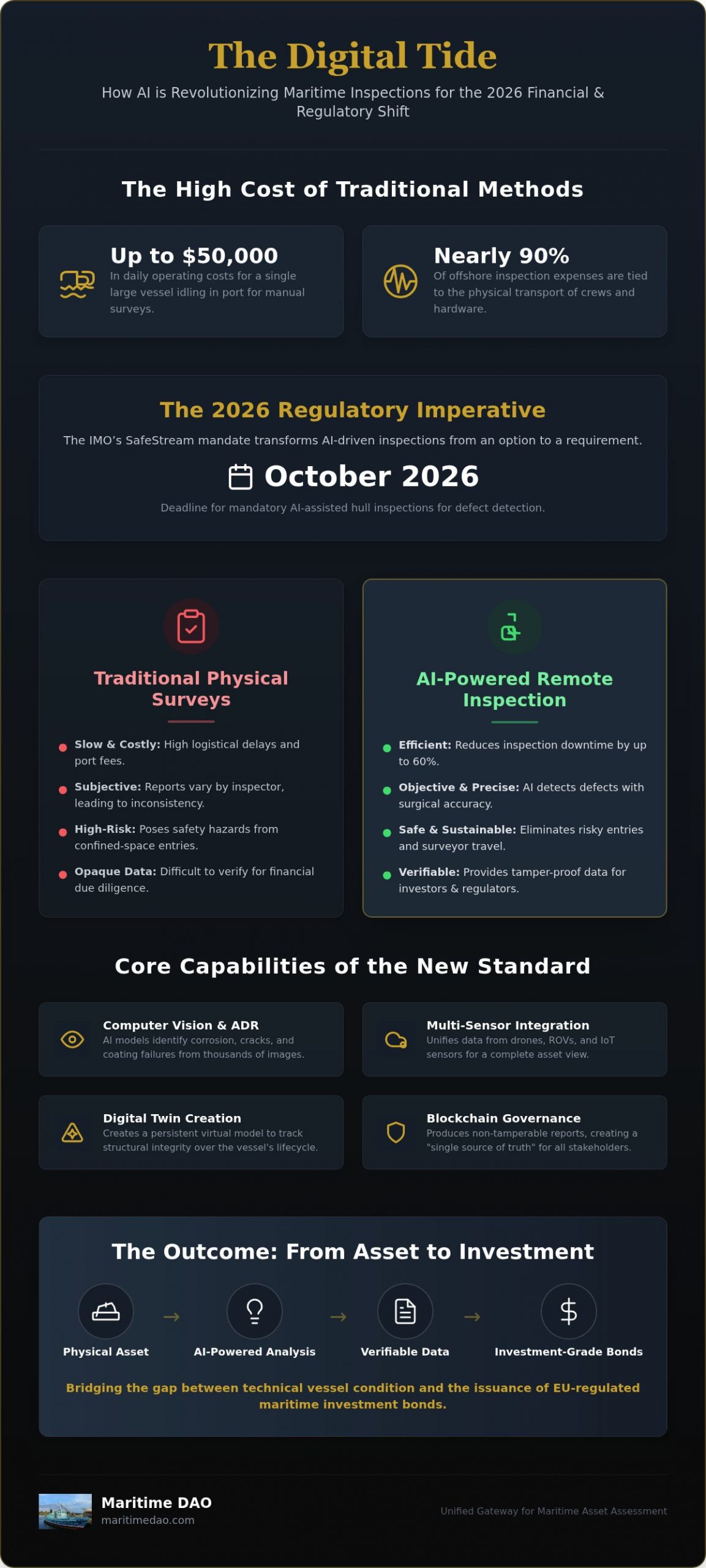
A large vessel idling in port for a manual survey can bleed up to $50,000 in daily operating costs, yet nearly 90% of offshore inspection expenses remain tethered to the physical transport of crews and hardware. You likely recognize that traditional maritime due diligence is often too slow and too subjective to satisfy the rigorous demands of institutional finance. In 2026, the deployment of a sophisticated remote vessel inspection tool is no longer a luxury but a fundamental requirement for risk mitigation. These systems utilize automated intelligence to bridge the gap between physical asset condition and financial bond issuance, ensuring that every weld and hull plate is accounted for within a transparent, data-driven framework.
This guide explores how AI-driven maritime surveys streamline operations, satisfy the IMO’s October 2026 SafeStream mandates, and provide the verifiable proof required for EU-regulated ship investment bonds. You’ll discover how to reduce inspection-related downtime by up to 60% while obtaining standardized reports that meet the highest standards of governance. We will detail the transition from manual, inconsistent checklists to a unified ecosystem where technical status, regulatory compliance, and capital security are inextricably linked.
Key Takeaways
- Understand the critical transition from manual surveys to integrated digital platforms that satisfy the 2026 SafeStream regulations and institutional transparency requirements.
- Discover how a modern remote vessel inspection tool utilizes Automated Defect Recognition (ADR) and computer vision to identify structural anomalies with objective precision.
- Evaluate the operational advantages of remote assessments, including significant cost reductions and the mitigation of safety risks associated with confined-space entries.
- Learn to bridge the gap between technical vessel condition and financial viability by utilizing AI-verified data to support the issuance of EU-regulated maritime investment bonds.
- Explore how ShipCheckAI serves as a unified gateway for multi-type inspections, providing the governed data necessary for transparent maritime asset management.
Remote Vessel Inspection Tools: Why Essential in 2026?
The maritime industry is undergoing a structural transformation, moving away from isolated technical checks toward a unified ecosystem of digital governance. A modern remote vessel inspection tool is no longer defined simply by a technician with a camera; it is a sophisticated digital platform that integrates automated intelligence, real-time data capture, and financial transparency. This shift marks a transition from “Remote Inspection Techniques” (RIT), which were often treated as supplementary methods, to comprehensive “Remote Inspection Tools” that serve as the primary engine for asset-backed security.
Geopolitical shifts and increasingly stringent environmental mandates require a level of transparency that manual reporting cannot provide. With the IMO’s SafeStream regulation taking effect in October 2026, the industry is now mandated to utilize AI-assisted hull inspections for defect detection. The marine TIC market, valued at $2.17 billion in 2026, reflects this rapid adoption of digital oversight. These platforms do more than just ensure compliance; they actively reduce the carbon footprint of maritime operations. By eliminating the need for international surveyor travel and reducing vessel idling time in port, these tools align operational efficiency with global sustainability goals.
The Evolution from Manual Surveys to Digital Asset Assessment
Traditional physical surveys are frequently hampered by logistical delays and high costs, with large vessels often incurring daily port expenses between $15,000 and $50,000. Manual inspections are also susceptible to human error and inconsistent reporting standards. Today’s technology enables real-time, high-definition data capture through Remote Visual Inspection (RVI), allowing stakeholders to assess a ship’s condition from anywhere in the world. This granular data serves as the foundation for “digital twins,” creating a persistent virtual model of the vessel that tracks structural integrity over its entire lifecycle.
Satisfying Modern Classification and Statutory Requirements
Adherence to IACS standards and classification society rules, such as those from ABS and RINA, is non-negotiable for institutional maritime finance. It’s essential to distinguish between a remote survey, which is a regulatory event, and a remote vessel inspection tool used for operational assessment. While a survey satisfies the flag state, a technical inspection provides the deep-dive analytics required by investors. To satisfy the due diligence requirements of maritime investment bonds, these tools must ensure data integrity. By utilizing blockchain-based governance, these platforms produce non-tamperable reports that bridge the gap between technical status and financial issuance, providing a “single source of truth” for all stakeholders.
The Core Capabilities of AI-Powered Vessel Inspection Software
The efficacy of a modern remote vessel inspection tool rests upon its ability to transform raw visual data into actionable financial intelligence. This transformation is achieved through a sophisticated architecture that unites automated intelligence, cloud-based collaboration, and multi-sensor integration. By centralizing data from drones, Remotely Operated Vehicles (ROVs), and IoT sensor streams, these platforms provide a comprehensive view of asset health that traditional methods simply cannot replicate. The result is a tripartite value proposition: high-fidelity detection, standardized analysis, and transparent reporting.
Computer Vision and Automated Defect Recognition
At the heart of this technological shift is Automated Defect Recognition (ADR). Utilizing advanced computer vision models, these tools employ neural networks trained on massive maritime-specific datasets to identify corrosion, structural cracks, and coating failures with surgical precision. This automated triage is critical when processing thousands of high-definition images from a single survey. ShipCheckAI, for instance, utilizes these models to categorize defects by severity, significantly reducing the frequency of “false positives” that plague less specialized software. This level of automated visual analysis ensures that technical managers can focus their resources on critical repairs rather than manual data sorting.
Beyond visual identification, Natural Language Processing (NLP) is utilized to convert these findings into standardized, professional reports. This eliminates the subjectivity inherent in manual surveys, providing a consistent register that meets the expectations of both technical superintendents and institutional investors. By grounding technical assessments in objective data, stakeholders can make informed decisions regarding maintenance and capital allocation.
Real-time Data Synchronization and Global Accessibility
The historical “data silo” between the ship and the shore office has long been a barrier to efficient asset management. Modern inspection software solves this through real-time data synchronization. While the tool is built for global connectivity, it also incorporates offline-first capabilities to ensure that inspections can proceed in environments with poor satellite reception. Once a connection is re-established, the data is securely uploaded to a cloud-based ecosystem where it becomes accessible to a global team of surveyors, owners, and insurers simultaneously.
This transparency is foundational for meeting industry-wide remote inspection standards, ensuring that all parties are viewing the same “single source of truth.” For institutional bondholders, this access is a critical component of due diligence, providing a transparent window into the physical status of the underlying asset. To see how these technical capabilities integrate into a broader financial framework, you can explore the Maritime DAO ecosystem, where AI-verified inspections support the issuance of regulated maritime securities.
Remote Inspection vs. Traditional Physical Ship Surveys
Traditional maritime surveys have historically relied on the physical presence of a surveyor, a process that inherently introduces logistical friction, significant expense, and subjective bias. A remote vessel inspection tool fundamentally redefines this dynamic by decoupling the act of data collection from the act of analysis. While a physical survey requires the coordination of travel, boarding permits, and vessel downtime, a digital assessment leverages locally deployed hardware or ship-based sensors to transmit high-fidelity data to shoreside experts. This shift prioritizes operational continuity, personnel safety, and data-driven governance over legacy manual processes.
The safety implications of this transition are profound. Traditional methods often require surveyors to enter hazardous confined spaces, such as ballast tanks or cargo holds, where oxygen deficiency and structural instability pose life-threatening risks. By utilizing a remote vessel inspection tool integrated with drones or ROVs, these high-risk environments are assessed without human entry. This approach not only protects personnel but also ensures a more comprehensive visual record than a human inspector could capture under restricted conditions. The resulting ecosystem is one where safety, efficiency, and transparency operate in tandem.
Cost-Efficiency and Operational Downtime Analysis
The financial impact of remote methodologies is measurable and immediate. Organizations utilizing remote video and AI-driven software report a reduction in inspection costs by 40% to 60%, primarily through the total elimination of surveyor travel, accommodation, and wait-time expenses. Because these tools allow for “live” assessments while the vessel is in transit or undergoing cargo operations, they prevent ships from going off-hire for routine verification checks. For large fleet owners, the return on investment for a remote vessel inspection tool is realized through the aggregation of avoided travel fees, reduced off-hire durations, and the extended lifespan of assets via predictive maintenance analytics.
Accuracy, Reliability, and the Role of Human-in-the-Loop AI
A common industry objection asks whether a digital tool can truly replicate the “feel” and intuition of an experienced surveyor. The answer lies in a hybrid, human-in-the-loop model. While AI cannot feel the vibration of a deck plate, it can detect microscopic fractures, coating failures, and thermal anomalies that elude the human eye. These tools don’t replace the surveyor; they empower them with standardized, non-tamperable data that eliminates the inconsistency of handwritten notes. This synergy ensures that the final condition report is grounded in objective evidence, providing a reliable foundation for long-term asset lifecycle management and the stringent due diligence required for maritime bond issuance.
Selecting the Right Remote Inspection Tool for Your Fleet
Choosing a remote vessel inspection tool requires a shift in perspective, moving from a narrow focus on visual hardware to a broader evaluation of structural integrity, system interoperability, and regulatory alignment. A fleet manager must prioritize platforms that offer seamless integration with existing ship management systems (SMS) while supporting a diverse range of assessment types, including pre-purchase surveys, vetting inspections, and routine condition monitoring. Versatility is essential; a tool that only handles hull checks but fails at ballast tank assessments or machinery space vetting creates fragmented data silos. The selection process should be governed by three distinct pillars: operational compatibility, data sovereignty, and financial transparency.
Essential Features for Regulatory Compliance and Transparency
Compliance in 2026 is no longer a static checklist but a dynamic, verifiable stream of evidence. The chosen software must generate reports that align with IMO SafeStream mandates and specific Flag State requirements, utilizing non-tamperable audit trails and multi-factor digital signatures to ensure data authenticity. This level of rigor is what separates a professional tool from a mere video streaming service. Implementing a robust framework for AI in maritime due diligence ensures that every structural finding is logged, timestamped, and immutable. This provides the high-stakes transparency that regulators and insurers now demand, ensuring that the vessel’s digital record remains an accurate reflection of its physical state.
Integration with Financial Reporting and Bond Issuance
For institutional capital, the technical health of a vessel is directly correlated with the security of the underlying investment. Modern investors demand “live” asset condition data to mitigate risk, making the link between technical status and financial performance a critical selection criterion. When technical data is integrated into the governance of EU regulated ship investment bonds, it provides a level of security that legacy reports cannot match. This data can even be used to trigger automated governance actions within a decentralized framework, ensuring that maintenance thresholds are met to protect bondholder value. To explore how these digital gateways unite technical oversight with capital security, you can visit the Maritime DAO platform.
ShipCheckAI: The Unified Gateway for Maritime Asset Assessment
ShipCheckAI represents the culmination of maritime engineering and financial technology, serving as the central nervous system for asset assessment within the Maritime DAO ecosystem. This remote vessel inspection tool is engineered to provide the granular transparency required for modern capital markets, functioning as both a technical utility and a financial gatekeeper. It moves beyond the limitations of single-purpose software by offering a unified interface where technical superintendents and financial auditors verify asset integrity in real-time. By centralizing data, ShipCheckAI ensures that every structural finding is logged within a governed framework that respects operational complexity and legal necessity. This platform empowers stakeholders to move from reactive repairs to a proactive, data-driven strategy where asset value is protected through continuous oversight.
Multi-Type Inspection Capabilities within a Single Platform
The architecture of ShipCheckAI is built on versatility, allowing users to switch between pre-purchase, condition, and statutory survey modes without migrating data between disparate systems. The platform provides customizable templates tailored to the unique structural requirements of tankers, bulk carriers, and containerships, ensuring that critical stress points and specialized machinery are never overlooked. A comprehensive ShipCheckAI vessel assessment standardizes global fleet data, transforming subjective observations into a unified digital record. This standardization is the bedrock of the 2026 maritime market, where interoperable data is the primary currency for asset management. By utilizing this remote vessel inspection tool, owners can maintain a persistent “digital health record” for every vessel in their fleet, facilitating faster vetting and more accurate valuations.
Bridging Technical Condition with Investment Security
The true power of ShipCheckAI lies in its ability to bridge the gap between technical condition and investment security through a tripartite model of verification, governance, and transparency. By providing an immutable, AI-verified record of a vessel’s health, the platform builds the essential trust required for maritime DAO investment. This transparency directly impacts the financial performance of asset-backed securities. When investors have real-time access to structural data, the perceived risk and subsequent risk premium for maritime bonds are significantly reduced. The platform acts as a reliable gatekeeper, ensuring that only assets meeting rigorous technical standards are permitted into the investment pool.
Looking toward the future, ShipCheckAI is evolving to incorporate predictive maintenance algorithms and real-time risk scoring, allowing owners to anticipate failures before they occur. This transition from static reporting to dynamic intelligence ensures that maritime assets remain compliant with evolving 2026 regulations while maximizing their operational lifespan. To participate in this new era of transparent maritime finance and explore how AI-driven assessments secure institutional capital, visit the Maritime DAO platform today.
Securing the Future of Maritime Due Diligence
The 2026 maritime landscape demands a departure from subjective, manual surveys toward a unified ecosystem of digital governance. By integrating a sophisticated remote vessel inspection tool into your operational workflow, you don’t just reduce downtime; you establish a non-tamperable record of asset integrity. This transition ensures your fleet remains compliant with the latest IMO SafeStream mandates while providing the transparent data required by institutional capital markets. ShipCheckAI delivers AI-powered accuracy for multi-type vessel assessments, bridging the gap between physical condition and financial security.
It’s fully integrated with EU-regulated financial frameworks and governed by the Maritime DAO ecosystem, creating a “single source of truth” for owners and investors alike. The integration of technical oversight and capital management is no longer a vision for the future; it’s a practical reality for those seeking to lead in a globalized, data-driven industry. We invite you to secure your maritime assets with the ShipCheckAI inspection tool and explore our regulated bond ecosystem. Your fleet’s evolution into a modern, transparent asset class starts here.
Frequently Asked Questions
What is the difference between a remote vessel inspection and a traditional survey?
Remote inspections decouple the act of data collection from the act of analysis. A surveyor doesn’t need to be physically present on the deck. Instead, high-definition video, drones, or ROVs capture the necessary data, which is then transmitted to shoreside experts for review. This process drastically reduces travel expenses and vessel downtime. Traditional surveys require physical attendance, which often leads to logistical delays and higher safety risks for personnel in confined spaces.
Are remote vessel inspection tools accepted by classification societies like ABS or RINA?
Major classification societies, including ABS and RINA, have established clear frameworks for accepting data from a remote vessel inspection tool. These bodies recognize remote methodologies provided they comply with specific class rules and IACS standards. Documentation must demonstrate that the remote platform provides an equivalent level of assurance to a physical survey. This usually requires high-resolution visual evidence, secure data transmission protocols, and verifiable audit trails for every structural finding.
How does ShipCheckAI use AI to improve vessel inspection accuracy?
ShipCheckAI utilizes Automated Defect Recognition (ADR) powered by neural networks to identify structural anomalies with surgical precision. The system processes thousands of images to detect corrosion, coating failures, and microscopic cracks that might be overlooked during a manual walkthrough. By comparing current data against vast maritime-specific datasets, the AI provides objective triage. This ensures that technical managers receive a standardized, data-driven report that prioritizes critical repairs based on verified severity levels.
Can a remote inspection tool be used for pre-purchase ship assessments?
Remote tools are increasingly the preferred method for pre-purchase due diligence in 2026. They allow potential buyers to conduct a comprehensive condition assessment without the delays associated with international travel or port restrictions. ShipCheckAI offers specialized pre-purchase templates that ensure every critical area of the vessel is visually documented and AI-verified. This transparency provides a “single source of truth” that accelerates the negotiation process and justifies the asset’s valuation to institutional investors.
What hardware is required to use a remote vessel inspection tool effectively?
Effective use typically requires a combination of high-definition cameras, stabilized drones for superstructure checks, and Remotely Operated Vehicles (ROVs) for underwater hull assessments. For internal spaces, hand-held mobile devices with high-lumen lighting and satellite connectivity are essential. These hardware components must be capable of capturing high-fidelity visual data that can be synchronized with the cloud-based remote vessel inspection tool for immediate analysis by shoreside superintendents and financial auditors.
How do remote inspection tools impact maritime insurance premiums?
Insurers view the continuous, high-fidelity data provided by remote tools as a significant risk-mitigation factor. By maintaining a transparent, AI-verified record of a vessel’s condition, owners can demonstrate proactive maintenance and superior risk management. This transparency can lead to more favorable premium structures or lower deductibles. The ability to provide objective evidence of structural integrity reduces the uncertainty that typically drives up insurance costs in the traditional maritime market, rewarding owners for technical transparency.
Is the data from remote inspection tools secure and tamper-proof?
Data integrity is maintained through a combination of encrypted cloud storage and blockchain-based audit trails. Every image, video, and AI finding is timestamped and digitally signed at the point of capture, creating an immutable record of the inspection. This ensures that the reports generated by ShipCheckAI can’t be altered or falsified by unauthorized parties. This level of security is fundamental for satisfying the rigorous due diligence requirements of institutional financiers and international regulatory bodies.
How does remote inspection technology support EU-regulated ship investment bonds?
Remote technology provides the objective transparency required to transform a physical ship into a bankable financial asset. For EU-regulated ship investment bonds, investors demand verifiable proof of the underlying asset’s condition before committing capital. ShipCheckAI acts as the primary due diligence engine, linking the vessel’s technical health directly to the financial instrument. This real-time visibility ensures that governance standards are met, protecting bondholder value through a transparent, AI-verified ecosystem of regulated maritime finance.