
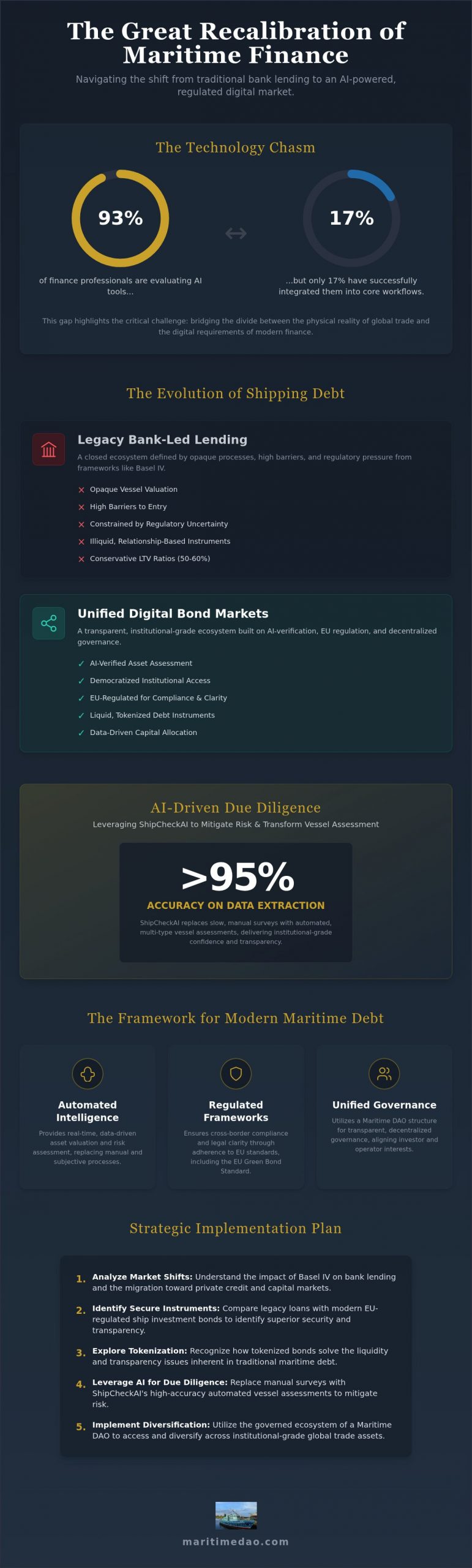
As of August 2026, while 93% of finance professionals are evaluating artificial intelligence, only 17% have successfully integrated these tools into their core workflows to solve the industry’s most persistent inefficiencies. For decades, the maritime sector remained a closed ecosystem defined by opaque vessel valuation processes and high barriers to entry that sidelined all but the largest institutional players. You likely recognize that traditional shipping debt financing options often feel constrained by regulatory uncertainty and a lack of transparency in cross-border capital flows. The gap between the physical reality of global trade and the digital requirements of modern finance has reached a critical turning point.
This guide explores the transition from legacy bank-led lending to a unified landscape of AI-verified and EU-regulated digital bond markets. You’ll discover how to identify high-yield debt instruments while leveraging ShipCheckAI to mitigate risk through automated, multi-type vessel assessments. We examine the rise of EU-regulated ship investment bonds, the impact of the EU Green Bond Standard, and the precise ways automated intelligence delivers over 95% accuracy on data extraction. By the end of this analysis, you’ll understand how to access institutional-grade maritime debt through a framework that prioritizes structural integrity, legal compliance, and transparent governance.
Key Takeaways
- Analyze the impact of Basel IV on traditional bank lending and the subsequent migration toward private credit and capital markets.
- Identify the most secure shipping debt financing options by comparing legacy senior secured loans with modern, EU-regulated debt instruments.
- Explore how tokenization and EU-regulated ship investment bonds solve the liquidity and transparency issues inherent in traditional maritime debt.
- Leverage ShipCheckAI to transform the due diligence process, replacing manual surveys with automated, high-accuracy vessel assessments.
- Implement a strategic diversification plan that utilizes the governed ecosystem of a Maritime DAO to access institutional-grade global trade assets.
The Shift in Shipping Debt Financing: From Banks to Capital Markets
The maritime credit landscape is undergoing a fundamental recalibration. For decades, the industry relied on a select group of European lenders to provide the bedrock of capital. That era has ended. As of 2026, the full implementation of Basel IV has fundamentally altered the risk-weighting of maritime assets, forcing traditional banks to increase their capital buffers significantly. This regulatory pressure has triggered a strategic retreat from direct lending, particularly for mid-market vessel owners who no longer fit the tightened risk profiles of institutional banks.
The Decline of Traditional Lending
The withdrawal of legacy providers has created a structural liquidity gap that traditional financial instruments struggle to fill. Increased capital requirements mean that even established lenders are prioritizing larger, lower-risk portfolios, leaving a vacuum in the financing of versatile, mid-sized fleets. This shift hasn’t been a gradual evolution but a sharp correction. Shipowners are now forced to look beyond the traditional ship mortgage to maintain operational continuity. They’re seeking diversified funding sources that offer more flexibility than bilateral bank loans, which are now often weighed down by restrictive covenants and ESG-related reporting mandates. Evaluating modern shipping debt financing options requires a move away from relationship-based banking toward data-driven capital allocation.
The Rise of Institutional Capital Markets
In this environment, alternative shipping debt financing options have transitioned from a niche backup to a structural necessity. Private debt funds, institutional investors, and family offices are aggressively entering the maritime sector, drawn by the sector’s tangible asset backing and attractive yield profiles. The global shipping finance market currently exceeds $400 billion in outstanding debt, with a growing percentage of that capital originating from non-bank sources. The evolution of these instruments reflects a broader move toward digitized, institutional-grade assets.
This shift toward structured finance and securitization is supported by a new ecosystem of digital platforms. These gateways provide the structural integrity, technical verification, and regulatory clarity required for institutional participation. Modern maritime finance now prioritizes three distinct pillars:
- Automated intelligence for real-time asset valuation.
- Regulated frameworks that ensure cross-border compliance.
- Unified governance through decentralized technology.
Transparency has become the primary currency. Investors in 2026 don’t just want yield; they demand a transparent window into the operational health and environmental compliance of the underlying assets. By moving debt into the capital markets, the industry is democratizing access to high-stakes global trade while building a more resilient, technology-governed financial infrastructure.
Comparing Traditional and Alternative Shipping Debt Structures
The hierarchy of capital in maritime finance is a study in risk mitigation and capital efficiency. Investors must distinguish between senior secured instruments and subordinated layers to optimize their risk-adjusted returns. Mezzanine maritime debt serves as the critical bridge between senior secured loans and equity participation. While senior debt offers the security of first-priority liens, mezzanine structures provide higher yields by absorbing more risk. Evaluating the spectrum of shipping debt financing options requires an understanding of how these distinct structures interact within a broader institutional portfolio.
Direct Lending and Mortgage-Backed Debt
Traditional ship mortgages continue to serve as the foundational layer of the industry’s capital stack. In 2026, the mechanics of these instruments have tightened. Loan-to-value (LTV) requirements typically hover between 50% and 60%, a conservative shift driven by the heightened capital requirements of the Basel IV era. Covenants now extend beyond simple financial ratios; they frequently include emissions targets and operational transparency mandates. Enforcing these debts across multi-jurisdictional waters remains a complex endeavor. This complexity often necessitates the involvement of local legal advisors to navigate the specific admiralty laws of various port states. For a broader perspective on how these instruments fit into global commerce, the U.S. government’s Trade Finance Guide provides an authoritative framework for understanding cross-border credit risks.
Leasing and Alternative Credit
Alternative credit structures have gained significant momentum as flexible shipping debt financing options compared to rigid bank debt. Sale-and-leaseback (SLB) arrangements are now a primary tool for fleet modernization, allowing owners to unlock capital from older vessels to fund green-tech retrofits. These transactions are increasingly governed by standardized term sheets, such as BIMCO SHIPLEASE, which provide a unified framework for documentation. In the Japanese market, JOLCOs (Japanese Operating Leases with Call Options) remain a sophisticated choice for tax-efficient financing, though they require deep expertise to execute correctly.
The cost of capital varies significantly across these tiers. While top-tier shipowners might secure bank margins of 100 to 150 basis points over SOFR, private credit funds often command higher rates in exchange for greater leverage and speed. This trade-off is essential for owners who need to move quickly in a competitive market. To understand how these structures are evolving, you might explore the future of ship finance and its transition toward decentralized, governed ecosystems.
Regulated Ship Investment Bonds: The 2026 Frontier
The maritime finance sector is witnessing the emergence of a standardized, institutional-grade asset class. While traditional debt remains fragmented across various jurisdictions, EU regulated ship investment bonds offer a unified vehicle for capital deployment. These instruments aren’t merely digital versions of legacy debt; they represent a fundamental shift toward a governed ecosystem. By aligning with the European Securities and Markets Authority (ESMA) standards, these bonds provide a level of structural integrity that traditional private placements often lack. For investors navigating the evolving landscape of shipping debt financing options, these regulated vehicles bridge the gap between heavy industry and high finance.
Tokenized Debt and Digital Assets
Liquidity has historically been the primary barrier to entry for maritime debt. Tokenization addresses this by enabling the fractional ownership of tokenized ship bonds, allowing both institutional and qualified retail investors to participate in specific vessel debt. Smart contracts serve as the automated enforcement mechanism. They govern the unified distribution of interest payments and ensure that principal repayments are executed without the delays typical of manual settlement. This digital architecture transforms an illiquid physical asset into a transparent, tradeable credit instrument. It’s a first-of-its-kind democratization of a high-stakes industry that was once the exclusive domain of global banks.
EU Regulatory Frameworks for Maritime Bonds
The distinction between speculative digital assets and regulated innovation lies in the rigor of maritime investment compliance. In 2026, issuers of ship investment bonds must adhere to strict reporting requirements, including the EU Green Bond Standard (EuGB). This regulation ensures that bondholders have a transparent view of the vessel’s environmental performance and operational health. Compliance isn’t an optional layer; it’s the foundation of the bond’s value. Unlike unregulated maritime tokens that lack legal recourse, these regulated bonds operate within a clear jurisdictional framework. This structural reliability is what attracts institutional capital. It provides a credible alternative to the shrinking pool of traditional shipping debt financing options while maintaining the sober reliability expected in institutional finance. The presence of a “greenium” in these bonds further incentivizes the transition to a sustainable fleet, rewarding transparency with lower borrowing costs.
AI-Driven Due Diligence: Securing Shipping Debt with Technology
Traditional ship surveys, often conducted by individual inspectors with varying degrees of subjectivity, are no longer sufficient for the rigorous underwriting requirements of modern capital markets. In a sector where physical assets are constantly in motion across jurisdictions, AI ship inspection is the technical foundation of 2026 maritime finance. While 93% of finance professionals are currently evaluating artificial intelligence, only 17% have successfully integrated these tools into their core workflows. This gap represents a significant opportunity for those who utilize technical verification to secure their shipping debt financing options.
Maritime debt underwriting is rapidly becoming a data-science discipline. Integrating AI in maritime due diligence allows lenders to move beyond anecdotal evidence and manual checklists. Research indicates that leading AI platforms deliver over 95% accuracy on data extraction while saving more than five days of processing time per deal. For bondholders, this level of precision isn’t just a convenience; it’s a structural safeguard that ensures the underlying collateral is accurately valued and legally compliant before any capital is deployed.
Automating the Vessel Inspection Process
Systems like ShipCheckAI are now essential for both pre-purchase assessments and recurring annual surveys. By automating the analysis of hull integrity, machinery health, and regulatory documentation, these tools significantly reduce the risk of human error in vessel valuation. This creates a tripartite link between the physical asset’s condition, the technical verification of that condition, and the ultimate bond yields delivered to investors. It’s a unified ecosystem where technology governs the flow of capital by proving the actual worth of the vessel in a transparent, auditable format.
Risk Management through Continuous Monitoring
Static, one-time reports are becoming obsolete in the face of dynamic asset monitoring. Modern debt structures now utilize real-time data streams to track vessel performance and maintenance schedules. If a ship’s operational efficiency drops or critical maintenance is deferred, AI-driven alerts notify bondholders and trustees immediately. This granular visibility directly influences how shipping debt financing options are priced in the secondary market. In 2026, vessels with high-fidelity, AI-verified data often secure more favorable interest rates because the risk premium is lowered by transparency. This proactive approach ensures that capital remains protected throughout the entire lifecycle of the debt instrument, bridging the gap between heavy industry and institutional finance. To integrate these technical safeguards into your maritime portfolio, explore the institutional gateways at Maritime DAO.
Implementing a Modern Maritime Debt Strategy
Success in the 2026 credit market requires a transition from passive observation to active, data-driven participation. Investors are no longer limited to the restrictive shipping debt financing options offered by legacy banks. Instead, they must construct a strategy that integrates technical verification with regulated financial vehicles. This approach ensures that capital is deployed into an ecosystem where risk is transparently governed, assets are continuously monitored, and legal frameworks are strictly followed. It’s a fundamental shift toward institutional-grade maritime debt that values structural integrity over legacy relationships.
Building a Diversified Maritime Portfolio
Diversification remains the primary safeguard against the inherent volatility of global trade. An institutional strategy balances senior secured bonds, which offer first-priority security, with mezzanine debt layers to enhance overall portfolio yield. Spreading exposure across multiple vessel classes, such as LNG carriers, dry bulkers, and container ships, mitigates the impact of sector-specific downturns. Geographic diversification is equally vital. Port fees, trade tariffs, and regional regulations vary significantly across international corridors, making a global footprint essential. In this environment, ESG compliance acts as a critical risk filter. Vessels aligned with the Poseidon Principles or the EU Green Bond Standard are better positioned to maintain their value as decarbonization mandates tighten. This tripartite approach-balancing debt tiers, vessel types, and regulatory compliance-creates a resilient foundation for long-term capital growth.
The Maritime DAO Advantage
The maritime DAO investment framework provides a unified gateway for this modern strategy. It replaces fragmented lending with a transparent, governed structure that bridges the physical and digital worlds. By participating in EU-regulated bond issuances via a DAO, investors gain access to high-stakes maritime assets within a legally compliant framework that prioritizes security and democratization. This is a first-of-its-kind model where technology governs the flow of capital and ensures that every participant has a transparent view of the underlying collateral.
For those seeking independent verification, accessing ShipCheckAI is the critical next step. It provides the multi-type vessel assessments needed to validate the condition of any ship before it’s tokenized or bonded. As the global shipping finance market continues to exceed $400 billion, the shift toward these unified capital markets will only accelerate. Fleet owners and investors who embrace these shipping debt financing options will lead the industry into a new era defined by technical precision and institutional reliability.
Navigating the Future of Maritime Capital
The maritime industry’s transition from legacy bank-led lending to a unified capital market defined by technical precision and institutional transparency is now a structural reality. As traditional lenders retreat under the weight of Basel IV capital requirements, sophisticated investors are increasingly prioritizing alternative shipping debt financing options that offer both structural integrity and legal compliance. By integrating AI-driven due diligence with regulated digital frameworks, the sector has finally bridged the gap between opaque physical assets and the rigorous demands of institutional finance.
Success in this era requires a commitment to three distinct operational pillars: regulated innovation, automated intelligence, and unified governance. This methodical approach ensures that every capital allocation is backed by high-fidelity data and a transparent legal framework that protects bondholders. You now have the opportunity to participate in a traditionally exclusive industry through a gateway designed for security and democratization.
Explore EU-Regulated Ship Investment Bonds at Maritime DAO to access our institutional-grade framework and leverage ShipCheckAI for professional vessel due diligence. The horizon for maritime credit has never been clearer; it’s time to secure your position in the next generation of global trade finance.
Frequently Asked Questions
What are the main types of shipping debt financing options available in 2026?
The primary shipping debt financing options in 2026 include senior secured bank loans, mezzanine debt, sale-and-leaseback arrangements, and EU-regulated ship investment bonds. Private credit funds have aggressively filled the vacuum left by traditional lenders, offering higher leverage and flexible terms. These instruments allow for a diversified capital stack where technical verification through AI platforms ensures the structural integrity of the underlying maritime collateral.
Is it possible to invest in ship bonds through a regulated platform?
Yes, investors can engage with maritime debt through institutional gateways like Maritime DAO, which offers EU-regulated ship investment bonds. These platforms provide a unified ecosystem where physical assets are linked to digital governance frameworks. This ensures that every bond issuance is compliant with European securities laws, offering a level of transparency and legal recourse that isn’t available in unregulated or speculative digital asset markets.
How does ShipCheckAI improve the security of maritime debt investments?
ShipCheckAI improves security by providing automated, high-fidelity vessel assessments that deliver over 95% accuracy in data extraction. By replacing subjective manual surveys with technical verification, the tool identifies operational risks and maintenance lapses in real-time. This technical foundation ensures that the debt is backed by a vessel in verified physical condition, significantly reducing the probability of collateral devaluation during the bond’s lifecycle.
What are the risks associated with alternative shipping finance?
Alternative financing risks include lower liquidity compared to public equities and the complexity of multi-jurisdictional legal enforcement. While private credit and mezzanine debt offer higher yields, they often sit lower in the capital stack than senior loans. Investors should also account for regulatory shifts in environmental compliance, as vessels failing to meet evolving ESG standards may face steeper depreciation or limited operational windows in regulated waters.
How do EU-regulated ship investment bonds differ from traditional bank loans?
EU-regulated ship investment bonds differ from bank loans by offering enhanced liquidity through fractional ownership and standardized reporting under the EU Green Bond Standard. Unlike bilateral bank loans, which are often opaque and relationship-based, these bonds are transparent credit instruments governed by smart contracts. This shift provides investors with real-time visibility into asset performance while allowing for more flexible capital structures than legacy mortgage-backed lending.
Can retail investors access the maritime debt market in 2026?
Qualified retail investors can now access the maritime debt market through tokenized investment vehicles that lower traditional entry barriers. By utilizing fractional ownership, these platforms allow participants to engage with institutional-grade shipping debt financing options that were previously reserved for global banks. This democratization isn’t just about access; it’s about providing a regulated framework where every participant benefits from the same level of transparency and legal protection.
What role does tokenization play in shipping debt financing?
Tokenization acts as the bridge between physical maritime assets and digital capital markets by converting vessel debt into tradeable digital units. It enables automated interest distribution via smart contracts and provides a transparent ledger of ownership. This digital architecture increases market efficiency by reducing settlement times and allowing for the seamless transfer of debt positions without the administrative overhead typical of traditional loan assignments.
Why is Basel IV significant for the shipping industry financing landscape?
Basel IV is significant because it’s dramatically increased the capital requirements for banks holding maritime loan portfolios. This regulatory pressure has forced many traditional European lenders to reduce their exposure, creating a structural liquidity gap in the market. Consequently, the financing landscape has shifted toward private credit and regulated bond markets, making these alternative instruments a structural necessity for modern fleet modernization and expansion.