
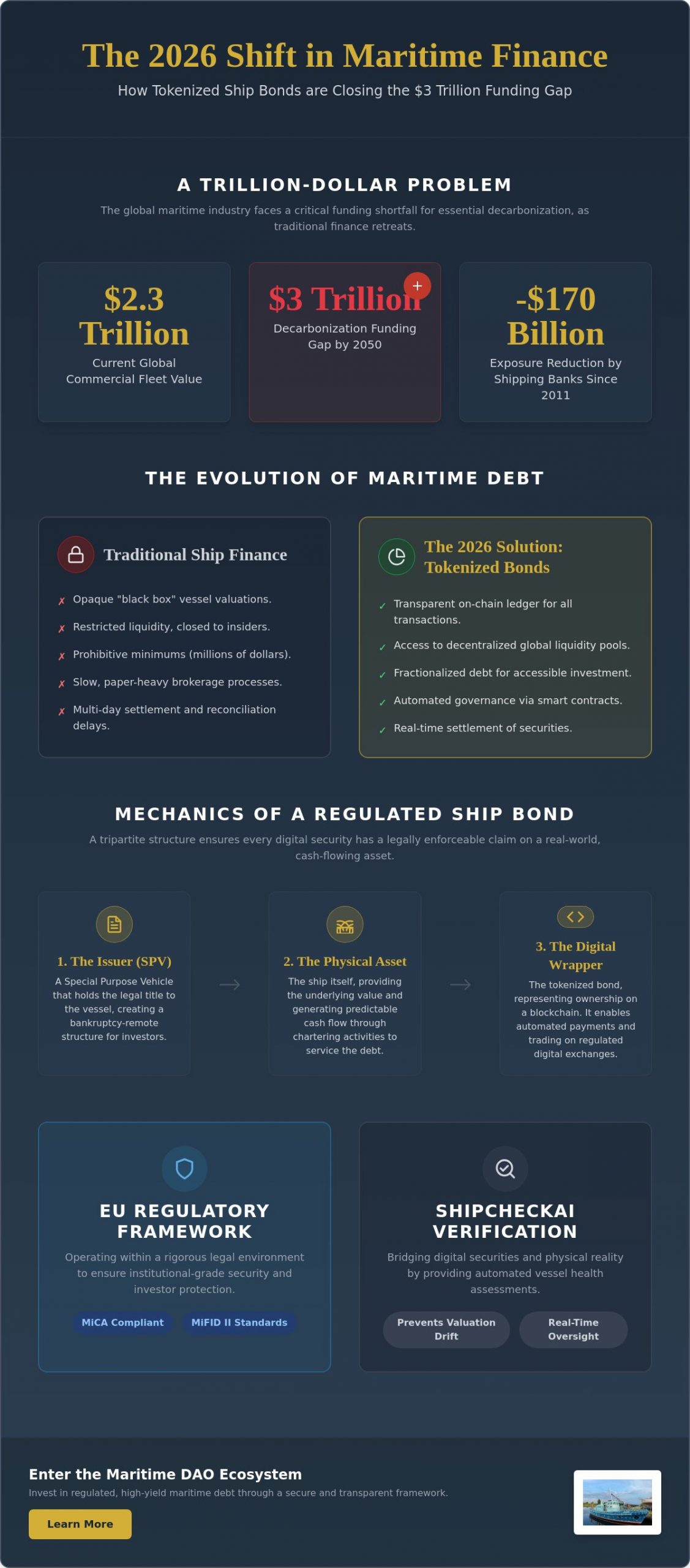
The global commercial fleet is currently valued at $2.3 trillion, yet the industry faces a staggering $3 trillion funding gap to achieve critical decarbonization targets by 2050. You likely recognize that traditional maritime finance has long functioned as a closed circuit, defined by restricted liquidity and opaque vessel valuations that deter even the most seasoned institutional players. The rise of tokenized ship bonds in 2026 is finally dismantling these systemic barriers, offering a sophisticated bridge between legacy debt markets and the efficiency of decentralized liquidity.
By reading this analysis, you’ll discover how regulated EU frameworks like MiCA and the DLT Pilot Regime provide the structural integrity needed to transform physical vessels into compliant digital securities. We will detail how a unified ecosystem of AI-powered inspections, governed digital assets, and institutional-grade oversight creates a new standard for transparency. This evolution promises to unlock access to high-yield maritime debt while ensuring real-time visibility into the operational health and verified value of every ship in the portfolio.
Key Takeaways
- Understand how the structural contraction of traditional shipping banks is driving the transition toward tokenized ship bonds as a primary vehicle for maritime debt.
- Learn the mechanics of the tripartite bond structure, which integrates an issuer, a physical asset, and a digital wrapper to ensure full compliance with EU financial regulations.
- Explore how ShipCheckAI bridges the gap between digital securities and physical reality by providing automated vessel health assessments to prevent valuation drift.
- Evaluate institutional risk management strategies that utilize maritime insurance and decentralized governance to protect capital against operational defaults.
- Gain a clear roadmap for entering the maritime DAO ecosystem, starting with secure onboarding and verification through regulated financial gateways.
The 2026 Shift: From Fragmented Ship Finance to Tokenized Debt
The maritime industry is undergoing a profound structural realignment. Tokenized ship bonds represent the digital evolution of regulated debt instruments, functioning as secure wrappers for capital backed by physical maritime assets. These instruments aren’t speculative digital assets; they’re a sophisticated advancement of asset-backed securities, designed to provide institutional-grade debt with the efficiency of blockchain technology. This shift responds directly to a decade of institutional retreat. Since 2011, traditional shipping banks have reduced their exposure by approximately $170 billion, creating a massive funding vacuum. Maritime DAO identifies this inefficiency and builds a high-tech solution to bridge it, acting as a visionary architect that unifies capital providers, vessel operators, and regulatory oversight into a single governed framework.
We’re moving away from the era of private, opaque equity deals that characterized shipping finance for decades. In those legacy models, valuation was often a “black box” and entry was restricted to a narrow circle of insiders. The 2026 evolution replaces this opacity with transparent, on-chain debt markets. By digitizing the debt, every transaction, interest payment, and asset update is recorded on a ledger that’s accessible, immutable, and verified. This transition provides the structural integrity required for significant capital investments while democratizing access to a traditionally exclusive industry.
The Liquidity Gap in Traditional Maritime Markets
Legacy ship bonds typically demand prohibitive minimum investments, often reaching millions of dollars. This high entry barrier effectively locks out mid-sized operators and alternative institutional investors, leading to severe capital market fragmentation. Mid-sized fleets have remained chronically underfunded because they fall outside the narrow criteria of the few remaining shipping banks. Fractionalized debt solves this by breaking down massive capital requirements into manageable digital units. It creates a liquid ecosystem where capital can flow freely across borders without the friction of traditional banking intermediaries.
Digital Transformation as a Market Mechanism
By 2026, the technological infrastructure has matured to enable real-time settlement of maritime securities, eliminating the multi-day delays of legacy systems. The industry has shifted from paper-heavy brokerage and manual reconciliations to automated on-chain governance. This automation ensures that compliance is “baked into” the asset itself, rather than being an afterthought. This transparency is why tokenization is the logical evolution of how to invest in maritime assets. It combines physical security, digital speed, and regulatory compliance into a unified investment vehicle that meets the demands of the modern financial landscape.
Mechanics of EU Regulated Ship Investment Bonds
Tokenized ship bonds are not merely digital assets; they are sophisticated financial instruments built upon a tripartite architectural foundation. This structure consists of the Issuer, the physical Asset, and the Digital Wrapper. The Issuer is typically a special purpose vehicle (SPV) that holds legal title to the vessel. The Asset provides the underlying value and cash flow through chartering activities. Finally, the Digital Wrapper serves as the technological layer that enables the bond to exist as a digital security. This synergy ensures that every bondholder possesses a clear, legally enforceable claim on the maritime asset, governed by the precision of code and the authority of law.
Unlike the speculative “maritime tokens” seen in previous market cycles, these bonds operate within a rigorous regulatory environment. By 2026, the transitional “grandfathering” period for crypto-asset service providers under the Markets in Crypto-Assets Regulation (MiCA) has concluded. This means all entities facilitating these bonds must be fully authorized under EU law. These instruments comply with MiFID II standards, ensuring they meet the same high-level transparency and investor protection requirements as traditional corporate debt. Smart contracts act as the automated custodians of the bond, executing coupon payments and principal returns directly to holders without the need for manual bank reconciliations or administrative delays.
Security Standards and On-Chain Compliance
The integration of regulated tokenized assets into institutional portfolios requires absolute certainty regarding participant identity. KYC (Know Your Customer) and AML (Anti-Money Laundering) protocols are no longer external hurdles; they’re embedded directly into the bond’s logic. Whitelisting mechanisms ensure that the tokens can only be transferred between verified, eligible investors. This creates a secure “permissioned” environment that satisfies the stringent compliance mandates of global asset managers while maintaining the liquidity benefits of a digital secondary market.
Asset-Backed Security vs. Pure Digital Speculation
Each bond is tethered to the physical world through a legal lien or mortgage registered against the vessel. If a charterer defaults, the bondholders’ rights are protected by the physical value of the ship itself, which can be liquidated or re-chartered. This is a fundamental departure from pure digital assets that lack tangible recourse. The role of the Decentralized Autonomous Organization (DAO) in this ecosystem is to act as a collective guardian, ensuring that governance decisions regarding the asset are transparent and methodical. You can begin exploring these secure frameworks at Maritime DAO to see how institutional reliability is being reconstructed for the digital age.
Synergizing AI Inspections and Bond Valuation
The integrity of tokenized ship bonds relies on more than just legal compliance; it demands an immutable connection to the physical condition of the underlying asset. ShipCheckAI serves as this critical bridge, transforming vessel health from a subjective variable into a verifiable data point. By integrating high-frequency AI inspections with digital debt instruments, we eliminate “valuation drift,” a common phenomenon where the recorded book value of a ship diverges from its actual technical state due to wear or mismanagement. This technical synchronization ensures that the digital security represents a precise, real-world value at every stage of the bond’s lifecycle.
Bondholders gain unprecedented transparency as detailed inspection logs are anchored to the blockchain, providing a real-time audit trail of the ship’s structural and operational integrity. This level of granularity significantly reduces the risk premium traditionally associated with maritime debt. When investors have objective, machine-verified proof of asset health, the “uncertainty discount” that typically plagues maritime finance vanishes. This results in a unified ecosystem where capital providers can commit funds with the same level of confidence found in more transparent asset classes, such as real estate or sovereign debt.
Real-Time Due Diligence with ShipCheckAI
Continuous monitoring is the new standard for institutional safety. ShipCheckAI facilitates this through multi-type assessments, ranging from hull integrity scans to engine performance diagnostics. The integration of AI in maritime due diligence into the bond issuance process ensures that every security is backed by a “living” digital twin of the vessel. This predictive capability allows operators to address maintenance needs before they escalate into costly failures, protecting the cash flows required for bond interest payments and principal preservation.
Standardizing Vessel Assessment for Global Investors
Global capital markets require a unified language of trust. We are moving away from subjective, manual surveys that often vary by region or individual surveyor. ShipCheckAI provides objective, standardized data that creates a robust trust layer for international investors who may never physically step onto the vessel. This technical health data directly impacts the secondary market price of tokenized ship bonds; a vessel with a superior, AI-verified health score naturally commands a higher valuation on digital exchanges, ensuring that market prices reflect physical reality rather than speculative sentiment.
Institutional Risk Management in Maritime Fintech
The primary concern for any capital allocator entering the maritime space is the physical and operational security of the underlying asset. When investors ask what happens if a vessel sinks or a charterer defaults, they’re seeking assurance that the tokenized ship bonds are protected by more than just digital code. Risk management in this ecosystem is built on a tripartite layer of protection: comprehensive maritime insurance, senior legal liens, and automated digital governance. Every vessel in the portfolio carries Hull & Machinery (H&M) and Protection & Indemnity (P&I) insurance, ensuring that the bond’s principal is safeguarded against total loss or environmental liabilities. If a charterer defaults, the legal mortgage held by the bond issuer allows for the arrest and re-chartering of the vessel, preserving the income stream for bondholders.
The transition to EU regulated ship investment bonds provides a level of risk mitigation that was previously unavailable to alternative investors. By fractionalizing debt, investors can diversify their exposure across multiple vessel types, routes, and charterers. Instead of concentrating capital in a single hull, you can hold a portfolio of fractional bonds, significantly reducing the impact of any single operational failure. This structural integrity is why institutional interest in maritime debt has surged, as it offers a tangible, asset-backed alternative to the volatility of unsecured corporate credit. You can explore our institutional risk management frameworks at Maritime DAO to see how we prioritize capital preservation.
Governance and Dispute Resolution in a DAO
The Maritime DAO utilizes a hybrid control model to handle technical defaults or vessel arrests with professional precision. While professional management teams execute day-to-day operations and legal actions, token holders maintain oversight and vote on major asset decisions, such as a vessel sale or a significant change in chartering strategy. This structure balances the need for specialized maritime expertise with the transparency of decentralized governance. It ensures that all actions are taken in the best interest of the bondholders, governed by smart contracts that prevent any single entity from acting without consensus.
Comparing Yields: Maritime Bonds vs. Traditional Fixed Income
Maritime debt often offers a significant premium over traditional corporate bonds because it requires specialized technical knowledge to assess and manage. In 2026, global trade volumes remain a primary driver of bond performance, as the demand for efficient, low-carbon shipping increases. Unlike unsecured corporate debt, these bonds are tethered to the physical earning potential of the global supply chain. For a deeper analysis of how these instruments stack up against legacy financing structures, our comprehensive resource on comparing maritime debt instruments provides a clear framework for evaluating yield, risk, and regulatory positioning. In the 2026 market environment, maritime debt typically commands a yield spread of 350 to 550 basis points over traditional investment-grade corporate credit, providing a necessary premium for the unique operational complexities of the shipping sector.
Navigating the Maritime DAO Ecosystem for 2026
Entering the maritime DAO investment space demands a methodical, multi-stage approach that mirrors the rigor of traditional private debt placement while utilizing the speed of digital infrastructure. For institutional and accredited investors, the transition to tokenized ship bonds is facilitated through a structured roadmap designed to ensure capital security and regulatory compliance at every gateway. This process replaces the fragmented, manual workflows of the past with a unified digital experience that prioritizes transparency and asset-backed reliability.
- Step 1: Onboarding and Verification: Investors undergo comprehensive KYC and AML screening through regulated financial gateways, ensuring that all participants meet the eligibility criteria defined by MiCA and national securities laws.
- Step 2: Technical Due Diligence: Participants access the ShipCheckAI data room to review machine-verified inspection reports, hull integrity scans, and predictive maintenance logs before committing capital.
- Step 3: Strategic Capital Deployment: Funds are allocated into specific bond tranches, where the smart contract issues the digital securities directly to the investor’s whitelisted wallet upon receipt of capital.
- Step 4: Active Portfolio Management: Investors utilize a unified dashboard to track real-time yields, monitor vessel performance, and exercise governance rights on major asset-level decisions.
The Role of the Unified Platform
The platform functions as the central nervous system for the maritime portfolio, where technical health, financial performance, and governance rights are unified into a single, transparent interface. This dashboard provides a single source of truth, eliminating the information asymmetry that has historically plagued shipping finance. As we look toward the 2030 horizon, this infrastructure is prepared to facilitate the expansion of tokenized ship bonds into green shipping initiatives. By providing a clear mechanism for funding the $3 trillion decarbonization gap, the platform ensures that capital is directed toward vessels that meet both environmental standards and rigorous financial benchmarks.
Conclusion: The Future of Maritime Capital
The 2026 evolution of maritime debt represents a definitive convergence of AI-driven intelligence, blockchain efficiency, and robust EU regulation. We have moved beyond the era of opaque, illiquid shipping investments into a new frontier where institutional-grade debt is accessible, transparent, and governed by the collective interests of verified stakeholders. This structural realignment provides the stability required for significant capital commitments while maintaining the flexibility of a digital ecosystem. Maritime DAO stands as the visionary architect of this transition, acting as a reliable gatekeeper between the physical world of global trade and the future of finance. For investors seeking high-yield, asset-backed opportunities within a regulated framework, the architecture is now in place to navigate the global seas with absolute confidence.
Securing the Next Frontier of Global Trade
The convergence of automated vessel intelligence and digital debt instruments has fundamentally restructured the relationship between global trade and institutional capital. By integrating the technical precision of ShipCheckAI with the legal certainty of an EU-Regulated Framework, we’ve built an ecosystem where tokenized ship bonds function as a transparent and reliable asset class. This evolution does more than just solve the liquidity crisis. It effectively reduces investment entry barriers by up to 90%, allowing a broader range of accredited participants to access high-yield maritime debt with institutional-grade security.
This is a first-of-its-kind opportunity to participate in a governed, unified marketplace that respects legacy financial standards while leveraging the efficiency of the 2026 digital landscape. The path forward is defined by structural integrity, automated oversight, and the democratization of complex debt structures. If you want to separate fact from fiction before committing capital, our analysis of regulated digital maritime assets and the common myths surrounding decentralized maritime finance provides essential context for navigating this evolving market. We invite you to Explore EU-Regulated Ship Investment Bonds with Maritime DAO and take your place in the future of maritime finance. The horizon of global trade has never been more accessible or secure.
Frequently Asked Questions
What are tokenized ship bonds and how do they differ from crypto?
Tokenized ship bonds are digital representations of regulated debt instruments that are legally backed by physical maritime assets. Unlike speculative cryptocurrencies, these bonds are institutional-grade securities that provide investors with a contractual claim on vessel earnings and residual value. They utilize blockchain technology solely as a high-efficiency settlement and record-keeping layer, ensuring every transaction is immutable and transparently governed by existing financial laws.
Are these maritime bonds regulated by the EU?
Yes, these instruments are fully integrated into the European Union’s financial regulatory framework. They operate under the Markets in Crypto-Assets Regulation (MiCA) and the Distributed Ledger Technology (DLT) Pilot Regime. Since July 2026, all service providers in this space must be fully authorized, ensuring that every bond issuance meets rigorous investor protection and anti-money laundering standards.
How does ShipCheckAI protect bondholders?
ShipCheckAI protects bondholders by providing a continuous, machine-verified audit of the vessel’s technical condition. By utilizing AI-driven inspections and multi-type assessments, the tool creates a transparent data trail that prevents the recorded value of the bond from diverging from the ship’s actual physical health. This technical oversight reduces the risk of undetected asset depreciation and ensures that bond valuations remain grounded in real-world operational data.
What is the minimum investment for tokenized ship bonds in 2026?
The minimum investment for these digital securities is determined by the specific requirements of each bond tranche and its corresponding regulatory filing. While traditional maritime debt often requires a minimum commitment of $1 million or more, the fractional nature of these bonds has reduced entry barriers by up to 90%. This allows a broader range of accredited and institutional investors to participate in maritime finance without the prohibitive capital requirements of legacy markets.
Can I sell my ship bond tokens before the maturity date?
You can typically sell your bond tokens on authorized secondary trading platforms before they reach their maturity date. The DLT Pilot Regime has facilitated the growth of regulated exchanges where these digital securities can be traded with real-time settlement. This liquidity is a significant advancement over traditional shipping debt, which often leaves capital locked in for the duration of the loan term.
How are the yields from maritime bonds paid out?
Yields are distributed automatically through smart contracts that execute payments directly to your verified digital wallet. These distributions are usually funded by the vessel’s charter income and are paid out at predetermined intervals, such as quarterly or semi-annually. By removing manual banking intermediaries, the system ensures that interest payments are processed with greater speed and lower administrative overhead.
What happens if a vessel in the bond portfolio is damaged?
If a vessel sustains damage, the bondholders’ interests are protected by a comprehensive suite of maritime insurance, including Hull & Machinery (H&M) and Protection & Indemnity (P&I) coverage. The insurance proceeds are typically used to repair the asset or compensate the bondholders, depending on the severity of the incident. Additionally, the legal mortgage held against the vessel provides a senior claim that ensures bondholders are prioritized during any recovery process.
Is a Maritime DAO legally recognized for financial investment?
A Maritime DAO is legally recognized when it utilizes a hybrid governance model that complies with EU securities and corporate laws. In this structure, a regulated legal entity acts as the issuer and manager of the assets, while the DAO provides a transparent framework for token holders to exercise their oversight and voting rights. This approach ensures that the organization benefits from decentralized transparency while maintaining the sober reliability required for significant financial investments.