
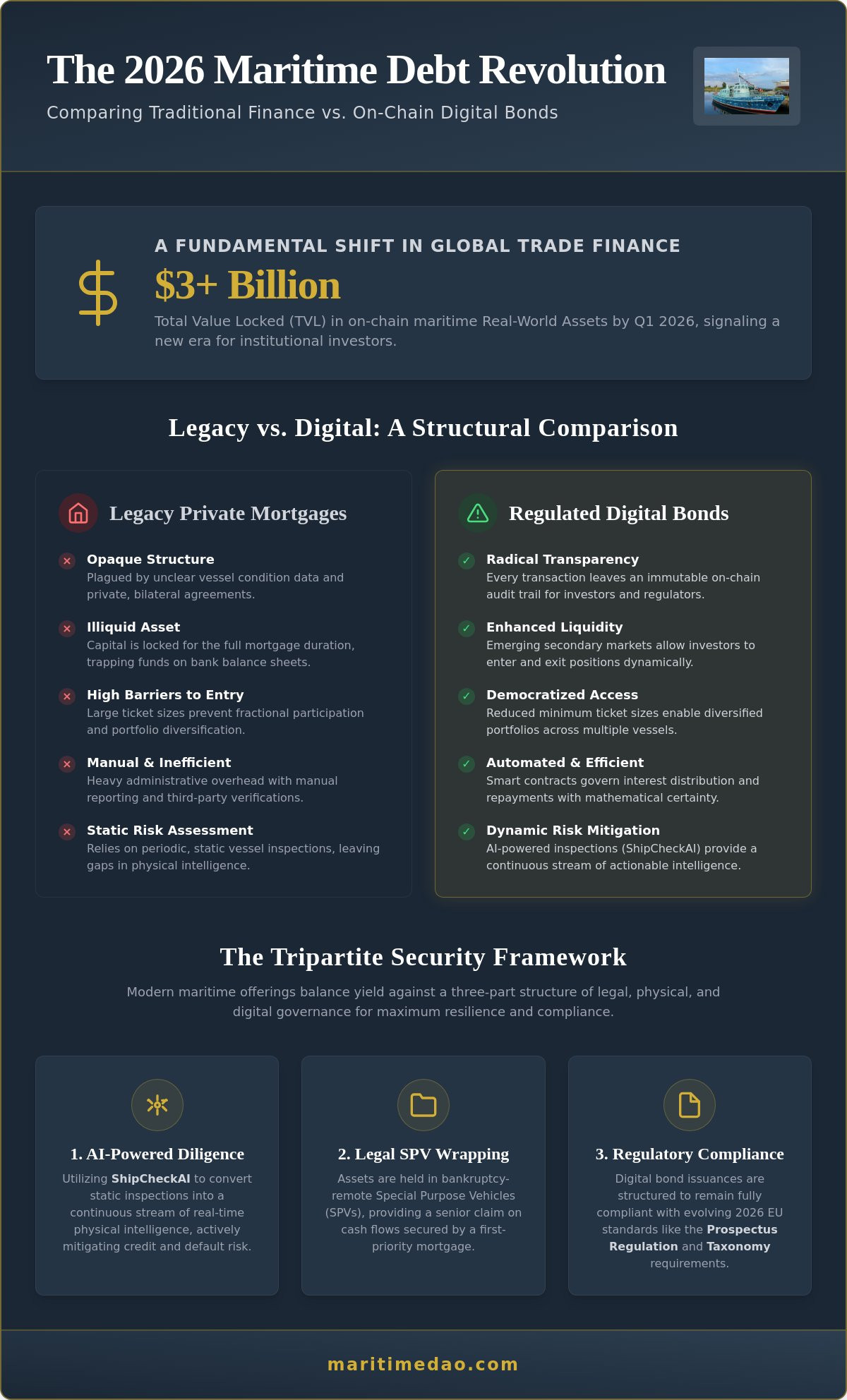
The on-chain maritime real-world asset market surpassed 3 billion dollars in total value locked during the first quarter of 2026, signaling a fundamental shift in how global trade is financed. For the institutional investor, comparing maritime debt instruments no longer means simply weighing interest rates against traditional bank risk. You likely recognize that legacy private mortgages are often plagued by opaque vessel condition data and high barriers to entry that stifle fractional participation. This lack of transparency creates a liquidity squeeze, especially as the full implementation of the EU Emissions Trading System forces a divide between green-shielded assets and legacy liabilities.
This guide provides a clear framework to help you master the technical and regulatory structures necessary to optimize institutional yield and security. You’ll learn how AI-powered inspections reduce credit risk by providing real-time physical intelligence and how the EU regulatory framework governs modern digital issuance. We will examine the tripartite relationship between physical vessel data, legal SPV wrapping, and regulated digital bonds to ensure your portfolio remains resilient in an economy increasingly defined by carbon accountability.
Key Takeaways
- Learn the fundamental shift from traditional bilateral ship mortgages to fractionalized digital bonds by comparing maritime debt instruments through a lens of transparency and asset-backed security.
- Analyze the critical difference in “time-to-liquidity” between legacy private debt and on-chain securities to optimize institutional portfolio turnover and yield.
- Implement a dynamic risk mitigation strategy using ShipCheckAI to convert static vessel inspections into a continuous stream of actionable maritime intelligence.
- Master the 2026 EU regulatory standards to ensure that digital bond issuances remain fully compliant with the evolving Prospectus Regulation and Taxonomy requirements.
- Utilize a professional checklist to evaluate the structural integrity of maritime offerings, balancing yield against the tripartite security of legal wrapping and digital governance.
Defining the 2026 Landscape of Maritime Debt Instruments
The global shipping finance market, valued at approximately 167 billion dollars in 2024, is undergoing a structural metamorphosis driven by the rise of Real World Assets (RWA). By the first quarter of 2026, the on-chain maritime RWA market surpassed 3 billion dollars in total value locked, signaling that institutional investors are no longer satisfied with the limitations of legacy credit structures. Maritime debt tokenization represents the digital issuance of ship-backed bonds or loans on a compliant blockchain, creating a unified ecosystem where capital meets physical assets with surgical precision. This shift is fundamental; it marks the transition from opaque traditional ship mortgages to fractionalized, yield-bearing debt instruments that offer granular control over risk and return.
When comparing maritime debt instruments in this modern context, investors must distinguish between equity-based ownership and debt-based yield instruments. While equity provides a stake in the vessel’s residual value, debt instruments offer a senior claim on cash flows, often secured by a first-priority mortgage. In 2026, these debt instruments are increasingly delivered as EU-regulated Ship Investment Bonds, providing a fixed-income profile that is governed by transparent code and legal wrapping rather than manual bank processing.
The Evolution of Ship Finance: From Banks to DAOs
Regulatory pressures from Basel IV have forced traditional banks to tighten lending criteria, creating a significant capital gap for mid-sized shipowners. This vacuum is being filled by a new generation of alternative lenders. A maritime DAO investment provides a unified governance layer that allows debt holders to exercise collective oversight without the administrative friction of legacy syndicates. Decentralized technology now automates the entire lifecycle of a loan; smart contracts govern interest distributions and principal repayments, ensuring that cash flows are distributed with absolute mathematical certainty the moment they’re received from charterers.
Key Benefits: Yield, Liquidity, and Transparency
The primary advantage of this digital evolution is the democratization of high-quality maritime credit. Tokenization significantly reduces minimum ticket sizes, which empowers institutional desks to build diversified maritime debt portfolios across different vessel classes and jurisdictions. Every transaction leaves an “on-chain” audit trail, providing a level of transparency for bondholders and regulators that was previously impossible. Unlike illiquid mortgages that remain trapped on bank balance sheets, tokenized ship bonds benefit from emerging secondary markets. This liquidity allows investors to enter and exit positions based on changing market conditions or SOFR fluctuations, which currently sits around 3.63 percent for 30-day averages as of July 2026. This combination of regulated innovation and operational efficiency is what defines the professional standard for comparing maritime debt instruments today.
How to Compare Traditional vs. Tokenized Debt Structures
When comparing maritime debt instruments, institutional investors must transition from subjective relationship-based lending to an objective, data-driven framework. This evaluation centers on three primary pillars: interest rates, collateralization ratios, and maturity terms. Traditional maritime loans typically benchmark against the Secured Overnight Financing Rate (SOFR). With the 30-day average SOFR holding steady at approximately 3.63 percent in July 2026, the competitive edge for tokenized debt isn’t always found in the rate itself, but in the efficiency of the structure. Tokenized instruments utilize smart contract automation to eliminate the heavy administrative overhead of traditional mortgage management, which often requires manual reporting and third-party verification.
The “time-to-liquidity” represents a seismic shift for portfolio managers. Private maritime debt is notoriously illiquid, often locking capital for the full duration of a vessel’s mortgage. On-chain securities, however, provide access to global whitelisted institutional pools, enabling secondary market trading that was previously non-existent for mid-market shipping debt. This accessibility transforms a stagnant asset into a dynamic component of an institutional portfolio. By expanding the investor reach beyond local bank syndicates, shipowners can tap into a more resilient capital base while investors gain the freedom to rebalance positions in real-time.
Structural Differences: Loans vs. EU-Regulated Bonds
While private loans offer bespoke flexibility, they lack the standardized protections found in EU regulated ship investment bonds. These bonds are typically issued through a Special Purpose Vehicle (SPV), a structure that ensures bankruptcy remoteness by isolating the vessel as the sole collateral. This legal “wrapping” ensures that the debt remains enforceable across multiple maritime jurisdictions. It provides a level of structural integrity that private bilateral agreements often struggle to match during complex cross-border defaults. For those looking to deepen their understanding of these frameworks, exploring institutional debt structures is a logical next step.
Risk Profiles: Collateralization and Covenants
Traditional risk management relies on periodic Loan-to-Value (LTV) assessments, which are often lagging indicators of a vessel’s true market worth. Digital debt structures replace this with real-time, automated collateral tracking. Smart contracts execute bond covenants automatically based on pre-defined triggers, such as a drop in the vessel’s hull value or a breach of environmental compliance. In the event of insolvency or vessel arrest, the priority of claims is hard-coded into the issuance. This ensures that senior debt holders are protected by a transparent, immutable hierarchy of repayment, effectively reducing the “human error” factor when comparing maritime debt instruments in high-stakes environments.
Mitigating Default Risk with ShipCheckAI and Technical Due Diligence
The ultimate security of any ship-backed financial product rests upon the physical integrity of the hull and machinery. When comparing maritime debt instruments, investors often focus on the financial creditworthiness of the shipowner while overlooking the underlying asset’s operational health. This oversight is a critical vulnerability. Unlike traditional finance where due diligence is a static, one-time event conducted at closing, modern institutional standards require a continuous flow of technical intelligence. This is where AI in maritime due diligence transforms the landscape, converting the vessel from a “black box” into a transparent data stream.
High-quality inspection data directly correlates with lower risk premiums for debt tokens. By utilizing ShipCheckAI, lenders can verify the structural and machinery status of a vessel with unprecedented precision. This level of technical oversight reduces the uncertainty that typically inflates interest rates in private ship mortgages. When the market has access to verifiable, real-time health data, the risk premium naturally compresses, enhancing the net yield for bondholders without compromising the safety of the principal. This data-driven approach ensures that the relationship between physical assets and digital governance is clearly understood at every step of the investment lifecycle.
ShipCheckAI: Verifying Physical Integrity
The AI ship inspection tool, ShipCheckAI, executes multi-dimensional assessments that cover structural integrity, engine performance, and regulatory compliance. These automated reports are not just for internal use; they’re made available to bondholders to maintain an ongoing environment of transparency. AI-driven inspections can identify structural anomalies 30% faster than traditional manual surveys. This speed ensures that potential issues are flagged before they escalate into costly repairs or operational downtime, effectively safeguarding the asset’s market value throughout the debt’s duration.
Real-Time Monitoring and Bond Covenants
The integration of technical data into financial governance is achieved through automated bond covenants. Smart contracts can be programmed to trigger immediate alerts if a vessel’s ShipCheckAI score falls below a pre-defined threshold. This creates a self-correcting ecosystem where the shipowner is incentivized to maintain high operational standards. Predictive maintenance reporting further protects the bondholder’s principal by ensuring that the vessel remains in class and fully operational. This continuous technical oversight doesn’t just prevent defaults; it improves the secondary market valuation of the debt instrument by providing prospective buyers with a verified history of the vessel’s physical condition.
Navigating EU Compliance and Regulatory Standards for Ship Bonds
The transition toward digital finance in 2026 is anchored by a robust legal bedrock that distinguishes institutional offerings from speculative experiments. Central to this shift is the role of maritime investment compliance, which ensures that every digital bond issuance aligns with the stringent requirements of the European market. Unlike unregulated offshore tokenization schemes that lack investor protection, EU-regulated ship bonds operate under the Markets in Crypto-Assets (MiCA) regulation. This framework provides clear classification for ship-backed debt tokens, often treating them as transferable securities that must adhere to the EU Prospectus Regulation. This alignment ensures that institutional investors receive the same level of disclosure and legal recourse they expect from traditional capital markets.
Rigorous adherence to these standards is essential when comparing maritime debt instruments across different jurisdictions. A regulated framework offers a tripartite shield of investor protection: legal enforceability, automated compliance, and standardized reporting. By contrast, unregulated platforms often operate in a legal vacuum, leaving debt holders vulnerable in the event of a cross-border dispute. For family offices and pension funds, the choice is clear; only a regulated environment can host the significant capital required for modern fleet renewal. You can explore our full range of EU-regulated maritime investment solutions to understand how these standards are applied in practice.
The Advantage of Regulated Tokenized Assets
Institutional participation in maritime finance requires more than just high yields; it demands structural integrity. The use of regulated tokenized assets allows for the seamless integration of KYC (Know Your Customer), AML (Anti-Money Laundering), and CTF (Counter-Terrorist Financing) protocols directly into the smart contract. This “whitelisting” process ensures that only verified, qualified investors can participate in debt offerings, maintaining a clean and compliant ecosystem. This level of automated governance satisfies the most demanding regulatory bodies while reducing the administrative burden on the issuer. For investors who want to separate fact from fiction about how these systems work in practice, our guide on regulated digital maritime assets and the 2026 reality of decentralized finance addresses the most persistent misconceptions in the market.
Governance and Bondholder Rights
Digital debt instruments in 2026 leverage decentralized governance to empower bondholders. A DAO structure provides a unified platform for voting on critical issues, such as debt restructuring or the liquidation of collateral if a technical default occurs. These governance rights are not merely digital suggestions; they hold full legal standing under the laws of major EU maritime jurisdictions like Malta and Cyprus. Dispute resolution is handled through pre-defined smart contract logic or established maritime arbitration centers, ensuring that digital debt holders have clear, enforceable pathways to protect their principal in any scenario.
Strategic Implementation: Transitioning to Regulated Digital Debt
The evolution of global trade finance has moved beyond the theoretical stage into a period of disciplined execution. We are now witnessing the emergence of an integrated, AI-governed ecosystem where the physical reality of a vessel is perfectly mirrored by its digital twin on the blockchain. Maritime DAO acts as the visionary architect of this physical-to-digital bridge, providing the structural integrity required to unite heavy industry with institutional capital. For shipowners, this transition offers an essential entry point to diversify capital sources, effectively bypassing the restrictive lending criteria of legacy banks to tap into global liquidity pools. This shift isn’t just about efficiency; it’s about building a more resilient financial foundation for the future of shipping.
Moving toward digital debt requires a methodical approach to risk and governance. Institutional desks are now prioritizing instruments that offer a tripartite value proposition: legal enforceability, technical transparency, and operational automation. By adopting these modern structures, investors can move away from the “black box” nature of traditional private mortgages. The process of comparing maritime debt instruments in 2026 demands a rigorous evaluation of how technology protects the principal. It’s no longer enough to rely on periodic paper reports; the modern standard requires a continuous, verifiable stream of asset data that informs every investment decision.
Checklist for Comparing Maritime Debt Instruments
To ensure portfolio resilience, institutional investors should utilize the following criteria when evaluating new offerings:
- Regulatory Jurisdiction: Confirm the instrument is issued under a recognized EU framework, such as the Prospectus Regulation or MiCA, to ensure full legal recourse.
- Asset Transparency: Verify that a ShipCheckAI or equivalent AI-driven inspection report is available to provide an objective assessment of the vessel’s physical condition.
- Liquidity Profile: Analyze the secondary market trading restrictions to ensure the instrument aligns with your portfolio’s turnover requirements.
- Governance Structure: Evaluate the DAO’s voting mechanisms to understand how debt restructuring or collateral liquidation is handled in a default scenario.
Investor Onboarding: Joining the Maritime DAO Ecosystem
Accessing this new frontier of maritime finance is a streamlined, professional process designed for institutional rigor. The journey begins with the creation of a verified institutional profile, where KYC and AML protocols are handled with automated precision. Once whitelisted, investors gain immediate access to a unified dashboard that provides real-time vessel assessment data for all current bond offerings. This transparency allows for a more sophisticated method of comparing maritime debt instruments, as users can drill down into the structural health and emissions profile of each underlying asset. To begin your transition into the future of shipping finance, explore our current EU-regulated ship investment bonds and discover how regulated innovation is redefining institutional yield.
Mastering the New Standard of Maritime Capital
The landscape of ship finance has reached a definitive turning point. When comparing maritime debt instruments, the distinction between legacy illiquidity and digital efficiency is now a matter of institutional resilience. We’ve explored how the integration of real-world assets into the blockchain creates a unified ecosystem where capital is protected by both code and law. Success in this new era requires a commitment to transparency, technical rigor, and strict regulatory alignment within the European framework.
Maritime DAO provides a tripartite foundation of security for the modern investor. Our ecosystem combines an EU-Regulated framework for institutional compliance with AI-Powered ShipCheckAI for real-time risk mitigation and transparent, on-chain governance. This structure ensures that every bond issuance is governed by structural integrity and data-driven intelligence. It’s time to move beyond the opaque systems of the past and embrace a more inclusive, high-tech frontier. Secure your position in the future of ship finance with Maritime DAO and lead the transformation of global trade.
Frequently Asked Questions
What is the difference between a traditional ship mortgage and a tokenized ship bond?
Traditional mortgages are bilateral, illiquid loans held on bank balance sheets; tokenized bonds are fractionalized, on-chain securities. While a mortgage requires manual administration and offers no exit before maturity, a tokenized bond provides secondary market liquidity. These digital instruments allow for broader institutional participation by breaking down high entry barriers into manageable, yield-bearing units that are governed by automated smart contracts.
How does Maritime DAO ensure the physical security of the underlying vessel?
Physical security is maintained through a tripartite system of legal wrapping, first-priority mortgage registration, and continuous technical monitoring. The vessel is held within a bankruptcy-remote Special Purpose Vehicle that grants bondholders a senior claim on the asset. We integrate ShipCheckAI to perform regular structural assessments, ensuring the hull and machinery remain in peak operational condition to protect the collateral’s market value.
Are tokenized maritime debt instruments regulated under EU law in 2026?
Yes, these instruments are fully governed by the Markets in Crypto-Assets (MiCA) regulation and the EU Prospectus Regulation. They’re classified as transferable securities, which requires issuers to provide standardized disclosures and maintain strict compliance with AML and KYC protocols. This regulated framework provides institutional investors with the same legal protections and recourse available in traditional capital markets across the European Union.
How does ShipCheckAI reduce the risk for maritime bondholders?
ShipCheckAI converts static, one-time inspections into a dynamic stream of technical intelligence. By identifying structural anomalies 30% faster than traditional manual surveys, the tool allows for predictive maintenance that prevents costly operational downtime. This level of transparency ensures that bondholders have an accurate, real-time understanding of the vessel’s health, effectively reducing the risk of a technical default or asset devaluation.
Can retail investors participate in comparing and buying maritime debt instruments?
Participation is currently restricted to verified institutional investors and whitelisted qualified individuals to ensure adherence to strict regulatory standards. This focus maintains the professional integrity of the ecosystem while ensuring that those comparing maritime debt instruments have the necessary financial sophistication. Our platform’s infrastructure is designed to handle significant capital allocations while providing the transparency required for institutional due diligence.
What happens to the tokenized debt if the shipowner defaults on payments?
The default protocol is hard-coded into the smart contract and backed by the legal SPV structure. In a default scenario, the DAO-governed entity initiates the seizure and liquidation of the vessel collateral through established maritime courts. Bondholders hold a first-priority claim on the liquidation proceeds, ensuring that capital is recovered and distributed according to the immutable hierarchy defined at the time of issuance.
How are interest payments distributed to token holders?
Interest distributions are automated via smart contracts that execute payments directly to whitelisted wallet addresses. The system calculates the yield based on the vessel’s earnings and distributes the funds with mathematical precision, removing the administrative delays associated with traditional bank transfers. This ensures that investors receive their pro-rata share of the yield the moment the funds are cleared by the SPV.
What is the role of the SPV in a tokenized maritime debt structure?
The Special Purpose Vehicle (SPV) acts as the legal owner of the vessel and the issuer of the digital bonds. Its primary function is to provide bankruptcy remoteness, which isolates the ship as the sole collateral and protects investors from the shipowner’s other liabilities. This structure ensures that the debt is governed by a dedicated legal entity, providing a transparent and enforceable link between the physical asset and the digital token.