
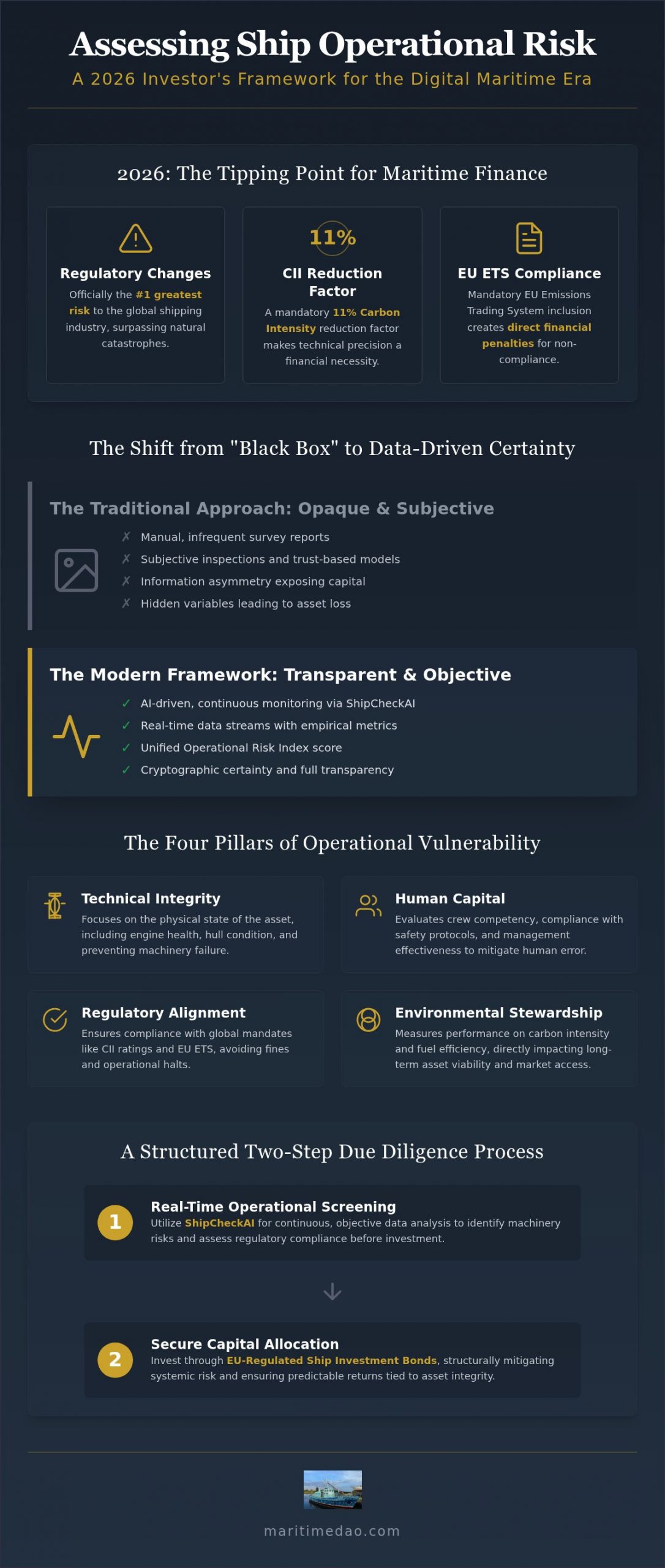
In a 2026 survey by Allianz, regulatory changes officially surpassed natural catastrophes as the single greatest risk to the global shipping industry. This shift reflects a market where an 11% Carbon Intensity Indicator reduction factor and mandatory EU Emissions Trading System compliance have made technical precision a financial necessity. You likely recognize that the traditional maritime sector often feels like an opaque “black box,” where technical survey reports are difficult to interpret and information asymmetry leaves your capital exposed to catastrophic asset loss or sudden regulatory fines. We understand that without a unified, transparent lens, the complexity of vessel management creates an unacceptable barrier to entry for institutional finance.
This guide provides a comprehensive framework for assessing ship operational risk for investors, bridging the gap between heavy industry and high finance through automated intelligence and governed ecosystems. You’ll learn how AI-driven due diligence through tools like ShipCheckAI identifies machinery failure risks before they manifest, how to evaluate the impact of the 2026 CII thresholds on long-term asset viability, and why EU-regulated ship investment bonds offer a secure, predictable path for capital allocation. We’ll break down the three pillars of modern risk management: real-time data integrity, regulatory alignment, and the structural security of tokenized real-world assets.
Key Takeaways
- Understand why 2026 is a pivotal year for maritime finance, driven by the convergence of carbon intensity regulations and the maturation of digital asset management.
- Identify the critical technical and human vulnerabilities, from engine health to crew competency, that directly influence the valuation and safety of maritime assets.
- Master a modern framework for assessing ship operational risk for investors by replacing subjective, manual surveys with the continuous, objective data provided by ShipCheckAI.
- Learn a structured two-step due diligence process that integrates real-time operational screening with the financial yields of regulated maritime debt instruments.
- Discover how the Maritime DAO ecosystem utilizes EU-regulated ship investment bonds and transparent governance to mitigate the systemic risks traditionally associated with maritime capital.
The Evolving Landscape of Assessing Ship Operational Risk for Investors in 2026
Operational risk in the maritime sector is the potential for financial loss resulting from inadequate vessel management, technical failure, or human error. For decades, this risk remained a hidden variable in maritime finance, often obscured by complex offshore structures and irregular reporting. However, 2026 represents a definitive turning point where global trade volatility and digital maritime maturity have finally converged. Investors no longer need to rely on the trust-based models of the past. Instead, a new paradigm of regulated innovation is bridging the gap between physical assets and digital capital, transforming how we quantify the health of a global fleet through transparency, automation, and legal integrity.
Traditional risk assessment relied on manual, infrequent, and subjective inspections that failed to capture the dynamic nature of a ship at sea. Modern methodologies have replaced these legacy systems with empirical, continuous, and data-driven frameworks. This shift is essential in a year where regulatory scrutiny has reached an all-time high. With the 2026 Carbon Intensity Indicator (CII) reduction factor now at 11% relative to the 2019 baseline, the cost of operational inefficiency is no longer just a technical concern; it’s a direct threat to the solvency of a maritime investment. Assessing ship operational risk for investors has evolved from a secondary due diligence step into a primary requirement for capital protection.
The Shift from Subjective to Objective Risk Metrics
Real-time data streams are rapidly replacing the outdated tradition of annual paper-based survey reports. By integrating automated intelligence, the industry has moved toward a model of continuous oversight that reduces the maritime premium often demanded by risk-averse institutional players. This transition relies on foundational concepts in maritime security to ensure that every variable, from hull integrity to crew compliance, is recorded with cryptographic certainty. Transparency isn’t just a buzzword in 2026; it’s a structural requirement that allows investors to see beyond the engine room. The Operational Risk Index serves as the core metric for 2026, providing a unified score that reflects a vessel’s real-time safety and compliance status.
Why Operational Risk Matters More to Bondholders
While equity holders may chase volatile upside, bondholders prioritize asset integrity and the stability of cash flow. Assessing ship operational risk for investors is particularly critical for those holding EU regulated ship investment bonds, as these instruments are structurally tied to the operational excellence of the underlying vessel. A single technical failure or a mandatory Corrective Action Plan resulting from a “D” or “E” CII rating can jeopardize interest payments. By utilizing structured financial governance and AI-driven monitoring, investors can mitigate the catastrophic loss scenarios that previously plagued the industry. This approach ensures that capital is not just deployed, but actively protected through a unified ecosystem of transparency and law.
The Four Pillars of Operational Vulnerability: A Technical Breakdown
Quantifying maritime volatility requires a granular understanding of the four distinct pillars that support vessel stability and financial performance. For those focused on assessing ship operational risk for investors, these pillars represent the primary points of failure where technical issues transform into balance sheet liabilities. In 2026, the complexity of these factors has intensified, necessitating a move beyond surface-level checks toward a unified assessment of technical integrity, human capital, regulatory alignment, and environmental stewardship.
- Technical Integrity: This involves the physical state of the asset, specifically engine health, hull stress, and the reliability of specialized onboard equipment.
- Human Capital and Safety: A vessel is only as secure as its crew. This pillar evaluates training standards, crew competency, and the efficacy of Safety Management Systems (SMS).
- Regulatory Compliance: This covers the adherence to IMO 2026 standards and regional Port State Control requirements, including new mandates for fire extinguishing media and lost container reporting.
- Environmental Stewardship: This focuses on managing Carbon Intensity Indicators (CII) and navigating the financial penalties associated with emissions.
Technical Integrity and Asset Longevity
Technical failure remains the leading cause of maritime incidents. According to Allianz Commercial’s 2026 Safety and Shipping Review, machinery damage and failure accounted for 1,505 incidents in 2025, representing the largest single operational risk for vessels over 100 GT. Investors must evaluate the physical condition of a vessel using automated sensor data rather than relying solely on legacy maintenance logs. Technical failures don’t just result in repair costs; they trigger “off-hire” financial penalties that immediately halt revenue generation. Furthermore, a ship’s maintenance history significantly dictates its secondary market value, making technical due diligence a prerequisite for long-term capital preservation. Utilizing a transparent data ecosystem allows bondholders to monitor these vitals in real time.
Regulatory Risk: The 2026 IMO Compliance Framework
The regulatory environment in 2026 is unforgiving. Shipping companies are now required to surrender EU ETS allowances covering 70% of their 2025 emissions by September 30, 2026. Non-compliance isn’t just a legal issue; it’s a financial drain that impacts the security of maritime debt. Assessing ship operational risk for investors involves a deep dive into how a fleet manages these evolving costs. This process is simplified by referencing a comprehensive maritime investment compliance guide, which details the interplay between global IMO mandates and regional EU regulations.
Beyond emissions, new 2026 requirements demand the removal of fire extinguishing media containing PFOS and the mandatory reporting of lost containers. These updates are integrated into the Formal Safety Assessment framework, a systematic methodology that institutional investors use to enhance safety and mitigate risk. Failure to align with these standards can lead to vessel detentions, which directly compromise the stability of investment returns.
Beyond Traditional Surveys: AI and the ShipCheckAI Methodology
Traditional maritime due diligence has long suffered from the “snapshot fallacy.” Manual surveys are infrequent, expensive, and inevitably colored by the subjective judgment of a single inspector. In contrast, assessing ship operational risk for investors in 2026 demands a dynamic, persistent approach that identifies vulnerabilities before they escalate into financial liabilities. ShipCheckAI disrupts this legacy model by providing an automated intelligence layer that analyzes vast datasets, from photographic evidence to historical maintenance patterns. This methodology uncovers subtle indicators of mismanagement or mechanical wear that often remain invisible to the human eye, ensuring that every asset is governed by objective truth rather than optimistic reporting.
Recent academic research on AI in maritime risk confirms that automated systems significantly improve fraud detection and risk assessment accuracy. By centralizing these insights into Unified Vessel Data, the industry creates a single, immutable source of truth for bondholders and operators alike. This structural transparency transforms a traditionally opaque industry into a measurable ecosystem where technical performance is directly linked to financial security.
The ShipCheckAI Advantage for Investors
The AI ship inspection tool capabilities of ShipCheckAI allow for a 360-degree risk profile that integrates technical, safety, and environmental data. This multi-type inspection protocol eliminates the information asymmetry that has historically plagued ship finance. Automated survey protocols reduce the high costs of traditional due diligence while increasing the frequency of oversight, allowing investors to monitor asset health throughout the entire lifecycle of the bond. This system evaluates three distinct pillars: technical vitals, safety compliance, and environmental efficiency.
Verifying Data Integrity in a DAO Ecosystem
Data is only as valuable as its integrity. Within the Maritime DAO, blockchain technology acts as a reliable gatekeeper, ensuring that vessel inspection reports cannot be altered or suppressed by ship operators. This decentralized governance model validates third-party survey results through a transparent consensus mechanism, effectively removing the “human factor” from risk reporting. By building trust through the maritime DAO investment framework, we transform physical maritime assets into an institutional-grade asset class. This unified ecosystem ensures that every data point is governed, transparent, and legally grounded, providing bondholders with the confidence required for significant capital commitments.
Integrating Operational Data into Maritime Investment Due Diligence
The transition from raw data to actionable investment intelligence requires a methodical, multi-stage process. For institutional bondholders, the goal isn’t just to identify risks but to price them accurately within the context of a fixed-income instrument. Assessing ship operational risk for investors in 2026 involves a rigorous five-step framework that prioritizes transparency, legal governance, and technical foresight. This structured approach ensures that every maritime asset is evaluated as a reliable component of a broader financial ecosystem rather than a volatile isolated variable.
- Step 1: Initial Screening. Conduct a comprehensive ShipCheckAI screening to identify “red flag” operational histories, focusing on past detentions, structural anomalies, and recurring machinery failures.
- Step 2: Yield Cross-Referencing. Evaluate the vessel’s technical health against the financial yield of the proposed bond. A high-risk technical profile must be compensated by a higher yield or supported by enhanced collateral.
- Step 3: Operator Benchmarking. Evaluate the ship operator’s safety management track record against 2026 industry benchmarks, ensuring their internal protocols align with modern safety requirements.
- Step 4: Future-Proofing. Assess the asset’s compliance status against 2026-2030 environmental regulations, specifically the tightening Carbon Intensity Indicator (CII) thresholds that will impact vessel liquidity.
- Step 5: Covenant Review. Review the bond’s legal covenants to ensure they mandate specific operational maintenance standards and maintain comprehensive insurance coverage throughout the term.
Quantifying Risk: From Technical Data to Financial Yield
The relationship between high-quality maintenance and lower bond default rates is empirical and direct. By utilizing AI in maritime due diligence, investors can automate the risk-pricing process, adjusting expected returns based on the vessel’s real-time Operational Risk Index. This index serves as a financial barometer; a declining score triggers an immediate reassessment of the asset’s risk premium. This data-driven methodology ensures that capital is allocated only to vessels that demonstrate a commitment to technical excellence and regulatory alignment, effectively bridging the gap between physical operations and institutional finance.
Mitigating Objections: The Role of Insurance and Covenants
Structural security in maritime finance is often reinforced through the synergy of insurance and smart contracts. Operational data generated by ShipCheckAI can be used to negotiate lower insurance premiums for the asset-backed security, as underwriters gain confidence in the vessel’s governed status. At the same time, we utilize “Smart Covenants” that trigger automatically if operational metrics, such as engine performance or emissions compliance, fall below a predefined threshold. This level of automated oversight is a core component of the how to invest in maritime assets strategy, providing bondholders with a layer of protection that traditional maritime debt simply cannot offer.
By integrating these technical vitals into the legal structure of the bond, we transform operational risk from an unknown threat into a manageable, transparent variable. You can explore our regulated bond structures to see how we unify these technological and financial pillars to protect global capital.
Maritime DAO: Architecting Security through Regulated Bonds and AI Governance
Maritime DAO provides the definitive answer to the systemic inefficiencies that have traditionally plagued ship finance. By integrating EU-regulated ship investment bonds with the real-time data integrity of ShipCheckAI, we have architected a “regulated innovation” model that transforms physical maritime assets into a transparent, institutional-grade asset class. This unified approach effectively solves the puzzle of assessing ship operational risk for investors, ensuring that every operational variable is governed and every technical vulnerability is identified through automated intelligence. We’ve replaced the opaque “black box” of maritime management with a methodical ecosystem built for the demands of the 2026 global market, where transparency is the primary currency of trust.
Institutional Reliability Meets Cutting-Edge Tech
Institutional reliability is the cornerstone of our framework. EU regulation provides the familiar legal structure that global capital demands, while the DAO architecture introduces a first-of-its-kind level of investor empowerment. Bondholders aren’t passive observers in this ecosystem; they’re part of a governed structure where voting rights on key operational decisions ensure that vessel management remains aligned with the interests of the capital providers. This synergy between legal rigor and technical automation positions Maritime DAO as the essential bridge between legacy shipping and the digital future of finance. It’s a system designed to unite, govern, and open up opportunities while maintaining order, security, and transparency for a global audience.
Next Steps for the Strategic Maritime Investor
The path for the strategic investor is methodical and transparent. By accessing our marketplace, you can review comprehensive ShipCheckAI assessment reports that provide a 360-degree view of asset health before you commit capital. Diversifying your portfolio with asset-backed maritime debt allows you to capture the steady yields of global shipping while benefiting from the security of AI-driven oversight. Assessing ship operational risk for investors has evolved from a manual, subjective burden into a streamlined, automated process that prioritizes capital preservation and long-term stability. Join the evolution of maritime finance and explore our governed ecosystem at maritimedao.com.
Mastering Maritime Volatility through Regulated Innovation
The maritime industry is no longer a territory of opaque risks and technical uncertainty. By embracing a framework that unifies technical integrity, regulatory foresight, and automated intelligence, you transform a traditionally volatile sector into a measurable asset class. The integration of ShipCheckAI assessments with institutional-grade asset-backed security ensures that every vessel in your portfolio is governed by objective data rather than subjective snapshots. This systematic approach to assessing ship operational risk for investors provides the clarity required to navigate the 11% CII reduction mandates and the complexities of the 2026 market with precision.
We invite you to step into a transparent ecosystem where physical trade meets digital governance. Through our EU-regulated compliance framework and multi-type inspection protocols, we provide the structural security necessary for significant, high-stakes capital allocation. It’s time to move beyond legacy trust models and embrace a future defined by transparency, order, and legal precision. You have the tools to turn maritime complexity into a predictable pillar of your investment strategy.
Secure your maritime portfolio with EU-regulated bonds at Maritime DAO
Frequently Asked Questions
What is the primary difference between commercial and operational risk in shipping?
Commercial risk involves external market volatility, such as fluctuating freight rates and global trade demand. In contrast, operational risk centers on internal factors like technical integrity, crew competency, and safety protocols. Assessing ship operational risk for investors is critical because it directly impacts the underlying asset’s ability to generate revenue. While you can’t control market cycles, you can mitigate technical failures through rigorous oversight and governed management.
How does ShipCheckAI improve the accuracy of vessel assessments for investors?
ShipCheckAI replaces subjective manual inspections with objective, AI-driven data analysis. The tool processes high-resolution photographic evidence and sensor inputs to detect early signs of machinery wear or structural stress. This methodology eliminates the “snapshot fallacy” of traditional surveys by providing continuous, multi-type inspection capabilities. It transforms vessel health into a measurable metric, allowing for more precise due diligence before capital is committed to a maritime bond.
Are maritime investment bonds regulated by any financial authorities?
Yes, the ship investment bonds offered through Maritime DAO are EU-regulated financial instruments. This provides a familiar and robust legal framework for global capital, ensuring that all investments meet stringent compliance and transparency standards. By operating within a regulated innovation model, we bridge the gap between decentralized technology and institutional finance. This structure offers bondholders the security of a governed ecosystem while leveraging the efficiency of digital asset management.
Can AI really predict technical failures before they happen on a ship?
AI identifies predictive patterns by analyzing anomalies in machinery performance and maintenance logs that typically precede a breakdown. Since machinery failure accounted for 1,505 incidents in 2025, this predictive capability is a vital component of assessing ship operational risk for investors. By spotting these deviations early, operators can perform corrective maintenance, preventing the “off-hire” scenarios that jeopardize the financial stability of a maritime investment.
How does the Maritime DAO governance model protect bondholders from mismanagement?
The DAO governance model empowers bondholders with voting rights on significant operational decisions that affect asset value. This decentralized approach ensures that ship operators remain accountable to their capital providers through a transparent, immutable ledger. It replaces the traditional “black box” of ship management with a system where every technical report and regulatory filing is visible. This level of oversight effectively mitigates the risk of mismanagement or hidden operational failures.
What are the specific IMO 2026 environmental standards investors should be aware of?
Investors must track the 11% Carbon Intensity Indicator (CII) reduction factor and the EU Emissions Trading System (ETS) requirements. By September 30, 2026, shipping companies must surrender allowances covering 70% of their 2025 emissions. Vessels with poor CII ratings face mandatory Corrective Action Plans and potential sanctions. These standards are no longer peripheral; they’re core financial metrics that determine the long-term viability and liquidity of a maritime asset.
Is it possible for retail investors to access these institutional-grade maritime bonds?
Yes, the Maritime DAO platform is designed to democratize access to institutional-grade maritime debt. While these opportunities were historically restricted to large banks and private equity firms, our unified ecosystem allows a global audience to participate in regulated ship investment bonds. This inclusivity is balanced with the sober reliability of institutional finance, ensuring that even smaller capital allocations benefit from the same level of AI-driven due diligence and legal protection.