
The global market for tokenized real-world assets has reached $185 billion in 2026, yet the maritime sector remains a complex frontier for those seeking stable, asset-backed opportunities. You likely recognize that traditional ship finance is often defined by opaque deal structures, high barriers to entry, and a persistent lack of transparency that excludes most global investors. This guide explores how regulated tokenized assets are fundamentally shifting this paradigm, turning maritime finance into a transparent, compliant, and accessible asset class.
We’ll provide a comprehensive framework for evaluating RWA security, detail the critical impact of EU MiCA compliance on maritime tokens, and demonstrate how unified digital governance ensures institutional-grade stability. By the end of this analysis, you’ll understand how a first-of-its-kind ecosystem unites physical vessel value, automated intelligence, and legal integrity to democratize global trade. We’re moving beyond the era of speculative digital hype into a new reality where maritime operations, traditional finance, and decentralized technology converge to create a secure, governed, and high-stakes investment landscape.
Key Takeaways
- Define the evolution from speculative tokens to regulated tokenized assets that represent legally enforceable fractional ownership or debt in global shipping vessels.
- Navigate the 2026 regulatory landscape, focusing on how MiCA authorization and EU-regulated ship investment bonds provide the structural integrity required for institutional-grade portfolios.
- Evaluate the liquidity advantages of digital ship bonds, which offer secondary market trading opportunities compared to the decade-long lock-up periods typical of traditional maritime finance.
- Implement a rigorous due diligence framework that unifies legal compliance, financial transparency, and physical asset verification through advanced tools like ShipCheckAI.
- Understand how a governed maritime ecosystem democratizes access to traditionally exclusive high-stakes trade, acting as a reliable bridge between physical assets and digital finance.
What Are Regulated Tokenized Assets in the Shipping Sector?
The maritime industry is undergoing a profound structural transformation. We define regulated tokenized assets as digital securities that represent fractional ownership or debt interests in maritime vessels, governed by programmed smart contracts and anchored in established financial law. Unlike the speculative volatility of utility tokens, these instruments are classified as asset-backed securities. They provide a transparent bridge between the physical world of global trade and the digital precision of blockchain technology. To understand this evolution, one should examine What is a Security Token Offering (STO)? as it represents the critical shift toward legally compliant digital issuance within institutional frameworks.
The Anatomy of a Regulated Maritime Token
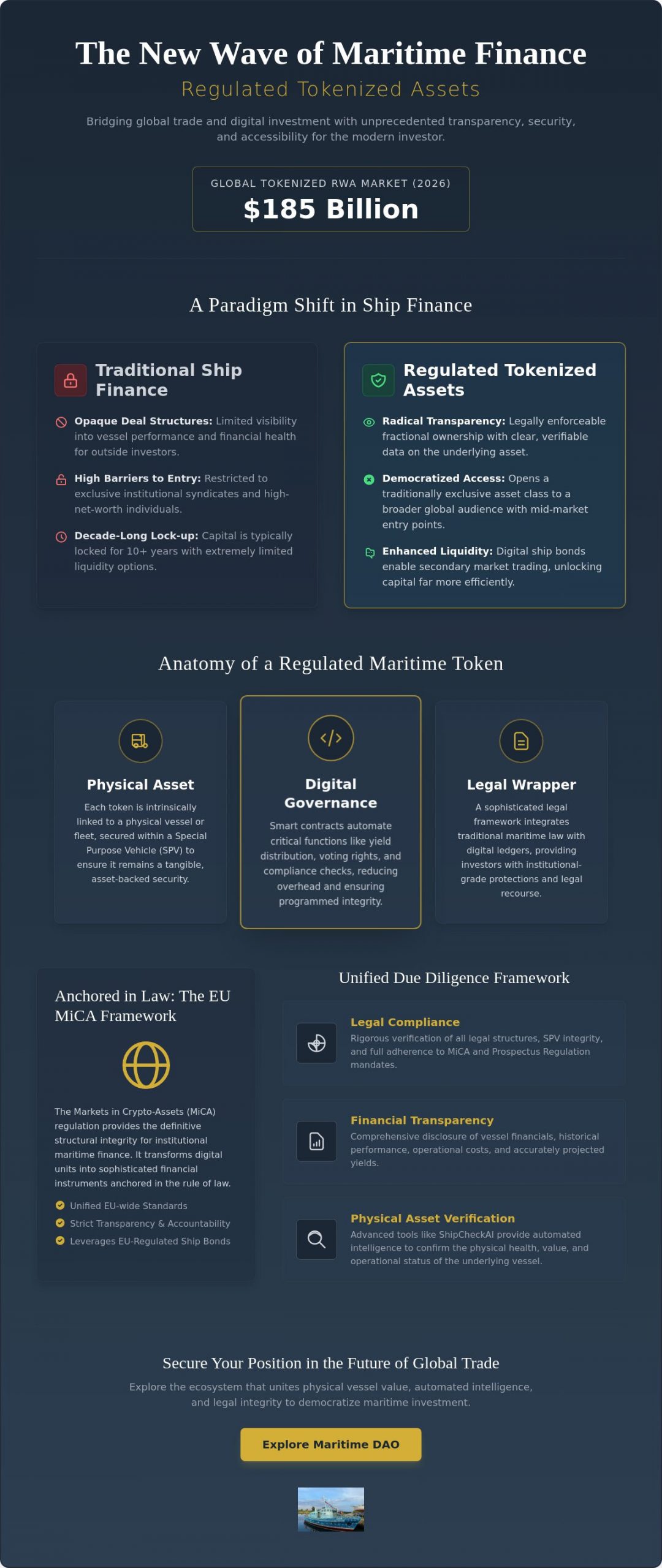
A regulated maritime token is built on three distinct pillars: the physical asset, the digital governance, and the legal wrapper. First, the token is intrinsically linked to a physical vessel or a fleet through a Special Purpose Vehicle (SPV), ensuring it remains a tangible, asset-backed security. Second, smart contract governance automates critical functions such as yield distribution, voting rights, and compliance checks, reducing administrative overhead. Third, these tokens utilize sophisticated legal wrappers that integrate traditional maritime law with digital ledgers; this provides investors with the same protections found in institutional finance while enabling the efficiency of decentralized technology.
Shipping is inherently capital-intensive. Historically, ship ownership was restricted to exclusive institutional syndicates or high-net-worth individuals due to massive capital requirements and opaque deal structures. Tokenization breaks these barriers. It allows for the democratization of maritime capital, enabling mid-market entry while maintaining the high-stakes integrity required for global trade operations. This shift addresses a systemic inefficiency, opening a $185 billion RWA market to a broader global audience through a unified, transparent ecosystem.
The Shift from Speculation to Institutional RWA
We’ve moved beyond the era of unregulated DeFi experimentation. The year 2026 marks the definitive maturity of maritime tokenization as a stable asset class, driven by what we call “Regulated Innovation.” This transition prioritizes predictable settlement, rigorous governance, and vessel-specific financial transparency. By unifying physical due diligence with digital compliance, the Maritime DAO acts as a visionary architect and reliable gatekeeper. This ensures that every digital unit reflects the actual operational health and value of the underlying ship. This systematic approach replaces speculative hype with the sober reliability of institutional-grade infrastructure, providing a clear legal basis for every investment through Special Purpose Vehicles.
The Legal Backbone: EU Regulation and the MiCA Framework for 2026
The era of regulatory ambiguity has ended. In 2026, the full implementation of the Markets in Crypto-Assets (MiCA) regulation provides the definitive structural integrity required for institutional maritime finance. This framework transforms regulated tokenized assets from experimental digital units into sophisticated financial instruments anchored in the rule of law. By establishing a unified standard across the European Union, MiCA ensures that every maritime issuance is governed by strict transparency, accountability, and operational requirements.
Central to this evolution is the utilization of EU-regulated ship investment bonds. These instruments leverage the Prospectus Regulation to provide investors with a familiar, high-stakes disclosure framework. This ensures that every technical, financial, and operational detail of the underlying vessel is vetted before the first token is issued. This systematic approach effectively bridges the gap between traditional maritime debt and modern digital efficiency.
MiCA Compliance and Maritime Securities
Under the 2026 MiCA mandates, maritime tokens are frequently classified as Asset-Referenced Tokens (ARTs). This classification requires issuers to maintain robust reserve assets and provide detailed whitepapers approved by national competent authorities. These protections aren’t mere suggestions; they’re legal requirements that safeguard capital against the speculative mismanagement seen in earlier digital asset cycles. With the July 2026 authorization deadline now in effect, the EU has solidified its position as the global benchmark for maritime financial governance.
Cross-Border Validity of Tokenized Maritime Debt
The power of this regulatory landscape lies in the concept of “Passporting.” This mechanism allows authorized maritime investment platforms to operate seamlessly across all EU member states. It simplifies the complex web of global maritime trade by ensuring that tokenized debt is recognized and enforceable across diverse jurisdictions. This unified approach integrates rigorous AML and KYC standards directly into the digital ledger, ensuring that the ecosystem remains clean, compliant, and ready for institutional scale.
Traditional maritime finance has long operated within a “closed-door” ecosystem. For decades, the capital-intensive nature of vessel acquisition meant that only elite institutional syndicates and high-net-worth individuals could participate in ship ownership or debt. Regulated tokenized assets dismantle this restrictive architecture, replacing opaque private equity structures with a transparent, unified digital gateway. This transition doesn’t just lower the barrier to entry; it fundamentally reengineers how capital interacts with global trade assets by providing a reliable bridge between physical industry and digital finance.
Liquidity represents a second major differentiator in this comparative analysis. While traditional ship finance often requires 10-year lock-up periods and offers limited exit strategies, tokenized ship bonds enable secondary market trading on regulated platforms. This liquidity is paired with a shift from quarterly paper reports to real-time asset monitoring. By digitizing the underlying debt through a governed framework, we eliminate the need for costly intermediaries, reduce administrative overhead, and resolve the systemic inefficiencies of legacy maritime capital markets. For a deeper analysis of how these instruments stack up against legacy structures, comparing maritime debt instruments across tokenized and traditional finance models reveals the full scope of this structural shift.
Breaking the Barrier to Entry
Fractional ship investment democratizes a trillion-dollar industry by allowing for a minimum entry point as low as $1,000. This is a radical departure from the multi-million dollar commitments required by traditional private equity “black boxes.” By utilizing public, regulated ledgers, we provide a clear audit trail that ensures every fractional unit is legally enforceable and compliant with global standards. This inclusivity doesn’t compromise security; instead, it strengthens the ecosystem by diversifying the capital base and providing mid-market investors with access to asset-backed stability that was previously unreachable.
Operational Efficiency in 2026
Automated systems define the operational landscape of 2026, where smart contracts govern the entire lifecycle of a maritime bond. This high-tech infrastructure ensures that the relationship between physical assets and digital governance remains precise and methodical. Key efficiencies include:
- Automated Yield Distribution: Dividends are programmed to be distributed directly to token holders, removing manual errors and delays.
- Rapid Settlement: Maritime debt instruments now settle in seconds, a massive improvement over the weeks-long cycles typical of traditional banking.
- Unified Governance: A single digital ledger manages voting rights, compliance checks, and financial audits, significantly reducing the administrative burden.
By removing the layers of traditional “middleman” fees, we ensure that more value remains within the investment itself. This creates a more streamlined, cost-effective model for both shipowners seeking capital and investors seeking yield.
Due Diligence Framework for Evaluating Regulated Maritime Tokens
Trust in the digital asset space isn’t a nebulous concept; it’s a measurable tripartite framework we call the “Trust Triangle.” For regulated tokenized assets, this framework consists of legal compliance, financial auditing, and physical asset verification. While many platforms focus solely on the legal “wrapper,” we believe a digital security is only as strong as the steel it represents. Without a rigorous, data-driven assessment of the underlying vessel’s operational health, even the most compliant token remains a high-risk instrument. Institutional-grade stability requires that the relationship between physical assets and digital governance is verified at every stage of the investment lifecycle.
Physical Asset Verification with ShipCheckAI
The necessity of AI in maritime due diligence has become undeniable in 2026. Traditional, manual inspections are often infrequent and prone to human error, leaving investors vulnerable to “Ghost Assets”—vessels that appear profitable on paper but are operationally obsolete or physically compromised. We utilize ShipCheckAI to conduct multiple ship inspection types, analyzing structural integrity and maintenance history with high-frequency precision. This AI-driven accuracy ensures that every tokenized bond is backed by a verified, high-performing physical asset, providing a layer of risk mitigation that legacy ship finance simply cannot match.
Analyzing the Issuer and Governance Structure
Beyond the physical ship, you must scrutinize the digital architecture and the entity behind the issuance. A transparent DAO governance model is vital for maintaining voting integrity; it ensures that token holders have a clear, methodical way to participate in significant operational decisions. This evaluation should include a review of the maritime fintech platform’s track record and, crucially, independent third-party audits of the smart contract code. We prioritize ecosystems where structural integrity is a fundamental pillar, not a secondary feature. This systematic approach ensures that the democratization of maritime capital doesn’t come at the expense of security or order.
When reviewing a maritime RWA whitepaper, use this essential checklist to verify the asset’s security:
- Verification of MiCA authorization or equivalent regulatory status in the issuing jurisdiction.
- Evidence of recent, AI-verified physical ship inspections and continuous monitoring protocols.
- Detailed disclosure of the Special Purpose Vehicle (SPV) structure and legal “wrapper.”
- Proof of independent audits for both the financial records and the smart contract code.
To see how these rigorous standards integrate into a unified, high-tech investment ecosystem, explore the current offerings at Maritime DAO.
Maritime DAO: Unifying AI Inspections with Regulated Asset Tokenization
Maritime DAO serves as the visionary architect of a unified ecosystem where heavy industry meets high finance. By integrating the technical precision of ShipCheckAI with the legal certainty of EU regulated ship investment bonds, we’ve built a bridge that connects physical vessel value to the digital world of blockchain. This synergy ensures that regulated tokenized assets are not merely speculative units but are instead verified financial instruments governed by structural integrity and automated intelligence. The emergence of regulated tokenized assets within this framework addresses the systemic lack of transparency that once defined maritime deals, providing a reliable gatekeeper for global capital.
The Role of ShipCheckAI in Bond Issuance
Standardized vessel assessments act as the bedrock of our issuance process. ShipCheckAI provides a high-frequency, data-driven analysis that lowers insurance and financing costs by providing a transparent record of a ship’s operational health. Bondholders gain access to real-time data, moving beyond the static reports of the past to a dynamic understanding of their investment. This proactive monitoring reduces the risk of default through automated maintenance alerts; it ensures that the relationship between physical assets and digital governance remains secure and methodical at every stage of the vessel’s lifecycle.
The scale of this opportunity is significant. With the total tokenized RWA market reaching $185 billion in 2026 and projections from the Boston Consulting Group suggesting a rise to $16 trillion by 2030, the maritime sector is poised for exponential growth. We’re moving from an era of systemic inefficiency to a future of “regulated innovation,” where institutional-grade infrastructure democratizes access to global trade. This evolution is driven by a commitment to transparency, legal frameworks, and the empowerment of a global audience through sophisticated financial structures that respect legacy systems while building for the future.
Joining the Maritime DAO Ecosystem
Accessing the maritime DAO investment platform is the next step for investors ready to diversify into global shipping assets. Our “Regulated DAO” model provides a first-of-its-kind environment where stakeholders participate in a governed, unified, and inclusive marketplace. By utilizing the ShipCheckAI tool and our compliant bond structures, you aren’t just investing; you’re securing a position in the future of ship finance. It’s time to transition from the sidelines of traditional finance into a transparent, high-stakes ecosystem built for the next decade of global trade.
Securing Your Position in the Future of Global Maritime Trade
The transition from exclusive, opaque ship finance to a transparent digital ecosystem is now complete. By unifying the legal certainty of an EU-Regulated Financial Framework, the technical precision of AI-Powered Vessel Inspection via ShipCheckAI, and the democratic empowerment of a transparent DAO governance model, we’ve created a reliable bridge for global capital. This guide has detailed how regulated tokenized assets function as stable, asset-backed instruments that prioritize structural integrity over speculative hype. You now possess the framework to evaluate these opportunities through a lens of methodical due diligence and institutional-grade compliance.
The maritime industry is no longer a restricted frontier; it’s a governed gateway for those seeking long-term stability and technological innovation. As the RWA market matures toward its projected multi-trillion dollar future, the synergy of physical industry and digital finance offers a first-of-its-kind opportunity for portfolio diversification. We invite you to step through this gateway and participate in a more inclusive, secure, and efficient era of global trade.
Explore Regulated Maritime Investment Opportunities with Maritime DAO
Frequently Asked Questions
What exactly are regulated tokenized assets in maritime finance?
Regulated tokenized assets are digital financial instruments that represent fractional ownership or debt interests in maritime vessels, issued within a strictly governed legal framework. These assets utilize blockchain technology to provide a transparent, immutable record of ownership while ensuring full compliance with international securities laws. By digitizing the underlying vessel value, they create a unified gateway for global capital to participate in maritime trade with institutional-grade security.
How does EU regulation like MiCA affect my maritime investment?
The Markets in Crypto-Assets (MiCA) regulation establishes a comprehensive legal backbone that mandates rigorous transparency and operational standards for all digital asset issuers in the EU. For your maritime investment, this means that tokenized offerings are classified as Asset-Referenced Tokens (ARTs), requiring authorized whitepapers and robust reserve assets. This framework effectively eliminates the speculative volatility of unregulated markets, providing the sober reliability required for significant capital allocations.
Can I sell my tokenized ship bonds before the maturity date?
Yes, you can trade tokenized ship bonds on authorized secondary markets, providing liquidity that was previously unavailable in traditional ship finance. Unlike legacy maritime debt which often involves decade-long lock-up periods, these digital securities allow for more flexible exit strategies. This shift from static paper contracts to liquid digital ledgers ensures that investors can manage their portfolios with greater precision and responsiveness to market conditions.
How does ShipCheckAI protect investors in the Maritime DAO?
ShipCheckAI acts as a reliable gatekeeper by conducting high-frequency, AI-driven inspections to verify the physical condition and operational health of the underlying vessel. This tool prevents the inclusion of “Ghost Assets” in tokenized portfolios by standardizing technical due diligence through automated intelligence. By providing bondholders with real-time data on asset health, it significantly reduces the risk of default and ensures that the digital unit reflects actual physical value.
What is the difference between a maritime token and a traditional ship bond?
The primary difference lies in the accessibility and operational efficiency of the digital instrument. While a traditional ship bond is often restricted to exclusive institutional syndicates and managed through manual paper processes, a maritime token allows for fractional entry and utilizes smart contracts for automated governance. This unified digital structure reduces administrative overhead and settlement times while maintaining the same high-stakes legal protections found in institutional finance.
Is fractional ship investment safe for retail investors?
Fractional ship investment is designed to be a secure asset class when issued as regulated tokenized assets within a compliant framework like MiCA. Safety is rooted in the “Trust Triangle” of legal compliance, financial audits, and physical vessel verification. By lowering the entry threshold to $1,000, the platform democratizes access to stable, asset-backed yields while maintaining the rigorous governance standards typical of high-level institutional investments.
What happens if the underlying ship is damaged or lost?
All vessels within the ecosystem are protected by comprehensive maritime insurance, and the assets are typically held in a Special Purpose Vehicle (SPV) to isolate risk. In the event of damage or loss, the insurance proceeds are managed through the governed legal structure to protect the interests of the token holders. This methodical approach ensures that the relationship between physical risk and digital investment is clearly defined and legally enforceable under maritime law.
How are dividends and yields paid out in a tokenized maritime asset?
Dividends and yields are distributed automatically to your digital wallet through programmed smart contracts, ensuring precise and timely settlement. This system removes the need for manual intermediaries and reduces the potential for administrative errors. By unifying the financial flow with the digital governance of the DAO, the platform provides a transparent, real-time record of all earnings and distributions for every asset holder.