
A vessel’s structural integrity is no longer the primary benchmark for its market value. In 2026, its environmental transparency and data accuracy are the factors that truly dictate capital eligibility. You’ve likely experienced how an opaque vessel assessment for financing leads to costly delays or increased risk premiums due to manual survey errors. It’s a systemic inefficiency that creates friction between traditional maritime operations and the high-stakes requirements of institutional finance.
This guide empowers you to master the technical and financial requirements to secure EU-regulated ship investment bonds and institutional debt. We’ll show you how to align physical assets with the 11% CII reduction factor and the 70% EU ETS allowance surrender deadline. You’ll discover a clear roadmap to reduce risk through automated diligence, unify your technical data with ESG requirements, and accelerate your path to capital. We’ll explore the integrated systems that govern modern maritime liquidity and transform your fleet into a financing-ready ecosystem.
Key Takeaways
- Transition from basic physical surveys to a tripartite evaluation model that integrates structural health, statutory compliance, and commercial history.
- Utilize ShipCheckAI to replace subjective, manual surveys with automated, multi-layered inspections. This creates a transparent vessel assessment for financing that meets institutional risk standards.
- Align your technical data with the rigorous due diligence frameworks required for EU-regulated ship investment bonds. It’s the only way to ensure your assets are positioned for high-yield commercial viability.
- Streamline the transition from physical inspection to capital deployment by leveraging a unified ecosystem that connects maritime operations with digital governance.
The Strategic Role of Vessel Assessment in Maritime Financing
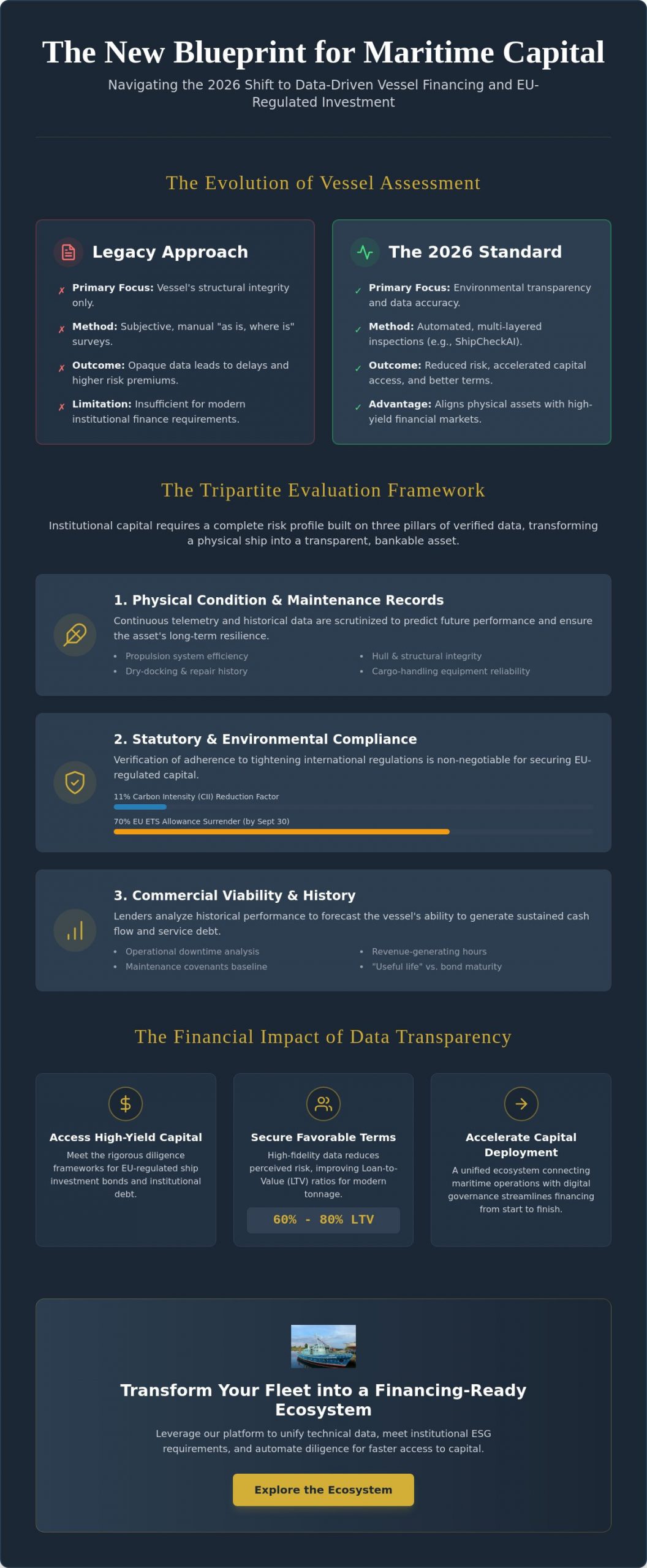
A vessel’s physical state used to be the sole metric of its worth. In 2026, the industry has moved beyond this narrow view. A comprehensive vessel assessment for financing now serves as the foundational gatekeeper for capital deployment. It’s the bridge between a physical asset and its digital financial identity. Traditional “as is, where is” surveys are no longer sufficient because they fail to account for the tightening regulatory environment. Lenders now demand a unified view of an asset’s technical health, carbon intensity, and commercial viability. This technical scrutiny ensures that the capital provided is backed by a resilient, future-proof asset.
This shift from subjective physical opinions to objective, data-driven valuations is critical. Modern Asset-based lending in the maritime sector requires granular transparency. When an assessment is accurate, it directly influences the loan-to-value (LTV) ratios and interest rates offered by institutional providers. High-fidelity data reduces the perceived risk, allowing owners to access capital with LTVs typically between 60% and 80% for modern tonnage. Conversely, opaque data or manual errors in surveys lead to higher risk premiums, effectively increasing the cost of capital for the shipowner.
Risk Management for Lenders and Bondholders
Lenders use assessments to identify latent defects that could compromise the vessel as collateral. It’s about protecting the principal. By evaluating the “useful life” of a ship against a bond’s maturity date, investors ensure the asset won’t become stranded before the debt is repaid. These assessments establish a baseline for maintenance covenants, ensuring the vessel’s value remains governed by strict operational standards throughout the financing term. This methodical approach identifies structural or mechanical risks long before they impact the vessel’s earning potential.
Aligning Asset Value with Capital Market Expectations
Institutional investors require standardized reporting to participate in maritime debt. Transparent assessments reduce the risk premium, making assets more attractive to global capital markets. This is especially vital for issuing EU-regulated ship investment bonds. By bridging the gap between physical operations and digital governance, owners can demonstrate commercial viability through automated intelligence. This unified approach ensures that every technical detail supports the vessel’s role as a high-yield financial instrument, meeting the sophisticated needs of modern bondholders.
Standard Components of a Comprehensive Vessel Assessment
Institutional capital doesn’t move on promises; it moves on verified data. A comprehensive vessel assessment for financing evaluates the tripartite pillars of physical condition, statutory compliance, and commercial history to build a complete risk profile. While legacy survey methods might rely on a snapshot in time, modern diligence requires a deep dive into historical maintenance logs to predict future operational downtime accurately. This methodical approach ensures that the asset can sustain the cash flows required to service debt or bond coupons throughout its lifecycle. It’s about transforming a physical ship into a transparent, bankable asset.
Lenders view the engine room and hull integrity through a lens of asset preservation. They aren’t just checking if the engine runs; they’re analyzing propulsion efficiency and fuel consumption metrics to ensure the vessel remains competitive under the 2026 FuelEU Maritime GHG intensity cuts. Verifying the vessel’s “Class” status and identifying any outstanding recommendations is the bare minimum. The real value lies in reviewing dry-docking history and the quality of previous repairs to ensure the structural integrity isn’t compromised by temporary fixes. Cargo-handling equipment also undergoes intense scrutiny because its reliability is directly linked to the vessel’s ability to minimize time in port and maximize revenue-generating hours.
Physical Condition and Maintenance Records
Propulsion systems are the heart of the asset. Assessments now include detailed telemetry on fuel consumption and power output to verify compliance with the 11% CII reduction factor. Continuous maintenance records are far more valuable than a single-point survey because they demonstrate a commitment to asset governance that reduces the likelihood of catastrophic failure. If you’re looking to unify your technical data for institutional scrutiny, you can explore how our ecosystem streamlines vessel inspections to meet these exacting standards. Quality repairs and documented dry-docking history provide the structural certainty that bondholders require.
Statutory Compliance and Flag State Status
Statutory compliance is the second pillar of the assessment framework. A vessel must meet all IMO and MARPOL regulations for 2026, including the 70% EU ETS allowance surrender deadline. Verifying the validity of Safety Management Certificates (SMC) and the Document of Compliance (DOC) is non-negotiable for institutional capital. This level of rigor mirrors the standards found in the Federal Ship Financing Program (Title XI), where technical adequacy is a prerequisite for government-backed guarantees. Owners who utilize AI in maritime due diligence gain a distinct advantage by providing lenders with high-fidelity, verified compliance reports that facilitate faster access to liquidity.
Traditional Surveys vs. AI-Enhanced Vessel Inspections
The maritime industry has long relied on the “clip-board” survey, a method where a single surveyor’s subjective opinion determines the fate of multi-million dollar capital allocations. These legacy inspections are inherently limited by human bias and a restricted observational scope. A traditional vessel assessment for financing often results in a fragmented report that fails to capture the granular technical realities of modern tonnage. In an era of institutional accountability, relying on a manual snapshot is a systemic risk that leads to inflated risk premiums and avoidable financing delays. It’s a bottleneck that prevents the efficient flow of capital into an industry that demands precision.
Manual reporting lacks the speed and depth required for contemporary bond issuance. While a traditional surveyor might take days to compile a static PDF, AI powered vessel survey systems deliver real-time digital assessments with a level of detail that was previously impossible. This evolution isn’t just about speed; it’s about structural integrity. Machine learning algorithms and computer vision now identify anomalies, such as micro-fractures in hull coatings—where specialized solutions from Seacoat SCT, LLC provide advanced protection—or subtle engine thermal imbalances, that are completely invisible to the naked eye. This transition from subjective observation to objective data ensures that every asset is governed by the same rigorous standards, regardless of where the physical inspection takes place.
The Limitations of Manual Inspection
Human-centric models suffer from the “snapshot” problem. A one-day inspection might catch an obvious leak, but it rarely uncovers the systemic maintenance failures that lead to future operational downtime. Human error in assessing complex machinery or hull integrity increases the uncertainty for lenders. Standardizing these reports across different global jurisdictions is nearly impossible without a unified technological framework. This inconsistency creates friction in the due diligence process. It makes it difficult for institutional investors to trust the underlying data without extensive, time-consuming verification that slows down access to capital.
The Accuracy and Efficiency of ShipCheckAI
ShipCheckAI addresses these inefficiencies by providing a unified, multi-layered inspection platform that replaces human variance with automated intelligence. By leveraging AI ship inspection software, the system automates condition scoring and provides a precise technical baseline. This technology integrates a tripartite inspection model; pre-purchase, condition, and valuation, into a single, transparent ecosystem. It provides a definitive source of truth for both bondholders and shipowners. This transparency is what allows for the democratization of maritime finance, as it replaces opaque, manual processes with a governed, data-driven architecture that is ready for the rigors of institutional capital. Learn how the ShipCheckAI vessel assessment acts as the computational trust layer that transforms physical hulls into high-fidelity financial instruments backed by institutional-grade data.
Due Diligence Framework for Bond-Based Financing
Securing capital through bond markets requires a level of scrutiny that far exceeds traditional bank lending. When preparing a vessel assessment for financing within this context, the focus shifts from simple collateral preservation to long-term yield stability and regulatory resilience. Institutional investors don’t just want to know if a ship is seaworthy. They need to know if it’s “bond-grade.” This means the assessment must align with the sophisticated requirements of EU regulated ship investment bonds, where transparency and legal governance are paramount. It’s a comprehensive process that unifies technical data with commercial forecasting to ensure the asset can meet its coupon obligations through 2030 and beyond.
The transition from private bank debt to public or private bond issuance demands a more expansive due diligence framework. This framework treats the vessel as a functional component of a larger financial ecosystem. It’s not enough to verify the hull’s integrity; the assessment must prove that the vessel can operate profitably within the fragmenting capital landscape of 2026. By integrating technical health with commercial viability, shipowners provide the structural certainty that bondholders demand. This methodical approach identifies potential financial friction points long before they can impact the investor’s return on investment.
Commercial Viability and Charter Market Analysis
A vessel is only as valuable as the revenue it generates. Bondholders prioritize employment security over physical aesthetics; they want to see a clear path to consistent cash flow. A robust assessment evaluates the vessel’s earning potential by analyzing current and projected charter rates against historical performance. It also involves a deep dive into the creditworthiness of existing charterers. If a charterer defaults, the bond’s security is compromised. Therefore, the assessment must treat the charter party as an integral part of the asset package, ensuring that the commercial yield is sufficient to cover both operational expenses and debt service.
ESG Scoring and Environmental Compliance
In 2026, environmental compliance is no longer a peripheral concern; it’s a core financial metric. An institutional-grade vessel assessment for financing must include a precise calculation of the Carbon Intensity Indicator (CII) rating. With the 2026 reduction factor set at 11% relative to the 2019 baseline, vessels with poor ratings face immediate commercial devaluation. Lenders also scrutinize ballast water treatment systems and emissions-reduction technologies to ensure the ship won’t be sidelined by the 70% EU ETS allowance surrender deadline in September. ESG-aligned assessments are the primary mechanism for unlocking lower-cost capital in the European market, as they mitigate the risk of the vessel becoming a stranded asset. If you’re ready to position your fleet for institutional investment, learn how to structure your assets for regulated bond issuance through our unified platform.
Navigating the Assessment Process with Maritime DAO
Maritime DAO functions as both a visionary architect and a reliable gatekeeper for the next generation of maritime liquidity. By unifying automated intelligence with a robust financial framework, the ecosystem streamlines the traditionally fragmented vessel assessment for financing. This integration ensures that every technical data point, from engine efficiency to hull integrity, is governed by the same institutional standards required for global bond issuance. It removes the systemic inefficiencies of manual surveys, replacing them with a transparent, methodical process that accelerates the transition from physical asset to digital financial instrument. The result is a unified ecosystem where physical health, regulatory standing, and commercial potential are perfectly aligned.
Reducing the time-to-capital is a primary objective of this DAO-governed architecture. While traditional bank loans for modern tonnage often involve LTV ratios between 60% and 80% and can take months to finalize, our automated diligence framework provides the high-fidelity reporting necessary for faster approvals. This systematic approach allows shipowners to bypass the opaque delays of legacy systems. It provides a first-of-its-kind bridge between the heavy industry of global trade and the sophisticated world of regulated innovation, ensuring that capital flows where it is most efficient and transparently managed.
Integrating ShipCheckAI into Your Financing Workflow
The journey toward institutional capital begins with a multi-point vessel assessment for financing using ShipCheckAI. This tool enables owners to generate standardized condition reports that satisfy the most stringent EU regulatory requirements, including the 2026 CII reduction factors. By collaborating with global surveyors through a unified AI powered vessel survey platform, you ensure that every inspection is objective and data-driven. This eliminates the human bias found in “clip-board” surveys and provides a technical baseline that bondholders can trust. The platform supports multiple inspection types, allowing for a comprehensive view of the asset’s lifecycle and maintenance history.
Securing Capital through Regulated Bonds
Transitioning from a successful assessment to capital deployment is a seamless process within our ecosystem. Once the technical data is verified and the commercial viability is established, the vessel is positioned for the issuance of EU-regulated ship investment bonds. This democratizes access to global debt markets, allowing shipowners to secure financing that is often more flexible than traditional mezzanine debt, which typically carries rates between 10% and 15%. By understanding The Future of Ship Finance, you can leverage this architecture to optimize your capital structure. Maritime DAO empowers stakeholders to operate with confidence, backed by a transparent governance model that values order, security, and long-term asset integrity.
Securing the Future of Maritime Liquidity
The transition toward a digital, transparent maritime economy requires a fundamental shift in how we verify asset value. A rigorous vessel assessment for financing now serves as the essential bridge between physical tonnage and institutional capital. By unifying technical health, environmental compliance, and commercial yield, shipowners can transform their fleets into bankable instruments that meet the exacting standards of global bondholders. The 2026 landscape no longer rewards opacity; it rewards the methodical integration of data and governance. It’s a first-of-its-kind era where structural integrity meets digital accountability.
Success in this new frontier depends on a tripartite commitment to an EU-regulated compliance framework, AI-driven inspection accuracy, and DAO-governed transparency. These pillars ensure that every asset is future-proofed against evolving regulations while providing the structural certainty that capital markets demand. It’s time to replace legacy friction with automated diligence and precise, institutional-grade reporting. Your path to efficient, high-stakes liquidity is ready. Access Institutional Capital with ShipCheckAI and lead the evolution of maritime finance with confidence.
Frequently Asked Questions
What is the difference between a standard ship survey and a vessel assessment for financing?
A standard ship survey primarily focuses on seaworthiness and safety, whereas a vessel assessment for financing integrates technical health with commercial viability and regulatory compliance. It acts as a comprehensive risk management tool for lenders to determine loan-to-value ratios and interest rates. This multi-layered approach ensures the asset can generate the necessary yield to service debt or bond coupons throughout its operational lifecycle.
How does ShipCheckAI improve the accuracy of vessel inspections?
ShipCheckAI utilizes computer vision and machine learning to identify structural anomalies and mechanical defects that human surveyors might overlook. By automating condition scoring, it eliminates subjective human bias and provides a unified technical baseline for all stakeholders. This level of precision is essential for institutional investors who require high-fidelity data to mitigate risk in complex, high-stakes maritime portfolios.
Why is EU regulation important for ship investment bonds in 2026?
EU regulation provides a standardized legal framework that ensures transparency and investor protection in maritime debt markets. As the industry faces strict 2026 deadlines, such as the 70% EU ETS allowance surrender requirement, regulated bonds offer a governed pathway for institutional capital. This structure reduces the risk premium for investors and attracts global capital looking for compliant, high-yield assets.
Can AI-powered vessel surveys replace traditional human surveyors?
AI-powered tools don’t replace human expertise; they augment it by providing a more granular and objective data set. While ShipCheckAI automates technical scoring and identifies latent structural defects, human surveyors provide the contextual oversight necessary for final asset valuations. This hybrid model combines automated intelligence with professional judgment to create a more reliable and transparent assessment ecosystem for lenders.
What ESG criteria are most important for maritime bondholders?
Bondholders prioritize the Carbon Intensity Indicator (CII) rating and compliance with the 11% reduction factor required for 2026. They also evaluate ballast water treatment systems and the vessel’s path to decarbonization under FuelEU Maritime regulations. These environmental metrics are critical because they directly impact the vessel’s earning potential and resale value, protecting investors from the risk of stranded assets.
How long does a typical vessel assessment for financing take with Maritime DAO?
A typical vessel assessment for financing is significantly faster than traditional manual processes due to our automated diligence framework. While legacy surveys might take weeks to compile into a final report, our integrated system streamlines data collection and institutional reporting. This efficiency reduces the time-to-capital, allowing shipowners to access global debt markets and secure liquidity with minimal operational friction.
What are the main risks identified during a ship condition assessment?
Assessments identify structural defects, mechanical inefficiencies, and statutory non-compliance that could compromise the asset as collateral. Specifically, surveyors look for hull corrosion, engine thermal imbalances, and outdated safety management systems that increase operational risk. Identifying these risks early allows lenders to establish maintenance covenants that preserve the vessel’s value and earning potential over the term of the financing agreement.
Is a pre-purchase ship inspection software suitable for bond issuance diligence?
ShipCheckAI is specifically designed to handle the rigors of bond issuance by providing multi-layered technical inspections. It offers the standardized reporting and transparent data governance that EU-regulated frameworks require for institutional diligence. This makes it an ideal tool for bridging the gap between physical maritime operations and the sophisticated, high-stakes needs of institutional bondholders and global investors.