
The era of relying on subjective, paper-based ship surveys to back multi-million dollar maritime bonds is over. As institutional capital seeks refuge in real-world assets, the industry can no longer tolerate the fragmented data and slow due diligence cycles that traditionally delay bond issuance. ShipCheckAI vessel assessment represents a fundamental shift in this paradigm, acting as the computational trust layer that transforms physical hulls into high-fidelity financial instruments. It’s a system built for a new regulatory environment where mandatory digital reporting and strict ESG compliance are the baseline for entry.
You likely recognize that the current lack of standardization in vessel condition reports creates unnecessary investment risk and stalls the growth of liquid maritime markets. This article demonstrates how ShipCheckAI vessel assessment integrates AI-driven precision with institutional finance to secure maritime asset-backed securities. You’ll discover how we unify automated inspections, regulatory alignment, and blockchain governance to provide the rapid, standardized data required for the Maritime DAO ecosystem. We’ll explore how this technology reduces risk, ensures asset integrity, and opens a global frontier for maritime investment.
Key Takeaways
- Understand the transition from subjective, manual surveys to an objective, AI-driven diagnostic framework that accelerates due diligence for institutional maritime bonds.
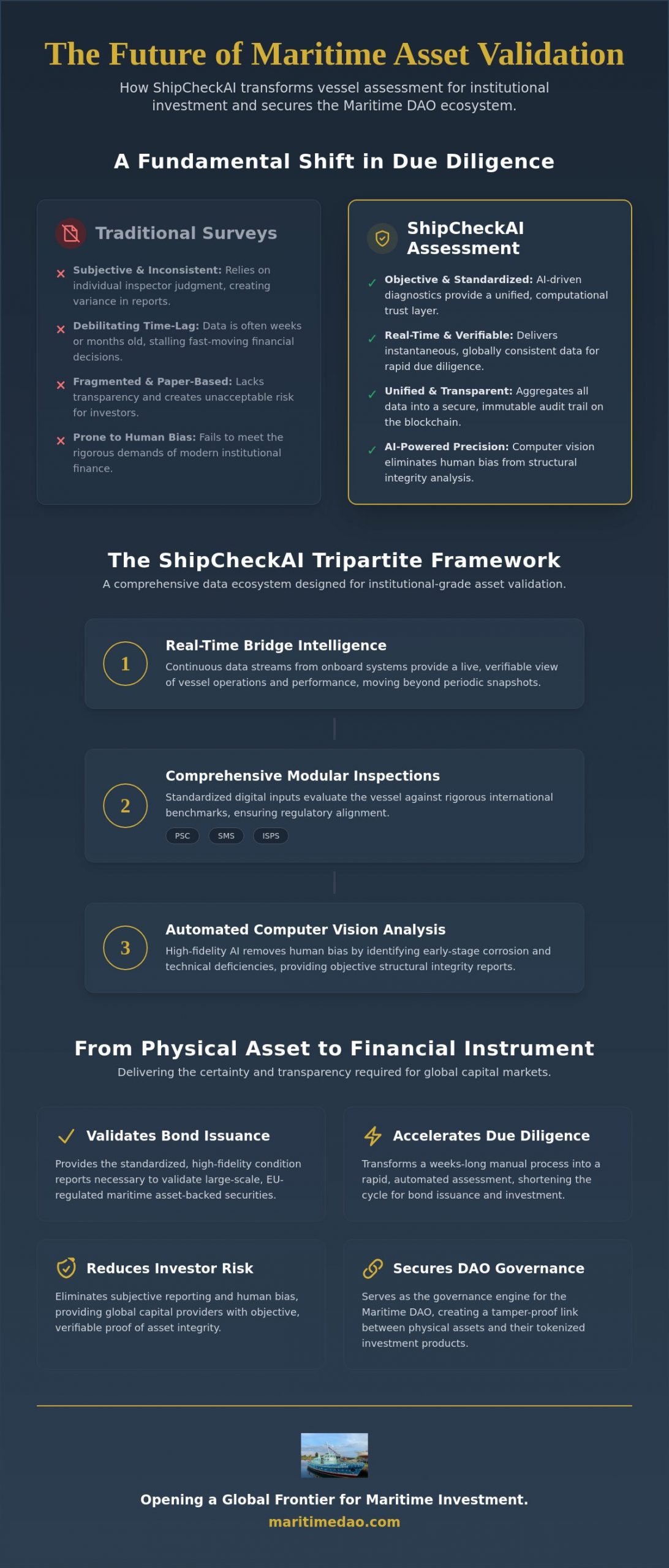
- Explore the tripartite architecture of ShipCheckAI vessel assessment, which unifies real-time Bridge Assistant data with comprehensive modular inspections covering PSC, SMS, and ISPS standards.
- Learn how automated computer vision removes human bias from structural integrity reports by identifying early-stage corrosion and technical deficiencies with high-fidelity precision.
- Analyze how standardized condition reports provide the necessary transparency to validate large-scale bond issuances and reduce risk for global capital providers.
- Discover how this integrated assessment framework serves as the governance engine for the Maritime DAO, securing the relationship between physical assets and tokenized investment products.
The Evolution of Maritime Due Diligence: Beyond Manual Surveys
The maritime industry has reached a critical inflection point where legacy inspection methods no longer meet the rigorous demands of modern institutional finance. For decades, the validation of global fleets rested on the localized judgment of individual inspectors, creating a fragmented landscape of data that lacked the transparency required for large-scale capital markets. ShipCheckAI vessel assessment replaces this antiquated model with a unified diagnostic framework. It’s a fundamental shift from human-centric observation to a computational trust layer that provides a standardized, objective view of asset integrity.
Institutional capital requires a level of certainty that traditional, periodic snapshots simply cannot provide. While the industry once operated on the assumption that a single point-in-time report was sufficient, the rise of tokenized assets and maritime bonds demands continuous verification. By integrating automated intelligence into the due diligence process, we move beyond the limitations of the physical survey to a system where data is live, verifiable, and globally consistent.
The Limitations of Traditional Vessel Surveys
Historically, vessel safety surveys have been plagued by significant variance in reporting. One inspector’s “minor maintenance” is another’s “critical deficiency,” and this subjectivity introduces an unacceptable level of risk for bond issuers and investors alike. There is also a debilitating time-lag between the physical inspection and the delivery of the final report. In a fast-moving financial environment, relying on data that is weeks or months old creates a visibility gap that can stall bond issuance. Implementing AI in maritime due diligence directly mitigates these legacy inefficiencies by providing instantaneous, standardized results that remove the “human factor” from the risk equation.
Defining the ShipCheckAI Computational Trust Layer
We define this transition as “Regulated Innovation.” ShipCheckAI vessel assessment isn’t merely a software tool; it’s a governance engine that bridges the gap between the physical world of global trade and the digital world of blockchain finance. By utilizing cloud-saved reports and secure, immutable audit trails, we ensure that every assessment is transparent and tamper-proof. This infrastructure is essential for creating high-fidelity asset-backed securities. It allows the Maritime DAO to govern its ecosystem with precision, ensuring that the relationship between physical asset condition and digital bond value is always grounded in verified reality. The result is a more inclusive, liquid, and secure market for maritime investments.
- Unified Data: Aggregating multiple inspection types into a single, standardized dashboard.
- Objective Analysis: Eliminating human bias through computer vision and automated logic.
- Institutional Readiness: Providing the high-fidelity reports required for EU-regulated financial products.
The ShipCheckAI Framework: A Tripartite Approach to Assessment
ShipCheckAI vessel assessment operates through a tripartite architecture that unifies real-time bridge intelligence, standardized modular inspections, and secure audit trails. This isn’t merely a digital checklist; it’s a comprehensive data ecosystem designed to provide institutional investors with an immutable record of asset integrity. By integrating these three distinct pillars, the platform creates a transparent bridge between physical ship operations and the rigorous requirements of maritime bond issuance. It’s a system built to govern risk through technical precision.
The framework prioritizes standardized digital inputs to ensure that every vessel, regardless of its location or crew, is evaluated against the same high-fidelity benchmarks. This methodology aligns with rigorous international standards and U.S. Coast Guard inspection laws, providing a level of regulatory confidence that manual surveys lack. The resulting audit reports aren’t just summaries; they’re professional financial instruments that validate the underlying value of the asset.
Standardized Inspection Modules for 2026
The platform’s multi-modular suite addresses the most critical areas of maritime compliance. The Port State Control (PSC) pre-inspection protocol allows crews to identify and rectify potential deficiencies before they lead to costly detentions. Simultaneously, the Safety Management System (SMS) internal audit automation ensures that operational procedures remain in constant alignment with the latest IMO mandates. For more technical requirements, the system utilizes AI powered vessel survey technology to perform structural integrity checks. This module identifies early-stage corrosion and fatigue that human eyes might overlook, providing a predictive layer to asset maintenance. These modules work together to create a unified view of the ship’s regulatory and physical health.
Bridge Assistant: Real-Time Operational Intelligence
The Bridge Assistant acts as the continuous monitoring engine of the ShipCheckAI vessel assessment ecosystem. Unlike traditional surveys that occur once or twice a year, the Bridge Assistant captures real-time data on daily operations. It monitors the condition of crew quarters and sanitation standards, ensuring compliance with the Maritime Labour Convention (MLC). It also maintains an automated log of safety equipment status, from lifeboats to fire-extinguishing media, identifying when items require servicing or replacement. This operational data feeds directly into the final vessel condition report, giving investors a dynamic rather than static understanding of the asset. Those looking to diversify their portfolios can explore these institutional-grade maritime bonds to see how this high-fidelity data translates into secure investment opportunities.
Case Study: Validating Bond Issuance via ShipCheckAI
Consider a maritime investment fund preparing for a €50M bond issuance. In the legacy environment, this process would require months of manual coordination, involving multiple third-party surveyors and inconsistent reporting formats that often failed to satisfy institutional risk committees. By deploying ShipCheckAI vessel assessment, the fund established a comprehensive baseline for its fleet within days. This rapid deployment allowed for a systematic evaluation of every asset, ensuring that the bond’s underlying value was backed by hard, verifiable data rather than subjective, point-in-time opinions.
The second phase of this implementation involved automated defect analysis. The AI identified specific technical deficiencies and outlined a clear upgradation scope for each vessel. This foresight allowed the fund to address maintenance needs proactively, protecting the long-term integrity of the collateral before the bonds were even offered to the market. By the time the issuance reached institutional desks, every vessel had undergone a rigorous verification process that adjusted its valuation based on actual physical condition. The result was a 40% reduction in due diligence time and a significant increase in the fund’s ability to demonstrate asset transparency to global investors.
Assessing Condition-Adjusted Valuation
Condition-adjusted valuation is a cornerstone of institutional-grade maritime finance. The ShipCheckAI system synthesizes over 500 distinct data points, ranging from structural integrity to engine performance, into a single, objective valuation score. This level of granularity is vital for predicting future maintenance costs and ensuring the capital stability of EU regulated ship investment bonds. Investors are no longer forced to rely on broad market averages; they now have access to a diagnostic depth that ensures the debt is appropriately collateralized against the true state of the fleet.
Streamlining Capital Deployment
Converting raw inspection data into investor-ready prospectuses is typically a bottleneck in capital deployment. ShipCheckAI vessel assessment automates this transition by generating standardized reports that meet the strict compliance standards of institutional gatekeepers. The transparency of the audit trail provides a clear, immutable record of every assessment, from the initial photo capture to the final AI-verified report. A dedicated vessel condition report platform is essential for transforming this raw inspection data into the actionable financial intelligence that institutional gatekeepers require. This systematic approach satisfies the most demanding institutional compliance standards, allowing funds to move from assessment to issuance with unprecedented speed. This efficiency doesn’t just save time. It builds a foundation of trust that is essential for the long-term democratization of maritime capital.
Optimizing Inspection Accuracy with AI Automation
The reliability of structural integrity reports has historically been compromised by human fatigue and the subjective nature of manual grading. While traditional methods rely on the localized judgment of technical superintendents, ShipCheckAI vessel assessment introduces a standardized, computational approach to asset evaluation. By deploying advanced computer vision, the platform identifies early-stage corrosion and microscopic structural fatigue that the human eye often misses. This objective analysis removes the variance inherent in manual inspections, providing a unified data set that institutional investors can trust without reservation.
The platform doesn’t operate in a vacuum. It cross-references real-time visual data with historical maintenance records to identify discrepancies that might indicate hidden risks. This automated reconciliation ensures that the ship’s physical state matches its documented history. While the AI performs the heavy lifting of data synthesis, it acts in synergy with expert human oversight. The system flags anomalies for professional review, creating a robust check and balance that maintains the highest standards of institutional due diligence. This combination of automated intelligence and human validation is what defines the next generation of maritime asset management.
The Role of Predictive Analytics in Asset Health
Predictive modeling transforms the assessment from a reactive report into a forward-looking financial safeguard. By analyzing trends across the global fleet, ShipCheckAI predicts potential Port State Control (PSC) detentions before a vessel ever enters a high-scrutiny jurisdiction. This foresight is critical for protecting bond yields, as it prevents the operational disruptions and legal penalties that erode investor returns. Our proprietary AI algorithms identify subtle anomalies in engine performance data by comparing real-time thermal and vibration signatures against optimized baseline models.
Enhancing Compliance through Digital Checklists
Standardization is the foundation of regulated innovation in maritime finance. The platform automates complex maritime labor compliance audits, ensuring that crew welfare and sanitation standards are consistently met across the fleet. Because vessel assessment for financing requires immutable digital records, every data point captured is cryptographically secured within the audit trail. This verification extends to safety management systems, where automated checks validate that emergency protocols and equipment status are in full regulatory alignment. To secure your position in this technological frontier, you can access our current maritime investment opportunities and explore how we’re reshaping global trade finance.
Securing the Maritime DAO Ecosystem: The Final Verdict
ShipCheckAI vessel assessment serves as the fundamental governance engine for the Maritime DAO ecosystem. It functions as the critical bridge between physical maritime assets and the digital world of tokenized finance, ensuring that every bond issued is backed by a hull of verified integrity. While traditional ship finance relied on fragmented, paper-heavy due diligence, our framework governs risk through a tripartite mechanism of automated physical inspection, AI-driven data synthesis, and blockchain anchoring. This evolution transforms a traditionally opaque industry into a transparent, institutional-grade market where asset health is a matter of public record.
The relationship between vessel assessment and tokenized ownership is one of absolute transparency. In this new paradigm, the value of a maritime bond is directly tethered to the real-time condition of the ship, as reported by our computational trust layer. By 2026, the maritime fintech landscape will be defined by this level of granular visibility. Institutional asset managers who adopt these AI-driven standards will find themselves at the forefront of a more liquid and secure global trade economy. It’s a shift that empowers investors while providing shipowners with the standardized data needed to access global capital markets.
Governance and Transparency in Tokenized Finance
Transparency is the primary currency of the Maritime DAO. Every ShipCheckAI vessel assessment is anchored to the blockchain, creating an immutable audit trail that protects bondholders from the risks of hidden technical deficiencies. This decentralized governance model ensures that all stakeholders, from retail participants to institutional funds, have access to the same high-fidelity data. When inspection reports are anchored to a secure ledger, the possibility of data tampering or “survey shopping” is eliminated. This level of accountability is what attracts a global audience to our ecosystem, as it provides the sober reliability required for high-stakes capital investments.
Next Steps: Integrating ShipCheckAI into Your Portfolio
Initiating a professional assessment for your next bond issuance is a methodical process designed for rapid deployment and minimal operational friction. Preparation requirements typically involve the synchronization of existing technical logs and the briefing of crew members on the use of the Bridge Assistant tool. Once deployed, the AI begins its continuous monitoring cycle, providing the standardized condition reports necessary for institutional compliance. To secure your position in this technological frontier, you should contact Maritime DAO to explore maritime DAO investment opportunities. We invite you to discover how our unified diagnostic framework can validate your assets and optimize your capital deployment in the global maritime market.
Standardizing the Future of Global Maritime Capital
ShipCheckAI vessel assessment has redefined the intersection of heavy industry and high finance. By replacing the inherent variance of manual surveys with a computational trust layer, we’ve established a new global benchmark for asset integrity. This ecosystem unifies automated inspections, predictive health analytics, and blockchain governance to create a transparent, high-stakes environment for global trade finance. It’s no longer a matter of estimation; it’s a matter of verified, standardized data that serves both shipowners and institutional bondholders with equal precision.
The integration of AI-driven analysis across 500+ data points ensures that every maritime bond is grounded in physical reality. This EU-regulated compliance framework provides the institutional-grade audit reports necessary to move significant capital with absolute confidence. As the Maritime DAO continues to bridge the gap between physical assets and digital liquidity, the traditional barriers to entry for global ship ownership are permanently dissolving. We’re building a world where the security of a vessel and the security of an investment are one and the same.
Access the ShipCheckAI Platform and Secure Your Maritime Investments. Join us as we architect a more inclusive and reliable frontier for maritime finance.
Frequently Asked Questions
What is the primary difference between a ShipCheckAI vessel assessment and a traditional survey?
A ShipCheckAI vessel assessment replaces subjective human judgment with an objective, AI-driven diagnostic framework that ensures global standardization. Traditional surveys rely on periodic, manual inspections that vary between individual surveyors; our system provides continuous monitoring and high-fidelity data synthesis. This transition moves the industry from fragmented snapshots to a unified, computational trust layer suitable for institutional finance.
How does the ShipCheckAI module handle Port State Control (PSC) pre-inspections?
The platform utilizes a dedicated pre-inspection protocol that allows crews to identify and rectify deficiencies before a vessel enters port. It cross-references the ship’s current physical state against global PSC databases to predict high-risk areas. This proactive approach reduces the likelihood of costly detentions and ensures the asset remains in full regulatory alignment with international safety standards.
Can ShipCheckAI assessments be used for EU-regulated ship investment bond due diligence?
Yes, the ShipCheckAI vessel assessment is specifically engineered to meet the rigorous transparency and reporting standards required for EU-regulated financial instruments. It generates the professional audit reports and immutable data trails that institutional risk committees demand. This high level of verification is essential for validating the underlying collateral of maritime asset-backed securities.
What types of shipping assets are compatible with the ShipCheckAI platform?
The platform supports a broad range of commercial vessels, including containerships, bulk carriers, and tankers. It is particularly valuable for vessels of 3,000 gross tonnage and upwards, which face new 2026 mandates for electronic inclinometers and enhanced emissions reporting. The system’s modular nature allows it to adapt to various technical specifications and regulatory requirements across the global fleet.
How does AI improve the accuracy of vessel valuation for bondholders?
AI improves valuation by aggregating over 500 distinct data points into a single, condition-adjusted score that reflects the ship’s true physical state. By using computer vision to detect early-stage corrosion and structural fatigue, the system removes the human bias often found in manual grading. This provides bondholders with a precise understanding of future maintenance liabilities and collateral stability.
Is the data from a ShipCheckAI vessel assessment secure and tamper-proof?
All inspection data is cryptographically anchored to the Maritime DAO blockchain to ensure it remains immutable and transparent. This secure architecture prevents data manipulation or “survey shopping,” providing a single version of truth for all stakeholders. This decentralized governance model is a critical requirement for attracting institutional capital to tokenized maritime assets.
How long does a comprehensive AI-driven vessel assessment typically take?
The AI-driven process can reduce traditional due diligence cycles by approximately 40%. While the physical capture of photos depends on crew coordination, the subsequent AI analysis and report generation are nearly instantaneous. This speed allows fund managers to move from initial assessment to bond issuance with significantly more efficiency than legacy methods allow.
Does ShipCheckAI offer specific modules for maritime labor compliance?
The platform includes dedicated modules designed to audit compliance with the Maritime Labour Convention (MLC). The Bridge Assistant monitors essential factors such as crew quarters condition and sanitation standards to ensure operational integrity. These automated checks help maintain the high ESG standards required for institutional-grade maritime investment products.